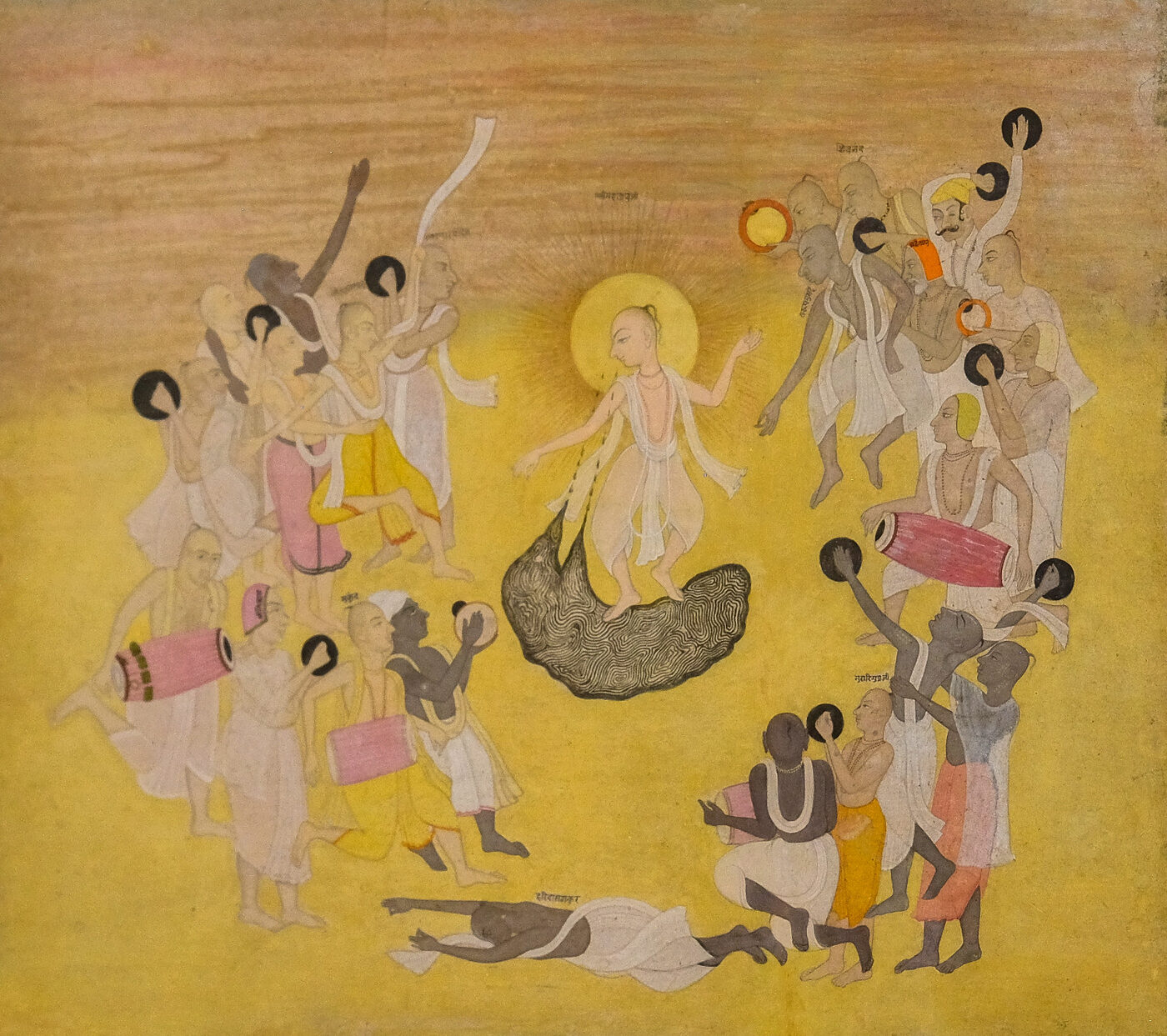
Sri Chaitanya Mahaprabhu founded a school of theology. He trained the men who wrote its books, and He left it a body of teaching that fills libraries. But He wrote almost none of it Himself. He left no commentary on the Vedanta-sutra, no other book of teaching, no life story and no letters. What remains of His own writing is eight Sanskrit verses, together called the Siksastaka, the "eight verses of instruction." All the other words of His that the tradition preserves have come to us through other people. They come through Svarupa Damodara Goswami's notebooks and through Murari Gupta's diary of the Nabadwip years. They come through Vrindavana Dasa Thakura's Chaitanya-bhagavata and Krishnadasa Kaviraja's Chaitanya-charitamrita. They also come through the systematic works of the Six Goswamis. He gave the Six Goswamis their task in person and then left them to write.
Verse
What It Teaches
One
The seven effects of congregational chanting of the holy name
Two
The name is open to everyone, and the speaker has no attachment to it
Three
Lower than the grass, more tolerant than a tree
Four
No wealth, no followers, no liberation, only unmotivated devotion
Five
I am Your eternal servant, fallen into the ocean of ignorance
Six
When will the tears flow and the voice falter
Seven
A moment become a millennium, the world empty without Govinda
Eight
Embrace me or trample me, He is unconditionally the Lord of my life
Gaudiya Vaishnavas explain that He wrote so little because He divided the work on purpose. Rupa Goswami was given the subject of rasa, the taste of devotion. Sanatana Goswami was given its practice, Jiva Goswami its philosophical defence and Gopala Bhatta Goswami the rules of worship. The founder kept for Himself only the essence. Whether or not one accepts this explanation, the result is unusual. The movement has a deep and detailed philosophy, yet everything its founder wrote can be recited aloud in under three minutes.
The verses appear in the biography at the very end. The twentieth and last chapter of the Antya-lila describes the nights of the last twelve years at Jagannatha Puri. On those nights the Lord would sit in the Gambhira with only Svarupa Damodara Goswami and Ramananda Raya and recite verses until morning. The verses came from Jayadeva, from the Bhagavatam, from Bilvamangala Thakura, and from these eight. Krishnadasa Kaviraja is careful to explain the order of events. The Lord had composed the eight verses earlier, to teach people in general. Now He was tasting their meaning for Himself. That is why, in this chapter, each verse is followed by the Lord's own broken explanation of it in Bengali. So the eight verses come to us together with their author's own notes on them.
The first verse is not about the speaker at all. It declares victory for the congregational chanting of Krishna's names, and it lists seven things that this chanting does. It cleanses the mirror of the heart. It extinguishes the forest fire of material existence. It spreads the cooling moonlight under which the white lotus of good fortune opens. It is the very life of all knowledge, described in a striking image as knowledge's bride. It swells an ocean of bliss. It gives, at every step, a full taste of nectar. And it bathes the entire self. The order is important. The first two effects remove a problem: a mirror is cleaned and a fire is put out. Only after that does the verse turn to what is gained. First the illness is found, and then the remedy is given. And the remedy is a practice done together and in public, not in private.
The second verse turns from the practice to the fact that it is open to everyone. Then it says something that shapes all the verses after it. God, it says, has innumerable names, and has invested His full potency in each of them. The mantras of Vedic ritual are surrounded by rules of time, place, initiation and purity. But the holy name has no such restrictions: it can be chanted anywhere, by anyone, at any hour. The verse has just made the most generous claim in the whole tradition. Yet it ends by turning that claim against the speaker: and I am so unfortunate that I have no attachment to them. From here on, the Siksastaka is spoken in the first person by someone who describes himself as having failed.
The third verse gives the qualification for chanting, and it is the most often quoted verse in Gaudiya Vaishnavism. One who thinks himself lower than the grass in the street, who is more tolerant than a tree, who takes no honour for himself and is ready to offer honour to everyone else, can chant the holy name constantly. The Chaitanya-charitamrita gives the Lord's own commentary on the picture of the tree, and it is very practical. A tree does not protest when it is cut down, and when it is drying up it asks nobody for water. It gives away its fruit and flowers to anyone who comes. It stands in scorching heat and in torrents of rain and still shelters others. So this verse describes a person's character, not a devotional emotion. This means that the right to the highest practice depends on a person's conduct and nature, not on birth, learning or status. In sixteenth-century Bengal this was a very bold idea that could shake society, and the tradition has never stopped quoting it.
The fourth verse defines the goal by refusing everything else. I do not want wealth, it says, nor followers, nor a beautiful wife, nor the results promised in the ornate language of the ritual scriptures; all I want, birth after birth, is unmotivated devotional service. The list fairly covers what people usually use religion for. And the words "birth after birth" quietly set aside the last thing on that list too. Even liberation from rebirth is not being asked for. Gaudiya teachers understand that in this verse devotion stops being a means to get anything else.
The fifth verse moves from what the speaker wants to who he is. It addresses Krishna as the son of Nanda Maharaja, the cowherd father, not as the king or the ruler of the universe. It says: I am Your eternal servant, and by my own actions I have fallen into this ocean of ignorance; be causelessly merciful and consider me a particle of dust at Your feet. The speaker does not ask for this relationship. He states it as a fact that was forgotten and is now being remembered. This is exactly the Gaudiya teaching about the soul's true and original identity.
The sixth verse asks a question instead of making a claim: when will my eyes be filled with constantly flowing tears as I chant Your name, when will my voice falter and the hair of my body stand on end? These are the recognised bodily signs of ecstatic devotion, and Rupa Goswami describes all of them in full detail. The verse does not say that the speaker has them. It asks when they will come. Later acharyas give this point great importance. They treat the verse as the tradition's own guard against people who imitate the signs of ecstasy. This was already a problem in Bengal in the century after the Lord's disappearance, and it has come up again and again since then.
The seventh verse is the first in which the main feeling is separation, not hope of reaching the goal. A moment has become a great millennium; tears fall from the eyes like torrents in the rainy season; the whole world has become empty in the absence of Govinda. The speaker has also changed. The Chaitanya-charitamrita says clearly that in this verse and the next, the Lord is speaking as Srimati Radharani. These are not the words of a devotee longing for God in a general way. They are the words of the one person whose separation from Krishna, in the tradition's theology, is held to be the measure of love itself.
The eighth verse is the highest point the tradition claims to be able to reach, and it is not a cry of victory. Let Him embrace me, it says, or trample me, or break my heart by never showing Himself again; He can do as He likes; He is unconditionally the Lord of my life, and no one else. Krishnadasa Kaviraja gives more than a dozen verses of commentary on this one. In them love is tested again and again, and each test is harder than the one before. My own distress does not concern me; I want Krishna's happiness, and if He is made happy by giving me distress, that distress is the best of my happiness. If He is attracted to another woman and cannot obtain her, I will go to her, take her by the hand, and bring her to Him. The power of the verse is that it does not end in a happy solution. There is no reunion in the eighth verse, and no promise of one. It describes a love that no longer depends on being loved back.
Read in order, the eight verses make one single journey. The first is public and confident. It declares what the chanting of the holy name does in the world. The second opens the practice to everyone, and then the speaker admits his own failure. The third gives the character that makes the practice possible. The fourth removes every selfish motive from the goal. In the fifth, the speaker remembers who he is. The sixth asks for the signs of awakened love. The seventh is filled with separation. And in the eighth, the speaker surrenders within that separation without asking for it to end. So the journey goes from cleaning a mirror to standing in the dark, refusing to want anything except the one who has gone. Srila Bhaktivinoda Thakura and the acharyas after him read the verses as a path in stages, from the first practices of sadhana up to the highest levels of prema. Because of that reading, the eight verses are treated as a course of teaching, not as a hymn.
This is why the Gaudiya tradition sees the Siksastaka as the seed of its entire theology. Rupa Goswami's Bhakti-rasamrita-sindhu can be read as an expansion of the third and sixth verses. Jiva Goswami's Sandarbhas can be read as a philosophical defence of the fifth. And the whole teaching that separation is the highest form of union can be read as an unfolding of the seventh and eighth. In daily practice, the reach of the verses is even easier to see. The third verse is recited before kirtana in temples all over the world. It is also the standard answer given to anyone who asks how one should chant. The eighth is quoted at the other end of the same tradition, where it describes the final purpose of chanting. Everything that Gaudiya Vaishnavism teaches lies somewhere between those two. According to the biography, the eight verses were composed during the years described on the page about His last years at Puri. Once Krishnadasa Kaviraja has finished recording them and the Lord's commentary on them, he closes his book.
cetaḥ: of the heart; darpaṇa: the mirror; mārjanam: cleansing; bhava: of material existence; mahā-dāva-agni: the blazing forest fire; nirvāpaṇam: extinguishing; śreyaḥ: of good fortune; kairava: the white lotus; candrikā: the moonshine; vitaraṇam: spreading; vidyā: of all education; vadhū: wife; jīvanam: the life; ānanda: of bliss; ambudhi: the ocean; vardhanam: increasing; prati-padam: at every step; pūrṇa-amṛta: of the full nectar; āsvādanam: giving a taste; sarva: for everyone; ātma-snapanam: bathing of the self; param: transcendental; vijayate: let there be victory; śrī-kṛṣṇa-saṅkīrtanam: for the congregational chanting of the holy name of Kṛṣṇa.
“ ‘Let there be all victory for the chanting of the holy name of Lord Kṛṣṇa, which can cleanse the mirror of the heart and stop the miseries of the blazing fire of material existence. That chanting is the waxing moon that spreads the white lotus of good fortune for all living entities. It is the life and soul of all education. The chanting of the holy name of Kṛṣṇa expands the blissful ocean of transcendental life. It gives a cooling effect to everyone and enables one to taste full nectar at every step.’
nāmnām: of the holy names of the Lord; akāri: manifested; bahudhā: various kinds; nija-sarva-śaktiḥ: all kinds of personal potencies; tatra: in that; arpitā: bestowed; niyamitaḥ: restricted; smaraṇe: in remembering; na: not; kālaḥ: consideration of time; etādṛśī: so much; tava: Your; kṛpā: mercy; bhagavan: O Lord; mama: My; api: although; durdaivam: misfortune; īdṛśam: such; iha: in this (the holy name); ajani: was born; na: not; anurāgaḥ: attachment.
“ ‘My Lord, O Supreme Personality of Godhead, in Your holy name there is all good fortune for the living entity, and therefore You have many names, such as “Kṛṣṇa” and “Govinda,” by which You expand Yourself. You have invested all Your potencies in those names, and there are no hard and fast rules for remembering them. My dear Lord, although You bestow such mercy upon the fallen, conditioned souls by liberally teaching Your holy names, I am so unfortunate that I commit offenses while chanting the holy name, and therefore I do not achieve attachment for chanting.’
tṛṇāt api: than downtrodden grass; su-nīcena: being lower; taroḥ: than a tree; iva: like; sahiṣṇunā: with tolerance; amāninā: without being puffed up by false pride; māna-dena: giving respect to all; kīrtanīyaḥ: to be chanted; sadā: always; hariḥ: the holy name of the Lord.
“ ‘One who thinks himself lower than the grass, who is more tolerant than a tree, and who does not expect personal honor but is always prepared to give all respect to others can very easily always chant the holy name of the Lord.’
uttama hañā āpanāke māne tṛṇādhama
dui-prakāre sahiṣṇutā kare vṛkṣa-sama
Word for word
uttama hañā: although being very much exalted; āpanāke: himself; māne: thinks; tṛṇa-adhama: lower than a blade of the grass on the ground; dui-prakāre: in two ways; sahiṣṇutā: tolerance; kare: performs; vṛkṣa-sama: like the tree.
“These are the symptoms of one who chants the Hare Kṛṣṇa mahā-mantra. Although he is very exalted, he thinks himself lower than the grass on the ground, and like a tree, he tolerates everything in two ways.
na dhanaṁ na janaṁ na sundarīṁ
kavitāṁ vā jagad-īśa kāmaye
mama janmani janmanīśvare
bhavatād bhaktir ahaitukī tvayi
Word for word
na: not; dhanam: riches; na: not; janam: followers; na: not; sundarīm: a very beautiful woman; kavitām: fruitive activities described in flowery language; vā: or; jagat-īśa: O Lord of the universe; kāmaye: I desire; mama: My; janmani: in birth; janmani: after birth; īśvare: unto the Supreme Personality of Godhead; bhavatāt: let there be; bhaktiḥ: devotional service; ahaitukī: with no motives; tvayi: unto You.
“ ‘O Lord of the universe, I do not desire material wealth, materialistic followers, a beautiful wife or fruitive activities described in flowery language. All I want, life after life, is unmotivated devotional service to You.’
ayi: O My Lord; nanda-tanuja: the son of Nanda Mahārāja, Kṛṣṇa; kiṅkaram: the servant; patitam: fallen; mām: Me; viṣame: horrible; bhava-ambudhau: in the ocean of nescience; kṛpayā: by causeless mercy; tava: Your; pāda-paṅkaja: lotus feet; sthita: situated at; dhūlī-sadṛśam: like a particle of dust; vicintaya: kindly consider.
“ ‘O My Lord, O Kṛṣṇa, son of Mahārāja Nanda, I am Your eternal servant, but because of My own fruitive acts I have fallen into this horrible ocean of nescience. Now please be causelessly merciful to Me. Consider Me a particle of dust at Your lotus feet.’
nayanam: the eyes; galat-aśru-dhārayā: by streams of tears running down; vadanam: mouth; gadgada: faltering; ruddhayā: choked up; girā: with words; pulakaiḥ: with erection of the hairs due to transcendental happiness; nicitam: covered; vapuḥ: the body; kadā: when; tava: Your; nāma-grahaṇe: in chanting the name; bhaviṣyati: will be.
“ ‘My dear Lord, when will My eyes be beautified by filling with tears that constantly glide down as I chant Your holy name? When will My voice falter and all the hairs on My body stand erect in transcendental happiness as I chant Your holy name?’
yugāyitaṁ nimeṣeṇa
cakṣuṣā prāvṛṣāyitam
śūnyāyitaṁ jagat sarvaṁ
govinda-viraheṇa me
Word for word
yugāyitam: appearing like a great millennium; nimeṣeṇa: by a moment; cakṣuṣā: from the eyes; prāvṛṣāyitam: tears falling like torrents of rain; śūnyāyitam: appearing void; jagat: the world; sarvam: all; govinda: from Lord Govinda, Kṛṣṇa; viraheṇa me: by My separation.
“ ‘My Lord Govinda, because of separation from You, I consider even a moment a great millennium. Tears flow from My eyes like torrents of rain, and I see the entire world as void.’
Verse seven, a moment become a millennium, and the world seen as void in separation from Govinda.
আশ্লিষ্য বা পাদরতাং পিনষ্টু মা- মদর্শনান্মর্মহতাং করোতু বা ।
যথা তথা বা বিদধাতু লম্পটো মত্প্রাণনাথস্তু স এব নাপরঃ ॥ ৪৭ ॥
āśliṣya vā pāda-ratāṁ pinaṣṭu mām
adarśanān marma-hatāṁ karotu vā
yathā tathā vā vidadhātu lampaṭo
mat-prāṇa-nāthas tu sa eva nāparaḥ
Word for word
āśliṣya: embracing with great pleasure; vā: or; pāda-ratām: who have fallen at the lotus feet; pinaṣṭu: let Him trample; mām: Me; adarśanāt: by not being visible; marma-hatām: brokenhearted; karotu: let Him make; vā: or; yathā: as (He likes); tathā: so; vā: or; vidadhātu: let Him do; lampaṭaḥ: a debauchee, who mixes with other women; mat-prāṇa-nāthaḥ: the Lord of My life; tu: but; saḥ: He; eva: only; na aparaḥ: not anyone else.
“ ‘Let Kṛṣṇa tightly embrace this maidservant who has fallen at His lotus feet, or let Him trample Me or break My heart by never being visible to Me. He is a debauchee, after all, and can do whatever He likes, but still He alone, and no one else, is the worshipable Lord of My heart.’
Verse eight, let Him embrace or trample or never appear; He alone is the Lord of my heart. The tradition's highest statement of unconditional love.
আমি — কৃষ্ণপদ-দাসী, তেঁহো — রসসুখরাশি, আলিঙ্গিয়া করে আত্মসাথ ।
কিবা না দেয় দরশন, জারেন মোর তনুমন, তবু তেঁহো — মোর প্রাণনাথ ॥ ৪৮ ॥
“āmi — kṛṣṇa-pada-dāsī, teṅho — rasa-sukha-rāśi,
āliṅgiyā kare ātma-sātha
kibā nā deya daraśana, jārena mora tanu-mana,
tabu teṅho — mora prāṇa-nātha
Word for word
āmi: I; kṛṣṇa-pada-dāsī: a maidservant at the lotus feet of Kṛṣṇa; teṅho: He; rasa-sukha-rāśi: the reservoir of transcendental mellows; āliṅgiyā: by embracing; kare: makes; ātma-sātha: merged; kibā: or; nā deya: does not give; daraśana: audience; jārena: corrodes; mora: My; tanu-mana: body and mind; tabu: still; teṅho: He; mora prāṇa-nātha: the Lord of My life.
“I am a maidservant at the lotus feet of Kṛṣṇa. He is the embodiment of transcendental happiness and mellows. If He likes He can tightly embrace Me and make Me feel oneness with Him, or by not giving Me His audience, He may corrode My mind and body. Nevertheless, it is He who is the Lord of My life.
pūrve: formerly; aṣṭa-śloka kari’: composing eight verses; loke śikṣā dilā: gave instruction to the people in general; sei: those; aṣṭa-ślokera: of the eight stanzas; artha: the meaning; āpane āsvādilā: personally tasted.
The Lord had formerly composed these eight verses to teach people in general. Now He personally tasted the meaning of the verses, which are called the Śikṣāṣṭaka.
Our editorial team comprises trained devotees and researchers of the Hare Krishna Movement, Kota, who follow this same disciplic tradition in daily practice. Every biography is carefully researched, fact-checked against Vedic scriptures, and cites its sources.
Reviewed by
Temple & Scriptural Research Team
Each biography undergoes a detailed review by our senior devotees and scriptural researchers to verify factual accuracy and ensure alignment with Vaishnava philosophy and Srila Prabhupada's teachings.