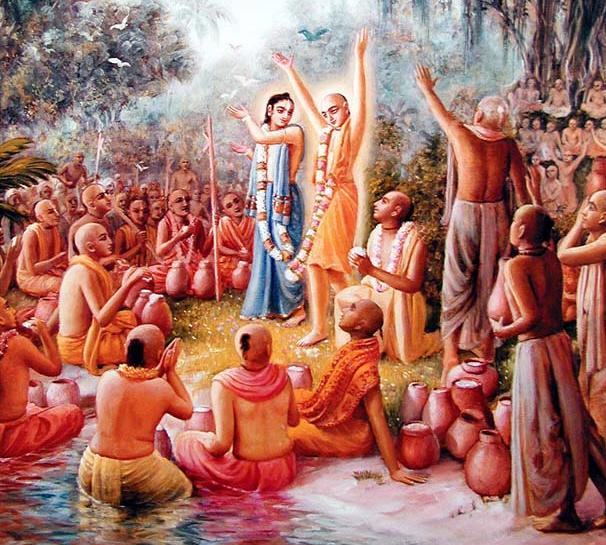
When Sri Chaitanya Mahaprabhu sent Nityananda Prabhu back to Bengal to preach, Nityananda Prabhu's travels brought Him to Panihati, among other places. The tradition says He was drawn there by Raghava Pandit's own reputation for pure devotion. He arrived with a large party that included the kirtaniya brothers Govinda Ghosh, Madhava and Vasudeva. The kirtan that followed in Raghava Pandit's own house is remembered as one of the most ecstatic recorded from Nityananda Prabhu's Bengal tour.
| Detail | Description |
|---|---|
| Location | Raghava Pandit's house, Panihati |
| Visitors | Nityananda Prabhu, the Ghosh brothers, and a wider party of devotees |
| Best-known outcome | The chida-dadhi-mahotsava (chipped-rice-and-yogurt festival) |
| Punished at this visit | Raghunatha Dasa Goswami, later one of the Six Goswamis of Vrindavana |
| Still celebrated | Yes, annually at Panihati to this day |
A House Filled With Kirtan #
As the Ghosh brothers sang, Nityananda Prabhu is remembered as passing into full ecstatic absorption, dancing without restraint until, exhausted, He sat down on the very altar where Raghava Pandit's Deities were worshiped. The devotees present responded by bathing and dressing Him as an honored guest, garlanding Him where He sat. At that moment, still deep in trance, Nityananda Prabhu suddenly asked Raghava Pandit to bring Him a garland of kadamba flowers. Raghava Pandit had to point out that this was impossible, since kadamba trees do not flower at that season. Nityananda Prabhu told him to look anyway. Searching the grounds, Raghava Pandit found kadamba blossoms growing, against nature, on a lime tree. He gathered them, made the garland, and placed it on Nityananda Prabhu. After that, the whole house filled with a different fragrance, the scent of damanaka flowers. Nityananda Prabhu explained this by saying that Mahaprabhu Himself had arrived from Puri, invisibly, wearing that very garland, to hear the kirtan.
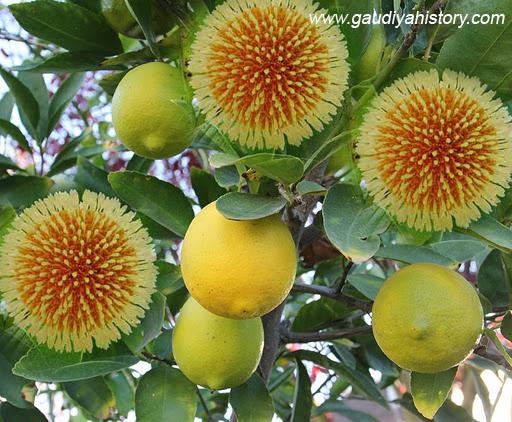
A different Vaishnava, Sundarananda Thakura, is remembered in a separate tradition for a strikingly similar wonder: a kadamba flower blooming on a lime tree at his own home in Maheshapura, offered there in the worship of his Deity of Radha-Ramana. The two accounts come from different places and different sources, and they credit the miracle differently. In the Maheshapura account, tradition credits Sundarananda Thakura himself. In the Panihati account, it is Nityananda Prabhu who reveals the flowers, and Raghava Pandit only searches them out. Gaudiya devotional biographies return to this same image more than once. It is a shared theme in two separately preserved traditions, not a contradiction between the two accounts.
The Festival That Followed #
The same visit produced a second, still more famous episode. Its central figure was not Raghava Pandit. It was Raghunatha Dasa Goswami, a young man who was longing to leave his family home and reach Sri Chaitanya Mahaprabhu. When Raghunatha Dasa arrived at Panihati and offered his obeisances from a distance, Nityananda Prabhu called out, laughing, that here was a thief who had come to be punished. As that punishment, He ordered him to hold a festival distributing chipped rice mixed with yogurt to the whole crowd: "Make a festival and feed all My associates yogurt and chipped rice." Hearing this, Raghunatha Dasa's heart was filled with joy. He threw himself into the task, buying out the food stocks of several villages. In the middle of the feast, Nityananda Prabhu brought Mahaprabhu to the riverbank in meditation, so that the two brothers ate together there, surrounded by devotees chanting the holy names. Raghava Pandit himself was present through all of this. Tradition says he brought food of his own that had not been touched by the general cooking. That same evening, at Raghava Pandit's own house, Mahaprabhu is remembered as appearing a second time, once Nityananda Prabhu had begun dancing again after the crowds had gone. The chida-dadhi-mahotsava, or Panihati festival, is still observed there every year. It is described in full, from Raghunatha Dasa Goswami's own side of the story, at The Blessing of Nityananda Prabhu at Panihati.
Remembered In The Bhakti-Ratnakara #
Generations later, the Vaishnava historian Narahari Chakravarti Thakura devoted several verses of his Bhakti-ratnakara to this same visit. In these verses, Raghava Pandit and Makaradhvaja Kara, along with the rest of the village, are overjoyed to see Nityananda Prabhu's party arrive. The kirtan that followed in Raghava Pandit's house is described as filling the whole world with transcendental joy. Narahari Chakravarti also makes a point of calling Panihati the birthplace of Raghava Pandit specifically. He treats the village's connection with Raghava Pandit as something that in itself makes the place glorious. This is a reminder that, at least for later generations of Gaudiya Vaishnavas, Raghava Pandit's own reputation and Panihati's standing as a holy site could no longer be separated.
Panihati As A Living Place Of Pilgrimage #
A banyan tree said to be more than five hundred years old still marks the traditional site of the festival at Panihati. In recent decades the chida-dadhi-mahotsava has grown from a single day's observance into an event of several days, drawing thousands of pilgrims. This unbroken link from Raghava Pandit's own household to the present is something few homes of Mahaprabhu's other associates can claim. What is known of Raghava Pandit's own later years and of Panihati's history since then is gathered at disappearance and legacy.
