Srila Raghava Pandit
Keeper of the Yearly Bhandara Carried to Jagannatha Puri
The complete life, on one page: The main biography and every pastime page, in order, in one place
Introduction
Srila Raghava Pandit lived at Panihati, a village on the Ganges a day's journey from Navadvipa. Sri Chaitanya-charitamrita names him as the seventh branch of the great tree of Mahaprabhu's associates: His "original follower." He is remembered most of all for one extraordinary act of devotion that he repeated every year of his life. Through his sister Damayanti's cooking, he gathered an entire year's worth of bhoga for Sri Chaitanya Mahaprabhu and sent it in sealed bags to Jagannatha Puri, hundreds of miles away. Those bags became so famous in Gaudiya Vaishnava memory that they still carry his name: raghavera jhali, "the bags of Raghava."
| Detail | Description |
|---|---|
| Home | Panihati, on the Ganges near Sodpur, a day's journey from Navadvipa |
| Position among the Lord's associates | Seventh branch of the tree of devotees (Chaitanya-charitamrita, Adi-lila 10.24) |
| Sister | Damayanti, who cooked the yearly bhandara sent to Puri |
| Disciple / sub-branch | Makaradhvaja Kara, superintendent of the bags |
| Identity | The gopi Dhanishtha, who cooked for Krishna in Vraja (Gaura-ganoddesha-dipika 166; Chaitanya-charitamrita Adi 10.24 purport) |
| Best known for | Raghavera jhali, the bags of bhoga carried yearly to Jagannatha Puri |
| Samadhi | Panihati, beside a Deity of Madana-mohana |
Scriptural evidence for the introduction (2)
rāghava-paṇḍita — prabhura ādya-anucara
tāṅra eka śākhā mukhya — makaradhvaja kara
Word for word
rāghava paṇḍita: Raghava Pandita; prabhura: of the Lord; ādya: original; anucara: follower; tāṅra: his; eka: one; śākhā: branch; mukhya: chief; makaradhvaja kara: Makaradhvaja Kara.
Raghava Pandita, Lord Sri Chaitanya Mahaprabhu's original follower, is understood to have been the seventh branch. From him proceeded another subbranch, headed by Makaradhvaja Kara.
From the purport: Purport excerpt: "Raghava Pandita was formerly a confidential gopi in Vraja during the time of Lord Krishna's pastimes, and his former name was Dhanishtha. This gopi, Dhanishtha, always engaged in preparing foods for Krishna."
The verse that establishes Raghava Pandit's rank among Mahaprabhu's associates and, through the purport's quotation of the Gaura-ganoddesha-dipika, his identity as the gopi Dhanishtha.
धनिष्ठा भक्ष्यसामग्रीं कृष्णायादाद्व्रजेऽमिताम् ।
सैव सम्प्रति गौराङ्गप्रियो राघवपण्डितः ॥
dhaniṣṭhā bhakṣya-sāmagrīṁ kṛṣṇāyādād vraje’mitām
saiva samprati gaurāṅga-priyo rāghava-paṇḍitaḥ
Rāghava Paṇḍita was formerly a confidential gopī in Vraja during the time of Lord Kṛṣṇa’s pastimes, and his former name was Dhaniṣṭhā. This gopī, Dhaniṣṭhā, always engaged in preparing foods for Kṛṣṇa.
Kavi Karnapura names the gopi Dhanishtha, who supplied Krishna with food in Vraja, as Raghava Pandit. Sanskrit: diacritic edition of the Gaura-ganoddesha-dipika (the second half of verse 166, which names him); translation: Srila Prabhupada, CC Adi 10.24 purport.
Chapter 1
Birth And Early Life
A householder devoted to Deity worship at Panihati, and, according to tradition, a former gopi of Vraja.
No scripture or purport records the year Raghava Pandit was born, who his parents were, or how he came to settle at Panihati. Panihati is a village on the Ganges roughly a day's journey from Navadvipa, close to what is today Sodpur station on the rail line out of Calcutta. What Sri Chaitanya-charitamrita does record is his standing among the associates of Sri Chaitanya Mahaprabhu. Krishnadasa Kaviraja Goswami calls him "Lord Sri Chaitanya Mahaprabhu's original follower," and places him as the seventh branch of the great tree of devotees that spread out from the Lord. That single phrase, ādya-anucara in the original Bengali, is important. It marks Raghava Pandit as someone whose attachment to Mahaprabhu went back to the very beginning, before the wider sankirtana movement had spread through Bengal.
| Detail | Description |
|---|---|
| Home village | Panihati, on the Ganges, a day's journey from Navadvipa |
| Household | Raghava Pandit and his sister, Damayanti |
| Rank among the Lord's associates | Seventh branch of the tree (Chaitanya-charitamrita, Adi-lila 10.24) |
| Identity in Gaura-ganoddesha-dipika | The gopi Dhanishtha, server of food to Krishna in Vraja |
| Sister's identity in the same text | The gopi Gunamala |
A House Built Around Deity Worship #
The tradition does clearly preserve what his household was like. Raghava Pandit lived with his sister Damayanti. The center of their shared life was the daily worship of a Deity of Krishna, later remembered together with a Deity of Madana-mohana at the same site. Everything else recorded about him grows out of that same daily temple service. This includes his famous standards of cleanliness in cooking, the extraordinary trouble he took to get good ingredients, and the food his sister prepared that eventually traveled all the way to Jagannatha Puri. All this is described in full at the bhandara of Raghava Pandit. This was not a public ministry or a teaching mission. It was one household's firm and complete devotion to feeding the Deity well, carried out with a strictness that in time became famous throughout Bengal.
Dhanishtha, The Gopi Who Fed Krishna #
Srila Prabhupada's purport to Chaitanya-charitamrita, Adi-lila 10.24, preserves a verse from the Gaura-ganoddesha-dipika that gives Raghava Pandit a spiritual identity reaching back into Krishna's own pastimes in Vraja: "Rāghava Paṇḍita was formerly a confidential gopī in Vraja during the time of Lord Krishna's pastimes, and his former name was Dhaniṣṭhā. This gopī, Dhaniṣṭhā, always engaged in preparing foods for Krishna." The next verse of the same text names Damayanti's earlier identity too: "The gopī named Guṇamālā appeared as Rāghava Paṇḍita's sister Damayantī." Read together, the two identifications describe a continuity, not a coincidence. Dhanishtha, the gopi whose service in Vrindavana was preparing food for Krishna, reappears at Panihati as Raghava Pandit. He does the same service for Krishna in the form of Sri Chaitanya Mahaprabhu. This time the service is shared in his household with his sister Damayanti, once the gopi Gunamala.
Not A Public Figure, But A Trusted One #
Raghava Pandit left no known writings, and he is not recorded giving any teaching or instruction of his own. He belongs to a smaller, quieter group of Mahaprabhu's associates. Their whole devotional life is remembered through one specific act of service, repeated again and again, not through words. Yet Sri Chaitanya-charitamrita clearly does not treat him as a minor figure. Mahaprabhu Himself visited his home during a tour of Bengal and publicly praised his service before the assembled devotees. Later, when Nityananda Prabhu came to Panihati with a large party of devotees, Raghava Pandit's own house became the center of the celebration. The story of that visit, and of a small, memorable miracle connected to it, is told at Nityananda Prabhu at Panihati. All these episodes together show that he was not a preacher. He was a householder whose reputation for pure devotion was so strong that the Lord's own closest associates sought out his home.
A Village Of Its Own Devotees #
Raghava Pandit was not the only notable Vaishnava living at Panihati. Makaradhvaja Kara was the sub-branch who proceeded from Raghava Pandit. He later took charge of carrying Raghava Pandit's bhandara to Puri, as described at the annual pilgrimage to Puri. Srila Prabhupada's purport at Adi-lila 10.25 notes that Makaradhvaja Kara was himself "also an inhabitant of Panihati," and that Kara was a surname generally found in the Kayastha community of Bengal. So Panihati was not simply the site of one devotee's household. It was a small cluster of Vaishnava families living close together on the Ganges, and Raghava Pandit's own household became by far the most celebrated of them. The exact location can still be identified after all these centuries. Srila Bhaktisiddhanta Sarasvati Thakura's own research placed it about a mile from Sodpur station, on the railway line running out of Sealdah in Calcutta, toward the Ganges. The village lies on the eastern bank of the river. It was close enough to the city that the site could still be visited and confirmed generations later.
Scriptural evidence for this chapter (1)
Raghava Pandita's sister Damayanti was the dear maidservant of the Lord. She always collected various ingredients with which to cook for Lord Chaitanya.
From the purport: Purport excerpt: "In the Gaura-ganoddesha-dipika (167) it is mentioned, guna-mala vraje yasid damayanti tu tat-svasa: the gopi named Gunamala appeared as Raghava Pandita's sister Damayanti."
Names Damayanti's own gopi identity, and confirms she and Raghava Pandit lived together as the two halves of one household of service.
Chapter 2
The Bhandara Of Raghava Pandit
Coconuts fetched from twenty miles away, and a standard of purity Mahaprabhu praised before all His devotees.
After Sri Chaitanya Mahaprabhu accepted sannyasa, He toured through Bengal in the years that followed to see His mother and His devotees. On that tour He stopped at Raghava Pandit's home at Panihati. What He saw there impressed Him so much that He later described it, without being asked, to the whole assembly of devotees gathered at Sarvabhauma Bhattacharya's house: "Just hear about the pure devotional service rendered to Krishna by Raghava Pandita. Indeed, Raghava Pandita's service is supremely pure and highly accomplished."
| Detail | Description |
|---|---|
| Setting | Raghava Pandit's home, Panihati, and later Sarvabhauma Bhattacharya's house, Puri |
| Source | Sri Chaitanya-charitamrita, Madhya-lila 15.69–91 |
| Best-documented offering | Coconuts, fetched from twenty miles away at four times the ordinary price |
| Also offered | Bananas, mangoes, oranges, jackfruit, spinach, sweetmeats, pickles, condiments |
| Praised by | Sri Chaitanya Mahaprabhu, in front of the assembled devotees |
Coconuts From Twenty Miles Away #
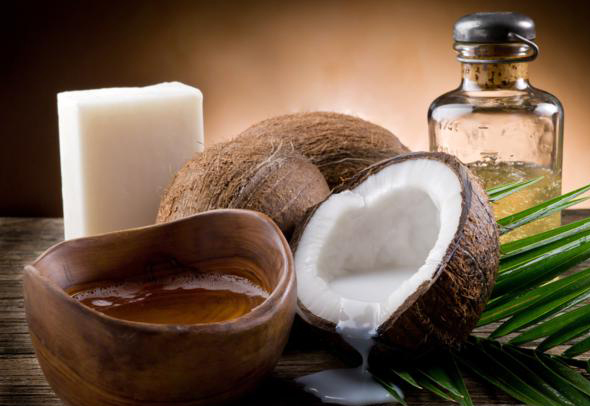
Mahaprabhu's description, as Krishnadasa Kaviraja Goswami records it, is remarkably specific. "Although he already has hundreds of trees and millions of fruits," the Lord said, "he is still very eager to hear about the place where sweet coconuts are available. He collects coconuts with great endeavor from a place twenty miles away, and he pays four panas each for them." Every day, five to seven coconuts were clipped and set in water to cool. At the time of offering they were clipped again, holes were made at the top, and they were presented to the Deity. Mahaprabhu said that the Deity drank the juice and sometimes refilled the pulp inside, so that Raghava Pandit found the shell mysteriously full again after the first offering. In Mahaprabhu's telling, this detail only deepened Raghava Pandit's faith.
The Coconuts He Threw Away #
One particular day shows the standard he held himself to. A servant was carrying ten coconuts, properly cleaned, to the Deity. While waiting at the door for a chance to enter, he brushed the ceiling above the doorway and then touched the coconuts with the same hand. Raghava Pandit noticed. "People are always coming and going through that door," he said. "The dust from their feet blows up and touches the ceiling. After touching the ceiling above the door, you have touched the coconuts. Now they are no longer fit to be offered to Krishna because they are contaminated." He had the entire batch thrown over the wall and new coconuts prepared from scratch.
Srila Bhaktisiddhanta Sarasvati Thakura's commentary, quoted in Srila Prabhupada's purport at this point, insists that this was not simply fussiness about cleanliness: "Raghava Pandita was not simply a crazy fellow suffering from some cleansing mania... He was always absorbed in the transcendental thought of how he could always serve Krishna with everything." The purport goes on to warn against the opposite error. It warns against devotees on a lower platform imitating his outward behavior as if cleanliness itself were the point. The whole episode was really about Raghava Pandit's very particular, personal absorption in service, and that cannot simply be copied.
Fruit From Distant Villages, And A Favorite Dish Of Spinach #
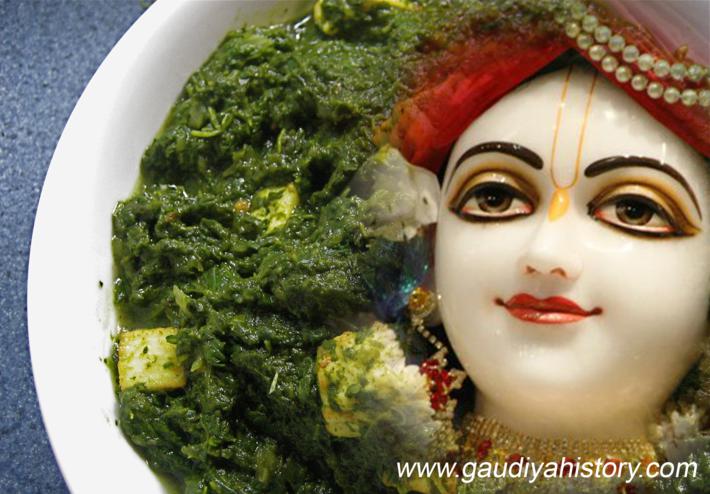
The same standard extended to everything else in the kitchen. "From distant villages he collects excellent bananas, mangoes, oranges, jackfruits and whatever other first-class fruits he has heard about," Mahaprabhu told the devotees, "bought at a high price" and trimmed with the same great care. Raghava Pandit prepared spinach, vegetables, radishes, chipped rice, powdered rice, sweetmeats, cakes, sweet rice, condensed milk and pickles such as kashamdi, along with scents, garments and ornaments for the Deity. By tradition, Mahaprabhu was especially fond of the spinach dishes that came from this same kitchen. Mahaprabhu's summary of the whole visit was direct: "Thus Raghava Pandita serves the Lord in an incomparable way. Everyone is very much satisfied just to see him." He then embraced Raghava Pandit before continuing on His tour.
This same household's cooking, on a far larger and more famous scale, is what filled the bags that traveled every year to Jagannatha Puri. That story is told in full at the annual pilgrimage to Puri. It was also this house that Nityananda Prabhu filled with kirtan and dancing on a separate visit, described at Nityananda Prabhu at Panihati.
Scriptural evidence for this chapter (2)
Quoted in the text above:
- Madhya 15.83 Sri Chaitanya-charitamrita
Further verses:
iṅhāra kṛṣṇa-sevāra kathā śuna, sarva-jana
parama-pavitra sevā ati sarvottama
Word for word
iṅhāra: of him; kṛṣṇa-sevāra: of service to Lord Krishna; kathā śuna: hear the stories; sarva-jana: all people; parama-pavitra: supremely pure; sevā: service; ati sarvottama: very much well accomplished.
Sri Chaitanya Mahaprabhu then informed everyone, "Just hear about the pure devotional service rendered to Krishna by Raghava Pandita. Indeed, Raghava Pandita's service is supremely pure and highly accomplished."
Mahaprabhu's own introduction of the long description of Raghava Pandit's Deity worship that follows in this chapter, used as the pull-quote for Raghava Pandit.
Chapter 3
Nityananda Prabhu At Panihati
A kirtan that filled Raghava Pandit's house, a garland of flowers found where none should have bloomed, and the festival still celebrated at Panihati today.
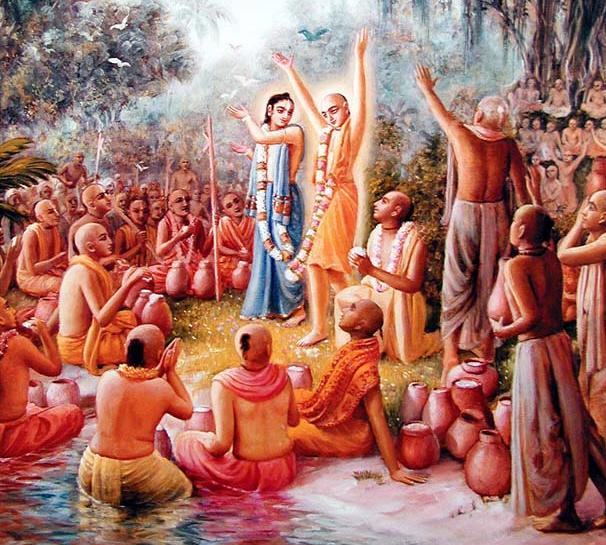
When Sri Chaitanya Mahaprabhu sent Nityananda Prabhu back to Bengal to preach, Nityananda Prabhu's travels brought Him to Panihati, among other places. The tradition says He was drawn there by Raghava Pandit's own reputation for pure devotion. He arrived with a large party that included the kirtaniya brothers Govinda Ghosh, Madhava and Vasudeva. The kirtan that followed in Raghava Pandit's own house is remembered as one of the most ecstatic recorded from Nityananda Prabhu's Bengal tour.
| Detail | Description |
|---|---|
| Location | Raghava Pandit's house, Panihati |
| Visitors | Nityananda Prabhu, the Ghosh brothers, and a wider party of devotees |
| Best-known outcome | The chida-dadhi-mahotsava (chipped-rice-and-yogurt festival) |
| Punished at this visit | Raghunatha Dasa Goswami, later one of the Six Goswamis of Vrindavana |
| Still celebrated | Yes, annually at Panihati to this day |
A House Filled With Kirtan #
As the Ghosh brothers sang, Nityananda Prabhu is remembered as passing into full ecstatic absorption, dancing without restraint until, exhausted, He sat down on the very altar where Raghava Pandit's Deities were worshiped. The devotees present responded by bathing and dressing Him as an honored guest, garlanding Him where He sat. At that moment, still deep in trance, Nityananda Prabhu suddenly asked Raghava Pandit to bring Him a garland of kadamba flowers. Raghava Pandit had to point out that this was impossible, since kadamba trees do not flower at that season. Nityananda Prabhu told him to look anyway. Searching the grounds, Raghava Pandit found kadamba blossoms growing, against nature, on a lime tree. He gathered them, made the garland, and placed it on Nityananda Prabhu. After that, the whole house filled with a different fragrance, the scent of damanaka flowers. Nityananda Prabhu explained this by saying that Mahaprabhu Himself had arrived from Puri, invisibly, wearing that very garland, to hear the kirtan.
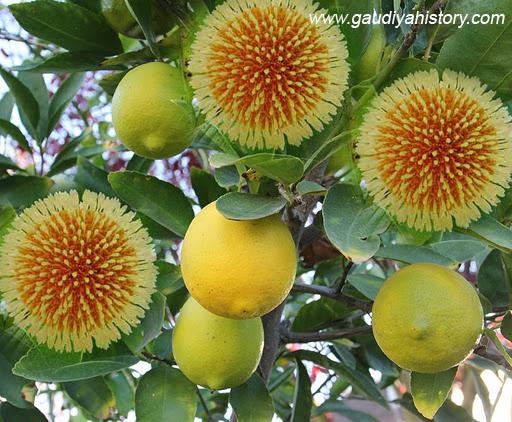
A different Vaishnava, Sundarananda Thakura, is remembered in a separate tradition for a strikingly similar wonder: a kadamba flower blooming on a lime tree at his own home in Maheshapura, offered there in the worship of his Deity of Radha-Ramana. The two accounts come from different places and different sources, and they credit the miracle differently. In the Maheshapura account, tradition credits Sundarananda Thakura himself. In the Panihati account, it is Nityananda Prabhu who reveals the flowers, and Raghava Pandit only searches them out. Gaudiya devotional biographies return to this same image more than once. It is a shared theme in two separately preserved traditions, not a contradiction between the two accounts.
The Festival That Followed #
The same visit produced a second, still more famous episode. Its central figure was not Raghava Pandit. It was Raghunatha Dasa Goswami, a young man who was longing to leave his family home and reach Sri Chaitanya Mahaprabhu. When Raghunatha Dasa arrived at Panihati and offered his obeisances from a distance, Nityananda Prabhu called out, laughing, that here was a thief who had come to be punished. As that punishment, He ordered him to hold a festival distributing chipped rice mixed with yogurt to the whole crowd: "Make a festival and feed all My associates yogurt and chipped rice." Hearing this, Raghunatha Dasa's heart was filled with joy. He threw himself into the task, buying out the food stocks of several villages. In the middle of the feast, Nityananda Prabhu brought Mahaprabhu to the riverbank in meditation, so that the two brothers ate together there, surrounded by devotees chanting the holy names. Raghava Pandit himself was present through all of this. Tradition says he brought food of his own that had not been touched by the general cooking. That same evening, at Raghava Pandit's own house, Mahaprabhu is remembered as appearing a second time, once Nityananda Prabhu had begun dancing again after the crowds had gone. The chida-dadhi-mahotsava, or Panihati festival, is still observed there every year. It is described in full, from Raghunatha Dasa Goswami's own side of the story, at The Blessing of Nityananda Prabhu at Panihati.
Remembered In The Bhakti-Ratnakara #
Generations later, the Vaishnava historian Narahari Chakravarti Thakura devoted several verses of his Bhakti-ratnakara to this same visit. In these verses, Raghava Pandit and Makaradhvaja Kara, along with the rest of the village, are overjoyed to see Nityananda Prabhu's party arrive. The kirtan that followed in Raghava Pandit's house is described as filling the whole world with transcendental joy. Narahari Chakravarti also makes a point of calling Panihati the birthplace of Raghava Pandit specifically. He treats the village's connection with Raghava Pandit as something that in itself makes the place glorious. This is a reminder that, at least for later generations of Gaudiya Vaishnavas, Raghava Pandit's own reputation and Panihati's standing as a holy site could no longer be separated.
Panihati As A Living Place Of Pilgrimage #
A banyan tree said to be more than five hundred years old still marks the traditional site of the festival at Panihati. In recent decades the chida-dadhi-mahotsava has grown from a single day's observance into an event of several days, drawing thousands of pilgrims. This unbroken link from Raghava Pandit's own household to the present is something few homes of Mahaprabhu's other associates can claim. What is known of Raghava Pandit's own later years and of Panihati's history since then is gathered at disappearance and legacy.
Scriptural evidence for this chapter (1)
Quoted in the text above:
- Antya 6.51 Sri Chaitanya-charitamrita
Chapter 4
The Annual Pilgrimage To Puri
Raghavera jhali: a year's worth of bhoga, sealed in bags, carried hundreds of miles, and eaten by Mahaprabhu only when He chose, little by little through the year.
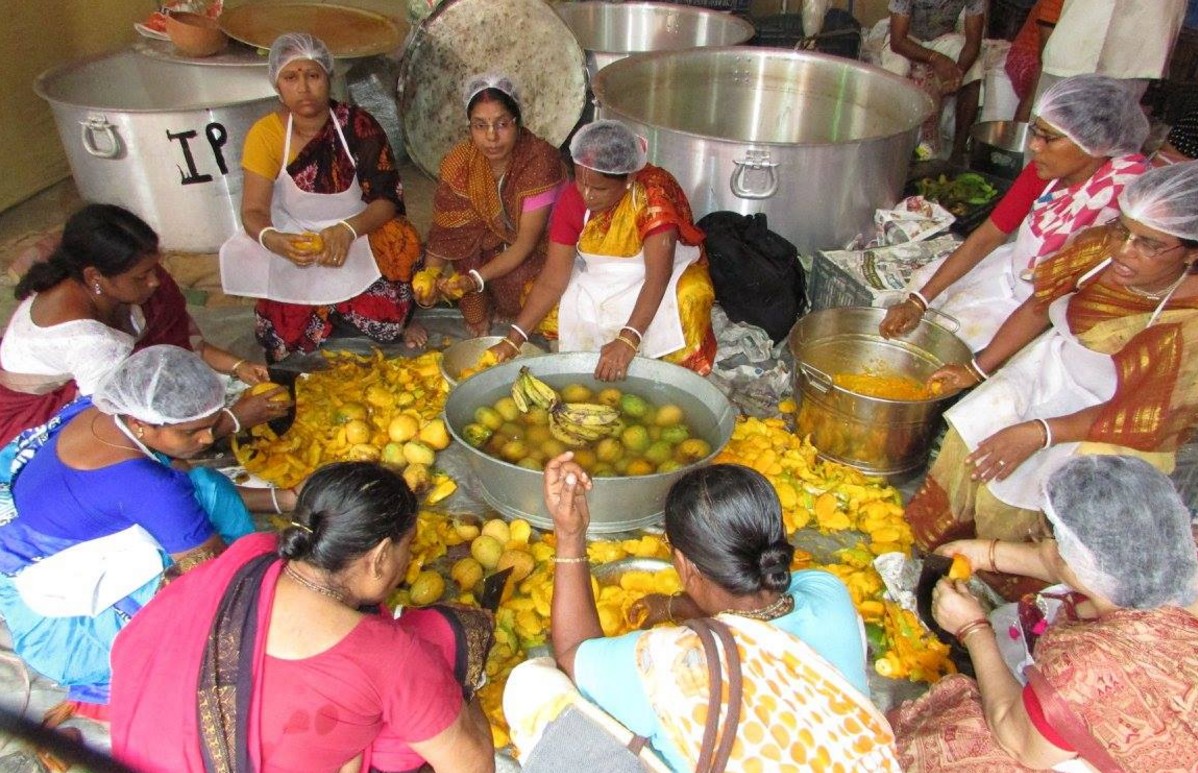
Every year, Shivananda Sena organized and paid for the long walk that carried Bengal's devotees to Jagannatha Puri to see Sri Chaitanya Mahaprabhu. That journey is described in full at Shivananda Sena's own account of leading it. Each year, Raghava Pandit's household also sent something with that same party that no other household sent. It was bags and bags of food that his sister Damayanti had spent the year preparing, packed and sealed for the journey south.
| Detail | Description |
|---|---|
| Prepared by | Damayanti, Raghava Pandit's sister, on his instruction |
| Carried by | Three bearers, under the pilgrim party organized by Shivananda Sena |
| Superintendent of the bags | Makaradhvaja Kara, Raghava Pandit's own disciple |
| Known collectively as | Raghavera jhali ("the bags of Raghava") |
| How long the food lasted | The entire year, until the next pilgrimage arrived |
| Source | Sri Chaitanya-charitamrita, Antya-lila 10.13–42, 124–131 |
What Went Into The Bags #
Sri Chaitanya-charitamrita gives an unusually long and detailed list of what Damayanti packed. She dried and powdered Ganges clay, strained it and rolled it into scented balls. She made a hundred kinds of pickles and condiments, including koli-shunthi, koli-churna and koli-khanda. She rolled sweets from coriander and anise cooked in sugar, and others from dried ginger meant to settle the digestion. She prepared long-lasting cheese, cream sweets and amrita-karpura. She also made several kinds of flattened and puffed rice fried in ghee and cooked in sugar syrup, and a preparation of powdered fused peas rolled into balls. "I could not mention the names of all these wonderful eatables, even in a lifetime," Krishnadasa Kaviraja Goswami writes. "Damayanti made hundreds and thousands of varieties." One preparation gets a special note of its own. It is sukuta, a bitter dish of dried vegetables. Damayanti thought of Mahaprabhu as an ordinary person who might fall sick from overeating. So she worried about His digestion and made sukuta to settle it. "Do not neglect sukuta because it is a bitter preparation," the text says. "Sri Chaitanya Mahaprabhu derived more happiness from eating this sukuta than from drinking panchamrita." Small cloth bags were sewn into larger ones, wrapped and sealed. The whole collection became famous ever after as raghavera jhali. It was given to three bearers and placed under the personal charge of Makaradhvaja Kara. The text describes him as guarding them "with great attention like his very life."
"Only The Bags Of Raghava" #
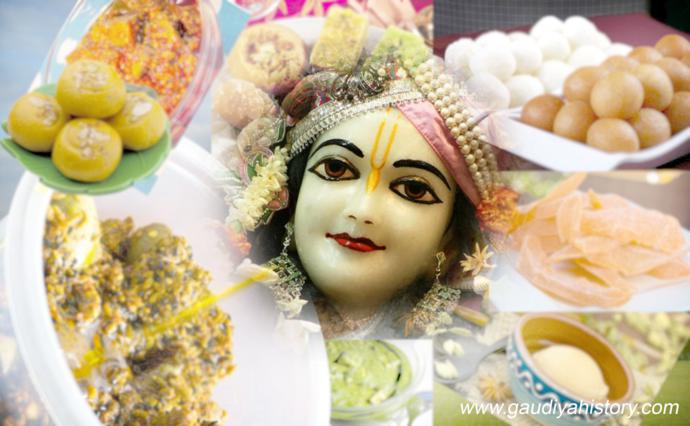
What happened when the party reached Puri shows clearly how Mahaprabhu thought of this gift. Each year, devotees brought food for Him, and His servant Govinda would announce each one by name as he set it before the Lord: from Advaita Acharya, from Srivasa Thakura, from Vasudeva Datta and Murari Gupta, from the communities of Kulina-grama and Khanda. Mahaprabhu ate all of it that same day. The text says it was enough for a hundred people. Then He asked Govinda if anything remained. "Now there are only the bags of Raghava," Govinda replied. Mahaprabhu set them aside and said, "Let them remain today. I shall see them later." The next day, while eating alone in a quiet place, He opened Raghava Pandit's bags Himself. He tasted a little from each one and praised its flavor and aroma. Then He had the rest kept aside. It was served to Him little by little, sometimes at lunch and sometimes at night, through the whole year that followed, until the next year's bags arrived. No other devotee's offering was treated this way. Everyone else's gifts were eaten at once, with others present, and named aloud. Only Raghava's bags were kept aside, enjoyed in private, and made to last.
A Gift That Outlasted The Season #
As a result, a piece of Raghava Pandit's and Damayanti's devotion was on Mahaprabhu's plate at Puri on most days of the year, long after the pilgrims who carried it had gone back to Bengal. In this quiet way, their devotion continued day after day, alongside the more public devotion of festivals and kirtan. What is known of Raghava Pandit's own later life, and how Panihati remembers him today, is told at disappearance and legacy.
Scriptural evidence for this chapter (3)
se saba sāmagrī yata jhālite bhariyā
rāghava la-iyā yā'na gupata kariyā
vāra-māsa tāhā prabhu karena aṅgīkāra
'rāghavera jhāli' bali' prasiddhi yāhāra
Word for word
se saba sāmagrī: all those ingredients; jhālite bhariyā: packing in bags; rāghava la-iyā: Raghava carrying; gupata kariyā: very confidentially; vāra-māsa: the whole year; aṅgīkāra: acceptance; rāghavera jhāli: the bags of Raghava; prasiddhi: celebrated.
The foods Damayanti cooked for Lord Chaitanya when He was at Puri were carried in bags by her brother Raghava without the knowledge of others. The Lord accepted these foods throughout the entire year. Those bags are still celebrated as raghavera jhali, "the bags of Raghava Pandita."
The verses that give the annual bhandara its lasting name, raghavera jhali, and state plainly that the food lasted Mahaprabhu the whole year.
saṅkṣepe kahiluṅ ei jhālira vicāra
'rāghavera jhāli' bali' vikhyāti yāhāra
jhālira upara 'munsiba' makaradhvaja-kara
prāṇa-rūpe jhāli rākhe hañā tatpara
Word for word
saṅkṣepe kahiluṅ: I have briefly spoken; vicāra: description; vikhyāti: fame; jhālira upara: upon the bags; munsiba: the superintendent; makaradhvaja-kara: Makaradhvaja Kara; prāṇa-rūpe: like his very life; hañā tatpara: with great attention.
Thus I have briefly described the bags that have become famous as raghavera jhali. The superintendent for all those bags was Makaradhvaja Kara, who kept them with great attention like his very life.
Names Makaradhvaja Kara as the disciple entrusted with the bags on the annual journey to Puri, closing Krishnadasa Kaviraja Goswami's long inventory of what Damayanti packed into them.
govinda bale, — 'rāghavera jhāli mātra āche'
prabhu kahe, — 'āji rahu, tāhā dekhimu pāche'
Word for word
govinda bale: Govinda replied; rāghavera jhāli: the bags given by Raghava; mātra āche: only there is; prabhu kahe: Sri Chaitanya Mahaprabhu said; āji rahu: let it remain today; dekhimu pāche: I shall see later.
Govinda replied, "Now there are only the bags of Raghava." The Lord said, "Let them remain today. I shall see them later."
The moment that shows Raghava Pandit's gift being treated differently from every other devotee's: set aside rather than eaten and named the same day, and opened by Mahaprabhu alone the next afternoon.
Chapter 5
Disappearance And Legacy
No recorded date of passing, a tomb once overgrown with vines, and a village now again a place of pilgrimage.
Sri Chaitanya-charitamrita gives no date for Raghava Pandit's disappearance, and no later Gaudiya Vaishnava source fills the gap. What has come down to us instead is a record of where he is buried and what happened to that spot over the following centuries. The same is true of several of Sri Chaitanya Mahaprabhu's closest Bengali associates. Their lives are remembered far more clearly than their deaths.
| Detail | Description |
|---|---|
| Samadhi location | Panihati, on the Ganges |
| Deity worshiped at the same site | Madana-mohana |
| Condition described by Bhaktisiddhanta Sarasvati Thakura (early twentieth century) | Tomb overgrown with vines; Deity temple broken down and neglected |
| Local caretaker named in that account | Shivachandra Raya Chaudhuri, a zamindar of Panihati |
| Present-day status | Panihati is an active Gaudiya Vaishnava pilgrimage site, with an ISKCON center established in 2013 |
A Tomb Overgrown With Vines #
The fullest surviving description of Raghava Pandit's samadhi comes from Srila Bhaktisiddhanta Sarasvati Thakura's Anubhasya. Srila Prabhupada quotes it in his own purport to Chaitanya-charitamrita, Adi-lila 10.25: "On Raghava Pandit's tomb is a creeper on a concrete platform. There is also a Madana-mohana Deity in a broken-down temple nearby. This temple is managed by a local zamindar of the name Sri Shivachandra Raya Chaudhuri." The note was written in the early twentieth century. It is plain and factual, not sorrowful. It simply records a holy place that had become quiet by then. The place was looked after by a local landowning family, not by any organized mission.
Panihati Remembered And Revived #
That quiet did not last. Gaudiya Vaishnavas continued to recognize Panihati as one of the well-known places in Sri Chaitanya Mahaprabhu's own life in Bengal. It was the site of Raghava Pandit's household, of Nityananda Prabhu's kirtan described at Nityananda Prabhu at Panihati, and of the chida-dadhi-mahotsava that continues there to this day. Srila Prabhupada himself visited Panihati twice during his own lifetime and spoke of wanting to see a temple built there. That wish began to come true in 2013, when an ancestral property on the Panihati riverbank was acquired and an ISKCON center was established there. Since then, the annual chipped-rice festival has grown from a single day into a celebration of several days, and it draws large numbers of pilgrims. The site now also has two ghats on the Ganges. They are used for traditional Vaishnava ceremonies such as shraddha rites for departed ancestors. A Govinda's restaurant was added in 2022. The center's leaders have announced plans for a boat service linking Panihati to Mayapura. This would fulfill a wish that Srila Prabhupada himself is remembered as having expressed. They have also announced a wider "Chaitanya Circuit" pilgrimage route, connecting the various places Sri Chaitanya Mahaprabhu lived and visited across West Bengal. It is not certain that any building standing at Panihati today is the same one Bhaktisiddhanta Sarasvati Thakura once described. But the place itself, the ground where Raghava Pandit and Damayanti lived and cooked, is still what it always was. It is a living center of devotion, not a monument to it.
What Remains #
Some of Mahaprabhu's other associates left behind books, philosophical schools or lines of formal disciples. Raghava Pandit did not. What he left behind was a standard: purity in cooking and care in offering. His devotion was so particular and so trusted that Mahaprabhu treated his gift differently from everyone else's. Mahaprabhu tasted it alone and made it last the whole year through. Today that standard is preserved only in the pages of Sri Chaitanya-charitamrita and in the continuing life of the village where Raghava Pandit lived it out. It is described from its beginning at birth and early life, and in the story of his kitchen at the bhandara of Raghava Pandit.
Scriptural evidence for this chapter (1)
From the purport: "On Raghava Pandit's tomb is a creeper on a concrete platform. There is also a Madana-mohana Deity in a broken-down temple nearby. This temple is managed by a local zamindar of the name Sri Shivachandra Raya Chaudhuri."
Srila Bhaktisiddhanta Sarasvati Thakura's own eyewitness description of Raghava Pandit's samadhi and the neglected Madana-mohana temple beside it, written in the 1930s and quoted in Srila Prabhupada's purport at this same reference.
Closing
A Former Gopi Of Vraja #
In his purport to this same verse, Srila Prabhupada quotes what the Gaura-ganoddesha-dipika (verse 166) says about Raghava Pandit's spiritual identity. He was formerly Dhanishtha, a confidential gopi of Vraja who "always engaged in preparing foods for Krishna." In the purport to the next verse (Adi 10.25), Srila Prabhupada quotes Srila Bhaktisiddhanta Sarasvati Thakura's Anubhasya, which cites the same text (verse 167) to say that his sister Damayanti was the gopi Gunamala. The connection is striking. In Krishna's pastimes, this gopi's service was cooking for Him. In Mahaprabhu's own pastimes, the same gopi appears again as the devotee whose household became famous for exactly that same service. This time the service was carried out by his own sister, at his direction.
In that purport to Chaitanya-charitamrita Adi 10.24 Srila Prabhupada quotes the Sanskrit of Gaura-ganoddesha-dipika 166 and explains it:
dhaniṣṭhā bhakṣya-sāmagrīṁ kṛṣṇāyādād vraje’mitām
saiva samprati gaurāṅga-priyo rāghava-paṇḍitaḥ
"Rāghava Paṇḍita was formerly a confidential gopī in Vraja during the time of Lord Kṛṣṇa’s pastimes, and his former name was Dhaniṣṭhā. This gopī, Dhaniṣṭhā, always engaged in preparing foods for Kṛṣṇa." (Chaitanya-charitamrita Adi 10.24 purport)
Four verses earlier, in verse 162, the same book speaks of a different devotee with almost the same name: Srila Raghava Pandita Goswami of Govardhana, the gopi Campakalata, who guided Shrinivasa Acharya and Narottama Dasa Thakura through Vraja. Modern books often mix the two up, but they are two different people.
