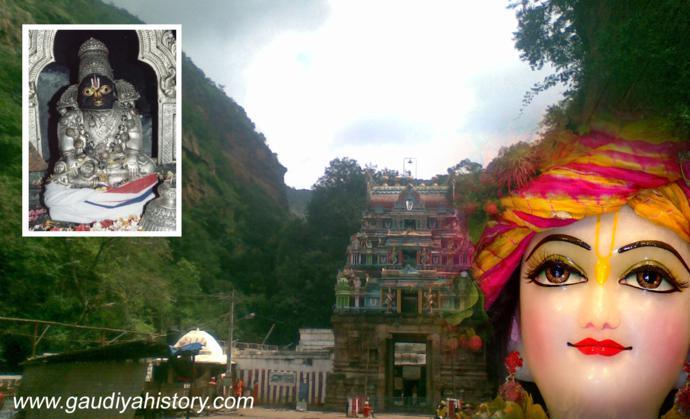
Ramadasa Brahmana
The Siddhavata Brahmana Whose Chanting Turned From Rama to Krishna
Also known as Ramadas Brahmana
“Sir, You are that Krishna Himself. This is my conclusion.”
Spoken to Sri Chaitanya Mahaprabhu at Siddhavata after Krishna's name replaced Rama's on his tongue (Chaitanya-charitamrita, Madhya-lila 9.37).
A Name Fixed by a Single Meeting #
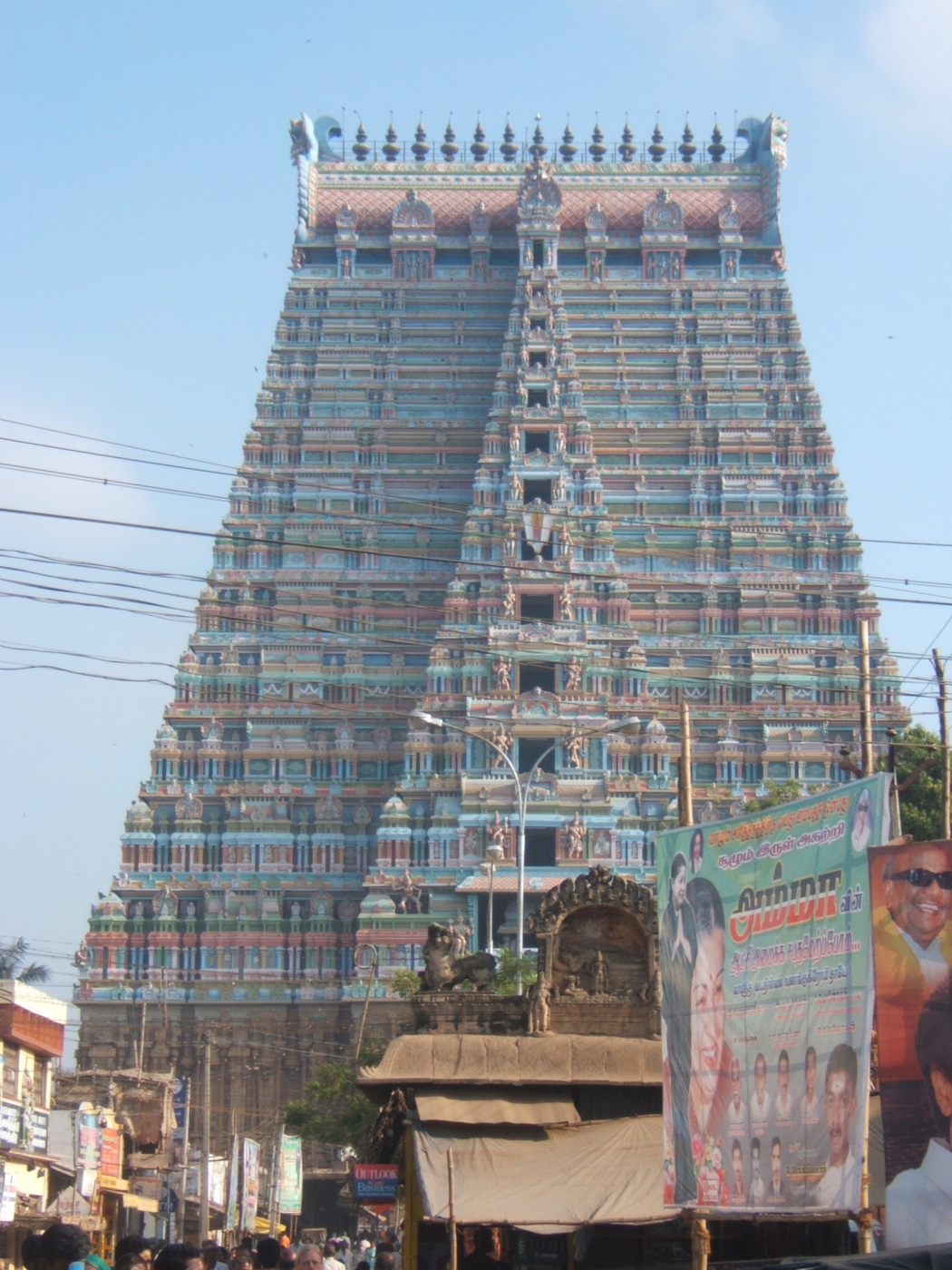
At Siddhavata, a pilgrimage town near the great Vishnu temple of Sri Ranganatha in South India, Sri Chaitanya Mahaprabhu met a brahmana remembered in the tradition only as "Ramadasa Brahmana". Here the word brahmana simply names his caste, not his family. Sri Chaitanya-charitamrita records only a single, short episode about him. He was a devotee who had chanted Lord Ramachandra's holy name every day of his life. But after two brief visits from Mahaprabhu, he found that the name of Krishna had appeared on his tongue instead and would not leave.
| Detail | Description |
|---|---|
| Met Sri Chaitanya Mahaprabhu | At Siddhavata, near the Sri Ranganatha temple, during the Lord's South India tour |
| Background | A brahmana devotee who chanted the holy name of Lord Ramachandra continuously, by his own account since childhood |
| Primary source | Sri Chaitanya-charitamrita, Madhya-lila, Chapter Nine (verses 17-38) |
| Best-known episode | Finding Krishna's holy name replacing Rama's on his tongue after seeing Mahaprabhu |
| What is not recorded | His birth and disappearance dates, his family, and any life before or after this one day |
Three Devotees Named Ramadasa #
Three separate worshipers of Lord Ramachandra are remembered by the name Ramadasa, and Sri Chaitanya Mahaprabhu met each of them independently. Sri Chaitanya-charitamrita itself gives this Siddhavata brahmana no personal name. It uses the name Ramadasa only for the other two. Later in the very same chapter of Chaitanya-charitamrita, at southern Mathura (Madurai), Mahaprabhu meets a different brahmana Rama-bhakta, remembered here as Ramadasa Vipra. Years afterward, in Bengal and at Jagannatha Puri, a government official of the kayastha caste who served Raghunatha Bhatta Goswami on the road appears as Ramadasa Vishvasa. A fourth man of a similar name, Minaketana Ramadasa, was Nityananda Prabhu's own servant and is unrelated to any of these three; he appears on Krishnadasa Kaviraja Goswami's page. Chaitanya-charitamrita treats all of them as distinct people who never appear together.
A Lifelong Chanter of Rama's Name #
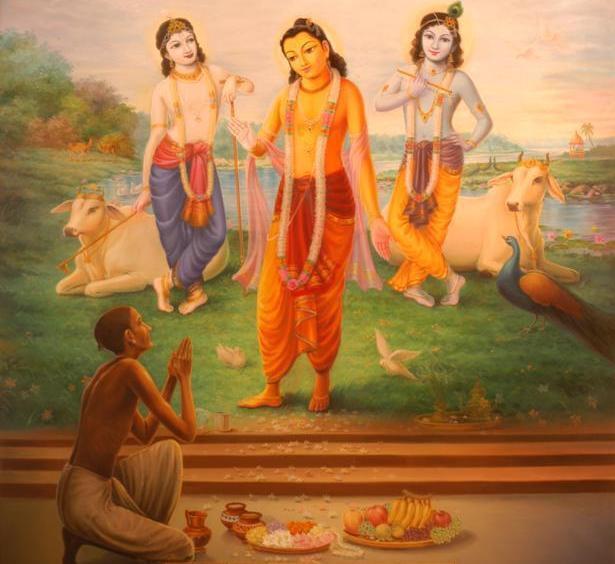
Mahaprabhu's tour through South India took Him first to see the Deity of Lord Nrisimha, and from there to Siddhavata, where He offered prayers before the Deity of Ramachandra, Lord of Sitadevi. It was there that this brahmana invited Him home for lunch. Krishnadasa Kaviraja Goswami is specific about the man's practice. He chanted Rama's holy name constantly, and Chaitanya-charitamrita says that apart from the sound of that name he barely spoke at all. Mahaprabhu accepted prasadam at his home and continued on His way. It was apparently no different from any other pilgrimage stop. But it was the first of two visits that would together form this brahmana's entire recorded story. That story is told in full in The Rama Bhakta Who Began Chanting Krishna's Name.
A Second Visit, A Different Name #
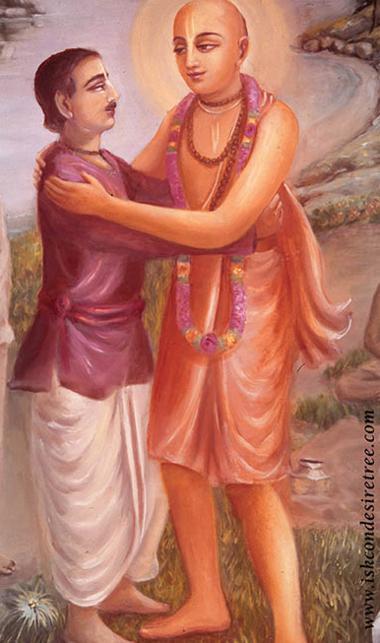
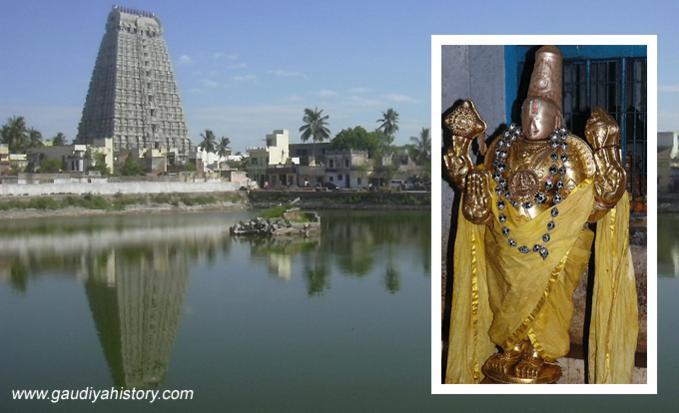
After visiting the temples of Skanda and of Trivikrama nearby, Mahaprabhu returned to the same house in Siddhavata. He found the brahmana now chanting the Hare Krishna maha-mantra instead of Rama's name alone. Asked directly why his lifelong practice had changed, the brahmana gave an answer that has since become a quietly moving passage in Chaitanya-charitamrita. He said that seeing Mahaprabhu even once had fixed Krishna's name on his tongue so firmly that Rama's name had faded from his heart, though he had chanted it since childhood.
Rama and Krishna, Weighed Against Each Other #
This brief episode is more than a simple conversion story, because the brahmana himself supplies the theology for it, quoting scripture he already knew. One verse, from the Shata-nama-stotra of the Padma Purana, says: "The Supreme Absolute Truth is called Rama because the transcendentalists take pleasure in the unlimited true pleasure of spiritual existence" (Chaitanya-charitamrita, Madhya 9.29). On this basis, the holy names of Rama and Krishna stand on an equal level as the Supreme Absolute Truth. But scripture also gives some further, specific information (Madhya 9.31). Lord Shiva tells his wife, Durga: "O Varanana, I chant the holy name of Rama, Rama, Rama and thus enjoy this beautiful sound. This holy name of Ramachandra is equal to one thousand holy names of Lord Vishnu" (Padma Purana, Brihad-vishnu-sahasranama-stotra; Chaitanya-charitamrita, Madhya 9.32). Another verse, from the Brahmanda Purana and quoted in the Laghu-bhagavatamrita, goes further: "The pious results derived from chanting the thousand holy names of Vishnu three times can be attained by only one utterance of the holy name of Krishna" (Madhya 9.33). He was not giving up Rama. As a scholar of scripture himself, he was simply reporting the conclusion he could no longer avoid once he had seen Mahaprabhu face to face. "Sir, You are that Lord Krishna Himself. This is my conclusion," he said, and fell at Mahaprabhu's feet (Madhya 9.37).
What the Tradition Does and Doesn't Preserve #
Beyond this single day at Siddhavata, nothing else about this brahmana survives in Chaitanya-charitamrita or in any source that could be located. No birth or disappearance date is recorded, no lineage, no later life, and no writing of his own beyond the words Krishnadasa Kaviraja records him speaking. Srila Prabhupada's own purports to this section explain the Sanskrit word-roots the brahmana cites, but they add no further biographical detail. So, honestly, only a single afternoon remains. But it is one of the clearest small examples in Chaitanya-charitamrita of Mahaprabhu's own teaching that the holy names of Krishna and Rama both call out to the same one Supreme Person. Here that teaching is met in the person of a brahmana who found that meeting could rewrite even a lifelong habit of the tongue.
Scriptural evidence
sei vipra rāma-nāma nirantara laya
'rāma' 'rāma' vinā anya vāṇī nā kahaya
Word for word
sei vipra: that brahmana; rāma-nāma: the holy name of Lord Ramachandra; nirantara laya: constantly chants; rāma rāma vinā: without the holy names Rama Rama; anya vāṇī: other vibration; nā kahaya: does not speak.
That brahmana constantly chanted the holy name of Ramachandra. Indeed, but for chanting Lord Ramachandra's holy name, that brahmana did not speak a word.
Establishes how total this brahmana's lifelong absorption in Rama's holy name was, before his meeting with Mahaprabhu changed it.
Frequently asked
When was Ramadasa Brahmana born?
Ramadasa Brahmana appeared Not recorded in Probably Siddhavata or its surrounding region, South India.
When and where did Ramadasa Brahmana disappear?
Ramadasa Brahmana disappeared Not recorded at Not recorded; last mentioned residing at Siddhavata.
What are the main pastimes of Ramadasa Brahmana?
The pastimes covered here include: The Rama Bhakta Who Began Chanting Krishna's Name.