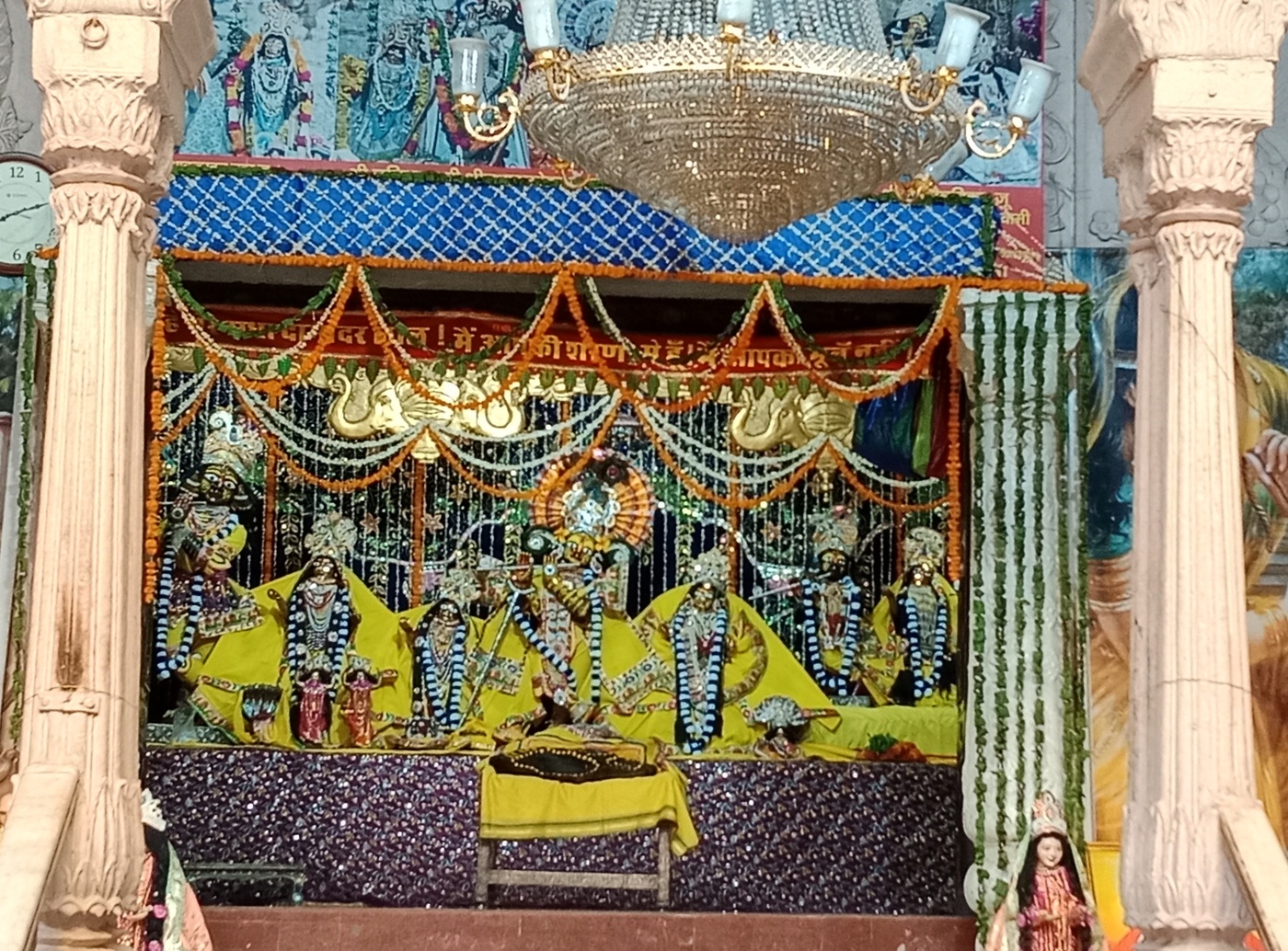
In his last years Rupa Gosvami lived much as he had lived for most of his adult life. He kept almost the same pace of chanting, writing and begging for his meals as when he first arrived in Vraja decades earlier. His bhajana-kutir, and later his samadhi, lie within Seva-kunja, in the courtyard of the Radha-Damodara temple in Vrindavana. The founding of that temple is closely connected with the community of Gosvamis that Rupa had helped to establish. Tradition places his disappearance from this world on Shravana Shukla Dvadashi in 1564. Some accounts state that he left only twenty-seven days after his elder brother Sanatana. This account follows the commonly repeated tradition. But no record from his own time fixes the exact date with certainty.
| Detail | Description |
|---|---|
| Final residence | Seva-kunja, beside the Radha-Damodara temple, Vrindavana |
| Traditional date of disappearance | Shravana Shukla Dvadashi, 1564 |
| Relationship to Sanatana's disappearance | Some sources place it twenty-seven days after Sanatana's own |
| Books passed on | Inherited and continued by his nephew Jiva Gosvami |
| Legacy title | Rupanuga Vaishnavism, followers in the line of Rupa Gosvami |
A Legacy Left to His Nephew #
By the time of his disappearance, Rupa Gosvami had already spent years working alongside Sri Jiva Gosvami, the son of his brother Anupama. Jiva had arrived in Vrindavana as a young scholar, already trained in Navadwipa and Varanasi, and he studied directly under both his uncles. Jiva inherited the unfinished parts of his uncles' theological work and carried it forward. Largely through Jiva's many commentaries and his own independent works, the philosophy that Rupa began at Prayaga was given the fullest and most systematic form it would take in the Six Gosvamis' own generation.
Remembered in a Single Prayer #
Gaudiya Vaishnavas have long honored Rupa Gosvami and his five companions together in the Sri Sad-Gosvamy-ashtaka, an eight-verse prayer still recited daily in temples following this tradition. Its opening verse offers obeisances to all six as an inseparable group: "I offer my respectful obeisances unto the Six Gosvamis... who are always engaged in chanting the holy name of Krishna and dancing. They are just like the ocean of love of God... and they are fully blessed by Lord Chaitanya." Srila Prabhupada, commenting on this same verse in a 1968 lecture in Los Angeles, recalled that when the Gosvamis' own writings were eventually carried out of Vrindavana, the collected manuscripts filled an entire cartload. It was a detail he offered simply to show how much theological literature this small community of renounced devotees had produced in a single generation.
What Later Rulers Undid, and What Survived #
Rupa's discovery of the deity had led to the building of the Govindaji temple. Later, that temple suffered because it was so grand. Generations after Rupa's disappearance, Emperor Aurangzeb is said to have ordered its upper stories destroyed, because he was displeased that its tower could be seen from so far away. The original deity was eventually moved for safety, first to Bharatpur and finally to Jaipur. The deity is still worshiped there today, not in Vrindavana itself. Rupa Gosvami did not live to see the temple completed, or what it suffered later. But a deity he personally uncovered from the earth is still worshiped every day, five centuries later and hundreds of miles from where he found it. This shows his legacy as clearly as any book he wrote.
A Window Srila Prabhupada Once Looked From #
There is one more connection with Rupa Gosvami's samadhi in Seva-kunja. Before he set out alone for the West in 1965, Srila Prabhupada stayed for a time in the temple complex built around this samadhi. He is remembered to have looked out from his kitchen window there at Rupa Gosvami's tomb, and to have drawn inspiration from it. This was in the days before his voyage, which would carry Rupa's own teachings, and the movement built on his authority, to the entire world.
The Movement Named After Him #
No one has stated Rupa Gosvami's place in the tradition more plainly than Srila Prabhupada himself. In the preface to his English summary of Bhakti-rasamrita-sindhu, he wrote that "the present Krishna consciousness movement is also based on the authority of Srila Rupa Gosvami Prabhupada," and he added that for this reason practitioners in the line are "generally known as rupanugas, or followers in the footsteps of Srila Rupa Gosvami." A chief secretary in a Muslim sultan's court once walked away from wealth and position to sit at the feet of a wandering ascetic. Almost four and a half centuries later, that description is still the clearest single statement of what Rupa Gosvami's life and writing mean to the tradition. Rupa helped build that tradition from almost nothing, in a forgotten forest.
A Final Darshan From Gopala Himself #
In his last years Rupa Gosvami was too frail to make the climb up Govardhana Hill as he once had, so he received the Lord's own visit instead. Sri Madhavendra Puri had first installed the Gopala Deity of Govardhana on that hill. Today the same deity is worshiped at Nathdwara as Srinathji. Tradition recounts that Gopala came down to Mathura and remained for a month at the home of Vitthalesvara, Vallabhacharya's second son, so that Rupa Gosvami could have His darshana without the climb. Rupa is said to have travelled to Mathura for this month-long visit with much of Vrindavana's Gosvami community. Among them were Gopala Bhatta Gosvami, Raghunatha Dasa Goswami, Raghunatha Bhatta Gosvami, Jiva Gosvami and others. Afterwards Gopala returned to His own place, and Rupa returned to Vrindavana.
