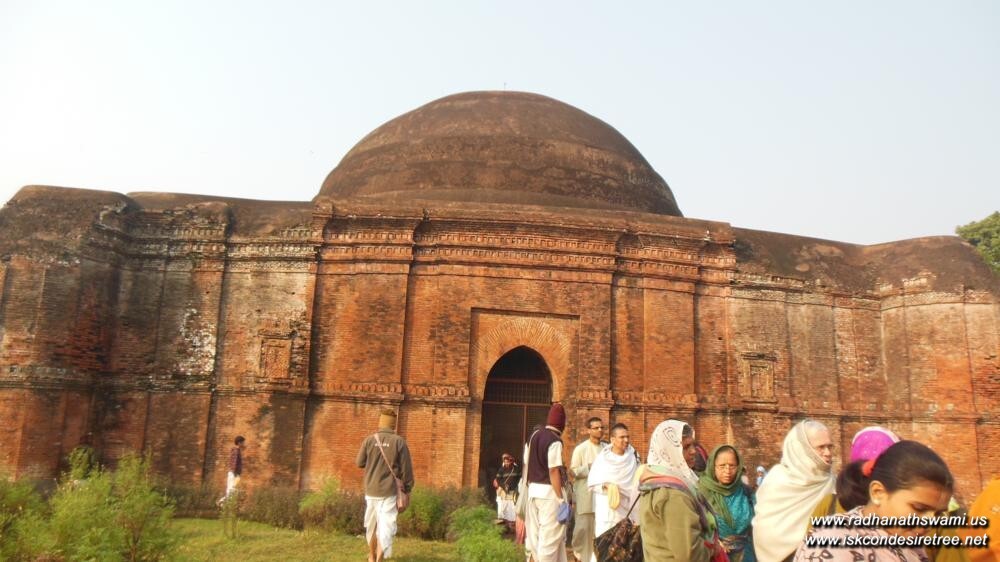
Sri Chaitanya Mahaprabhu arrived at the border village of Ramakeli while travelling from Bengal toward Vrindavana. The crowds that immediately gathered to see Him were so large that news of them reached Sultan Husain Shah himself. Sri Chaitanya-charitamrita records that the Sultan reacted with cautious respect, not alarm. He was told that a wandering man was attracting enormous public devotion without offering anyone money or favor. So he concluded that the man must be a genuine prophet, and he ordered his officials not to interfere. When the Sultan privately asked his secretary Dabira Khasa (Rupa, under his court name) what he thought, Rupa answered carefully. He turned the question back onto the Sultan's own judgment, because he did not want to risk showing where his own heart already stood.
| Detail | Description |
|---|---|
| Place | Ramakeli, on the border of Bengal |
| Time of meeting | Late at night, in secret |
| Rupa's court name at the time | Dabira Khasa |
| Sanatana's court name at the time | Sakara Mallika |
| Outcome | Both brothers renamed Rupa and Sanatana by Sri Chaitanya Mahaprabhu |
An Approach Made in the Dead of Night #
That same night, the two brothers decided between themselves to see Sri Chaitanya Mahaprabhu directly, but only in secret. They went first to Nityananda Prabhu and Haridasa Thakura to be introduced. When they finally stood before the Lord, both men placed straw between their teeth, a traditional sign of complete humility. They fell to the ground like rods, weeping. Their prayer is preserved at length in Sri Chaitanya-charitamrita. It is one of the harshest passages of self-blame in the whole book. They declared that they were lower than the sinners Jagai and Madhai, and unfit even to speak their own wrongs aloud. They called themselves servants of meat-eaters. Through years of court service, they said, they had made themselves enemies of cows and brahmanas.
New Names, Given at Once #
Sri Chaitanya Mahaprabhu's reply was completely different from what the two brothers, in their humility, were ready for. He did not scold them. He told Dabira Khasa and Sakara Mallika plainly that they were His own old servants, birth after birth. He said that their very letters, full of that same self-blame, had already revealed their hearts to Him. "From this day your names will be changed to Rupa and Sanatana," He said, placing His hands on their heads, and the two men, in turn, placed the Lord's feet on theirs. All the Vaishnavas gathered there, including Nityananda Prabhu, Haridasa Thakura, Srivasa Thakura and Gadadhara Pandita, called out the holy names of Hari to witness it.
A Crowd Too Large to Ignore #
The crowd that had first drawn the Sultan's attention was huge. Sri Chaitanya-charitamrita describes people gathering by the thousands at Ramakeli simply to see Sri Chaitanya Mahaprabhu pass. Some wept, some laughed, and some rolled on the ground calling out the name of Krishna. Wherever He touched the ground with His feet, devotees would gather up the dirt itself as something sacred. This, and not any political threat, is what had first reached Husain Shah's ears. He concluded that a man who could move so many people without offering anyone wealth or favor in return must be a genuine prophet. Sri Chaitanya-charitamrita presents this conclusion as sincere, not just politically careful. Against that background, Rupa and Sanatana chose to approach the Lord themselves, in secret and at night. They did not use any official channel open to men of their rank. This can be read as a sign that what they wanted from Him had nothing to do with politics at all.
A Warning Mahaprabhu Took Seriously #
Before the two brothers went back to their homes, they gave the Lord one more very practical piece of advice. They asked Him not to go on to Vrindavana followed by the enormous crowd then gathered around Him at Ramakeli. Their reason was that a Muslim ruler might tolerate a Hindu holy man in public, but it was unwise to test that tolerance carelessly with such numbers. Sri Chaitanya Mahaprabhu went on as far as Kanai Natashala, and that night He weighed their advice seriously. He decided to go to Vrindavana alone, or with at most one companion, not with the crowd that had followed Him until then. So the next morning He turned back toward Jagannatha Puri. When He later went to Vrindavana, He travelled through the Jharikhanda forest with only Balabhadra Bhattacharya and one servant. Sri Chaitanya-charitamrita presents this as evidence of how quickly the Lord had come to trust the judgment of His newly renamed servants. Rupa did not act at once on his own decision to leave court service, however. That longer and more difficult process took another year or more to complete. It is described in Renouncing Worldly Service.
