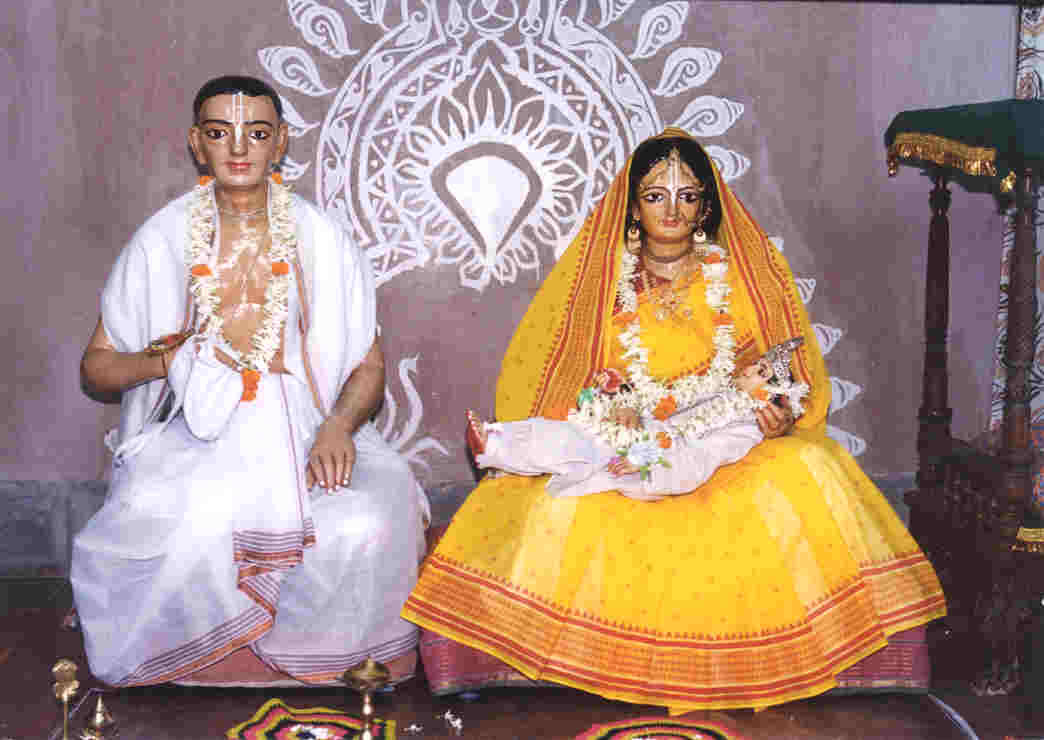
Sachi Devi's own story, in the sources that survive, begins the way most women's stories from fifteenth-century Bengal begin: with her father's name and her husband's arrival. She was the only daughter of Nilambara Chakravarti, a working astrologer and scholar settled in the Belapukuriya quarter of Navadwip, well enough known locally that Srila Prabhupada's own commentary on the Chaitanya-charitamrita records the neighbourhood's Muslim magistrate addressing him as "kaka," meaning "uncle." Nilambara had two sons besides her, Yogeshvara and Ratnagarbha, but Sachi was his only daughter, and it was to his house that a young brahmana from the far side of Bengal came to find a bride.
| Detail | Description |
|---|---|
| Father | Nilambara Chakravarti, astrologer and scholar of Navadwip |
| Father's neighbourhood | Belapukuriya (now Vamanapukura), Navadwip |
| Brothers | Yogeshvara and Ratnagarbha |
| Husband | Jagannatha Mishra, brahmana of Srihatta (Sylhet) |
| Home after marriage | Sridhama Mayapur, on the Ganges bank at Navadwip |
| Children | Ten in all; eight daughters died in infancy |
Jagannatha Mishra Arrives From Srihatta #
Sachi Devi's husband was not a Navadwip man by birth. Jagannatha Mishra's own father, Upendra Mishra, was a learned brahmana of Srihatta district in eastern Bengal, modern Sylhet. Like many ambitious young scholars of the period, Jagannatha travelled west to study at Navadwip. At that time Navadwip was the most famous centre of Sanskrit learning in all of Bengal. There he studied under Nilambara Chakravarti. In the ordinary way of a teacher-student household, he married the astrologer's only daughter. The couple settled on the Ganges bank in the quarter that would later be known as Sridhama Mayapur. They lived simply, as a learned but poor brahmana family. Within a generation, that household would become the most visited pilgrimage site in the Gaudiya Vaishnava world.
Eight Daughters Lost #
What followed was a long stretch of grief before any joy. Vaishnava biographers record that eight daughters were born to Sachi Devi, one after another, and that each died shortly after birth. No source says more about this than the bare fact. But the fact itself deserves a moment of thought. A young wife in a poor household buried eight children before any child of hers lived to see a second year. The Chaitanya-charitamrita does not treat this as a private sorrow separate from the larger story it is telling. Sachi Devi and Jagannatha Mishra responded to it with more devotion, not with despair. The Chaitanya-charitamrita treats this response as the first evidence of the kind of people they were.
Vishvarupa Restores The House #
The first child to survive was a son, Vishvarupa. He was a boy of striking beauty, and as he grew, he also became very serious. In time he would leave the household to accept sannyasa under the name Shankararanya, instead of accepting the marriage his parents were arranging for him. Krishnadasa Kaviraja records the couple's reaction to finally having a living son in plain words that a reader can easily pass over: "having gotten Vishvarupa as their son, the husband and wife became very pleased within their minds," and he adds that their joy did not turn into worldly self-satisfaction. It turned into deeper service at the feet of Govinda. It is a small verse, but it shows the difference the tradition wants to show between an ordinary pious household and this one. In this household, gain and loss produced the same result.
A Long-Awaited Second Son #
After Vishvarupa, and after what the biographies describe as a long gap, Sachi Devi conceived again. This time the pregnancy came with unusual signs. There were dreams, and remarks from visiting astrologers, that suggested the child would be unlike any before. The birth itself took place on the evening of the full moon of Phalguna in 1486, during a total lunar eclipse. At that very hour the whole of Navadwip stood in the Ganges chanting the holy names, as was the very old custom. That birth, its exact timing and what the tradition makes of it are told on Sri Chaitanya Mahaprabhu's own page, so they are not repeated here. This page looks at what it meant for Sachi Devi herself, after eight daughters and a long wait, to hold this particular son.
Two Names For One Newborn #
Her own father cast the horoscope. Nilambara Chakravarti read in it a prediction of unmatched greatness. He gave the child the name Vishvambhara, "one who maintains the entire universe," a name that Vaishnavas have always taken as more than a grandfather's ordinary hopes. The household name by which Bengal would know Him for the next twenty-four years came from someone else. Sita Thakurani, wife of Advaita Acharya at Shantipura, travelled to Mayapur with gifts when she heard of the birth. She named Him Nimai, after the nimba tree beside the house. The reasoning was that a name taken from a bitter tree would keep evil spirits from noticing Him. So, from the very first hours, Sachi Devi's own household was surrounded by exactly the devotees who would matter most to her for the rest of her life. This pattern continues through Mother of an Extraordinary Child, where her own direct experience of her son's earliest years is told in full.
A Neighbourhood Of Devotees #
Even before Nimai was born, Sachi Devi's circle of support was already close. The sources disagree on part of this, but it should still be recorded here. Some accounts place the family of Gadadhara Pandit a few doors from the Mishra house at Mayapur from before Gadadhara's birth. In these accounts his mother Ratnavati Devi was "on sisterly terms with Sachi Devi and constantly in and out of her house," and, as that page notes, this is the version that most Gaudiya Vaishnavas have in mind. But other accounts place Gadadhara's family in Chittagong until he was twelve. No one disputes that Malini Devi, wife of Srivasa Thakura, was a close friend of Sachi Devi's who helped nurse the infant Nimai. So, before her extraordinary son had said a single word, Sachi Devi's household was already part of the small circle of families around whom the entire sankirtana movement would soon form.
