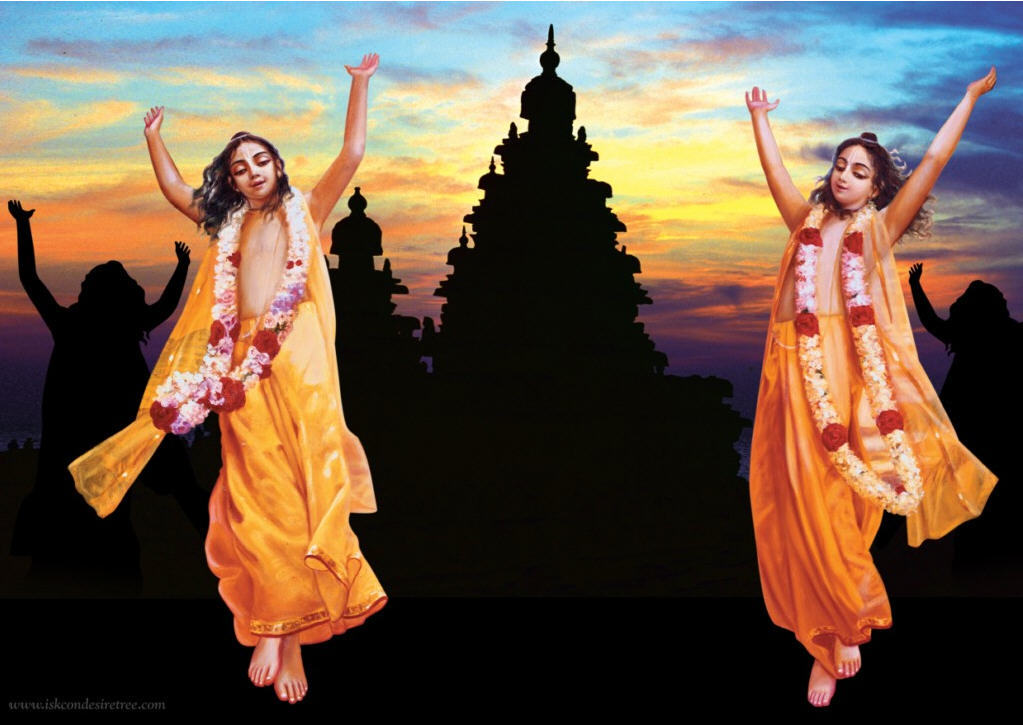
The earlier pages have told of the eight lost daughters, the crying that only the holy name would quiet, the widowhood, the two marriages, the vision of Krishna and Balarama, the grief at Katwa and the yearly cloth from Puri. All of this belongs within one further claim that Gaudiya Vaishnavism makes about Sachi Devi, and the tradition does not treat this claim as poetic exaggeration. The tradition holds that she is Yashoda. She is the same mother who raised Krishna Himself in Vrindavana, returned to raise Him again, in Navadwip, as Vishvambhara.
Krishnadasa Kaviraja's Own Words #
Later devotees did not simply work this out from her devotion. The Chaitanya-charitamrita itself states it openly, by name. Krishnadasa Kaviraja describes the eternal associates of Krishna's Vraja pastimes as they appear again around Mahaprabhu, and he writes plainly: "Father Nanda, the King of Vrajabhumi, is now Jagannatha Mishra, the father of Chaitanya Mahaprabhu. And mother Yashoda, the Queen of Vrajabhumi, is now Sachidevi, Lord Chaitanya's mother." The verse leaves no room for doubt, and the tradition has always read it in the same way. Jagannatha Mishra and Sachi Devi are not only devotees blessed with an extraordinary son. They are Nanda and Yashoda themselves, in another age and another body, doing again what they had already done once in Vraja.
Devoted Before She Ever Married #
Srila Prabhupada's own purport to a related verse takes the claim back even further, to before her marriage. He is commenting on Sachi Devi's overwhelmed maternal love at Shantipura. He writes that she "was born in the family of Nilambara Chakravarti" and "used to worship Lord Vishnu even before her marriage," and he adds that she is a nitya-siddha. A nitya-siddha is an eternally perfect soul who never actually falls from the Lord's service, however ordinary her outward life may look. "Mother Sachi," he writes, "a nitya-siddha living entity, is an incarnation of mother Yashoda. She appeared in the house of Nilambara Chakravarti and was everlastingly engaged in the service of Lord Vishnu. Later she directly had as her child Lord Vishnu, Sri Chaitanya Mahaprabhu, and she served Him from the day of His appearance." Her story elsewhere describes many acts of devotion: the invitation to the neighbourhood women to chant, the humility before Advaita Acharya, the cooking at Shantipura, the yearly patience for word from Puri. On this reading, none of these was ever a pious woman learning devotion from her extraordinary son. Each was Yashoda's own devotion, the same across two ages, showing itself again in a new setting.
A Fuller, More Contested Layer #
Bengali Vaishnava tradition, drawing on Kavi Karnapura's Gaura-ganoddesha-dipika, takes the identification even further. That further step is reported here with care. It is not presented as settled in the same way as the Chaitanya-charitamrita's own verse. According to that text, Nilambara Chakravarti himself was formerly Sumukha, the cowherd who was Yashoda's own father in Krishna's Vraja pastimes. Sachi Devi's mother was formerly Sumukha's wife, Patala Devi. So the identification is drawn back one more generation, to Sachi Devi's own parents. Some Vaishnava writers go further still. They hold that the demigods Aditi and Kashyapa, who had earlier appeared as the parents of Rama and Krishna in other ages, also entered the bodies of Sachi Devi and Jagannatha Mishra. They say that this alone explains how Balarama Himself could take birth as their son Vishvarupa. This last claim is kept here in the way the tradition itself keeps it. In Gaudiya History's own careful phrase, it is a theological explanation offered by "some devotees," not a point on which every source agrees, or one that any outside record could confirm.
One Of Four #
Within her own lifetime, this high theological position also gave her a very real social standing. Alongside Sita Thakurani, Vishnupriya Devi and Malini Devi, wife of Srivasa Thakura, Sachi Devi is remembered as one of four leading women Vaishnavas. During Mahaprabhu's lifetime the sankirtana movement singled out their devotion by name. It honoured them not only as wives and mothers of famous men, but as devotees whose spiritual standing the movement itself recognised. As Sita Thakurani's own page points out, this was very unusual for the period: a fifteenth-century Bengali religious movement that named four women, without any reservation, among the devotees whose example mattered most.
What Remains #
Sachi Devi left no writings, founded no institution, and has no samadhi site separately maintained in her own name the way some of Mahaprabhu's male associates do. Instead, her legacy lives in the place where her whole story began. The house at Mayapur where she gave birth to Vishvambhara during the lunar eclipse is marked today by the temple known as Yogapith. It is one of the most visited pilgrimage sites in the Gaudiya Vaishnava world. The anniversary of that birth, Gaura Purnima, is still the single most important festival in the Gaudiya calendar. Quite literally, this festival exists because Sachi Devi, after eight earlier losses, safely completed a difficult pregnancy and gave birth on a particular full-moon night in 1486. Every Gaudiya Vaishnava who observes Gaura Purnima is, whether the connection is spoken aloud or not, also keeping the anniversary of a night Sachi Devi lived through as a mother first and only afterward, if ever fully, as the tradition's own Yashoda returned.
