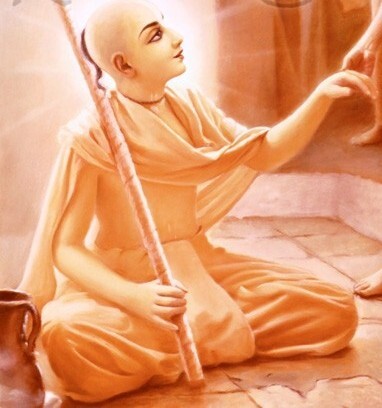
By the time Nimai was twenty-four, Sachi Devi had spent her life holding her household together. It had already come through a widowhood, two marriages and her son's public change into ecstatic devotion. But it had not yet faced losing Him completely. That is what the sannyasa took from her, in a single night, without warning.
An Offense Against Her Own Son's Order #
One episode from before His departure belongs here. It shows how fully even Sachi Devi's own conduct was now judged by the standard her son had set. As rumours spread that Nimai intended to take sannyasa, Sachi Devi, the Chaitanya-bhagavata records, "apparently showing her feminine nature," accused Advaita Acharya of encouraging her son toward renunciation. Mahaprabhu treated the accusation as an act of Vaishnava-aparadha, offense against a senior Vaishnava. He had His own mother touch Advaita Acharya's feet to make up for it. Krishnadasa Kaviraja is not embarrassed for her when he comments on the episode. He is almost envious: "A similar punishment was awarded to mother Sachidevi. Who could be more fortunate than she to receive such punishment?" The tradition does not read the whole exchange as a mother being scolded. It sees Mahaprabhu using His own household to teach, publicly and without exception, how seriously Vaishnava-aparadha must be taken, even when the offender is the woman who raised Him.
A Kirtana Movement She Watched From Close By #
In the months before the sannyasa, Sachi Devi did not watch her son's new life from a distance. At times Mahaprabhu's ecstatic states in Srivasa Thakura's courtyard grew violent as well as beautiful. Once He tore at His own chest as He cried out to reach the Krishna He felt hidden in His heart. Gadadhara Pandit was the one who could calm Him. Sachi Devi, watching, asked Gadadhara to stay always at her son's side. In practice Gadadhara did so for the next twenty-six years. It is a small request, but it shows a mother who had stopped trying to manage what her son had become. Instead, she made sure He was looked after by someone who could.
The Night He Left Without A Farewell #
Then, at Katwa, it happened. Nimai was convinced that His mission of freely distributing Krishna-prema to every soul could not fully succeed while He remained a grihastha protected by a brahmana's social standing. So He left home quietly at night and travelled from Navadwip to Katwa. He went in this way so that His mother and young wife would be spared the pain of watching Him go. There He accepted the sannyasa order from Keshava Bharati and became Sri Krishna Chaitanya. When word reached Navadwip, devotees led by Nityananda Prabhu hurried to Katwa. Back in Navadwip, Sachi Devi and Vishnupriya were told that Nimai had renounced the world without even a final goodbye. They were overcome with grief, and the biographies do not try to soften it. In a single night they had lost the son and husband on whom their whole home life had depended.
Brought To Shantipura By A Gentle Deception #
What happened next is among the most tender passages in the whole of Vaishnava literature. Nityananda Prabhu did not let the Lord, now newly a sannyasi, continue straight on toward Vrindavana. By what the tradition calls a gentle deception, Nityananda Prabhu arranged for Him to be brought instead to the western side of Shantipura. The Lord was in continuous ecstasy, and He was persuaded that the Ganges before Him was the Yamuna. While He worshipped the river, Advaita Acharya arrived by boat and took Him home. Word went to Navadwip, and Sachi Devi came. Krishnadasa Kaviraja records the reunion in a verse that is still just as moving after five centuries: "as soon as mother Sachi appeared, Chaitanya Mahaprabhu fell before her like a stick; mother Sachi began to cry, taking the Lord on her lap." In the days that followed, He would often fall to the ground in ecstasy, and each time Sachi Devi saw it happen, she wept. The Chaitanya-charitamrita says this plainly, twice, in verses one after the other, as if to stress it.
Cooking For A Son Who Was No Longer Hers Alone #
Sachi Devi stayed at Shantipura for several days. The household scenes that the Chaitanya-charitamrita preserves from that visit are surprisingly ordinary, after what had just happened. Sita Thakurani had cooked the meal that broke the sannyasi's three-day fast on His arrival. In the days that followed, Sachi Devi herself cooked for her son and for Nityananda Prabhu. The record says there was joking at the meal. There was laughter, even inside a grief that had not gone away. Prabhupada's own purport describes the vatsalya-prema Sachi Devi showed in these days as a transformation into "happiness, fear and humility" all at once. These are the ordinary words for a mother's love. But what had happened to her son pushed her love beyond what such words normally hold.
Her Request That Shaped Everything After #
According to the tradition that Gaudiya History preserves, it was during these days that Sachi Devi made the request that decided the rest of Sri Chaitanya Mahaprabhu's manifest life. She asked Him to settle at Nilachala, Jagannatha Puri, instead of going on into Vrindavana. Puri could be reached from Bengal by a journey of weeks, so His absence there would not mean losing Him for a lifetime. In Vrindavana she might never see or hear from Him again. Mahaprabhu honoured her request. He would spend His last eighteen years at Puri, not in Vrindavana. Across those years their bond was kept alive, not by being together, but by messages and prasadam sent across three hundred miles. What that decision meant for both of them is the subject of Life After Mahaprabhu's Departure.
