Srimati Sachi Devi
Mother of Sri Chaitanya Mahaprabhu
The complete life, on one page: The main biography and every pastime page, in order, in one place
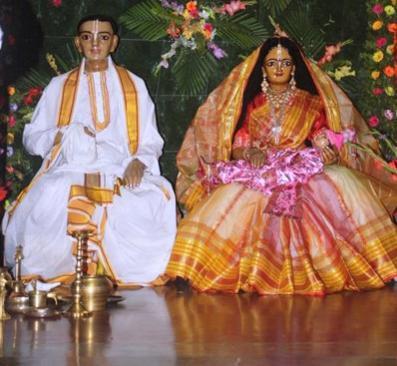
Introduction
Srimati Sachi Devi is remembered across the Gaudiya Vaishnava world simply as Sachi Mata, "mother Sachi," the wife of Jagannatha Mishra of Navadwip and the mother of Sri Chaitanya Mahaprabhu. No separate life story of her was ever written. Everything known about her comes from what her son's biographers wrote about their own subject, mainly the Chaitanya-bhagavata and Krishnadasa Kaviraja Goswami's Sri Chaitanya-charitamrita. It also comes from the household memories that later Bengali writers preserved. Even so, what survives is much more than a small note. Krishnadasa Kaviraja, in his own words, clearly identifies her with Yashoda, the mother who raised Krishna in Vrindavana. He gives long, tender passages of his book to her tears, her patience and her household devotion. He also tells of a single request of hers that decided where Sri Chaitanya Mahaprabhu would spend the last eighteen years of His manifest life.
| Detail | Description |
|---|---|
| Husband | Jagannatha Mishra, a brahmana of Sridhama Mayapur, originally of Srihatta |
| Father | Nilambara Chakravarti, astrologer and scholar of Navadwip |
| Children | Ten, of whom two sons lived to adulthood: Vishvarupa and Vishvambhara |
| Home | Sridhama Mayapur, on the bank of the Ganges at Navadwip |
| Identity | Mother Yashoda, Queen of Vraja and mother of Krishna (Chaitanya-charitamrita Adi 17.294; Gaura-ganoddesha-dipika 37) |
| Recognition | One of four leading women Vaishnavas of Mahaprabhu's own lifetime |
Scriptural evidence for the introduction (3)
সেই ব্রজেশ্বর—ইহঁ জগন্নাথ পিতা ।
সেই ব্রজেশ্বরী—ইহঁ শচীদেবী মাতা ॥ ২৯৪ ॥
sei vrajeśvara — ihaṅ jagannātha pitā
sei vrajeśvarī — ihaṅ śacīdevī mātā
Father Nanda, the King of Vrajabhūmi, is now Jagannātha Miśra, the father of Caitanya Mahāprabhu. And mother Yaśodā, the Queen of Vrajabhūmi, is now Śacīdevī, Lord Caitanya’s mother.
Krishnadasa Kaviraja Goswami's own statement that Yashoda, the Queen of Vraja, is now Sachi Devi, and Nanda is Jagannatha Mishra.
पुरा यशोदाव्रजराजनन्दौ
वृन्दावने प्रेमरसाकरौ यौ ।
शचीजगन्नाथपुरन्दराभिधौ
बभूवतुस्तौ न च संशयोऽत्र ॥
purā yaśodā-vrajarāja-nandau
vṛndāvane prema-rasākarau yau
śacī-jagannātha-purandarābhidhau
babhūvatus tau na ca saṁśayo’tra
Srimati Yasoda-devi and Vraja's king Nanda, who had been like two great oceans of the nectar of love for Krsna during the Lord's pastimes in Vrndavana, appeared during Lord Caitanya's pastimes as Srimati Saci-devi and Sriman Jagannatha Purandara. Of this there is no doubt.
Kavi Karnapura names Yashoda and Nanda as Sachi Devi and Jagannatha Mishra (Purandara) and says there is no doubt of it. Sanskrit: diacritic edition of the Gaura-ganoddesha-dipika; English translation as published at bvmlu.org.
এইমত শচীদেবী বাৎসল্যে বিহ্বল ।
হর্ষ-ভয়-দৈন্যভাবে হইল বিকল ॥ ১৬৭ ॥
ei-mata śacīdevī vātsalye vihvala
harṣa-bhaya-dainya-bhāve ha-ila vikala
When mother Śacī was thus overwhelmed in maternal love for Lord Caitanya Mahāprabhu, she became transformed with happiness, fear and humility, as well as bodily symptoms.
From the purport: Mother Śacī, a nitya-siddha living entity, is an incarnation of mother Yaśodā.
Srila Prabhupada's purport explains that Sachi Devi is a nitya-siddha, eternally perfect, associate who worshipped Lord Vishnu even before her marriage.
Chapter 1
Birth and Marriage to Jagannatha Mishra
How the only daughter of a Navadwip astrologer became, after eight lost daughters, the mother of Sri Chaitanya Mahaprabhu.
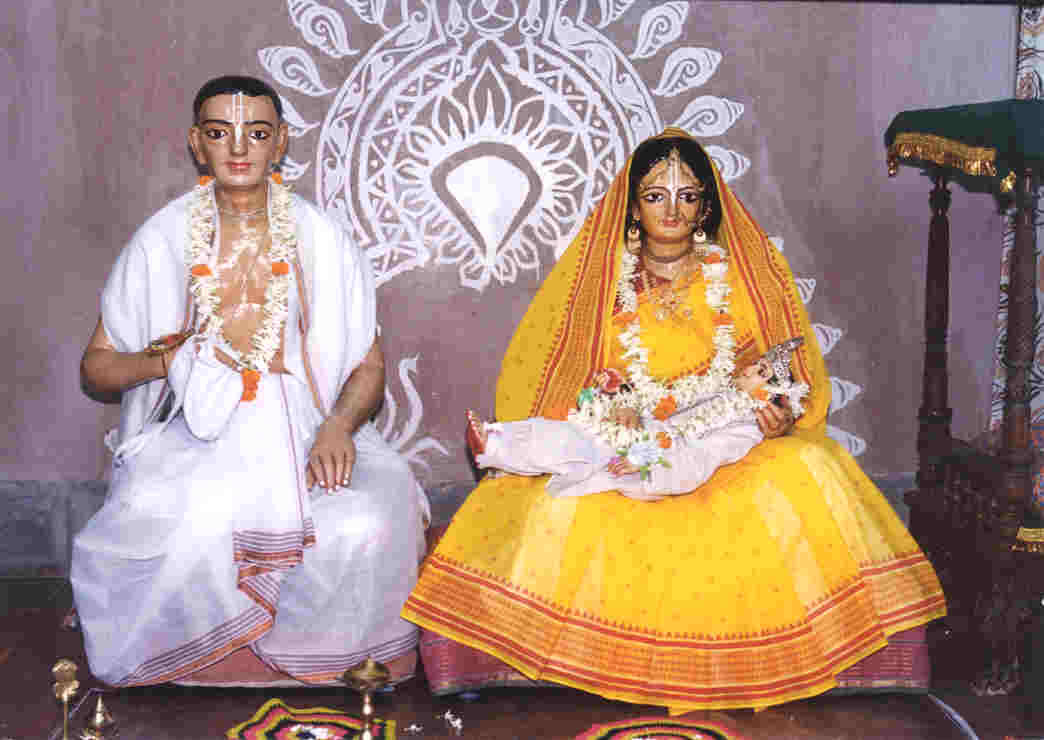
Sachi Devi's own story, in the sources that survive, begins the way most women's stories from fifteenth-century Bengal begin: with her father's name and her husband's arrival. She was the only daughter of Nilambara Chakravarti, a working astrologer and scholar settled in the Belapukuriya quarter of Navadwip, well enough known locally that Srila Prabhupada's own commentary on the Chaitanya-charitamrita records the neighbourhood's Muslim magistrate addressing him as "kaka," meaning "uncle." Nilambara had two sons besides her, Yogeshvara and Ratnagarbha, but Sachi was his only daughter, and it was to his house that a young brahmana from the far side of Bengal came to find a bride.
| Detail | Description |
|---|---|
| Father | Nilambara Chakravarti, astrologer and scholar of Navadwip |
| Father's neighbourhood | Belapukuriya (now Vamanapukura), Navadwip |
| Brothers | Yogeshvara and Ratnagarbha |
| Husband | Jagannatha Mishra, brahmana of Srihatta (Sylhet) |
| Home after marriage | Sridhama Mayapur, on the Ganges bank at Navadwip |
| Children | Ten in all; eight daughters died in infancy |
Jagannatha Mishra Arrives From Srihatta #
Sachi Devi's husband was not a Navadwip man by birth. Jagannatha Mishra's own father, Upendra Mishra, was a learned brahmana of Srihatta district in eastern Bengal, modern Sylhet. Like many ambitious young scholars of the period, Jagannatha travelled west to study at Navadwip. At that time Navadwip was the most famous centre of Sanskrit learning in all of Bengal. There he studied under Nilambara Chakravarti. In the ordinary way of a teacher-student household, he married the astrologer's only daughter. The couple settled on the Ganges bank in the quarter that would later be known as Sridhama Mayapur. They lived simply, as a learned but poor brahmana family. Within a generation, that household would become the most visited pilgrimage site in the Gaudiya Vaishnava world.
Eight Daughters Lost #
What followed was a long stretch of grief before any joy. Vaishnava biographers record that eight daughters were born to Sachi Devi, one after another, and that each died shortly after birth. No source says more about this than the bare fact. But the fact itself deserves a moment of thought. A young wife in a poor household buried eight children before any child of hers lived to see a second year. The Chaitanya-charitamrita does not treat this as a private sorrow separate from the larger story it is telling. Sachi Devi and Jagannatha Mishra responded to it with more devotion, not with despair. The Chaitanya-charitamrita treats this response as the first evidence of the kind of people they were.
Vishvarupa Restores The House #
The first child to survive was a son, Vishvarupa. He was a boy of striking beauty, and as he grew, he also became very serious. In time he would leave the household to accept sannyasa under the name Shankararanya, instead of accepting the marriage his parents were arranging for him. Krishnadasa Kaviraja records the couple's reaction to finally having a living son in plain words that a reader can easily pass over: "having gotten Vishvarupa as their son, the husband and wife became very pleased within their minds," and he adds that their joy did not turn into worldly self-satisfaction. It turned into deeper service at the feet of Govinda. It is a small verse, but it shows the difference the tradition wants to show between an ordinary pious household and this one. In this household, gain and loss produced the same result.
A Long-Awaited Second Son #
After Vishvarupa, and after what the biographies describe as a long gap, Sachi Devi conceived again. This time the pregnancy came with unusual signs. There were dreams, and remarks from visiting astrologers, that suggested the child would be unlike any before. The birth itself took place on the evening of the full moon of Phalguna in 1486, during a total lunar eclipse. At that very hour the whole of Navadwip stood in the Ganges chanting the holy names, as was the very old custom. That birth, its exact timing and what the tradition makes of it are told on Sri Chaitanya Mahaprabhu's own page, so they are not repeated here. This page looks at what it meant for Sachi Devi herself, after eight daughters and a long wait, to hold this particular son.
Two Names For One Newborn #
Her own father cast the horoscope. Nilambara Chakravarti read in it a prediction of unmatched greatness. He gave the child the name Vishvambhara, "one who maintains the entire universe," a name that Vaishnavas have always taken as more than a grandfather's ordinary hopes. The household name by which Bengal would know Him for the next twenty-four years came from someone else. Sita Thakurani, wife of Advaita Acharya at Shantipura, travelled to Mayapur with gifts when she heard of the birth. She named Him Nimai, after the nimba tree beside the house. The reasoning was that a name taken from a bitter tree would keep evil spirits from noticing Him. So, from the very first hours, Sachi Devi's own household was surrounded by exactly the devotees who would matter most to her for the rest of her life. This pattern continues through Mother of an Extraordinary Child, where her own direct experience of her son's earliest years is told in full.
A Neighbourhood Of Devotees #
Even before Nimai was born, Sachi Devi's circle of support was already close. The sources disagree on part of this, but it should still be recorded here. Some accounts place the family of Gadadhara Pandit a few doors from the Mishra house at Mayapur from before Gadadhara's birth. In these accounts his mother Ratnavati Devi was "on sisterly terms with Sachi Devi and constantly in and out of her house," and, as that page notes, this is the version that most Gaudiya Vaishnavas have in mind. But other accounts place Gadadhara's family in Chittagong until he was twelve. No one disputes that Malini Devi, wife of Srivasa Thakura, was a close friend of Sachi Devi's who helped nurse the infant Nimai. So, before her extraordinary son had said a single word, Sachi Devi's household was already part of the small circle of families around whom the entire sankirtana movement would soon form.
Scriptural evidence for this chapter (2)
tanra patni 'saci'-nama, pativrata sati
yanra pita 'nilambara' nama cakravarti
Word for word
tanra patni: his wife; saci-nama: named Saci; pati-vrata sati: a chaste woman devoted to her husband; yanra pita: whose father; nilambara nama cakravarti: named Nilambara Cakravarti
His wife, Srimati Sacidevi, was a chaste woman highly devoted to her husband. Sacidevi's father's name was Nilambara, and his surname was Cakravarti.
From the purport: Purport excerpt: "Nilambara Cakravarti lived at Navadvipa, in the neighborhood of Belapukuriya... the Kazi used to address Nilambara Cakravarti as kaka, or 'uncle.'"
Establishes Sachi Devi's father, the astrologer Nilambara Chakravarti, and the Navadwip neighbourhood where her side of the family was rooted.
putra pana dampati haila anandita mana
visese sevana kare govinda-carana
Word for word
putra pana: having gotten a son; dampati: husband and wife; haila anandita mana: became pleased within their minds; visese sevana kare: specifically render service; govinda-carana: to the lotus feet of Govinda
The husband and wife [Jagannatha Misra and Sacimata], having gotten Visvarupa as their son, were very pleased within their minds. Because of their pleasure, they specifically began to serve the lotus feet of Govinda.
From the purport: Purport excerpt: "The husband and wife...were very unhappy because their eight daughters had passed away... instead of forgetting the Lord, they became more and more adherent in rendering service to the lotus feet of Govinda."
Shows that Sachi Devi and Jagannatha Mishra met both the loss of eight daughters and the joy of Vishvarupa's birth with the same increase in devotion.
Chapter 2
Mother of an Extraordinary Child
The infancy and boyhood pastimes Sachi Devi witnessed at first hand, from the crying that only the holy name could quiet to a vision given to her alone.
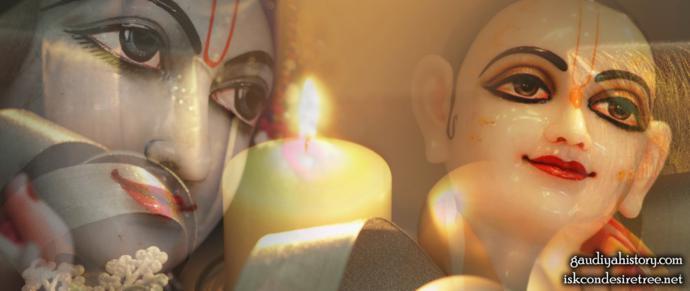
By its nature, no one else can check a mother's account of her own child's infancy. Even so, Sachi Devi's account is preserved in the Chaitanya-bhagavata, the Chaitanya-charitamrita and Locana Dasa Thakura's Chaitanya-mangala. It is kept in so much specific and matching detail that Gaudiya Vaishnavas have never treated it as ordinary parental memory. These sources do not describe a baby who was simply wonderful in a general way. They record a series of very particular incidents. Sachi Devi herself saw each of them at close range, and several of them only she could have reported to the biographers who came after her.
At A Glance #
- Her infant son's crying stopped only for the sound of the holy name, never for anything else she tried.
- She caught Him eating clay and received an answer too clever for a toddler to have invented.
- Sita Thakurani's visit to see the newborn ended with the naming that stuck for twenty-four years.
- She was given a private vision of heavenly glory, heard as flute-song. It came to her directly, not through someone else's report.
The Crying That Only Stopped For Hari #
Vaishnava biographers record that the infant Vishvambhara cried in His mother's arms and could not be comforted, sometimes for hours. Nothing quieted Him except the sound of neighbourhood women calling out "Haribol! Haribol!" (chant the name of Hari). Sachi Devi is said to have learned this quickly, and she made a practice of it. Whenever her son wept, she would gather the women of the neighbourhood to chant. The crying stopped the moment the holy names were chanted, as surely as any remedy she might otherwise have tried. This pastime is charming, and it is easy to miss what it asked of her. Through a mother's ordinary trial and error, and without being told, she discovered exactly what the rest of Bengal would spend the next twenty years learning directly from her son.
Clay, Cooking Pots, and an Answer Too Sharp For A Toddler #
As He grew into a toddler, Nimai gave His mother more usual kinds of trouble. She once found Him eating clay from the courtyard instead of the sweets she had left for Him. She scolded Him and demanded to know why. By the tradition's own telling, He answered that earth is used to make cooking pots, and cooking pots hold the food she gives Him, so He saw no real difference between the two. Whatever a reader thinks of the theology around Him, this exchange, as it is recorded, is the kind of small, specific thing that a mother remembers and keeps. It is not the kind of thing a devotee invents afterwards.
Two Thieves Undone By Their Own Greed #
On another occasion two travelling thieves saw the unusually beautiful golden child playing alone. They tried to lure Him away with sweets, meaning to steal the gold ornaments He wore. The stories tell that they became hopelessly lost, wandering in circles around Navadwip for hours. At last terror and regret forced them to bring the child safely back to His mother's door. Sachi Devi's role in the episode is simple. She is the person the frightened thieves finally had to face. But the episode belongs to the small set of childhood pastimes that the tradition treats as clear signs that this was no ordinary brahmana boy. Anyone in Navadwip who cared to notice could see these signs.
Sita Thakurani's Visit and the Name That Stuck #
Word of the birth reached Shantipura quickly. Sita Thakurani, wife of Advaita Acharya, came in person to see the child. She brought ornaments, cloth, turmeric, sandalwood and the kind of gifts one brings to a newborn. Gaudiya tradition holds that she recognised at once who this child was. She saw that, except for a difference in complexion, the child in Sachi Devi's arms was Krishna of Gokula Himself. Sita Thakurani named Him Nimai, after the nimba tree beside the house. She reasoned that a name taken from a bitter tree would protect Him from the notice of evil spirits. The name held for the next twenty-four years, and Bengal still uses it. For Sachi Devi, this meant that within days of giving birth, one of Navadwip's most respected Vaishnava households had already recognised, formally though quietly, exactly who she was raising.
A Vision Given To Her Directly #
Not every sign came through other people's recognition. The Chaitanya-bhagavata records an episode from later in Nimai's boyhood. Sachi Devi herself heard the sound of a flute and was shown something of her son's hidden glory. This came in her own experience, not through anyone's report to her. Vaishnava readers place this episode beside the sacred-thread ceremony and other formal rites of His boyhood. They take it as evidence that her devotion was never simply borrowed from what others told her about Him. A related moment, better recorded in the sources, came somewhat later. Sachi Devi dreamt that the household Deities of Krishna and Balarama had taken the forms of her own son and Nityananda Prabhu, fighting playfully over an offering, as children do. The next day she invited Nityananda to take prasadam in her house and watched the two of them eat together. In that ordinary household scene she recognised exactly what her dream had shown her, and she fainted where she stood. The Chaitanya-charitamrita records this plainly, without adding anything, as one more example of what her own eyes, not her son's later fame, had already told her.
Small Domestic Frictions #
Not every memory preserved of these years is dramatic. The biographies also keep smaller, more ordinary moments of tension. Once young Nimai was annoyed with His mother because she was slow in gathering items for a Ganges worship. On a gentler occasion, Sachi Devi kept Him from playing with a stray puppy. These details matter for the same reason the grander ones do. They show that, whatever else this household was, it was also an ordinary Bengali brahmana home in its daily life. An ordinary mother was raising an extraordinary child inside it. This daily life is explored further in Raising Nimai Pandita, as Nimai grows into a scholar and a householder.
Scriptural evidence for this chapter (1)
ekadina saci-devi putrere bhartsiya
dharibare gela, putra gela palaiya
Word for word
eka-dina: one day; saci-devi: mother Saci; putrere bhartsiya: rebuking her son; dharibare gela: went to catch Him; putra gela palaiya: the son went away running
One day mother Saci went to catch her son, wanting to rebuke Him, but He fled from the spot.
One verse from the cycle of chiding pastimes (the olahana-lila of Chaitanya-bhagavata) in which Sachi Devi tries, and fails, to discipline her mischievous son.
Chapter 3
Raising Nimai Pandita
Widowhood, two marriages arranged for her son, and the private vision that told Sachi Devi who Nimai really was before the rest of Navadwip understood.
Nearly two decades passed between the childhood pastimes told on their own page and the night Nimai finally left home for sannyasa. In those years Sachi Devi bore one grief after another. So far as the record shows, she never turned any of it against her son. This page follows those years from her side of the household. The scholarship and the debates belong to Sri Chaitanya Mahaprabhu's own pages. Here we look at what a mother watched happen to her family while that scholarship was being built.
| Detail | Description |
|---|---|
| Elder son | Vishvarupa, left home for sannyasa as Shankararanya |
| Husband | Jagannatha Mishra, died while Nimai was still a boy |
| First daughter-in-law | Lakshmipriya, died of a snakebite in Nimai's absence |
| Second daughter-in-law | Vishnupriya, married at Sachi Devi's own insistence |
| Turning point | Nimai's journey to Gaya and initiation by Ishvara Puri, c. 1508 |
Vishvarupa Leaves Without Warning #
The first of these griefs came from her elder son. Vishvarupa had grown into a young man of unusual detachment. Instead of accepting the marriage his parents were arranging for him, he left home and accepted sannyasa, taking the name Shankararanya. The Chaitanya-bhagavata does not pass quickly over the household's wailing at this departure. It gives it real attention. It also records that young Nimai afterwards comforted His mother with a promise that He would not do the same to her. Vaishnava readers have never been able to read this promise without also remembering what He would do at twenty-four. Some while later, Nimai fell unconscious one day. When He came back to His senses, He said that Vishvarupa had taken Him away and then sent Him back home with a message, asking that "hundreds and thousands of obeisances" be offered to his mother. Krishnadasa Kaviraja preserved this small detail. It suggests that the son who left never stopped thinking of the mother he left behind.
Widowed, With A Household To Keep #
The second grief was the death of Jagannatha Mishra while Nimai was still a boy. The family had never been wealthy, and now it was left in real difficulty. Sachi Devi, now a widow, had to keep the household running with little money. Meanwhile her surviving son continued His education, by this point largely on His own, from His father's books. Some years later Sachi Devi herself, not any male relative, arranged Nimai's first marriage. The bride was Lakshmipriya, daughter of Vallabhacharya of Navadwip. Sachi Devi arranged it after she saw her son and the girl meeting near the Ganges. By every account, the wedding was simple and entirely traditional. It was exactly what a widowed brahmani of limited means could manage for her only remaining son.
A Second Bereavement, A Second Marriage #
That marriage did not last. While Nimai was away teaching in East Bengal, Lakshmipriya died of a snakebite at home in Navadwip. Krishnadasa Kaviraja leaves the meaning of this death open, on purpose. Gaudiya commentators, for example, have long read it as the "serpent of separation," meaning she could not survive being parted from Him. Sachi Devi's own grief at this loss is recorded in the Chaitanya-mangala without softening. Once again it was Sachi Devi who insisted on a second marriage, this time to Vishnupriya, daughter of the raja-pandita Sanatana Mishra. This match was far above the widow's own circumstances. The tradition says that Nimai agreed to it out of respect for His mother, not from any wish of His own. Vishnupriya Devi's own life, from this marriage to the far longer story of what followed it, is told on her own pages.
Fear, Then Recognition #
The turning point in these years came when Nimai travelled to Gaya to perform His late father's memorial rites. He returned home a transformed man, after receiving initiation from the wandering sannyasi Ishvara Puri. He was weeping, fainting and dancing, constantly absorbed in the names of Krishna. Most people in Navadwip reacted in the obvious way. They thought a brilliant young scholar had suffered some kind of breakdown, whether from grief or from something worse. According to the account preserved at Gaudiya History, Sachi Devi's own first reaction was exactly this fear. She thought her son might be suffering a mental disorder and arranged for medical treatment. This should be recorded honestly, not smoothed over, because it is the most human moment in her entire story. Even Sachi Devi, so often described in the tradition as unshakeable, needed time to recognise what her son had become.
A Vision That Removed The Fear #
When that recognition finally came, it came through her own eyes, not because anyone persuaded her. Sachi Devi dreamt that the household Deities of Krishna and Balarama had taken the forms of her son and Nityananda Prabhu, wrestling playfully over an offering as children do. The next day she invited Nityananda to take prasadam at her house and watched the two of them eat side by side. In that ordinary scene she recognised exactly what her dream had shown her, and she fainted on the spot. The Chaitanya-charitamrita records this immediately before the story of Jagai and Madhai, the two drunken brothers Mahaprabhu delivered soon afterward. It is as though the household's own mother had to see the truth first, before the wider work of deliverance could begin. In a gentler moment, Nimai is also remembered telling His mother directly about a dream-vision of Krishna He had had. This is one of the few moments in the record where a private religious experience is shared by the son with the mother, not the other way round.
What These Years Established #
By the time Nimai stood at the head of Navadwip's sankirtana movement, His mother had already buried a husband and a daughter-in-law. She had said goodbye to one son for sannyasa and arranged two marriages for the other. She had feared for His sanity. And she had been shown exactly who He was, in a vision no one gave her but her own dreaming mind. None of it, the tradition insists, weakened her devotion or turned her against the path her sons had chosen. Instead, it built in her a particular kind of strength, which let her survive the much larger grief still to come. It was not the strength of someone who has simply given up. She was a mother who had already learned, little by little through smaller losses, how to keep loving what she could not keep.
Scriptural evidence for this chapter (1)
tabe saci dekhila, rama-krsna — dui bhai
tabe nistarila prabhu jagai-madhai
Word for word
tabe: thereafter; saci dekhila: mother Sacidevi saw; rama-krsna dui bhai: the two brothers Krsna and Balarama; tabe nistarila prabhu: then the Lord delivered; jagai-madhai: the two brothers Jagai and Madhai
Thereafter mother Sacidevi saw the brothers Krishna and Balarama in Their manifestation of Lord Chaitanya and Nityananda. Then the Lord delivered the two brothers Jagai and Madhai.
From the purport: Purport excerpt: "Sacidevi realized that They were none other than Krsna and Balarama. Seeing this, she fainted."
Records Sachi Devi's own dream and waking vision identifying her son and Nityananda Prabhu as Krishna and Balarama, a direct, personal realization, not devotion borrowed from others.
Chapter 4
The Sannyasa and a Mother's Grief
The night Mahaprabhu left home without warning, the reunion Nityananda Prabhu arranged at Shantipura, and the request that decided He would settle at Puri.
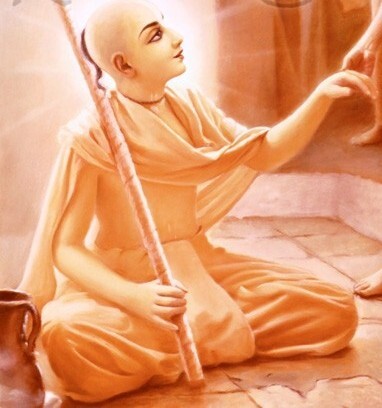
By the time Nimai was twenty-four, Sachi Devi had spent her life holding her household together. It had already come through a widowhood, two marriages and her son's public change into ecstatic devotion. But it had not yet faced losing Him completely. That is what the sannyasa took from her, in a single night, without warning.
An Offense Against Her Own Son's Order #
One episode from before His departure belongs here. It shows how fully even Sachi Devi's own conduct was now judged by the standard her son had set. As rumours spread that Nimai intended to take sannyasa, Sachi Devi, the Chaitanya-bhagavata records, "apparently showing her feminine nature," accused Advaita Acharya of encouraging her son toward renunciation. Mahaprabhu treated the accusation as an act of Vaishnava-aparadha, offense against a senior Vaishnava. He had His own mother touch Advaita Acharya's feet to make up for it. Krishnadasa Kaviraja is not embarrassed for her when he comments on the episode. He is almost envious: "A similar punishment was awarded to mother Sachidevi. Who could be more fortunate than she to receive such punishment?" The tradition does not read the whole exchange as a mother being scolded. It sees Mahaprabhu using His own household to teach, publicly and without exception, how seriously Vaishnava-aparadha must be taken, even when the offender is the woman who raised Him.
A Kirtana Movement She Watched From Close By #
In the months before the sannyasa, Sachi Devi did not watch her son's new life from a distance. At times Mahaprabhu's ecstatic states in Srivasa Thakura's courtyard grew violent as well as beautiful. Once He tore at His own chest as He cried out to reach the Krishna He felt hidden in His heart. Gadadhara Pandit was the one who could calm Him. Sachi Devi, watching, asked Gadadhara to stay always at her son's side. In practice Gadadhara did so for the next twenty-six years. It is a small request, but it shows a mother who had stopped trying to manage what her son had become. Instead, she made sure He was looked after by someone who could.
The Night He Left Without A Farewell #
Then, at Katwa, it happened. Nimai was convinced that His mission of freely distributing Krishna-prema to every soul could not fully succeed while He remained a grihastha protected by a brahmana's social standing. So He left home quietly at night and travelled from Navadwip to Katwa. He went in this way so that His mother and young wife would be spared the pain of watching Him go. There He accepted the sannyasa order from Keshava Bharati and became Sri Krishna Chaitanya. When word reached Navadwip, devotees led by Nityananda Prabhu hurried to Katwa. Back in Navadwip, Sachi Devi and Vishnupriya were told that Nimai had renounced the world without even a final goodbye. They were overcome with grief, and the biographies do not try to soften it. In a single night they had lost the son and husband on whom their whole home life had depended.
Brought To Shantipura By A Gentle Deception #
What happened next is among the most tender passages in the whole of Vaishnava literature. Nityananda Prabhu did not let the Lord, now newly a sannyasi, continue straight on toward Vrindavana. By what the tradition calls a gentle deception, Nityananda Prabhu arranged for Him to be brought instead to the western side of Shantipura. The Lord was in continuous ecstasy, and He was persuaded that the Ganges before Him was the Yamuna. While He worshipped the river, Advaita Acharya arrived by boat and took Him home. Word went to Navadwip, and Sachi Devi came. Krishnadasa Kaviraja records the reunion in a verse that is still just as moving after five centuries: "as soon as mother Sachi appeared, Chaitanya Mahaprabhu fell before her like a stick; mother Sachi began to cry, taking the Lord on her lap." In the days that followed, He would often fall to the ground in ecstasy, and each time Sachi Devi saw it happen, she wept. The Chaitanya-charitamrita says this plainly, twice, in verses one after the other, as if to stress it.
Cooking For A Son Who Was No Longer Hers Alone #
Sachi Devi stayed at Shantipura for several days. The household scenes that the Chaitanya-charitamrita preserves from that visit are surprisingly ordinary, after what had just happened. Sita Thakurani had cooked the meal that broke the sannyasi's three-day fast on His arrival. In the days that followed, Sachi Devi herself cooked for her son and for Nityananda Prabhu. The record says there was joking at the meal. There was laughter, even inside a grief that had not gone away. Prabhupada's own purport describes the vatsalya-prema Sachi Devi showed in these days as a transformation into "happiness, fear and humility" all at once. These are the ordinary words for a mother's love. But what had happened to her son pushed her love beyond what such words normally hold.
Her Request That Shaped Everything After #
According to the tradition that Gaudiya History preserves, it was during these days that Sachi Devi made the request that decided the rest of Sri Chaitanya Mahaprabhu's manifest life. She asked Him to settle at Nilachala, Jagannatha Puri, instead of going on into Vrindavana. Puri could be reached from Bengal by a journey of weeks, so His absence there would not mean losing Him for a lifetime. In Vrindavana she might never see or hear from Him again. Mahaprabhu honoured her request. He would spend His last eighteen years at Puri, not in Vrindavana. Across those years their bond was kept alive, not by being together, but by messages and prasadam sent across three hundred miles. What that decision meant for both of them is the subject of Life After Mahaprabhu's Departure.
Scriptural evidence for this chapter (2)
ye danda paila sri-saci bhagyavati
se danda prasada anya loka pabe kati
Word for word
ye danda paila: the punishment that was given; sri-saci bhagyavati: the most fortunate mother Sacidevi; se danda prasada: that same punishment as a favor; anya loka pabe kati: how could another person get it
"A similar punishment was awarded to mother Sacidevi. Who could be more fortunate than she to receive such punishment?"
From the purport: Purport excerpt: "Sacidevi...accused Advaita Prabhu of encouraging her son to become a sannyasi. Caitanya Mahaprabhu...asked Sacidevi to touch the lotus feet of Advaita Acarya to mitigate the offense."
Records the one occasion Mahaprabhu used His own mother as the example of how seriously Vaishnava-aparadha must be taken, having her seek Advaita Acharya's forgiveness.
saci-age padila prabhu dandavat hana
kandite lagila saci kole uthaina
Word for word
saci-age: in front of mother Saci; padila prabhu dandavat hana: the Lord fell down like a stick; kandite lagila saci: mother Saci began to cry; kole uthaina: taking Him on her lap
As soon as mother Saci appeared on the scene, Caitanya Mahaprabhu fell before her like a stick. Mother Saci began to cry, taking the Lord on her lap.
The reunion of Sachi Devi with her sannyasi son at Advaita Acharya's house in Shantipura, days after His sannyasa at Katwa.
Chapter 5
Life After Mahaprabhu's Departure
How Sachi Devi lived out her years at Navadwip, sustained by cloth and prasadam sent yearly from Puri and by a community that never stopped seeking her blessing.
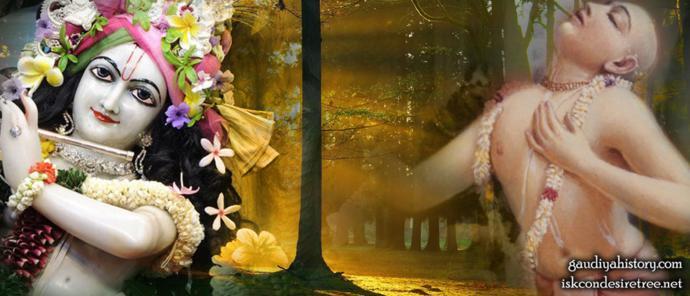
Sachi Devi lived at Navadwip for the rest of her own life, and her extraordinary son never again lived under her roof. But the record of the twenty-four years after His sannyasa does not show a household in permanent mourning. It shows a mother cared for, on purpose and again and again, by a son who never let three hundred miles make Him forget her.
| Detail | Description |
|---|---|
| Her home | Navadwip, throughout |
| Regular gifts from Puri | Cloth from the Jagannatha Deity and prasadam, sent annually |
| Chief messenger | Jagadananda Pandita, by the Lord's own order |
| Guests she received | Paramananda Puri and other Vaishnava sannyasis |
| Standing practice | Devotees took her permission before the yearly journey to Puri |
Prasadam and Cloth, Every Year, By The Lord's Own Order #
The clearest evidence of how Mahaprabhu kept His mother in mind is also the most concrete. The Chaitanya-charitamrita records that Jagadananda Pandita travelled to Navadwip "the previous year," by the Lord's own order, especially to see Sachi Devi. On arriving he "offered prayers at her lotus feet and then offered her the cloth and prasadam of Lord Jagannatha." This was not a single gesture. It was a regular arrangement. Cloth that had dressed the Deity and food that had been offered to Him were carried by hand across Bengal to Navadwip, year after year. In this way Sachi Devi could receive from her son's new life exactly the kind of real, practical care a mother values from any son living far from home. Antya-lila's twelfth chapter, "The Loving Dealings Between Lord Sri Chaitanya Mahaprabhu and Jagadananda Pandita," treats this errand as so important that Jagadananda's faithfulness to it becomes part of his own story, not only a detail of hers.
A House The Devotees Still Deferred To #
Her standing among the wider community of Bengali Vaishnavas did not become less once her son was gone. If anything, the record shows it more clearly, because it states it simply as something everyone accepted, without arguing for it. Every year the devotees of Bengal set out on their pilgrimage to the Ratha-yatra at Puri. Sri Chaitanya Mahaprabhu had started this journey especially so that He could meet all of them together once a year. The Chaitanya-charitamrita records that before setting out, "the devotees first saw Sacimata and took her permission." Only once she had given it did they set off, chanting the holy name in great happiness. In the eyes of a strict reading, a mother in her place might have had no public role left except quiet grief. Instead, an entire movement treated her as someone whose blessing was needed before its central yearly event could properly begin.
Talking Of Her Son, Day And Night #
Jagadananda Pandita did not simply deliver cloth and prasadam and then leave. The Chaitanya-charitamrita records that "Jagadananda Pandita and mother Sachi talked day and night about the happiness of Sri Chaitanya Mahaprabhu" during his stays in Navadwip. This picture deserves attention. It is one of the few moments in the entire record where Sachi Devi appears not weeping, not fainting and not overwhelmed. She is simply talking, at length, with someone who had just come from her son's actual daily life at Puri. Whatever grief shaped the rest of her life, these conversations suggest that by this time she could live with it and still ask ordinary questions: what He ate, how He seemed, who was with Him. These are the questions any mother asks about a child who has moved away.
Her House As A Place Vaishnavas Still Came To #
Sachi Devi's home remained more than a private house in mourning. The Chaitanya-charitamrita records that when Paramananda Puri travelled through Navadwip, "he took his board and lodging at the house of Sacimata. She provided him with everything very respectfully," and that it was while staying under her roof that he heard the news of Mahaprabhu's return to Jagannatha Puri and decided to go there himself. So a wandering Vaishnava sannyasi chose Sachi Devi's house as his place to stay while passing through Navadwip, and he was looked after there with clear respect. This is a small but telling sign. Her household had not simply survived her son's departure. In its own quieter way, it had kept the same reputation for hospitality to Vaishnavas that it had held when He was still there to fill it.
A Life Closed Without A Recorded Date #
The sources do not give any account of exactly when or how Sachi Devi's own life came to an end, and it is better to say so plainly than to invent an answer. The Chaitanya-charitamrita gives an entire chapter to the passing of Haridasa Thakura, with the day, the manner and the procession. The tradition says much less about the disappearance of Srivasa Thakura, but it at least places it at Kumarahatta. For Sachi Devi's own disappearance, no available verse gives a year, a place or a circumstance. We can honestly say that she remained at Navadwip for the rest of her natural life, supported by her son's yearly gifts and by the community's continuing respect. Vaishnava tradition has always seen her devotion in these final years as one with everything the rest of her life had already shown. Her grief was not resolved. It was absorbed into her daily practice. How that devotion is understood in theology, and what it had been all along, is the subject of Spiritual Identity and Legacy.
Scriptural evidence for this chapter (3)
purva-varse jagadananda 'ai' dekhibare
prabhu-ajna lana aila nadiya-nagare
aira carana yai' karila vandana
jagannathera vastra-prasada kaila nivedana
Word for word
purva-varse: the previous year; jagadananda ai dekhibare: Jagadananda Pandita to see Sacimata; prabhu-ajna lana: taking the Lord's order; aila nadiya-nagare: came to the city of Nadia; aira carana yai: going to Sacimata's lotus feet; karila vandana: offered prayers; jagannathera vastra-prasada: cloth and prasadam of Lord Jagannatha; kaila nivedana: offered
The previous year, Jagadananda Pandita, following the Lord's order, had returned to the city of Nadia to see Sacimata. When he arrived, he offered prayers at her lotus feet and then offered her the cloth and prasadam of Lord Jagannatha.
Documents the standing yearly arrangement by which Mahaprabhu sent cloth from the Jagannatha Deity and prasadam to His mother in Navadwip through Jagadananda Pandita.
sacimata dekhi' sabe tanra ajna lana
anande calila krsna-kirtana kariya
Word for word
sacimata dekhi: seeing Sacimata; sabe tanra ajna lana: all of them taking her permission; anande calila: they proceeded in great happiness; krsna-kirtana kariya: performing congregational chanting
The devotees first saw Sacimata and took her permission. Then in great happiness they started for Jagannatha Puri, congregationally chanting the holy name of the Lord.
Shows the respect in which Sachi Devi was held by the wider community of Bengali devotees, who would not leave for the annual Puri pilgrimage without her blessing.
ei-mata jagadananda sacimata-sane
caitanyera sukha-katha kahe ratri-dine
Word for word
ei-mata: in this way; jagadananda sacimata-sane: Jagadananda Pandita with mother Saci; caitanyera sukha-katha: words of Sri Chaitanya Mahaprabhu's happiness; kahe ratri-dine: speaks day and night
In this way, Jagadananda Pandita and mother Sachi talked day and night about the happiness of Sri Chaitanya Mahaprabhu.
A rare glimpse of Sachi Devi simply talking, at length and without grief foregrounded, about her son's daily life at Puri.
Chapter 6
Spiritual Identity and Legacy
Why Krishnadasa Kaviraja Goswami identifies Sachi Devi outright as Yashoda returned, and what that identity has meant for how the tradition remembers her.
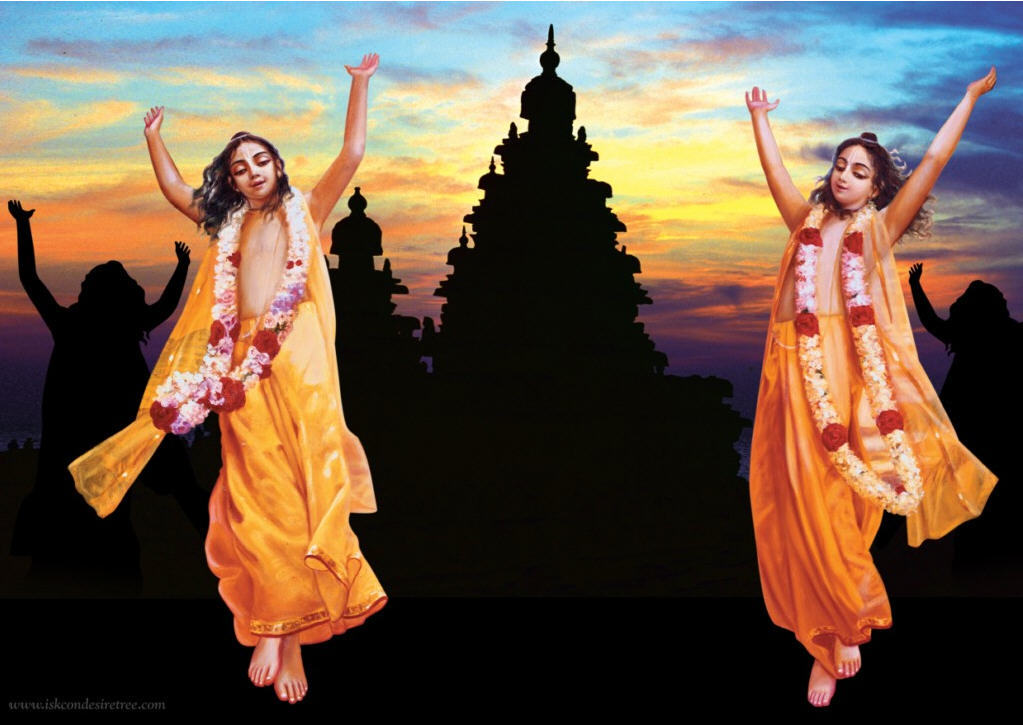
The earlier pages have told of the eight lost daughters, the crying that only the holy name would quiet, the widowhood, the two marriages, the vision of Krishna and Balarama, the grief at Katwa and the yearly cloth from Puri. All of this belongs within one further claim that Gaudiya Vaishnavism makes about Sachi Devi, and the tradition does not treat this claim as poetic exaggeration. The tradition holds that she is Yashoda. She is the same mother who raised Krishna Himself in Vrindavana, returned to raise Him again, in Navadwip, as Vishvambhara.
Krishnadasa Kaviraja's Own Words #
Later devotees did not simply work this out from her devotion. The Chaitanya-charitamrita itself states it openly, by name. Krishnadasa Kaviraja describes the eternal associates of Krishna's Vraja pastimes as they appear again around Mahaprabhu, and he writes plainly: "Father Nanda, the King of Vrajabhumi, is now Jagannatha Mishra, the father of Chaitanya Mahaprabhu. And mother Yashoda, the Queen of Vrajabhumi, is now Sachidevi, Lord Chaitanya's mother." The verse leaves no room for doubt, and the tradition has always read it in the same way. Jagannatha Mishra and Sachi Devi are not only devotees blessed with an extraordinary son. They are Nanda and Yashoda themselves, in another age and another body, doing again what they had already done once in Vraja.
Devoted Before She Ever Married #
Srila Prabhupada's own purport to a related verse takes the claim back even further, to before her marriage. He is commenting on Sachi Devi's overwhelmed maternal love at Shantipura. He writes that she "was born in the family of Nilambara Chakravarti" and "used to worship Lord Vishnu even before her marriage," and he adds that she is a nitya-siddha. A nitya-siddha is an eternally perfect soul who never actually falls from the Lord's service, however ordinary her outward life may look. "Mother Sachi," he writes, "a nitya-siddha living entity, is an incarnation of mother Yashoda. She appeared in the house of Nilambara Chakravarti and was everlastingly engaged in the service of Lord Vishnu. Later she directly had as her child Lord Vishnu, Sri Chaitanya Mahaprabhu, and she served Him from the day of His appearance." Her story elsewhere describes many acts of devotion: the invitation to the neighbourhood women to chant, the humility before Advaita Acharya, the cooking at Shantipura, the yearly patience for word from Puri. On this reading, none of these was ever a pious woman learning devotion from her extraordinary son. Each was Yashoda's own devotion, the same across two ages, showing itself again in a new setting.
A Fuller, More Contested Layer #
Bengali Vaishnava tradition, drawing on Kavi Karnapura's Gaura-ganoddesha-dipika, takes the identification even further. That further step is reported here with care. It is not presented as settled in the same way as the Chaitanya-charitamrita's own verse. According to that text, Nilambara Chakravarti himself was formerly Sumukha, the cowherd who was Yashoda's own father in Krishna's Vraja pastimes. Sachi Devi's mother was formerly Sumukha's wife, Patala Devi. So the identification is drawn back one more generation, to Sachi Devi's own parents. Some Vaishnava writers go further still. They hold that the demigods Aditi and Kashyapa, who had earlier appeared as the parents of Rama and Krishna in other ages, also entered the bodies of Sachi Devi and Jagannatha Mishra. They say that this alone explains how Balarama Himself could take birth as their son Vishvarupa. This last claim is kept here in the way the tradition itself keeps it. In Gaudiya History's own careful phrase, it is a theological explanation offered by "some devotees," not a point on which every source agrees, or one that any outside record could confirm.
One Of Four #
Within her own lifetime, this high theological position also gave her a very real social standing. Alongside Sita Thakurani, Vishnupriya Devi and Malini Devi, wife of Srivasa Thakura, Sachi Devi is remembered as one of four leading women Vaishnavas. During Mahaprabhu's lifetime the sankirtana movement singled out their devotion by name. It honoured them not only as wives and mothers of famous men, but as devotees whose spiritual standing the movement itself recognised. As Sita Thakurani's own page points out, this was very unusual for the period: a fifteenth-century Bengali religious movement that named four women, without any reservation, among the devotees whose example mattered most.
What Remains #
Sachi Devi left no writings, founded no institution, and has no samadhi site separately maintained in her own name the way some of Mahaprabhu's male associates do. Instead, her legacy lives in the place where her whole story began. The house at Mayapur where she gave birth to Vishvambhara during the lunar eclipse is marked today by the temple known as Yogapith. It is one of the most visited pilgrimage sites in the Gaudiya Vaishnava world. The anniversary of that birth, Gaura Purnima, is still the single most important festival in the Gaudiya calendar. Quite literally, this festival exists because Sachi Devi, after eight earlier losses, safely completed a difficult pregnancy and gave birth on a particular full-moon night in 1486. Every Gaudiya Vaishnava who observes Gaura Purnima is, whether the connection is spoken aloud or not, also keeping the anniversary of a night Sachi Devi lived through as a mother first and only afterward, if ever fully, as the tradition's own Yashoda returned.
Scriptural evidence for this chapter (2)
sei vrajesvara — ihan jagannatha pita
sei vrajesvari — ihan sacidevi mata
Word for word
sei vrajesvara: that King of Vraja; ihan jagannatha pita: is now Jagannatha Misra, the father; sei vrajesvari: that Queen of Vraja; ihan sacidevi mata: is now Sacidevi, the mother
Father Nanda, the King of Vrajabhumi, is now Jagannatha Misra, the father of Caitanya Mahaprabhu. And mother Yasoda, the Queen of Vrajabhumi, is now Sacidevi, Lord Caitanya's mother.
The direct textual identification, in Krishnadasa Kaviraja's own words, of Sachi Devi with Yashoda and Jagannatha Mishra with Nanda Maharaja.
ei-mata sacidevi vatsalye vihvala
harsa-bhaya-dainya-bhave ha-ila vikala
Word for word
ei-mata: in this way; sacidevi vatsalye vihvala: mother Saci overwhelmed in parental affection; harsa-bhaya-dainya-bhave: with happiness, fear and humility; ha-ila vikala: became transformed
When mother Saci was thus overwhelmed in maternal love for Lord Caitanya Mahaprabhu, she became transformed with happiness, fear and humility, as well as bodily symptoms.
From the purport: Purport excerpt: "Mother Saci, a nitya-siddha living entity, is an incarnation of mother Yasoda... she used to worship Lord Visnu even before her marriage."
Prabhupada's own purport stating outright that Sachi Devi is Yashoda returned, and that her devotion predates her marriage into the Chakravarti-Mishra household.
