Gaura Purnima 1486, a lunar eclipse, a town already chanting, and the golden child born on the bank of the Ganges
Sridhama Mayapur, Nabadwip · 18 February 1486
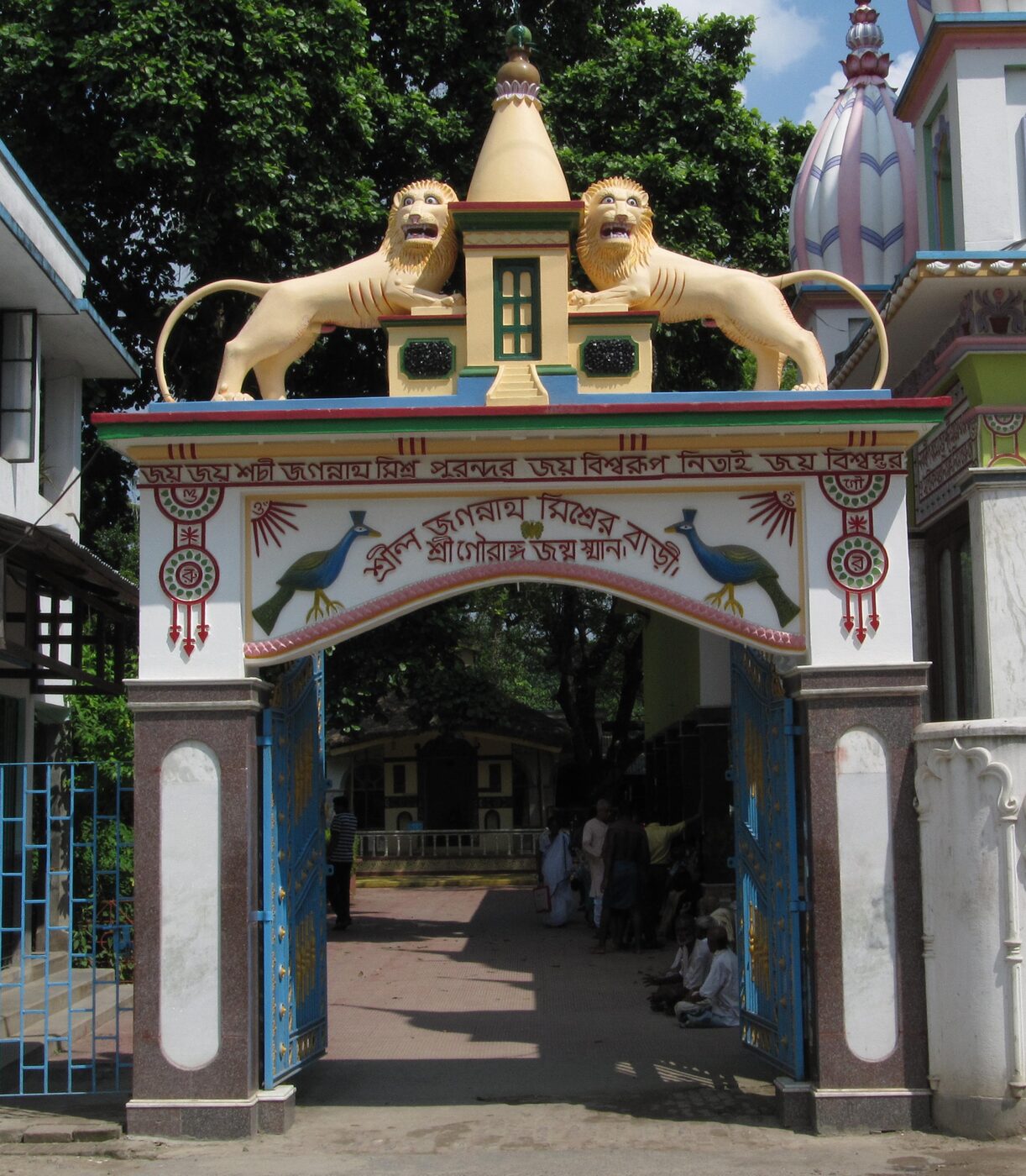
The claimed birthplace of Chaitanya Mahaprabhu in the Pracheen Mayapur area of Nabadwip, West Bengal - the courtyard and shrine building on the site.Wikimedia Commons · CC BY-SA 3.0
Reading tools
The family into which Sri Chaitanya Mahaprabhu was born had come to Nabadwip from elsewhere. His grandfather Upendra Mishra was a learned brahmana of the Srihatta district in eastern Bengal (modern Sylhet). Upendra Mishra's son Jagannatha Mishra travelled west to Nabadwip to continue his studies. At that time Nabadwip was the most famous centre of Sanskrit learning in Bengal. There Jagannatha Mishra studied under the astronomer and scholar Nilambara Chakravarti, and there he married Nilambara's daughter, Sachi Devi. The couple settled on the bank of the Ganges in the area now known as Sridhama Mayapur. They lived simply, as a learned but poor brahmana family.
Detail
Description
Date
18 February 1486; the full moon of Phalguna, Saka era 1407
Place
Sridhama Mayapur, on the bank of the Ganges at Nabadwip
Their married life was marked by repeated grief. Vaishnava biographers record that eight daughters were born to Sachi Devi before any child survived infancy. Each of them died shortly after birth. The first son to live was Vishvarupa, a boy of extraordinary beauty and seriousness. He would later leave home to accept the renounced order while still young. Then, after a long interval, Sachi Devi conceived again. The biographies describe how Jagannatha Mishra and his wife received signs that this child would be different from any that had come before. These signs came through dreams and through the words of visiting astrologers.
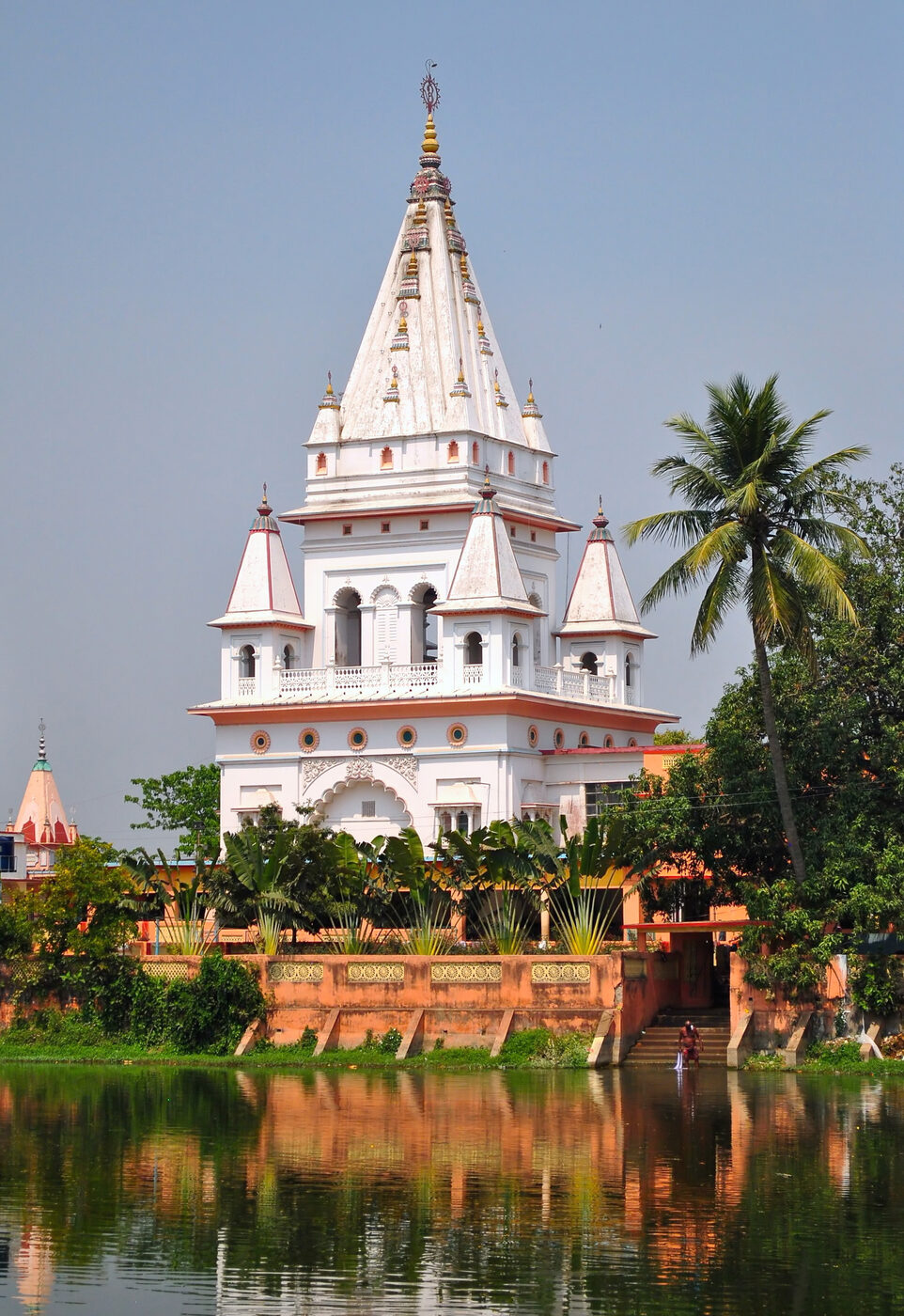
Sri Yogapith, the temple marking Chaitanya Mahaprabhu's birthplace at Mayapur, established in the 1880s by Bhaktivinoda Thakura - the temple facade and the neem tree courtyard.Wikimedia Commons · CC BY-SA 3.0
The birth took place on the evening of the full moon of the Bengali month of Phalguna. In the Saka era the year was 1407, and by the Western calendar the date was the eighteenth of February, 1486. Vaishnavas remember this moment especially because of something that happened at the same time. That evening there was a total lunar eclipse. By a very old custom, followers of Sanatana Dharma bathe in a sacred river during an eclipse and chant the names of God for purification. So the whole of Nabadwip was standing in the Ganges, calling out the holy names of Krishna. At that very hour, the child was born a few yards away on its bank. The tradition does not see this as an accident at all. It sees it as the first and clearest sign of what He had come to do. A whole town was chanting together, without being asked, at the moment the Lord of the sankirtana movement entered the world.
Nilambara Chakravarti, His maternal grandfather and a respected astrologer, drew up the child's horoscope. After reading it, he is said to have declared that this boy would become a teacher without equal, that His name would be honoured across the world, and that He would deliver countless souls. Nilambara Chakravarti gave Him the name Vishvambhara, "he who maintains the entire universe," a name with special meaning for Vaishnavas. They see in this choice a quiet sign that the grandfather recognised something far greater in this child than any grandparent usually hopes for.
Because a nimba tree stood beside the house where He was born, He was given the household name by which the whole of Nabadwip would know Him for the next twenty-four years: Nimai. The biographies say that the name was chosen by Sita Thakurani, the wife of Advaita Acharya. She came from Shantipura with gifts for the newborn. She chose the name of a bitter tree to protect Him from the notice of ghosts and witches. His golden complexion was unusual, and people often spoke about it. It gave Him the other names He carried through life: Gaurahari, Gauranga and Gaura, all built on the Sanskrit word for gold.
Gaudiya Vaishnava theology does not treat this birth as the arrival of an unusually gifted religious teacher who was later recognised as divine. It holds that Krishna Himself descended, and in a special and deliberate way. He did not come in His own original form and dark complexion. Instead, He took on the golden complexion of His own greatest devotee, Srimati Radharani. More importantly, He took on Radharani's interior emotional life. The Chaitanya-charitamrita explains the reason. Krishna wished to taste for Himself the sweetness of the love that Radharani feels for Him. By its very nature, this experience is not open to Him as the object of that love. At the same time, He wished to distribute that love freely to everyone, which He had not done in His previous descent. The verses in which this is set out are gathered below.
There is another part of the tradition that is dear to Bengali Vaishnavas. Advaita Acharya was an elderly and greatly respected Vaishnava of Shantipura. For years he had been troubled by the irreligion of the age. He had worshipped Krishna with Ganges water and tulasi leaves, calling on Him with great intensity to descend and rescue the people of Kali-yuga. Vaishnavas hold that the Lord agreed to appear in answer to Advaita Acharya's appeal. Advaita Acharya was far older than Mahaprabhu in years. Even so, he is counted among the Panca-tattva, as one of the five features of the Lord's own descent, because Chaitanya-charitamrita explains that he is not different from the Lord Himself.
Today the temple known as Yogapith marks the house at Mayapur where the birth took place. It is one of the main places of pilgrimage in the Gaudiya Vaishnava world. The anniversary of the day, Gaura Purnima, is the most important festival in the Gaudiya calendar. Devotees observe it by fasting until moonrise, by reading the accounts of His pastimes and by performing sankirtana.
kṛṣṇa-varṇaṁ tviṣākṛṣṇaṁ
sāṅgopāṅgāstra-pārṣadam
yajñaiḥ saṅkīrtana-prāyair
yajanti hi su-medhasaḥ
Word for word
kṛṣṇa-varṇam: repeating the syllables kṛṣ-ṇa; tviṣā: with a luster; akṛṣṇam: not black (golden); sa-aṅga: along with associates; upa-aṅga: servitors; astra: weapons; pārṣadam: confidential companions; yajñaiḥ: by sacrifice; saṅkīrtana-prāyaiḥ: consisting chiefly of congregational chanting; yajanti: they worship; hi: certainly; su-medhasaḥ: intelligent persons.
In the Age of Kali, intelligent persons perform congregational chanting to worship the incarnation of Godhead who constantly sings the names of Kṛṣṇa. Although His complexion is not blackish, He is Kṛṣṇa Himself. He is accompanied by His associates, servants, weapons and confidential companions.
From the purport: Purport excerpt: “Śrīla Jīva Gosvāmī has explained this verse in his commentary on the Bhāgavatam known as the Krama-sandarbha, wherein he says that Lord Kṛṣṇa also appears with a golden complexion. That golden Lord Kṛṣṇa is Lord Caitanya, who is worshiped by intelligent men in this age.”
itthaṁ nṛ-tiryag-ṛṣi-deva-jhaṣāvatārair
lokān vibhāvayasi haṁsi jagat pratīpān
dharmaṁ mahā-puruṣa pāsi yugānuvṛttaṁ
channaḥ kalau yad abhavas tri-yugo ’tha sa tvam
Word for word
ittham: in this way; nṛ: like a human being (such as Lord Kṛṣṇa and Lord Rāmacandra); tiryak: like animals (such as the boar); ṛṣi: as a great saint (Paraśurāma); deva: as demigods; jhaṣa: as an aquatic (such as the fish and tortoise); avatāraiḥ: by such different incarnations; lokān: all the different planetary systems; vibhāvayasi: You protect; haṁsi: You (sometimes) kill; jagat pratīpān: persons who have simply created trouble in this world; dharmam: the principles of religion; mahā-puruṣa: O great personality; pāsi: You protect; yuga-anuvṛttam: according to the different millenniums; channaḥ: covered; kalau: in the Age of Kali; yat: since; abhavaḥ: have been (and will be in the future); tri-yugaḥ: named Triyuga; atha: therefore; saḥ: the same personality; tvam: You.
In this way, my Lord, You appear in various incarnations as a human being, an animal, a great saint, a demigod, a fish or a tortoise, thus maintaining the entire creation in different planetary systems and killing the demoniac principles. According to the age, O my Lord, You protect the principles of religion. In the Age of Kali, however, You do not assert Yourself as the Supreme Personality of Godhead, and therefore You are known as Triyuga, or the Lord who appears in three yugas.
From the purport: Purport excerpt: “In all the yugas but Kali-yuga, the Lord appears in various incarnations and asserts Himself as the Supreme Personality of Godhead, but although Lord Śrī Caitanya Mahāprabhu, who appears in Kali-yuga, is the Supreme Personality of Godhead, He never asserted Himself as such.”
āsan varṇās trayo hy asya
gṛhṇato ’nuyugaṁ tanūḥ
śuklo raktas tathā pīta
idānīṁ kṛṣṇatāṁ gataḥ
Word for word
āsan: were assumed; varṇāḥ trayaḥ: three colors; hi: indeed; asya: of your son Kṛṣṇa; gṛhṇataḥ: accepting; anuyugam tanūḥ: transcendental bodies according to the different yugas; śuklaḥ: sometimes white; raktaḥ: sometimes red; tathā: as well as; pītaḥ: sometimes yellow; idānīm kṛṣṇatām gataḥ: at the present moment He has assumed a blackish color.
Your son Kṛṣṇa appears as an incarnation in every millennium. In the past, He assumed three different colors — white, red and yellow — and now He has appeared in a blackish color. [In another Dvāpara-yuga, He appeared (as Lord Rāmacandra) in the color of śuka, a parrot. All such incarnations have now assembled in Kṛṣṇa.]
yuga-dharma: the religion of the age; pravartāimu: I shall inaugurate; nāma-saṅkīrtana: chanting of the holy name; cāri: four; bhāva: of the moods; bhakti: devotion; diyā: giving; nācāmu: I shall cause to dance; bhuvana: the world.
“I shall personally inaugurate the religion of the age — nāma-saṅkīrtana, the congregational chanting of the holy name. I shall make the world dance in ecstasy, realizing the four mellows of loving devotional service.
āpani: personally; karimu: I shall make; bhakta-bhāva: the position of a devotee; aṅgīkāre: acceptance; āpani: personally; ācari’: practicing; bhakti: devotional service; śikhāimu: I shall teach; sabāre: to all.
“I shall accept the role of a devotee, and I shall teach devotional service by practicing it Myself.
He will descend in the role of a devotee and teach devotional service by practising it Himself.
আপনে না কৈলে ধর্ম শিখান না যায় ।
এই ত’ সিদ্ধান্ত গীতা–ভাগবতে গায় ॥ ২১ ॥
āpane nā kaile dharma śikhāna nā yāya
ei ta’ siddhānta gītā-bhāgavate gāya
Word for word
āpane: personally; nā kaile: if not practiced; dharma: religion; śikhāna: the teaching; nā yāya: does not advance; ei: this; ta’: certainly; siddhānta: conclusion; gītā: in the Bhagavad-gītā; bhāgavate: in Śrīmad-Bhāgavatam; gāya: they sing.
“Unless one practices devotional service himself, he cannot teach it to others. This conclusion is indeed confirmed throughout the Gītā and Bhāgavatam.
Establishes the principle that a teacher of bhakti must practise it, explaining why Krishna comes as a devotee.
যুগধর্ম–প্রবর্তন হয় অংশ হৈতে ।
আমা বিনা অন্যে নারে ব্রজপ্রেম দিতে ॥ ২৬ ॥
yuga-dharma-pravartana haya aṁśa haite
āmā vinā anye nāre vraja-prema dite
Word for word
yuga-dharma: of the religion of the age; pravartana: the inauguration; haya: is; aṁśa: the plenary portion; haite: from; āmā: for Me; vinā: except; anye: another; nāre: is not able; vraja-prema: love like that of the residents of Vraja; dite: to bestow.
“My plenary portions can establish the principles of religion for each age. No one but Me, however, can bestow the kind of loving service performed by the residents of Vraja.
santv avatārā bahavaḥ paṅkaja-nābhasya sarvato-bhadrāḥ
kṛṣṇād anyaḥ ko vā latāsv api prema-do bhavati
Word for word
santu: let there be; avatārāḥ: incarnations; bahavaḥ: many; paṅkaja-nābhasya: of the Lord, from whose navel grows a lotus flower; sarvataḥ-bhadrāḥ: completely auspicious; kṛṣṇāt: than Lord Kṛṣṇa; anyaḥ: other; kaḥ vā: who possibly; latāsu: on the surrendered souls; api: also; prema-daḥ: the bestower of love; bhavati: is.
“ ‘There may be many all-auspicious incarnations of the Personality of Godhead, but who other than Lord Śrī Kṛṣṇa can bestow love of God upon the surrendered souls?’
tāhāte: in that; āpana: My own; bhakta-gaṇa: with devotees; kari’: doing; saṅge: in association; pṛthivīte: on the earth; avatari’: descending; karimu: I shall perform; nānā: various; raṅge: colorful pastimes.
“Therefore in the company of My devotees I shall appear on earth and perform various colorful pastimes.”
Krishna resolves to appear together with His devotees and perform colourful pastimes on earth.
শেষলীলায় ধরে নাম ‘শ্রীকৃষ্ণচৈতন্য’ ।
শ্রীকৃষ্ণ জানায়ে সব বিশ্ব কৈল ধন্য ॥ ৩৪ ॥
śeṣa-līlāya dhare nāma ‘śrī-kṛṣṇa-caitanya’
śrī-kṛṣṇa jānāye saba viśva kaila dhanya
Word for word
śeṣa-līlāya: in His final pastimes; dhare: He held; nāma: the name; śrī-kṛṣṇa-caitanya: Śrī Kṛṣṇa Caitanya; śrī-kṛṣṇa: about Lord Kṛṣṇa; jānāye: He taught; saba: all; viśva: the world; kaila: made; dhanya: fortunate.
In His later pastimes He is known as Lord Śrī Kṛṣṇa Caitanya. He blesses the whole world by teaching about the name and fame of Lord Śrī Kṛṣṇa.
suvarṇa: of gold; varṇaḥ: having the color; hema-aṅgaḥ: whose body was like molten gold; vara-aṅgaḥ: having a most beautiful body; candana-aṅgadī: whose body was smeared with sandalwood; sannyāsa-kṛt: practicing the renounced order of life; śamaḥ: equipoised; śāntaḥ: peaceful; niṣṭhā: devotion; śānti: and of peace; parāyaṇaḥ: the highest resort.
“In His early pastimes He appears as a householder with a golden complexion. His limbs are beautiful, and His body, smeared with the pulp of sandalwood, seems like molten gold. In His later pastimes He accepts the sannyāsa order, and He is equipoised and peaceful. He is the highest abode of peace and devotion, for He silences the impersonalist nondevotees.”
suvarṇa-varṇaḥ: whose complexion is like gold; hema-aṅgaḥ: having a body like molten gold; vara-aṅgaḥ: whose body is very beautifully constructed; candana-aṅgadī: smeared with the pulp of sandalwood; sannyāsa-kṛt: accepting the renounced order of life; śamaḥ: self-controlled; śāntaḥ: peaceful; niṣṭhā: firmly fixed; śānti: bringing peace by propagating the Hare Kṛṣṇa mahā-mantra; parāyaṇaḥ: always in the ecstatic mood of devotional service.
“ ‘The Lord [in the incarnation of Gaurasundara] has a golden complexion. Indeed, His entire body, which is very nicely constituted, is like molten gold. Sandalwood pulp is smeared all over His body. He will take the fourth order of spiritual life [sannyāsa] and will be very much self-controlled. He will be distinguished from Māyāvādī sannyāsīs in that He will be fixed in devotional service and will spread the saṅkīrtana movement.’ ”
vyakta: evident; kari’: making; bhāgavate: in Śrīmad-Bhāgavatam; kahe: they say; bāra bāra: time and time again; kali-yuge: in the Age of Kali; dharma: the religion; nāma-saṅkīrtana: congregational chanting of the holy name; sāra: the essence.
In Śrīmad-Bhāgavatam it is repeatedly and clearly said that the essence of religion in the Age of Kali is the chanting of the holy name of Kṛṣṇa.
iti dvāpara urv-īśa
stuvanti jagad-īśvaram
nānā-tantra-vidhānena
kalāv api yathā śṛṇu
Word for word
iti: thus; dvāpare: in the Dvāpara Age; uru-īśa: O King; stuvanti: they praise; jagat-īśvaram: the Lord of the universe; nānā: various; tantra: of scriptures; vidhānena: by the regulations; kalau: in the Age of Kali; api: also; yathā: in which manner; śṛṇu: please hear.
“O King, in this way people in Dvāpara-yuga worshiped the Lord of the universe. In Kali-yuga they also worship the Supreme Personality of Godhead by the regulations of the revealed scriptures. Kindly now hear of that from me.
kṛṣṇa-varṇaṁ tviṣākṛṣṇaṁ
sāṅgopāṅgāstra-pārṣadam
yajñaiḥ saṅkīrtana-prāyair
yajanti hi su-medhasaḥ
Word for word
kṛṣṇa-varṇam: repeating the syllables kṛṣ-ṇa; tviṣā: with a luster; akṛṣṇam: not black (golden); sa-aṅga: along with associates; upāṅga: servitors; astra: weapons; pārṣadam: confidential companions; yajñaiḥ: by sacrifice; saṅkīrtana-prāyaiḥ: consisting chiefly of congregational chanting; yajanti: they worship; hi: certainly; su-medhasaḥ: intelligent persons.
“In the Age of Kali, intelligent persons perform congregational chanting to worship the incarnation of Godhead who constantly sings the name of Kṛṣṇa. Although His complexion is not blackish, He is Kṛṣṇa Himself. He is accompanied by His associates, servants, weapons and confidential companions.”
anarpita: not bestowed; carīm: having been formerly; cirāt: for a long time; karuṇayā: by causeless mercy; avatīrṇaḥ: descended; kalau: in the Age of Kali; samarpayitum: to bestow; unnata: elevated; ujjvala-rasām: the conjugal mellow; sva-bhakti: of His own service; śriyam: the treasure; hariḥ: the Supreme Lord; puraṭa: than gold; sundara: more beautiful; dyuti: of splendor; kadamba: with a multitude; sandīpitaḥ: lighted up; sadā: always; hṛdaya-kandare: in the cavity of the heart; sphuratu: let Him be manifest; vaḥ: your; śacī-nandanaḥ: the son of mother Śacī.
May the Supreme Lord who is known as the son of Śrīmatī Śacī-devī be transcendentally situated in the innermost chambers of your heart. Resplendent with the radiance of molten gold, He has appeared in the Age of Kali by His causeless mercy to bestow what no incarnation has ever offered before: the most sublime and radiant mellow of devotional service, the mellow of conjugal love.
rādhā: Śrīmatī Rādhārāṇī; kṛṣṇa: of Lord Kṛṣṇa; praṇaya: of love; vikṛtiḥ: the transformation; hlādinī śaktiḥ: pleasure potency; asmāt: from this; eka-ātmānau: both the same in identity; api: although; bhuvi: on earth; purā: formerly; deha-bhedam: separate forms; gatau: obtained; tau: those two; caitanya-ākhyam: known as Śrī Caitanya; prakaṭam: manifest; adhunā: now; tat-dvayam: the two of Them; ca: and; aikyam: unity; āptam: obtained; rādhā: of Śrīmatī Rādhārāṇī; bhāva: mood; dyuti: the luster; su-valitam: who is adorned with; naumi: I offer my obeisances; kṛṣṇa-svarūpam: to Him who is identical with Śrī Kṛṣṇa.
The loving affairs of Śrī Rādhā and Kṛṣṇa are transcendental manifestations of the Lord’s internal pleasure-giving potency. Although Rādhā and Kṛṣṇa are one in Their identity, previously They separated Themselves. Now these two transcendental identities have again united, in the form of Śrī Kṛṣṇa Caitanya. I bow down to Him, who has manifested Himself with the sentiment and complexion of Śrīmatī Rādhārāṇī although He is Kṛṣṇa Himself.
śrī-rādhāyāḥ: of Śrīmatī Rādhārāṇī; praṇaya-mahimā: the greatness of the love; kīdṛśaḥ: of what kind; vā: or; anayā: by this one (Rādhā); eva: alone; āsvādyaḥ: to be relished; yena: by that love; adbhuta-madhurimā: the wonderful sweetness; kīdṛśaḥ: of what kind; vā: or; madīyaḥ: of Me; saukhyam: the happiness; ca: and; asyāḥ: Her; mat-anubhavataḥ: from realization of My sweetness; kīdṛśam: of what kind; vā: or; iti: thus; lobhāt: from the desire; tat: Her; bhāva-āḍhyaḥ: richly endowed with emotions; samajani: took birth; śacī-garbha: of the womb of Śrīmatī Śacī-devī; sindhau: in the ocean; hari: Lord Kṛṣṇa; induḥ: like the moon.
Desiring to understand the glory of Rādhārāṇī’s love, the wonderful qualities in Him that She alone relishes through Her love, and the happiness She feels when She realizes the sweetness of His love, the Supreme Lord Hari, richly endowed with Her emotions, appeared from the womb of Śrīmatī Śacī-devī, as the moon appeared from the ocean.
States the three internal desires of Krishna that caused Him to appear as the son of Saci.
প্রেমরস–নির্যাস করিতে আস্বাদন ।
রাগমার্গ ভক্তি লোকে করিতে প্রচারণ ॥ ১৫ ॥
রসিক–শেখর কৃষ্ণ পরমকরুণ ।
এই দুই হেতু হৈতে ইচ্ছার উদ্গম ॥ ১৬ ॥
prema-rasa-niryāsa karite āsvādana
rāga-mārga bhakti loke karite pracāraṇa
rasika-śekhara kṛṣṇa parama-karuṇa
ei dui hetu haite icchāra udgama
Word for word
prema-rasa: of the mellow of love of God; niryāsa: the essence; karite: to do; āsvādana: tasting; rāga-mārga: the path of spontaneous attraction; bhakti: devotional service; loke: in the world; karite: to do; pracāraṇa: propagation; rasika-śekhara: the supremely jubilant; kṛṣṇa: Lord Kṛṣṇa; parama-karuṇa: the most merciful; ei: these; dui: two; hetu: reasons; haite: from; icchāra: of desire; udgama: the birth.
The Lord’s desire to appear was born from two reasons: the Lord wanted to taste the sweet essence of the mellows of love of God, and He wanted to propagate devotional service in the world on the platform of spontaneous attraction. Thus He is known as supremely jubilant and as the most merciful of all.
The two reasons for His advent: to taste the mellows of love Himself and to propagate raganuga-bhakti.
অতএব সেই ভাব অঙ্গীকার করি’ ।
সাধিলেন নিজ বাঞ্ছা গৌরাঙ্গ–শ্রীহরি ॥ ৫০ ॥
ataeva sei bhāva aṅgīkāra kari’
sādhilena nija vāñchā gaurāṅga-śrī-hari
Word for word
ataeva: therefore; sei bhāva: that mood; aṅgīkāra kari’: accepting; sādhilena: fulfilled; nija: His own; vāñchā: desire; gaurāṅga: Lord Caitanya Mahāprabhu; śrī-hari: the Supreme Personality of Godhead.
Therefore Lord Gaurāṅga, who is Śrī Hari Himself, accepted the sentiments of Rādhā and thus fulfilled His own desires.
sureśānāṁ durgaṁ gatir atiśayenopaniṣadāṁ
munīnāṁ sarva-svaṁ praṇata-paṭalīnāṁ madhurimā
viniryāsaḥ premṇo nikhila-paśu-pālāmbuja-dṛśāṁ
sa caitanyaḥ kiṁ me punar api dṛśor yāsyati padam
Word for word
sura-īśānām: of the kings of the demigods; durgam: fortress; gatiḥ: the goal; atiśayena: eminently; upaniṣadām: of the Upaniṣads; munīnām: of the sages; sarva-svam: the be-all and end-all; praṇata-paṭalīnām: of the groups of the devotees; madhurimā: the sweetness; viniryāsaḥ: the essence; premṇaḥ: of love; nikhila: all; paśu-pālā: of the cowherd women; ambuja-dṛśām: lotus-eyed; saḥ: He; caitanyaḥ: Lord Caitanya; kim: what; me: my; punaḥ: again; api: certainly; dṛśoḥ: of the two eyes; yāsyati: will come; padam: to the abode.
“Lord Caitanya is the shelter of the demigods, the goal of the Upaniṣads, the be-all and end-all of the great sages, the beautiful shelter of His devotees, and the essence of the love of the lotus-eyed gopīs. Will He again be the object of my vision?”
apāraṁ kasyāpi praṇayi-jana-vṛndasya kutukī
rasa-stomaṁ hṛtvā madhuram upabhoktuṁ kam api yaḥ
rucaṁ svām āvavre dyutim iha tadīyāṁ prakaṭayan
sa devaś caitanyākṛtir atitarāṁ naḥ kṛpayatu
Word for word
apāram: boundless; kasya api: of someone; praṇayi-jana-vṛndasya: of the multitude of lovers; kutukī: one who is curious; rasa-stomam: the group of mellows; hṛtvā: stealing; madhuram: sweet; upabhoktum: to enjoy; kam api: some; yaḥ: who; rucam: luster; svām: own; āvavre: covered; dyutim: luster; iha: here; tadīyām: related to Him; prakaṭayan: manifesting; saḥ: He; devaḥ: the Supreme Personality of Godhead; caitanya-ākṛtiḥ: having the form of Lord Caitanya Mahāprabhu; atitarām: greatly; naḥ: unto us; kṛpayatu: may He show His mercy.
“Lord Kṛṣṇa desired to taste the limitless nectarean mellows of the love of one of His multitude of loving damsels [Śrī Rādhā], and so He has assumed the form of Lord Caitanya. He has tasted that love while hiding His own dark complexion with Her effulgent yellow color. May that Lord Caitanya confer upon us His grace.”
rādhā: Śrīmatī Rādhārāṇī; kṛṣṇa: of Lord Kṛṣṇa; praṇaya: of love; vikṛtiḥ: the transformation; hlādinī śaktiḥ: pleasure potency; asmāt: from this; eka-ātmānau: both the same in identity; api: although; bhuvi: on earth; purā: from beginningless time; deha-bhedam: separate forms; gatau: obtained; tau: these two; caitanya-ākhyam: known as Śrī Caitanya; prakaṭam: manifest; adhunā: now; tat-dvayam: the two of Them; ca: and; aikyam: unity; āptam: obtained; rādhā: of Śrīmatī Rādhārāṇī; bhāva: mood; dyuti: the luster; suvalitam: who is adorned with; naumi: I offer my obeisances; kṛṣṇa-svarūpam: to Him who is identical with Śrī Kṛṣṇa.
“The loving affairs of Śrī Rādhā and Kṛṣṇa are transcendental manifestations of the Lord’s internal pleasure-giving potency. Although Rādhā and Kṛṣṇa are one in Their identity, They separated Themselves eternally. Now these two transcendental identities have again united, in the form of Śrī Kṛṣṇa Caitanya. I bow down to Him, who has manifested Himself with the sentiment and complexion of Śrīmatī Rādhārāṇī although He is Kṛṣṇa Himself.”
The two have now appeared in one body as Sri Chaitanya Mahaprabhu to enjoy rasa.
প্রেমভক্তি শিখাইতে আপনে অবতরি ।
রাধা–ভাব–কান্তি দুই অঙ্গীকার করি’ ॥ ৯৯ ॥
শ্রীকৃষ্ণচৈতন্যরূপে কৈল অবতার।
এই ত’ পঞ্চম শ্লোকের অর্থ পরচার ॥ ১০০ ॥
prema-bhakti śikhāite āpane avatari
rādhā-bhāva-kānti dui aṅgīkāra kari’
śrī-kṛṣṇa-caitanya-rūpe kaila avatāra
ei ta’ pañcama ślokera artha paracāra
Word for word
prema-bhakti: devotional service in love of Godhead; śikhāite: to teach; āpane: Himself; avatari: descending; rādhā-bhāva: the mood of Śrīmatī Rādhārāṇī; kānti: and luster; dui: two; aṅgīkāra kari’: accepting; śrī-kṛṣṇa-caitanya: of Lord Caitanya Mahāprabhu; rūpe: in the form; kaila: made; avatāra: incarnation; ei: this; ta’: certainly; pañcama: fifth; ślokera: of the verse; artha: meaning; paracāra: proclamation.
To promulgate prema-bhakti [devotional service in love of Godhead], Kṛṣṇa appeared as Śrī Kṛṣṇa Caitanya with the mood and complexion of Śrī Rādhā. Thus I have explained the meaning of the fifth verse.
sva-mādhurya: His own conjugal love; rādhā-prema-rasa: the mellow of the loving affairs between Rādhārāṇī and Kṛṣṇa; āsvādite: to taste; rādhā-bhāva: the mood of Śrīmatī Rādhārāṇī; aṅgī kariyāche: He accepted; bhāla-mate: very well.
To taste the mellows of Śrīmatī Rādhārāṇī’s loving affairs in Her relationship with Kṛṣṇa, and to understand the reservoir of pleasure in Kṛṣṇa, Kṛṣṇa Himself, as Śrī Caitanya Mahāprabhu, accepted the mood of Rādhārāṇī.
Our editorial team comprises trained devotees and researchers of the Hare Krishna Movement, Kota, who follow this same disciplic tradition in daily practice. Every biography is carefully researched, fact-checked against Vedic scriptures, and cites its sources.
Reviewed by
Temple & Scriptural Research Team
Each biography undergoes a detailed review by our senior devotees and scriptural researchers to verify factual accuracy and ensure alignment with Vaishnava philosophy and Srila Prabhupada's teachings.