Sundarananda Thakura
Nityananda Prabhu's Most Intimate Servant Among the Twelve Gopalas
The complete life, on one page: The main biography and every pastime page, in order, in one place
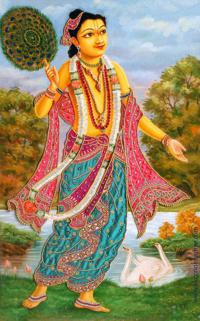
Introduction
Sundarananda Thakura was one of the twelve gopalas. These were Krishna's own cowherd-boy friends who, Gaudiya Vaishnava tradition says, descended with Balarama when He appeared in this age as Nityananda Prabhu. They came to help Him carry the sankirtana mission of Sri Chaitanya Mahaprabhu through Bengal. Sri Chaitanya-charitamrita calls him a branch of Nityananda Prabhu's own devotional family and His most intimate servant. Chaitanya-bhagavata calls him an ocean of prema-rasa and the chief among Nityananda Prabhu's associates. Both descriptions agree on how close he stood to Nityananda Prabhu. But almost nothing else about his life is as clearly recorded. On at least one point, the very date of his disappearance, the sources do not agree with each other.
| Detail | Description |
|---|---|
| Birth place | Maheshapura village, Jessore district, Bengal (now Bangladesh), on the Vetravati river |
| Status | Naishtika-brahmachari, a lifelong celibate; no children |
| Identity | Sudama, Krishna's cowherd friend; one of the twelve gopalas (Gaura-ganoddesha-dipika 127; Chaitanya-charitamrita Adi 11.23 purport) |
| Role | Among the twelve gopalas, remembered as Nityananda Prabhu's most intimate servant |
| Disappearance | Full moon of Magha (Anubhasya) or full moon of Kartika (a separate account) - sources differ |
Scriptural evidence for the introduction (3)
sundarananda -- nityanandera sakha, bhrtya marma
yanra sange nityananda kare vraja-narma
Word for word
sundarananda -- Sundarananda; nityanandera sakha -- a branch of Nityananda Prabhu; bhrtya marma -- very intimate servant; yanra sange -- with whom; nityananda -- Lord Nityananda; kare -- performs; vraja-narma -- activities of Vrindavana.
Sundarananda, another branch of Sri Nityananda Prabhu, was Lord Nityananda's most intimate servant. Lord Nityananda Prabhu perceived the life of Vrajabhumi in his company.
From the purport: Purport excerpt: "In the Gaura-ganoddesa-dipika (127) he is stated to have been Sudama in krsna-lila. Thus he was one of the twelve cowherd boys who came down with Balarama when He descended as Sri Nityananda Prabhu."
Establishes Sundarananda's identity as Sudama of Vrindavana and his standing as Nityananda Prabhu's most intimate servant.
prema-rasa samudra sundarananda nama
nityananda svarupera parsada pradhana
Word for word
prema-rasa -- the mellow of loving devotion; samudra -- an ocean; sundarananda nama -- named Sundarananda; nityananda svarupera -- of Nityananda Prabhu's own personal form; parsada pradhana -- the chief associate.
Sundarananda, an ocean of the mellow of loving devotion, is the chief associate of Nityananda Prabhu's own personal form.
Chaitanya-bhagavata's own description of Sundarananda as chief among Nityananda Prabhu's associates; this verse is not on vedabase.io (which has no separate Chaitanya-bhagavata corpus) and is quoted here via two independent secondary sources that both cite Vrindavana Dasa Thakura's text and agree with Bhaktisiddhanta Sarasvati Thakura's own reference to 'Caitanya-bhagavata, Antya-khanda, chapter five' in his Anubhasya to CC Adi 11.23.
पुरा सुदामनामासीदद्य सुन्दरठक्कुरः ।
वसुदामसखा यश्च पण्डितः श्रीधनञ्जयः ॥१२७॥
purā sudāma-nāmāsīd adya sundara-ṭhakkuraḥ |
vasudāma-sakhā yaś ca paṇḍitaḥ śrī-dhanañjayaḥ ||127||
Lord Krsna's cowherd friend Sudama appeared in Lord Caitanya's pastimes as Sundara Thakura. Lord Krsna's cowherd friend Vasudama appeared in Lord Caitanya's pastimes as Sri Dhananjaya Pandita.
Kavi Karnapura's verse naming Sundarananda (Sundara Thakura) as Sudama, a cowherd friend of Krishna (the same verse names Dhananjaya Pandit as Vasudama); the Anubhashya sentence confirming it is shown under Chaitanya-charitamrita Adi 11.23. Sanskrit: diacritic edition of the Gaura-ganoddesha-dipika; English translation as published at bvmlu.org.
Chapter 1
The Kadamba Flower and the Crocodile
Two mystic-power episodes remembered from Sundarananda Thakura's years at Maheshapura.
A Flower Vrindavana Alone Should Grow #
The kadamba tree belongs to Vrindavana. Krishna is pictured standing beneath its golden, fragrant blossoms in some of the best-loved images of His pastimes there, and the flower does not naturally grow on an ordinary Bengal tree. Tradition remembers that Sundarananda Thakura made one bloom anyway, on a plain lime tree near his home in Maheshapura. He then offered that flower in the worship of Radha-Ramana, the Deity he had himself established there. A short Bengali verse of praise, still recited in his honor, names the miracle directly. It says: "In great hope, I worship Sundarananda Thakura who made a kadamba flower bloom on a lime tree." The verse is not scripture in the way Chaitanya-charitamrita or Chaitanya-bhagavata are. It belongs to the wider class of vaishnava-vandana, verses of praise composed for devotees after their disappearance, and its author is not recorded. The fact that it has survived tells us something by itself. Centuries after Sundarananda Thakura's own lifetime, devotees were still composing verses that expected their listeners to know the story behind them already.
Otherwise, Sundarananda Thakura's Deity worship is recorded only in bare, practical detail: who founded it, where it was later moved, and who looks after it now. A story like this one gives something the temple records cannot. It gives a sense of why the worship mattered enough to be remembered at all. Sundarananda Thakura was Krishna's own boyhood friend, now living out that same closeness through Nityananda Prabhu. In his hands, Vrindavana's flower bloomed out of season on a tree that had never produced it before. This is exactly the kind of small miracle that Gaudiya devotional biographies keep for their sakhya-rasa devotees. In a single image, it is proof that the person performing the pastime and the world he came from were never really separated.
A similar kadamba-on-a-lime-tree image appears in the traditional accounts of a different Vaishnava, Raghava Pandit, during Nityananda Prabhu's own visit to Panihati. The two stories are set in different places (Maheshapura here, Panihati there) and have different sources behind them. They also differ in who makes the miracle happen. At Panihati, tradition credits Nityananda Prabhu Himself with revealing the flowers, and Raghava Pandit simply finds and gathers them. But the verse of praise for Sundarananda Thakura credits him directly with making the flower bloom. Gaudiya devotional biographies return to this same image in the lives of more than one devotee. So the two pages do not contradict each other. They only share a common image, taken from two traditions that were handed down separately.
More about who Sundarananda Thakura was is given on the main biography page.
Pulled From the Jaws of a Crocodile #
The second story recorded about Sundarananda Thakura takes place at a river somewhere near Maheshapura. The source that preserves it does not name the river. A man was seized by a crocodile, and by every ordinary expectation he should have been killed. Sundarananda Thakura dove in after him and pulled him free. The source that records this episode is Srila Bhakti Ballabh Tirtha Maharaja's "Sri Chaitanya: His Life and Associates". It draws its own comparison directly. In this act, it says, Sundarananda Thakura resembled Nityananda Prabhu Himself. Across all of Gaudiya Vaishnava memory, Nityananda Prabhu is known above all as the savior of the most fallen. As Krishnadasa Kaviraja Goswami himself writes about this principle: "Because He is intoxicated by ecstatic love and is an incarnation of mercy, He does not distinguish between the good and the bad. He delivers all those who fall down before Him. Therefore He has delivered such a sinful and fallen person as me" (Chaitanya-charitamrita, Adi 5.208-209). This small story implies that a servant ends up carrying something of his master's own nature. He shows it not by any claim or title, but by what he actually does when a life is at stake.
Beyond these two moments, the available sources record nothing more of Sundarananda Thakura's specific pastimes. What is clearly recorded instead is set out on the main biography page: his standing as one of the twelve gopalas, his place at Nityananda Prabhu's side, and the disagreement between sources over when his disappearance is observed.
Scriptural evidence for this chapter (2)
Quoted in the text above:
- Praise-verse for Sundarananda Thakura Vaishnava-vandana (traditional Bengali verse of praise)
- Adi 5.208-5.209 Sri Chaitanya-charitamrita
Chapter 2
Seated Beside Nityananda Prabhu at Panihati
The last mention of Sundarananda Thakura in Sri Chaitanya-charitamrita, at the Panihati festival where Raghunatha Dasa Goswami came to meet Nityananda Prabhu.
The Day Raghunatha Dasa Goswami Came to Panihati #
Raghunatha Dasa Goswami longed to leave his father's wealthy household in Bengal and reach Sri Chaitanya Mahaprabhu at Jagannatha Puri, but his family kept bringing him back. Before his final escape, he went to see Nityananda Prabhu at Panihati, on the bank of the Ganges. Krishnadasa Kaviraja Goswami's Sri Chaitanya-charitamrita records this scene in the Antya-lila, and it is a crowded scene. Nityananda Prabhu asked Raghunatha to hold a festival of chipped rice and yogurt. At that festival, Nityananda Prabhu's own associates sat around Him on a raised platform. Chaitanya-charitamrita (Antya 6.61) names seven of them directly: Ramadasa, Sundarananda, Gadadhara dasa, Murari, Kamalakara, Sadashiva and Purandara. The following verses add Uddharana Datta Thakura by name, and close with the note that no one could count them all.
As far as the written record alone shows, this is the last dated appearance of Sundarananda Thakura anywhere in Sri Chaitanya-charitamrita or Chaitanya-bhagavata. It took place in Bengal, during the years of Nityananda Prabhu's preaching there, which are described on the main biography page. It is separate from the undated episodes told on The Kadamba Flower and the Crocodile. Here Sundarananda Thakura's place beside Nityananda Prabhu is recorded in Sri Chaitanya-charitamrita itself.
Why the Guest List Matters #
Krishnadasa Kaviraja Goswami is not simply filling a crowd scene with names. Bhaktisiddhanta Sarasvati Thakura's Anubhasya is part of Sri Chaitanya-charitamrita's own tradition of commentary. It uses a passage exactly like this one to link every devotee named back to the fuller descriptions given of them earlier in the text, by chapter and verse. A list like this has survived, with Sundarananda Thakura's name still in it among six others that most readers today have never heard of. In every other way, very little is recorded about him. Such lists are part of how a devotee like him stays on the historical record at all. He is remembered not through a biography written about him in his own lifetime, but by appearing, by name, at the side of the associate everyone did write about.
The Anubhasya's cross-references also clear up a possible confusion in the list itself. The Ramadasa named alongside Sundarananda in this verse is Abhirama Gopala Thakura, another of the twelve gopalas, here called by his other name. The Murari named just after him is not Murari Gupta, the well-known physician-devotee. He is a separate associate of Nityananda Prabhu, whose full name was Murari Chaitanya dasa. This is a small clarification. But it reminds us how easily two devotees who share a common name can be merged into one when stories are casually retold. It also shows how carefully Bhaktisiddhanta Sarasvati Thakura's own commentary works to keep each one distinct.
The platform scene also answers a question that the rest of the record leaves open. Uddharana Datta Thakura's own biography describes the same gathering. Sundarananda Thakura's name appears alongside his in the same group of verses. This confirms that the twelve gopalas were not only names in the list of Nityananda Prabhu's associates in Adi-lila 11. Several of them sat together, still clearly a group, in Nityananda Prabhu's company at Panihati.
Sri Chaitanya-charitamrita does not record what, if anything, Sundarananda Thakura said or did at this gathering, beyond being present and named. Only a handful of verses speak of him at all. So even that bare fact is worth keeping: he was present, he was named, and he was seated beside Nityananda Prabhu.
Scriptural evidence for this chapter (1)
ramadasa, sundarananda, dasa-gadadhara
murari, kamalakara, sadasiva, purandara
Word for word
ramadasa -- Ramadasa; sundarananda -- Sundarananda; dasa-gadadhara -- Gadadhara dasa; murari -- Murari; kamalakara -- Kamalakara; sadasiva -- Sadasiva; purandara -- Purandara.
Among them were Ramadasa, Sundarananda, Gadadhara dasa, Murari, Kamalakara, Sadashiva and Purandara.
Places Sundarananda among the devotees seated with Nityananda Prabhu at Panihati on the day Raghunatha Dasa Goswami came to meet Him -- the last dated appearance of Sundarananda anywhere in the text.
Closing
Sudama of Vrindavana Among the Twelve Gopalas #
Kavi Karnapura's Gaura-ganoddesha-dipika (verse 127) identifies Sundarananda as Sudama, one of Krishna's cowherd companions in Vrindavana. Sudama is a different person from Sridama, the cowherd friend of Krishna whom the same text identifies with Abhirama Gopala Thakura. Gaudiya tradition places both among the dvadasha-gopala, the twelve gopalas. They carried Nityananda Prabhu's mission in Bengal, much as the Panca-tattva's own associates carried the mission of Sri Chaitanya Mahaprabhu. Besides Abhirama Gopala Thakura, several other members of that same circle are also remembered on their own pages here. Among them are Uddharana Datta Thakura, Kholavecha Shridhara, Dhananjaya Pandit, Gauridasa Pandit and Purushottama Dasa Thakura. Each is remembered for something different within the same shared mission.
The verse calls him Sundara Thakura, a short form of his name:
purā sudāma-nāmāsīd adya sundara-ṭhakkuraḥ
"Lord Krsna's cowherd friend Sudama appeared in Lord Caitanya's pastimes as Sundara Thakura." (Gaura-ganoddesha-dipika 127)
Srila Prabhupada's purport to Chaitanya-charitamrita Adi 11.23, drawing on Srila Bhaktisiddhanta Sarasvati Thakura's Anubhashya, confirms it: "In the Gaura-gaṇoddeśa-dīpikā (127) he is stated to have been Sudāmā in kṛṣṇa-līlā. Thus he was one of the twelve cowherd boys who came down with Balarāma when He descended as Śrī Nityānanda Prabhu."
Nityananda Prabhu's Most Intimate Servant #
Sri Chaitanya-charitamrita (Adi 11.23) names Sundarananda directly. He was a branch of Nityananda Prabhu's own family and His bhrtya-marma, servant of the innermost heart. He was so close that Nityananda Prabhu treated his company as if He were back among His own Vraja friends. Their exchanges had the same easy joking as Krishna's own cowherd pastimes. As the verse itself says: "Sundarananda, another branch of Sri Nityananda Prabhu, was Lord Nityananda's most intimate servant. Lord Nityananda Prabhu perceived the life of Vrajabhumi in his company." Chaitanya-bhagavata, in its Antya-khanda, is even more direct. It calls him an ocean of loving rapture and the chief associate of Nityananda Prabhu's own personal form. Srila Prabhupada's purport to the Chaitanya-charitamrita verse draws on Bhaktisiddhanta Sarasvati Thakura's Anubhasya. It adds that Sundarananda came from the village of Maheshapura in the Jessore district, on the Vetravati river. The village is about fourteen miles east of the Majdiya railway station, on the line from Calcutta to Burdwan, and is now within Bangladesh.
A Brahmachari's Legacy at Maheshapura #
Sundarananda Thakura was a naishtika-brahmachari, a lifelong celibate, and left no children. He established the Deities Radha-Vallabha and Radha-Ramana at Maheshapura. Later the Goswamis who took over their worship moved them to Saidabad near Berhampur, and a wooden Deity was installed at Maheshapura in their place. Since then, the temple has been looked after first by the descendants of Sundarananda's own disciples and later by a local zamindar family, not by any blood family of his own. Relatives of his are recorded to have settled at Mangaladihi in the Birbhum district. There a Deity of Balarama, fittingly Nityananda Prabhu's own original form, is still regularly worshiped. A separate, much shorter modern account adds that a personal Deity of his is worshiped today in the Radha-Govinda temple at Vrindavana, and that he has a samadhi there among that pilgrimage site's "64 Samadhis." None of the fuller, better-sourced accounts confirm that claim, so it is noted here but not as settled fact.
Disappearance and an Honest Discrepancy #
Sources disagree on when Sundarananda Thakura's disappearance is observed. Bhaktisiddhanta Sarasvati Thakura's Anubhasya, quoted in Srila Prabhupada's own purport, states that the anniversary is kept every year on the full-moon day of the month of Magha (January-February) at Maheshapura. A separate account, Bhakti Ballabh Tirtha Maharaja's "Sri Chaitanya: His Life and Associates", instead gives the full-moon day of Kartika (October-November). Neither source dates the disappearance to a specific year, and the two months cannot be made to agree. So both are reported here, instead of quietly choosing one. But both traditions agree on something that matters more. A festival is still kept for him. And centuries later, Sundarananda Thakura is remembered exactly as Sri Chaitanya-charitamrita and Chaitanya-bhagavata described him: the intimate, joking, prema-filled companion at Nityananda Prabhu's own side.
- Sri Chaitanya-charitamrita, Adi-lila 11.23 (translation and purport)
- Sri Chaitanya-charitamrita, Antya-lila 6.61-6.63 (Raghunatha Dasa Goswami's arrival at Puri)
- Sundarananda Thakura - Gaudiya History (ISKCON Desire Tree)
- Sundarananda Thakura - Biography 2 (excerpted from Sri Chaitanya: His Life & Associates, Srila Bhakti Ballabh Tirtha Maharaj) - Gaudiya History
- Glories of Sundarananda Thakur (Srila Bhakti Ballabh Tirtha Goswami Maharaj)
- Dwadash Gopal - Twelve Cowherd Boys, Associates of Lord Nityananda - The Gaudiya Treasures of Bengal
