A verse-by-verse look at the theological exchange that reshaped a lifelong Sri Vaishnava's devotion.
Srirangam, South India, A.D. 1511
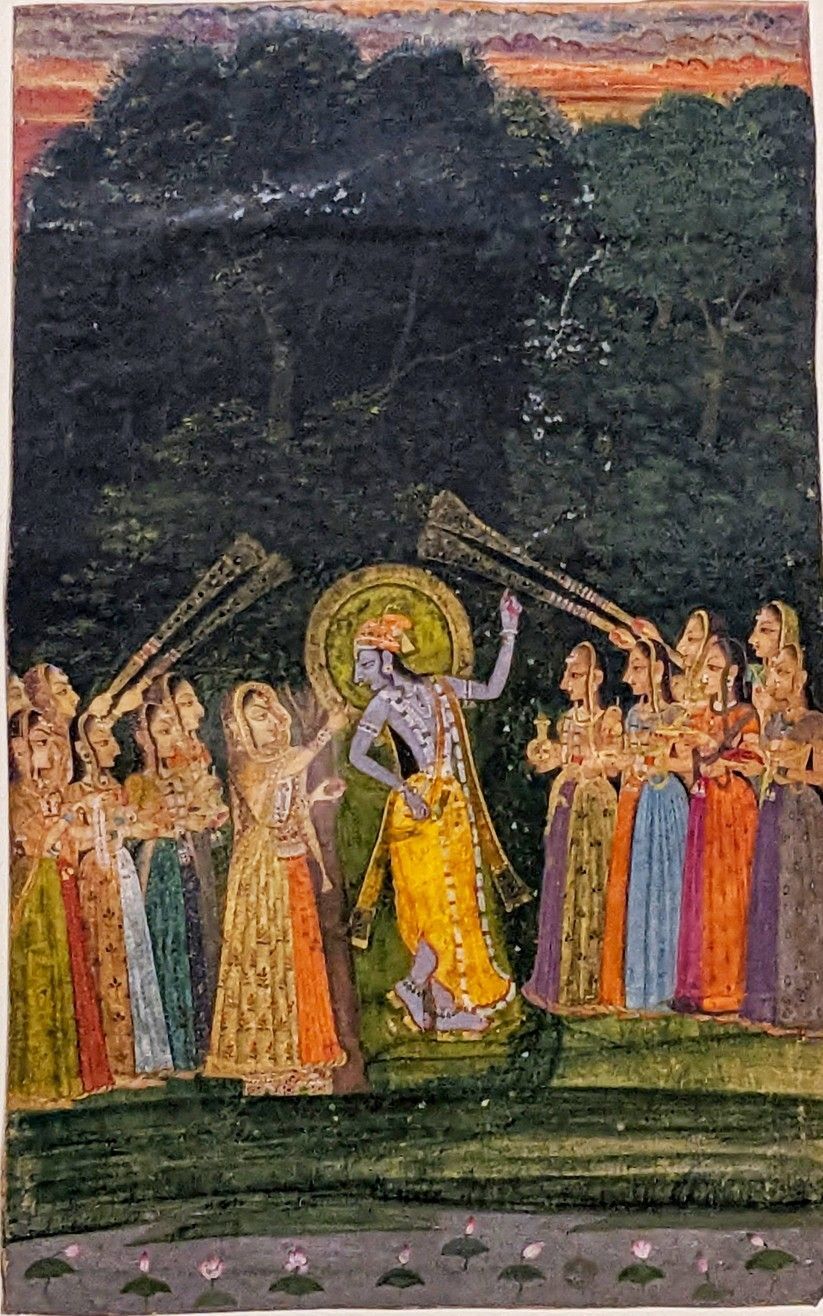
Krishna with the gopis of Vraja, a Kishangarh-school Rajasthani painting (circa 1750-1800) held at the V&A Museum, London - the intimate mood of Vraja bhakti at the heart of Mahaprabhu's conversation with Venkata Bhatta.Wikimedia Commons · CC BY-SA 4.0
Sri Chaitanya-charitamrita gives the theological centerpiece of Venkata Bhatta's whole story a long, careful treatment - roughly eighty verses of Madhya-lila's ninth chapter - and it is worth following in some detail, because the argument is more subtle than "Krishna is greater than Narayana." Krishnadasa Kaviraja Goswami opens by noting Mahaprabhu's own satisfaction: seeing how sincerely Venkata Bhatta worshipped the Deities of Lakshmi and Narayana, "Sri Chaitanya Mahaprabhu was very satisfied" (Chaitanya-charitamrita, Madhya 9.109). This is not a story about a false devotion being corrected; it begins from real devotion being deepened.
Mahaprabhu's opening move was not an argument but an observation, framed with real tenderness: "Your worshipable goddess of fortune, Lakshmi, always remains on the chest of Narayana, and she is certainly the most chaste woman in the creation" (Madhya 9.111). And yet, He continued, this same Lakshmi left the comfort of Vaikuntha for long ages of austerity and regulated vows, all for the mere chance of joining Krishna's rasa dance in Vraja (Madhya 9.113). If Narayana and Krishna are simply the same, why would perfect chastity need to travel anywhere at all?
Venkata Bhatta answered as his training had prepared him to: with a precise verse on rasa, arguing that in ultimate truth there is no difference at all between the forms of Narayana and Krishna, but that Krishna's form carries a special, superior sweetness (rasa) because of the conjugal mellow - "This is the conclusion of transcendental mellows" (Madhya 9.117). It was a sophisticated, entirely orthodox answer, precise enough that Krishnadasa Kaviraja Goswami adds a striking editorial note: this same verse appears in Rupa Gosvami's own Bhakti-rasamrta-sindhu (1.2.59), a text on the science of devotional rasa that Rupa would not systematize in writing for another generation. Venkata Bhatta, in other words, was already fluent in exactly the technical vocabulary of rasa-shastra that the Gaudiya Goswamis would later build into a full philosophy.
Mahaprabhu did not reject this answer so much as widen it, turning to Srimad-Bhagavatam itself. He described how the great sages and the personified Vedic hymns are said to have taken birth as gopis in Vraja, giving up their own liberated status, purely to enter Krishna's company on Vraja's own intimate terms (Madhya 9.128) - and He quoted a verse still cited across the Gaudiya tradition today: "when Lord Sri Krishna was dancing with the gopis in the rasa-lila, the gopis were embraced around the neck by the Lord's arms. This transcendental favor was never bestowed upon the goddess of fortune or the other consorts in the spiritual world" (Srimad-Bhagavatam 10.47.60, quoted at Madhya 9.121). The point was not that Lakshmi's love is inferior in quality, but that the unguarded, opulence-free intimacy of Vraja is a category of love even the goddess of fortune, bound as she is to Narayana's majesty, cannot enter without first giving up that very majesty - which she does not do. A companion verse, drawn from Rupa Gosvami's own play Lalita-madhava-nataka, drives the same point home with an unforgettable image: when Krishna once playfully manifested a four-armed Narayana form before the gopis, their ecstatic feelings for Him were, in the text's own word, "crippled" - so completely was their love fixed on the two-armed cowherd boy of Nanda's Vraja, and not on any form of opulence at all (Madhya 9.150).
What makes this exchange remarkable is how it ends. Venkata Bhatta does not simply concede an argument; he surrenders one. "The transcendental pastimes of the Lord are unfathomable, and I do not know anything about them," he says. "Whatever You say I accept as the truth" (Madhya 9.158) - language Srila Prabhupada's own purport compares directly to Arjuna's surrender in Bhagavad-gita 10.14, where Arjuna says much the same thing to Krishna Himself. And then, in a line that captures exactly how Gaudiya Vaishnavism understands this whole episode, Venkata Bhatta adds: "I have been engaged in the service of Lakshmi-Narayana, and it is due to Their mercy that I have been able to see Your lotus feet" (Madhya 9.159). His years of sincere Sri Vaishnava worship were not discarded as an error - they were honored as the very means by which Krishna's own mercy had reached him.
What that surrender meant for his household in the days and years that followed - and what it did not change about the great public temple of Sri Ranganatha itself - is told in A Household Transformed, and the broader, still-warmer story of the friendship that made room for this whole conversation is in Mahaprabhu's Four-Month Stay.
śrī-vaiṣṇava — a devotee of the Rāmānuja-sampradāya; bhaṭṭa — Veṅkaṭa Bhaṭṭa; seve — used to worship; lakṣmī-nārāyaṇa — the Deities of Lakshmi and Narayana; tāṅra — his; bhakti — devotion; dekhi' — seeing; prabhura — of Lord Chaitanya Mahaprabhu; tuṣṭa — happy; haila — became; mana — the mind.
Being a Vaishnava in the Ramanuja-sampradaya, Venkata Bhatta worshiped the Deities of Lakshmi and Narayana. Seeing his pure devotion, Sri Chaitanya Mahaprabhu was very satisfied.
prabhu kahe — Lord Chaitanya Mahaprabhu said; bhaṭṭa — My dear Bhattacharya; tomāra — your; lakṣmī-ṭhākurāṇī — goddess of fortune; kānta-vakṣaḥ-sthitā — situated on the chest of her husband, Narayana; pati-vratā-śiromaṇi — the topmost chaste woman.
Sri Chaitanya Mahaprabhu told the Bhattacharya, "Your worshipable goddess of fortune, Lakshmi, always remains on the chest of Narayana, and she is certainly the most chaste woman in the creation."
The opening move of the whole conversation - framed as praise for Lakshmi, not as an attack on her position.
ei lāgi' sukha-bhoga chāḍi' cira-kāla
vrata-niyama kari' tapa karila apāra
Word for word
ei lāgi' — for this reason; sukha-bhoga — the enjoyment of Vaikuṇṭha; chāḍi' — giving up; cira-kāla — for a long time; vrata-niyama kari' — accepting vows and regulative principles; tapa karila apāra — performed unlimited austerity.
Just to associate with Krishna, Lakshmi abandoned all transcendental happiness in Vaikuntha and for a long time accepted vows and regulative principles and performed unlimited austerities.
The pointed question at the heart of the exchange: why would perfect chastity in Vaikuntha need austerity to reach Krishna, if Krishna and Narayana are simply identical?
siddhāntatas tv abhede 'pi śrīśa-kṛṣṇa-svarūpayoḥ
rasenotkṛṣyate kṛṣṇa-rūpam eṣā rasa-sthitiḥ
Word for word
siddhāntataḥ — in reality; tu — but; abhede — no difference; api — although; śrī-īśa — of the husband of Lakshmi, Narayana; kṛṣṇa — of Lord Krishna; svarūpayoḥ — between the forms; rasena — by transcendental mellows; utkṛṣyate — is superior; kṛṣṇa-rūpam — the form of Lord Krishna; eṣā rasa-sthitiḥ — this is the reservoir of pleasure.
Venkata Bhatta continued, "According to transcendental realization, there is no difference between the forms of Narayana and Krishna. Yet in Krishna there is a special transcendental attraction due to the conjugal mellow, and consequently He surpasses Narayana. This is the conclusion of transcendental mellows."
From the purport: Purport excerpt: "This verse quoted by Venkata Bhatta is also found in the Bhakti-rasamrta-sindhu (1.2.59)."
Venkata Bhatta's own answer, given as a trained Sri Vaishnava scholar of rasa - the same verse Rupa Gosvami would independently include, a generation later, in his own systematic work on devotional aesthetics.
nāyaṁ śriyo 'ṅga u nitānta-rateḥ prasādaḥ
svar-yoṣitāṁ nalina-gandha-rucāṁ kuto 'nyāḥ
rāsotsave 'sya bhuja-daṇḍa-gṛhīta-kaṇṭha-
labdhāśiṣāṁ ya udagād vraja-sundarīṇām
Word for word
na ayam śriyaḥ aṅge — not this, on the chest of the goddess of fortune; u — alas; nitānta-rateḥ prasādaḥ — the favor of one very intimately related; svaḥ-yoṣitām nalina-gandha-rucām — of heavenly women having the aroma and luster of the lotus; kutaḥ anyāḥ — much less others; rāsa-utsave asya — in the festival of His rāsa dance; bhuja-daṇḍa-gṛhīta-kaṇṭha — their necks embraced by His arms; labdha-āśiṣām — who achieved such a blessing; vraja-sundarīṇām — of the beautiful gopīs of Vrajabhūmi.
When Lord Sri Krishna was dancing with the gopis in the rasa-lila, the gopis were embraced around the neck by the Lord's arms. This transcendental favor was never bestowed upon the goddess of fortune or the other consorts in the spiritual world, nor was it ever imagined by the most beautiful girls of the heavenly planets - and what to speak of ordinary women.
From the purport: Purport excerpt: "This is a verse from Srimad-Bhagavatam (10.47.60)."
Mahaprabhu's key Bhagavatam citation, showing that the gopis' embrace in rasa-lila belongs to a category of intimacy Lakshmi herself, bound to Narayana's opulence, does not share.
gopīnām paśupa-indra-nandana-juṣaḥ bhāvasya — of the gopis' ecstasy in loving service to the son of Vraja's king; kaḥ kṛtī vijñātum kṣamate — what learned man is able to understand; durūha-padavī — very difficult to comprehend; āviṣkurvati vaiṣṇavīm tanum — when He manifested the form of Vishnu; bhujaiḥ jiṣṇubhiḥ caturbhiḥ — with four beautiful arms; adbhuta-rucim rāga-udayaḥ kuñcati — their wonderful evoking of ecstatic feelings became crippled.
Once Lord Sri Krishna playfully manifested Himself as Narayana, with four victorious hands and a very beautiful form. When the gopis saw this exalted form, their ecstatic feelings were crippled. A learned scholar cannot understand the gopis' ecstatic feelings, fixed as they are upon Krishna's original form as the son of Nanda Maharaja.
From the purport: Purport excerpt: "This is a verse spoken by Narada Muni in the Lalita-madhava-nataka (6.14), a drama written by Srila Rupa Gosvami."
A vivid image of exactly why the gopis' love is fixed on Krishna's two-armed cowherd form and not on any four-armed form of opulence, however magnificent.
agādha — unfathomable; īśvara-līlā — pastimes of the Lord; kichui nā jāni — I do not know anything; tumi yei kaha — whatever You say; sei satya kari' māni — I accept that as the truth.
The transcendental pastimes of the Lord are unfathomable, and I do not know anything about them. Whatever You say I accept as the truth.
From the purport: Purport excerpt: "After hearing the Bhagavad-gita, Arjuna said very much the same thing... 'O Krishna, I totally accept as truth all that You have told me.'"
