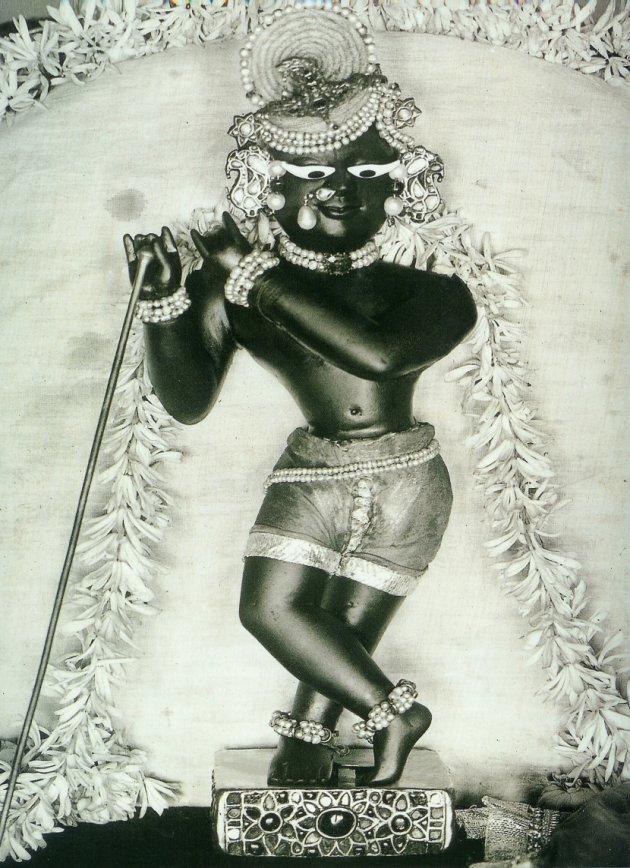
When Venkata Bhatta fell at Mahaprabhu's feet in surrender, it was not only his own turning point. Prabodhananda Saraswati's own biography records plainly that "by the time the four months ended, all three brothers... had made that same turn" from the worship of Lakshmi-Narayana toward Radha-Krishna bhakti. The three were Venkata Bhatta, Tirumalaya Bhatta, and the future Prabodhananda, together. For generations this household had been respected Sri Vaishnava priests. Now it found that its center of devotion had shifted toward Vraja, gently and without any sense of a break.
What Changed, and What Did Not #
Here we should be exact, and report what the sources actually say instead of smoothing the story into something tidier. Sri Chaitanya-charitamrita and the traditions built on it describe a personal change within one household. The Bhatta brothers' own private worship, study, and devotional focus turned toward Krishna. The sources do not record any change anywhere to the great public Sri Ranganatha temple itself. That temple has remained, without interruption, a major center of Sri Vaishnava worship of Vishnu down to the present day. Venkata Bhatta's conversion was real. It ran deep enough to reshape the religious lives of three brothers and, through his son, an entire branch of the Gaudiya sampradaya. But it was the conversion of a family, not of an institution, and the sources keep that difference clear.
Devotion Fulfilled, Not Discarded #
The theology behind this "conversion" is more careful than the word usually suggests. Sri Chaitanya-charitamrita does not describe Venkata Bhatta's years of Lakshmi-Narayana worship as wasted or mistaken. Venkata Bhatta himself says the opposite. He says that it was "by Their mercy" that he was able to see Mahaprabhu's own feet at all (Madhya 9.159). The change was not a rejection of everything that came before. It was the completion of it. The same sincerity that had gone into worshipping Vishnu's four-armed opulence now found a still more intimate focus in Krishna's own two-armed form as a cowherd boy of Vraja. Chaitanya-charitamrita describes this same pattern again and again across Mahaprabhu's South Indian tour. A person's earlier faith is not destroyed. Instead, its own deepest meaning is drawn out.
A Father Watching His Son Awaken #
The clearest sign of how completely the household's devotional life had turned came through the youngest member of the family. Venkata Bhatta's son Gopala, only seven or eight years old during Mahaprabhu's stay, had been serving the Lord continuously throughout the four months. As the visit finally drew to its close, the boy's visible grief moved Mahaprabhu to extend His stay further still. During those extra days Gopala received a vision, in which Mahaprabhu revealed His own identity as Krishna. He also spoke of two great souls, Rupa and Sanatana, whom the boy would one day meet in Vrindavana. This vision is already told in full on Gopala Bhatta Goswami's own page. Venkata Bhatta had been absorbed his whole life in the worship of Lakshmi-Narayana. For such a father, watching his young son receive so direct and personal a revelation of Krishna must have been a confirmation of its own kind. It was not an argument won. It was a mercy he saw for himself, inside his own home.
Fainting at the Parting #
How deeply things had changed was seen again, very clearly, when the four months finally ended and Mahaprabhu prepared to leave for good. Sri Chaitanya-charitamrita records the moment simply: "Venkata Bhatta did not want to return home but also wanted to go with the Lord. It was with great endeavor that Sri Chaitanya Mahaprabhu bade him farewell" (Chaitanya-charitamrita, Madhya 9.164). Then, in the chapter's own closing verse, "Venkata Bhatta fell down unconscious" from separation (Madhya 9.165). This was not the response of a scholar who had lost a debate. It was the grief of a man who, in four short months, had found something he could no longer imagine living without.
Toward Vrindavana, By a Different Road #
The family did not make the journey to Vrindavana together, and none of them went at once. Prabodhananda Saraswati left for the sacred forests of Vraja within a few years of this conversion. Gopala Bhatta went only after both his parents had died, following Mahaprabhu's own clear instruction that the boy first serve them at home. Venkata Bhatta himself, so far as any source records, never left Srirangam at all. Legacy and Family tells how the family's story continued from there. It continued through a brother who became one of the Gaudiya tradition's great poets, and a son who became one of its six founding Goswamis.
