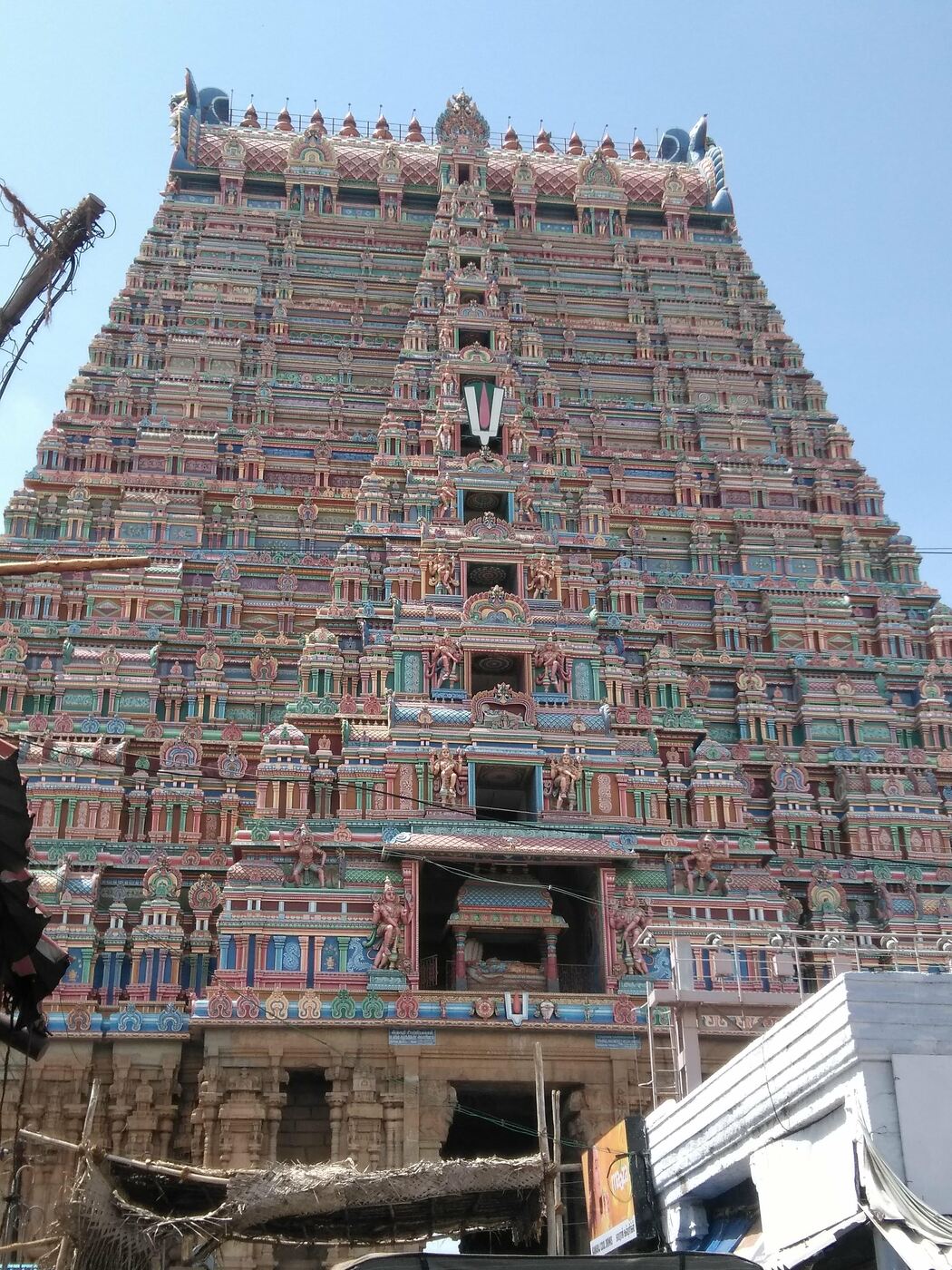
Srirangam, an island temple town formed where the Kaveri River splits into two channels, was already centuries old as a center of Sri Vaishnava worship by the early sixteenth century. Its great temple to Sri Ranganatha, a reclining form of Vishnu, had been a center of Ramanujacharya's own teaching tradition for hundreds of years. Here, in a family of priestly brahmanas, Venkata Bhatta lived, taught, and worshipped, long before Sri Chaitanya Mahaprabhu ever set foot in the south.
A Family of Acharyas #
Venkata Bhatta was the youngest of three brothers. The eldest, Tirumalaya Bhatta, was the head of the family. The second brother would later become famous across the Gaudiya world as Prabodhananda Saraswati. All three served their local community as acharyas, teachers and authorities on ritual within the Sri sampradaya. Their worship centered on the Deities of Lakshmi and Narayana. In the Sri Vaishnava tradition they are understood as the Supreme Lord together with His eternal consort, the source and goal of all devotion. This was not a minor or informal household. To serve as acharya in an established Vadagalai lineage, at a temple town as important as Srirangam, meant real standing and real learning. It also meant real responsibility for guiding others in scripture and practice.
The Title Bhatta #
The very name by which history remembers him carries a clue to his standing. Srila Prabhupada explained in a 1969 lecture at New Vrindaban that "Bhatta" and "Bhattacharya" were titles given specifically to brahmanas recognized as very learned and very influential. They were not family surnames in the ordinary sense, but marks of scholarship that had to be earned. Venkata Bhatta, Tirumalaya Bhatta, and their descendants at Srirangam all carried this title for exactly that reason. Venkata Bhatta's own son would keep the same title for the rest of his life, as Gopala Bhatta Goswami.
Vadagalai Learning #
By Srila Prabhupada's own account in his purport to Sri Chaitanya-charitamrita, Venkata Bhatta belonged specifically to the Vadagalai branch of the Sri sampradaya. This school leaned more heavily on Sanskrit scripture and a more traditionally Vedic way of explaining it. The Tengalai branch, by contrast, gave greater emphasis to the Tamil devotional hymns of the Alvars. This detail helps us understand what happened later. Venkata Bhatta was not a casual devotee. He was a man trained in the deep, technical language of Vaishnava theology and aesthetics. These were the very tools Sri Chaitanya Mahaprabhu would use, verse by verse, to lead him toward a different conclusion. When the moment came, Venkata Bhatta could answer with real exactness in Sanskrit. Without being asked, he even produced a verse on rasa so exact that Krishnadasa Kaviraja Goswami later noted it was identical to one Rupa Gosvami would place in his own Bhakti-rasamrta-sindhu. A scholar with less training could not have discussed these things with Mahaprabhu at that level at all.
Srila Prabhupada's purport adds one more interesting note. The name Venkata was not one commonly kept by families native to the Tamil-speaking region around Srirangam. This raises the possibility that his family had moved there at some earlier point from further north or west. Perhaps they came from Andhra, where the name (tied to the hill of Venkata at Tirupati) is still extremely common. Later biographers never fully settled this question. Other traditional accounts, repeated in modern summaries such as Wikipedia's, describe the family simply as Tamil Iyengars, the Sri Vaishnava brahmana community native to the region. Both things can be true if they describe the family at different points in time. So the difference is reported here openly, not hidden.
A Household Already Touched by Krishna #
One detail rarely told is that Venkata Bhatta's own inner life did not begin the day Mahaprabhu arrived. Sri Chaitanya-charitamrita records that even before the famous theological conversation took place, simply hearing Mahaprabhu speak of Krishna's pastimes filled Venkata Bhatta with a spontaneous, unasked-for ecstatic happiness. These were pastimes such as Krishna instructing Arjuna, and Krishna among the cowherds. The text also records that his mind was gradually purified by these repeated glimpses of Krishna. This went on until, in the text's own words, he "could understand the truth of Sri Chaitanya Mahaprabhu in all details." In other words, something had already begun to change beneath a lifetime of careful Sri Vaishnava scholarship, well before the two of them ever spoke directly about Lakshmi and Narayana. Mahaprabhu's Four-Month Stay tells what happened when Mahaprabhu actually arrived at his door, and how those four months of hospitality passed day by day.
His son - still a small boy at this time - was Gopala, who would grow up to become Gopala Bhatta Goswami, one of the Six Goswamis of Vrindavana; the fuller story of that son's own early life is told on his own page.
