Srila Venkata Bhatta
Sri Vaishnava Host of Mahaprabhu at Srirangam, Father of Gopala Bhatta Goswami
The complete life, on one page: The main biography and every pastime page, in order, in one place
Introduction
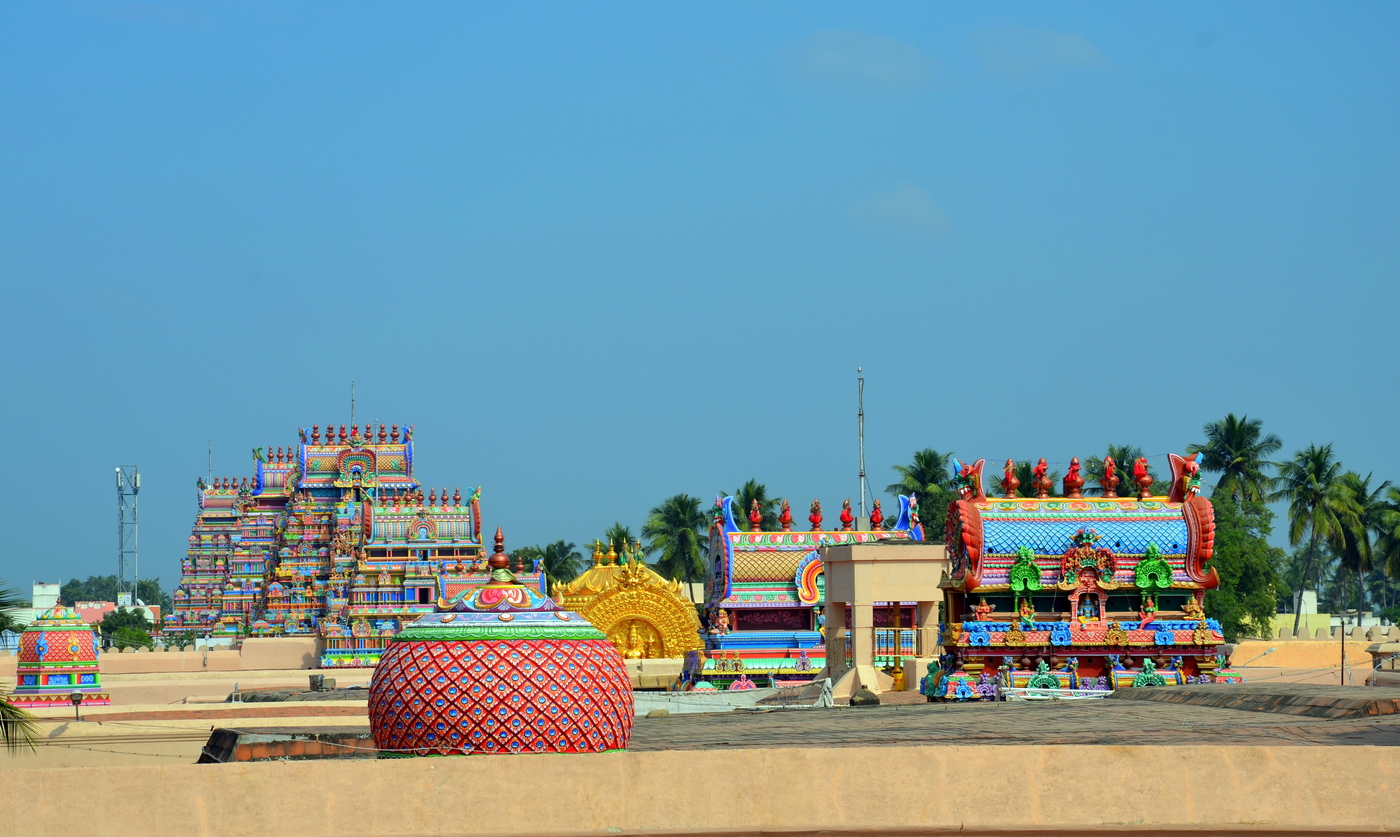
Srila Venkata Bhatta was a Sri Vaishnava brahmana and scholar of Srirangam in South India. He was already respected in his own community for his worship of Lakshmi and Narayana. In A.D. 1511 Sri Chaitanya Mahaprabhu arrived at his door, asking for shelter through the four months of Chaturmasya. What began as simple hospitality to a guest grew into one of the most fully recorded conversations in the whole of Sri Chaitanya-charitamrita. By the time the rains ended, Venkata Bhatta's household, meaning himself, his two brothers and his young son, had turned from the worship of Vishnu's four-armed form toward the cowherd boy of Vrindavana. That son grew up to be Gopala Bhatta Goswami, one of the Six Goswamis of Vrindavana. Venkata Bhatta's elder brother became the poet-sannyasi Prabodhananda Saraswati.
| Detail | Description |
|---|---|
| Home | Srirangam, on the Kaveri River, Tamil Nadu, South India |
| Sampradaya before conversion | Sri (Ramanuja) sampradaya, Vadagalai branch |
| Brothers (both elder) | Tirumalaya Bhatta (the eldest) and Prabodhananda Saraswati |
| Son | Gopala Bhatta Goswami, one of the Six Goswamis of Vrindavana |
| Meeting with Mahaprabhu | Four-month Chaturmasya stay, 1433 Sakabda / A.D. 1511 |
| Textual source | Sri Chaitanya-charitamrita, Madhya-lila 9.82-165 |
| Later life | No source records his own disappearance; the family remained at Srirangam |
Chapter 1
Life as a Sri Vaishnava Scholar at Srirangam
The standing, family, and scholarship of a Vadagalai priest of Srirangam before Mahaprabhu ever arrived.
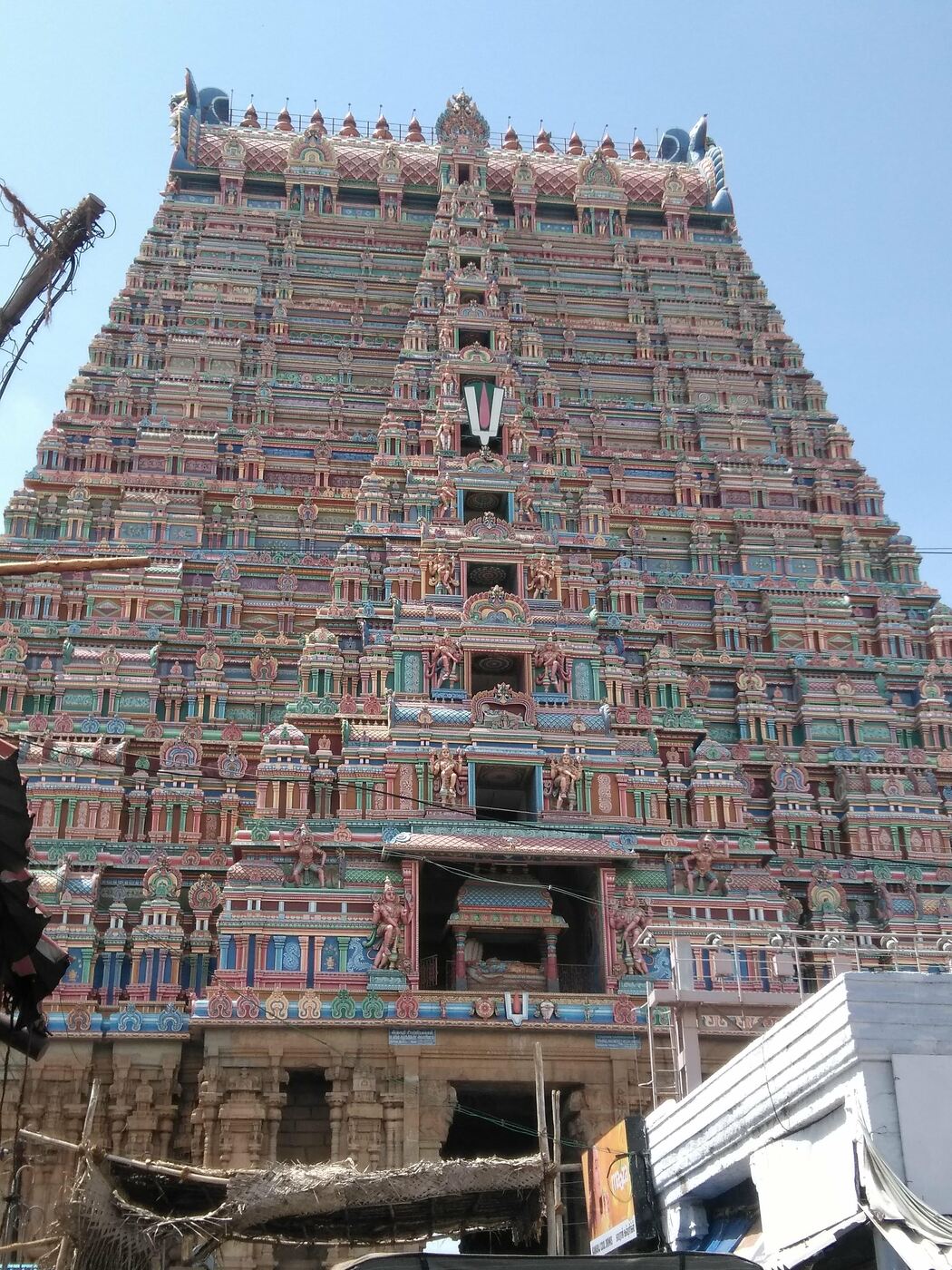
Srirangam, an island temple town formed where the Kaveri River splits into two channels, was already centuries old as a center of Sri Vaishnava worship by the early sixteenth century. Its great temple to Sri Ranganatha, a reclining form of Vishnu, had been a center of Ramanujacharya's own teaching tradition for hundreds of years. Here, in a family of priestly brahmanas, Venkata Bhatta lived, taught, and worshipped, long before Sri Chaitanya Mahaprabhu ever set foot in the south.
A Family of Acharyas #
Venkata Bhatta was the youngest of three brothers. The eldest, Tirumalaya Bhatta, was the head of the family. The second brother would later become famous across the Gaudiya world as Prabodhananda Saraswati. All three served their local community as acharyas, teachers and authorities on ritual within the Sri sampradaya. Their worship centered on the Deities of Lakshmi and Narayana. In the Sri Vaishnava tradition they are understood as the Supreme Lord together with His eternal consort, the source and goal of all devotion. This was not a minor or informal household. To serve as acharya in an established Vadagalai lineage, at a temple town as important as Srirangam, meant real standing and real learning. It also meant real responsibility for guiding others in scripture and practice.
The Title Bhatta #
The very name by which history remembers him carries a clue to his standing. Srila Prabhupada explained in a 1969 lecture at New Vrindaban that "Bhatta" and "Bhattacharya" were titles given specifically to brahmanas recognized as very learned and very influential. They were not family surnames in the ordinary sense, but marks of scholarship that had to be earned. Venkata Bhatta, Tirumalaya Bhatta, and their descendants at Srirangam all carried this title for exactly that reason. Venkata Bhatta's own son would keep the same title for the rest of his life, as Gopala Bhatta Goswami.
Vadagalai Learning #
By Srila Prabhupada's own account in his purport to Sri Chaitanya-charitamrita, Venkata Bhatta belonged specifically to the Vadagalai branch of the Sri sampradaya. This school leaned more heavily on Sanskrit scripture and a more traditionally Vedic way of explaining it. The Tengalai branch, by contrast, gave greater emphasis to the Tamil devotional hymns of the Alvars. This detail helps us understand what happened later. Venkata Bhatta was not a casual devotee. He was a man trained in the deep, technical language of Vaishnava theology and aesthetics. These were the very tools Sri Chaitanya Mahaprabhu would use, verse by verse, to lead him toward a different conclusion. When the moment came, Venkata Bhatta could answer with real exactness in Sanskrit. Without being asked, he even produced a verse on rasa so exact that Krishnadasa Kaviraja Goswami later noted it was identical to one Rupa Gosvami would place in his own Bhakti-rasamrta-sindhu. A scholar with less training could not have discussed these things with Mahaprabhu at that level at all.
Srila Prabhupada's purport adds one more interesting note. The name Venkata was not one commonly kept by families native to the Tamil-speaking region around Srirangam. This raises the possibility that his family had moved there at some earlier point from further north or west. Perhaps they came from Andhra, where the name (tied to the hill of Venkata at Tirupati) is still extremely common. Later biographers never fully settled this question. Other traditional accounts, repeated in modern summaries such as Wikipedia's, describe the family simply as Tamil Iyengars, the Sri Vaishnava brahmana community native to the region. Both things can be true if they describe the family at different points in time. So the difference is reported here openly, not hidden.
A Household Already Touched by Krishna #
One detail rarely told is that Venkata Bhatta's own inner life did not begin the day Mahaprabhu arrived. Sri Chaitanya-charitamrita records that even before the famous theological conversation took place, simply hearing Mahaprabhu speak of Krishna's pastimes filled Venkata Bhatta with a spontaneous, unasked-for ecstatic happiness. These were pastimes such as Krishna instructing Arjuna, and Krishna among the cowherds. The text also records that his mind was gradually purified by these repeated glimpses of Krishna. This went on until, in the text's own words, he "could understand the truth of Sri Chaitanya Mahaprabhu in all details." In other words, something had already begun to change beneath a lifetime of careful Sri Vaishnava scholarship, well before the two of them ever spoke directly about Lakshmi and Narayana. Mahaprabhu's Four-Month Stay tells what happened when Mahaprabhu actually arrived at his door, and how those four months of hospitality passed day by day.
His son - still a small boy at this time - was Gopala, who would grow up to become Gopala Bhatta Goswami, one of the Six Goswamis of Vrindavana; the fuller story of that son's own early life is told on his own page.
Scriptural evidence for this chapter (1)
śrī-vaiṣṇava eka, — 'vyeṅkaṭa bhaṭṭa' nāma
prabhure nimantraṇa kaila kariyā sammāna
Word for word
śrī-vaiṣṇava eka: a devotee belonging to the Rāmānuja-sampradāya; vyeṅkaṭa bhaṭṭa: Veṅkaṭa Bhaṭṭa; nāma: named; prabhure: unto Lord Caitanya Mahāprabhu; nimantraṇa: invitation; kaila: did; kariyā: offering; sammāna: great respect.
A Vaishnava known as Venkata Bhatta then invited Sri Chaitanya Mahaprabhu to his home with great respect.
From the purport: Purport excerpt: "Venkata Bhatta had a brother in the Ramanuja-sampradaya known as Sripada Prabodhananda Sarasvati. The son of Venkata Bhatta was later known in the Gaudiya-sampradaya as Gopala Bhatta Gosvami."
Srila Prabhupada's purport here gives the clearest primary confirmation of the family structure - Venkata Bhatta, his brother Prabodhananda Saraswati, and his son Gopala Bhatta Goswami - and identifies Venkata Bhatta's Vadagalai branch of the Sri sampradaya.
Chapter 2
Mahaprabhu's Four-Month Stay
How an extraordinary invitation became the longest single halt of Mahaprabhu's South Indian tour.
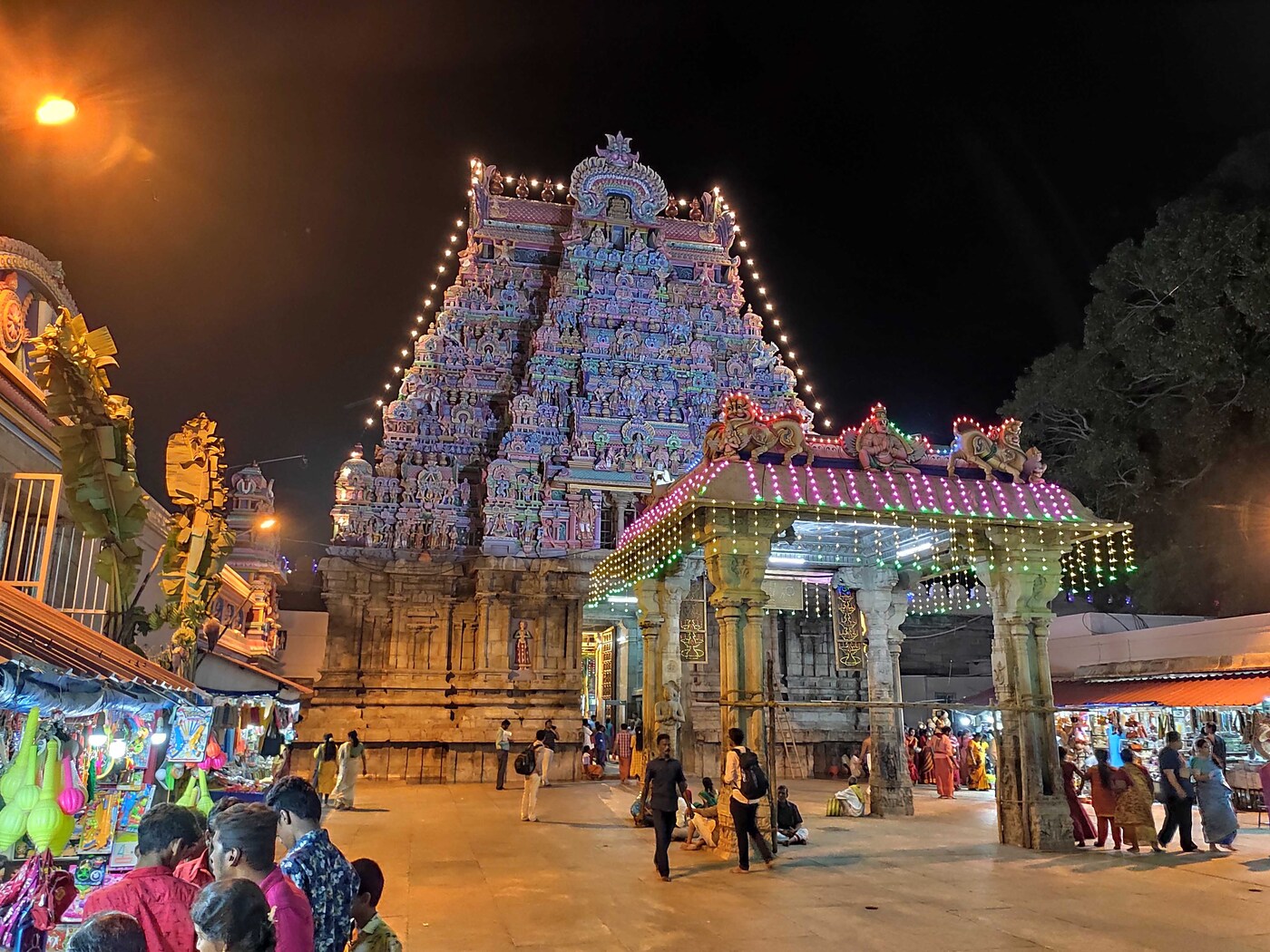
When Sri Chaitanya Mahaprabhu reached Srirangam during his long walking tour of South India, Venkata Bhatta sought Him out and invited Him home with unusual insistence. His own words are recorded in Sri Chaitanya-charitamrita: "Please be merciful to me and stay at my house during Chaturmasya. Speak about Lord Krishna's pastimes and kindly deliver me by Your mercy." It was an extraordinary request from a settled Sri Vaishnava householder to a wandering sannyasi he barely knew, and Mahaprabhu accepted it. The stay that followed lasted four full months. It became the longest single halt of the Lord's entire South Indian pilgrimage. By Srila Prabhupada's dating, it fell in 1433 Sakabda, or A.D. 1511 (a few secondary sources round this to 1510).
Why This Stay Stood Out #
Across the rest of His South Indian tour, Mahaprabhu generally kept to the wandering sannyasi's discipline of brief stops, simple bhiksha, and near-constant movement toward the next holy place. This tour is described more broadly on Sri Chaitanya Mahaprabhu's own South India Tour page. By that standard, a four-month halt in one household was extraordinary. It was long enough for Venkata Bhatta's home to become, in practice, a small, temporary center of sankirtana and Krishna-katha in the middle of Sri Vaishnava Srirangam. The fact that the Lord granted such a long stay at all says something about how quickly He saw Venkata Bhatta's sincerity.
An Unusual Honor #
Venkata Bhatta's deep reverence showed itself at once, in a small but telling detail. He brought Mahaprabhu to his own home, washed His feet, and then had every member of his family drink that water. This is a mark of the highest respect a Vaishnava household can pay a guest. From there the two men fell into an easy, constant companionship. Sri Chaitanya-charitamrita says they talked about Krishna without interruption. It also says that they sometimes simply laughed and joked together like old friends, not like a teacher and student arguing over doctrine. This detail says as much about Mahaprabhu's warmth as about Venkata Bhatta's own character. Mahaprabhu's Visit and a Father's Hospitality, on Gopala Bhatta Goswami's own pages, already tells the fuller story of that friendship from the boy's side. It also tells how Venkata Bhatta's own seven-year-old son served the Lord throughout these months.
A Slow Unveiling, Not a Single Debate #
It would be easy to imagine the whole four months as building toward one dramatic theological debate. But the text itself suggests something gentler and more gradual. Long before Mahaprabhu ever raised His pointed question about Lakshmi and Krishna, Venkata Bhatta was already having quiet devotional experiences he could not fully explain. In his own words, preserved in the text, he describes moments of spontaneous ecstatic happiness that came simply from hearing Krishna's pastimes described. In his mind's eye he saw Krishna instructing Arjuna on the battlefield, and he felt himself flooded with joy at the vision. Chaitanya-charitamrita states plainly that "the mind of the brahmana was purified by the revelation of Lord Krishna, and therefore he could understand the truth of Sri Chaitanya Mahaprabhu in all details". This purification is described as happening across the visit, not in a single conversation. By his tradition's own account, Venkata Bhatta's heart had already been prepared by the time the famous exchange about Lakshmi and Narayana actually took place.
Feeling Krishna's Presence Everywhere #
There is also a smaller, often-overlooked episode from this same stay. Even while He was a guest in Venkata Bhatta's own home, Mahaprabhu felt deep separation from His beloved Lord Jagannatha of Puri. In that mood He carved a small personal set of Jagannatha Deities. These images are still worshipped near the site of the Bhatta family home today. This shows that even during these four months of theological depth, Mahaprabhu's own devotional life never paused. His hosts were simply given a rare chance to see it closely.
Toward the Central Question #
The friendship, the small daily mercies and the slowly growing ecstasy all prepared the way for the conversation that would shape how later generations remember Venkata Bhatta at all. It was a patient, respectful dialogue that in the end brought deep change. The question was whether Krishna's own cowherd form could truly be superior to Lakshmi-Narayana's four-armed majesty. That exchange, verse by verse, is the subject of The Conversation on Krishna and Lakshmi-Narayana.
Scriptural evidence for this chapter (4)
Quoted in the text above:
- Madhya 9.105 Sri Chaitanya-charitamrita
Further verses:
nija-ghare lañā kaila pāda-prakṣālana
sei jala lañā kaila sa-vaṁśe bhakṣaṇa
Word for word
nija-ghare: to his own home; lañā: bringing; kaila: did; pāda-prakṣālana: washing of the feet; sei jala: that water; lañā: taking; kaila: did; sa-vaṁśe: with all the family members; bhakṣaṇa: drinking.
Sri Venkata Bhatta took Sri Chaitanya Mahaprabhu to his home. After he washed the Lord's feet, all the members of his family drank the water.
Drinking the water that washed a guest's feet is among the highest marks of reverence in Vaishnava etiquette; the whole family's participation shows how completely the household received Mahaprabhu even before any theological conversation began.
cāturmāsye kṛpā kari' raha mora ghare
kṛṣṇa-kathā kahi' kṛpāya uddhāra' āmāre
Word for word
cāturmāsye: during this period of Cāturmāsya; kṛpā kari': being merciful; raha: please stay; mora ghare: at my place; kṛṣṇa-kathā: topics of Lord Kṛṣṇa; kahi': speaking; kṛpāya: by Your mercy; uddhāra' āmāre: kindly deliver me.
Venkata Bhatta said, "Please be merciful to me and stay at my house during Chaturmasya. Speak about Lord Krishna's pastimes and kindly deliver me by Your mercy."
Venkata Bhatta's own words of invitation, quoted directly in Chaitanya-charitamrita - a Sri Vaishnava householder asking a wandering Gaudiya sannyasi for spiritual deliverance before any conversion had taken place.
ei-mata bhaṭṭa-gṛhe rahe gauracandra
nirantara bhaṭṭa-saṅge kṛṣṇa-kathānanda
Word for word
ei-mata: in this way; bhaṭṭa-gṛhe: in the house of Veṅkaṭa Bhaṭṭa; rahe: remained; gauracandra: Sri Chaitanya Mahaprabhu; nirantara: constantly; bhaṭṭa-saṅge: with Venkata Bhatta; kṛṣṇa-kathā-ānanda: the transcendental bliss of talking about Krishna.
Sri Chaitanya Mahaprabhu remained at the house of Venkata Bhatta and constantly talked with him about Lord Krishna. In this way He was very happy.
This verse captures the tone of ordinary, happy friendship in which the entire theological exchange took place.
Chapter 3
The Conversation on Krishna and Lakshmi-Narayana
A verse-by-verse look at the theological exchange that reshaped a lifelong Sri Vaishnava's devotion.
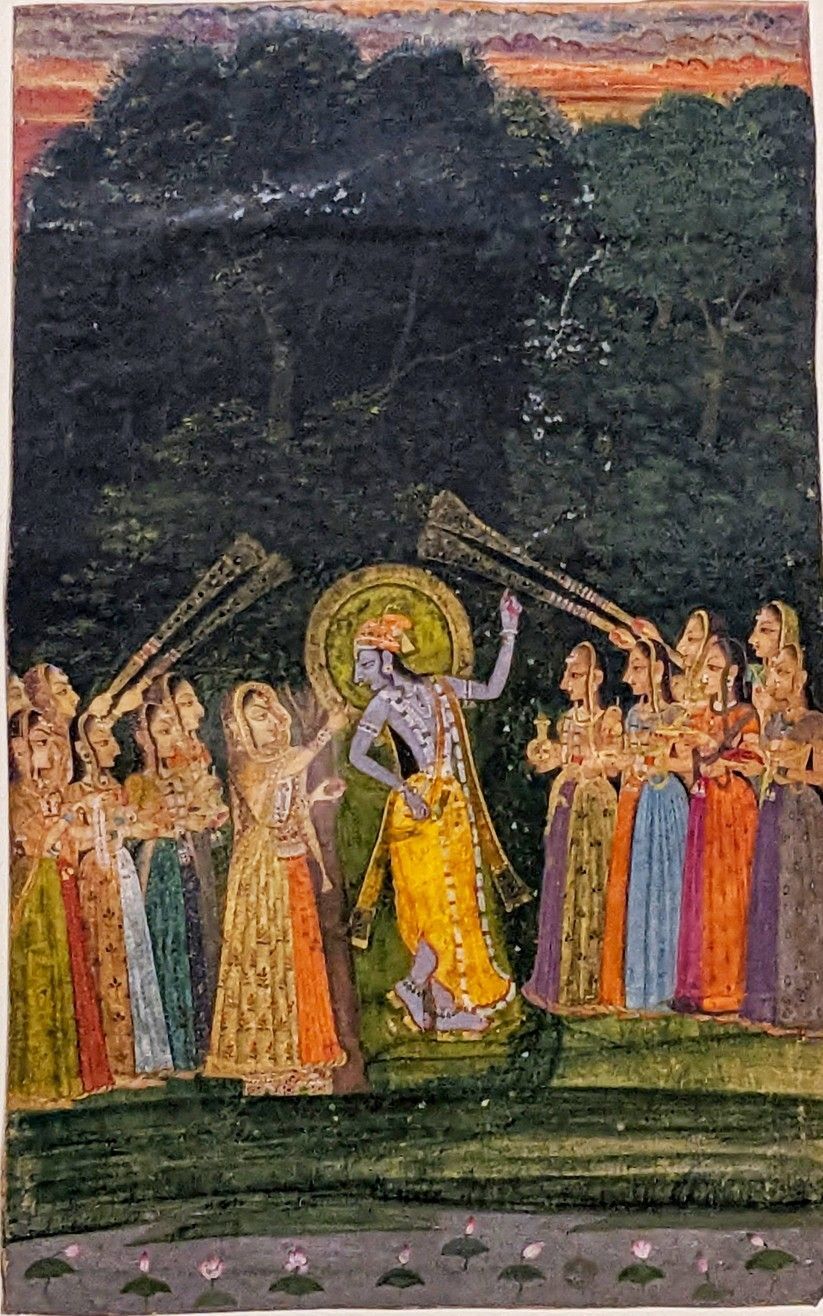
Sri Chaitanya-charitamrita tells the most important theological part of Venkata Bhatta's whole story at length and with care, in roughly eighty verses of Madhya-lila's ninth chapter. We follow it here in some detail, because the argument is more subtle than "Krishna is greater than Narayana." Krishnadasa Kaviraja Goswami opens by noting Mahaprabhu's own satisfaction. Seeing how sincerely Venkata Bhatta worshipped the Deities of Lakshmi and Narayana, "Sri Chaitanya Mahaprabhu was very satisfied" (Chaitanya-charitamrita, Madhya 9.109). This is not a story about false devotion being corrected. It begins from real devotion, which is then deepened.
The Question That Started Everything #
Mahaprabhu began, not with an argument, but with a tender observation: "Your worshipable goddess of fortune, Lakshmi, always remains on the chest of Narayana, and she is certainly the most chaste woman in the creation" (Madhya 9.111). And yet, He continued, this same Lakshmi left the comfort of Vaikuntha for long ages of austerity and regulated vows, all just for the chance of joining Krishna's rasa dance in Vraja (Madhya 9.113). If Narayana and Krishna are simply the same, why would such a perfectly chaste goddess need to go anywhere at all?
Venkata Bhatta's Scholarly Answer #
Venkata Bhatta answered as his training had prepared him to, with an exact verse on rasa. He argued that in ultimate truth there is no difference at all between the forms of Narayana and Krishna. Yet, he said, Krishna's form carries a special, superior sweetness (rasa) because of the conjugal mellow: "This is the conclusion of transcendental mellows" (Madhya 9.117). It was a learned and fully traditional answer. It was so exact that Krishnadasa Kaviraja Goswami adds a striking note of his own. This same verse appears in Rupa Gosvami's own Bhakti-rasamrta-sindhu (1.2.59). That is a text on the science of devotional rasa, which Rupa would not set out in writing as a system for another generation. In other words, Venkata Bhatta was already at home in the exact technical language of rasa-shastra that the Gaudiya Goswamis would later build into a full philosophy.
Widening the Question #
Instead of rejecting this answer, Mahaprabhu widened it, turning to Srimad-Bhagavatam itself. He described how the great sages and the personified Vedic hymns are said to have taken birth as gopis in Vraja. In doing so, they are said to have given up their own liberated status, purely to enter Krishna's company in Vraja's own intimate way (Madhya 9.128). He also quoted a verse still cited across the Gaudiya tradition today: "when Lord Sri Krishna was dancing with the gopis in the rasa-lila, the gopis were embraced around the neck by the Lord's arms. This transcendental favor was never bestowed upon the goddess of fortune or the other consorts in the spiritual world" (Srimad-Bhagavatam 10.47.60, quoted at Madhya 9.121). The point was not that Lakshmi's love is inferior in quality. The point was that the love of Vraja is an unguarded intimacy, free of any sense of opulence. It is a kind of love that even the goddess of fortune cannot enter, because she is bound to Narayana's majesty. She could enter it only by first giving up that very majesty, and this she does not do. A companion verse from Rupa Gosvami's own play Lalita-madhava-nataka makes the same point with an unforgettable image. Once Krishna playfully manifested a four-armed Narayana form before the gopis. Their love was fixed so completely on the two-armed cowherd boy of Nanda's Vraja, and not on any form of opulence at all, that their ecstatic feelings for Him were, in the text's own word, "crippled" (Madhya 9.150).
Surrender, Not Defeat #
What makes this exchange remarkable is how it ends. Venkata Bhatta does not simply admit that he has lost an argument. He surrenders. "The transcendental pastimes of the Lord are unfathomable, and I do not know anything about them," he says. "Whatever You say I accept as the truth" (Madhya 9.158). Srila Prabhupada's own purport compares this language directly to Arjuna's surrender in Bhagavad-gita 10.14, where Arjuna says much the same thing to Krishna Himself. Then Venkata Bhatta adds a line that shows exactly how Gaudiya Vaishnavism understands this whole episode: "I have been engaged in the service of Lakshmi-Narayana, and it is due to Their mercy that I have been able to see Your lotus feet" (Madhya 9.159). His years of sincere Sri Vaishnava worship were not thrown away as an error. They were honored as the very means by which Krishna's own mercy had reached him.
A Household Transformed tells what that surrender meant for his household in the days and years that followed. It also tells what it did not change about the great public temple of Sri Ranganatha itself. The broader and even warmer story of the friendship that made this whole conversation possible is in Mahaprabhu's Four-Month Stay.
Scriptural evidence for this chapter (7)
Quoted in the text above:
- Madhya 9.121 Sri Chaitanya-charitamrita
- Madhya 9.158 Sri Chaitanya-charitamrita
Further verses:
'śrī-vaiṣṇava' bhaṭṭa seve lakṣmī-nārāyaṇa
tāṅra bhakti dekhi' prabhura tuṣṭa haila mana
Word for word
śrī-vaiṣṇava: a devotee of the Rāmānuja-sampradāya; bhaṭṭa: Veṅkaṭa Bhaṭṭa; seve: used to worship; lakṣmī-nārāyaṇa: the Deities of Lakshmi and Narayana; tāṅra: his; bhakti: devotion; dekhi': seeing; prabhura: of Lord Chaitanya Mahaprabhu; tuṣṭa: happy; haila: became; mana: the mind.
Being a Vaishnava in the Ramanuja-sampradaya, Venkata Bhatta worshiped the Deities of Lakshmi and Narayana. Seeing his pure devotion, Sri Chaitanya Mahaprabhu was very satisfied.
Establishes that Mahaprabhu approached the conversation from evident respect for Venkata Bhatta's existing devotion, not as a corrective debate.
prabhu kahe, — bhaṭṭa, tomāra lakṣmī-ṭhākurāṇī
kānta-vakṣaḥ-sthitā, pativratā-śiromaṇi
Word for word
prabhu kahe: Lord Chaitanya Mahaprabhu said; bhaṭṭa: My dear Bhattacharya; tomāra: your; lakṣmī-ṭhākurāṇī: goddess of fortune; kānta-vakṣaḥ-sthitā: situated on the chest of her husband, Narayana; pati-vratā-śiromaṇi: the topmost chaste woman.
Sri Chaitanya Mahaprabhu told the Bhattacharya, "Your worshipable goddess of fortune, Lakshmi, always remains on the chest of Narayana, and she is certainly the most chaste woman in the creation."
The opening move of the whole conversation - framed as praise for Lakshmi, not as an attack on her position.
ei lāgi' sukha-bhoga chāḍi' cira-kāla
vrata-niyama kari' tapa karila apāra
Word for word
ei lāgi': for this reason; sukha-bhoga: the enjoyment of Vaikuṇṭha; chāḍi': giving up; cira-kāla: for a long time; vrata-niyama kari': accepting vows and regulative principles; tapa karila apāra: performed unlimited austerity.
Just to associate with Krishna, Lakshmi abandoned all transcendental happiness in Vaikuntha and for a long time accepted vows and regulative principles and performed unlimited austerities.
The pointed question at the heart of the exchange: why would perfect chastity in Vaikuntha need austerity to reach Krishna, if Krishna and Narayana are simply identical?
siddhāntatas tv abhede 'pi śrīśa-kṛṣṇa-svarūpayoḥ
rasenotkṛṣyate kṛṣṇa-rūpam eṣā rasa-sthitiḥ
Word for word
siddhāntataḥ: in reality; tu: but; abhede: no difference; api: although; śrī-īśa: of the husband of Lakshmi, Narayana; kṛṣṇa: of Lord Krishna; svarūpayoḥ: between the forms; rasena: by transcendental mellows; utkṛṣyate: is superior; kṛṣṇa-rūpam: the form of Lord Krishna; eṣā rasa-sthitiḥ: this is the reservoir of pleasure.
Venkata Bhatta continued, "According to transcendental realization, there is no difference between the forms of Narayana and Krishna. Yet in Krishna there is a special transcendental attraction due to the conjugal mellow, and consequently He surpasses Narayana. This is the conclusion of transcendental mellows."
From the purport: Purport excerpt: "This verse quoted by Venkata Bhatta is also found in the Bhakti-rasamrta-sindhu (1.2.59)."
Venkata Bhatta's own answer, given as a trained Sri Vaishnava scholar of rasa - the same verse Rupa Gosvami would independently include, a generation later, in his own systematic work on devotional aesthetics.
gopīnāṁ paśupendra-nandana-juṣo bhāvasya kas tāṁ kṛtī
vijñātuṁ kṣamate durūha-padavī-sañcāriṇaḥ prakriyām
āviṣkurvati vaiṣṇavīm api tanuṁ tasmin bhujair jiṣṇubhir
yāsāṁ hanta caturbhir adbhuta-ruciṁ rāgodayaḥ kuñcati
Word for word
gopīnām paśupa-indra-nandana-juṣaḥ bhāvasya: of the gopis' ecstasy in loving service to the son of Vraja's king; kaḥ kṛtī vijñātum kṣamate: what learned man is able to understand; durūha-padavī: very difficult to comprehend; āviṣkurvati vaiṣṇavīm tanum: when He manifested the form of Vishnu; bhujaiḥ jiṣṇubhiḥ caturbhiḥ: with four beautiful arms; adbhuta-rucim rāga-udayaḥ kuñcati: their wonderful evoking of ecstatic feelings became crippled.
Once Lord Sri Krishna playfully manifested Himself as Narayana, with four victorious hands and a very beautiful form. When the gopis saw this exalted form, their ecstatic feelings were crippled. A learned scholar cannot understand the gopis' ecstatic feelings, fixed as they are upon Krishna's original form as the son of Nanda Maharaja.
From the purport: Purport excerpt: "This is a verse spoken by Narada Muni in the Lalita-madhava-nataka (6.14), a drama written by Srila Rupa Gosvami."
A vivid image of exactly why the gopis' love is fixed on Krishna's two-armed cowherd form and not on any four-armed form of opulence, however magnificent.
Chapter 4
A Household Transformed
What Venkata Bhatta's surrender meant for his family, his son, and his years of Sri Vaishnava devotion.
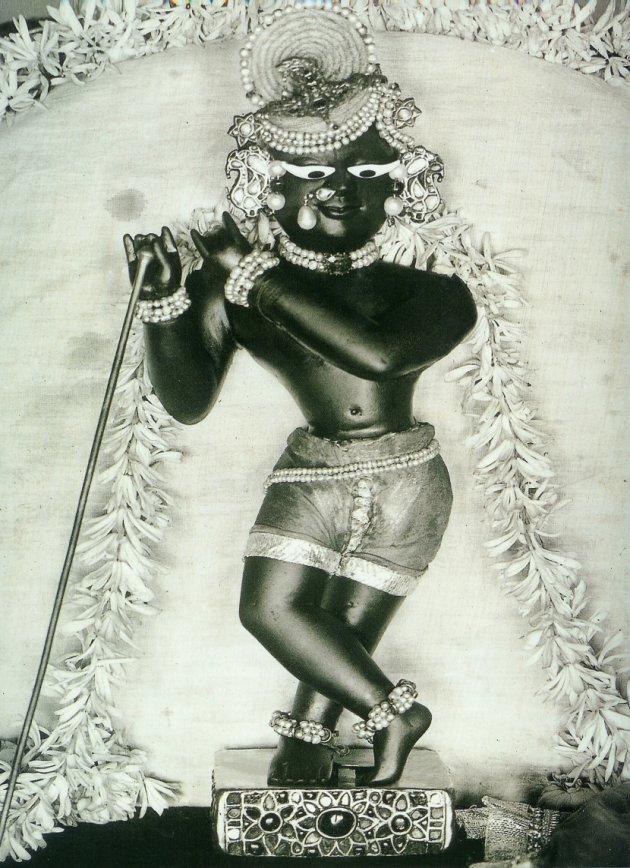
When Venkata Bhatta fell at Mahaprabhu's feet in surrender, it was not only his own turning point. Prabodhananda Saraswati's own biography records plainly that "by the time the four months ended, all three brothers... had made that same turn" from the worship of Lakshmi-Narayana toward Radha-Krishna bhakti. The three were Venkata Bhatta, Tirumalaya Bhatta, and the future Prabodhananda, together. For generations this household had been respected Sri Vaishnava priests. Now it found that its center of devotion had shifted toward Vraja, gently and without any sense of a break.
What Changed, and What Did Not #
Here we should be exact, and report what the sources actually say instead of smoothing the story into something tidier. Sri Chaitanya-charitamrita and the traditions built on it describe a personal change within one household. The Bhatta brothers' own private worship, study, and devotional focus turned toward Krishna. The sources do not record any change anywhere to the great public Sri Ranganatha temple itself. That temple has remained, without interruption, a major center of Sri Vaishnava worship of Vishnu down to the present day. Venkata Bhatta's conversion was real. It ran deep enough to reshape the religious lives of three brothers and, through his son, an entire branch of the Gaudiya sampradaya. But it was the conversion of a family, not of an institution, and the sources keep that difference clear.
Devotion Fulfilled, Not Discarded #
The theology behind this "conversion" is more careful than the word usually suggests. Sri Chaitanya-charitamrita does not describe Venkata Bhatta's years of Lakshmi-Narayana worship as wasted or mistaken. Venkata Bhatta himself says the opposite. He says that it was "by Their mercy" that he was able to see Mahaprabhu's own feet at all (Madhya 9.159). The change was not a rejection of everything that came before. It was the completion of it. The same sincerity that had gone into worshipping Vishnu's four-armed opulence now found a still more intimate focus in Krishna's own two-armed form as a cowherd boy of Vraja. Chaitanya-charitamrita describes this same pattern again and again across Mahaprabhu's South Indian tour. A person's earlier faith is not destroyed. Instead, its own deepest meaning is drawn out.
A Father Watching His Son Awaken #
The clearest sign of how completely the household's devotional life had turned came through the youngest member of the family. Venkata Bhatta's son Gopala, only seven or eight years old during Mahaprabhu's stay, had been serving the Lord continuously throughout the four months. As the visit finally drew to its close, the boy's visible grief moved Mahaprabhu to extend His stay further still. During those extra days Gopala received a vision, in which Mahaprabhu revealed His own identity as Krishna. He also spoke of two great souls, Rupa and Sanatana, whom the boy would one day meet in Vrindavana. This vision is already told in full on Gopala Bhatta Goswami's own page. Venkata Bhatta had been absorbed his whole life in the worship of Lakshmi-Narayana. For such a father, watching his young son receive so direct and personal a revelation of Krishna must have been a confirmation of its own kind. It was not an argument won. It was a mercy he saw for himself, inside his own home.
Fainting at the Parting #
How deeply things had changed was seen again, very clearly, when the four months finally ended and Mahaprabhu prepared to leave for good. Sri Chaitanya-charitamrita records the moment simply: "Venkata Bhatta did not want to return home but also wanted to go with the Lord. It was with great endeavor that Sri Chaitanya Mahaprabhu bade him farewell" (Chaitanya-charitamrita, Madhya 9.164). Then, in the chapter's own closing verse, "Venkata Bhatta fell down unconscious" from separation (Madhya 9.165). This was not the response of a scholar who had lost a debate. It was the grief of a man who, in four short months, had found something he could no longer imagine living without.
Toward Vrindavana, By a Different Road #
The family did not make the journey to Vrindavana together, and none of them went at once. Prabodhananda Saraswati left for the sacred forests of Vraja within a few years of this conversion. Gopala Bhatta went only after both his parents had died, following Mahaprabhu's own clear instruction that the boy first serve them at home. Venkata Bhatta himself, so far as any source records, never left Srirangam at all. Legacy and Family tells how the family's story continued from there. It continued through a brother who became one of the Gaudiya tradition's great poets, and a son who became one of its six founding Goswamis.
Scriptural evidence for this chapter (3)
Quoted in the text above:
- Madhya 9.164 Sri Chaitanya-charitamrita
Further verses:
more pūrṇa kṛpā kaila lakṣmī-nārāyaṇa
tāṅra kṛpāya pāinu tomāra caraṇa-daraśana
Word for word
more: unto me; pūrṇa kṛpā kaila: showed complete mercy; lakṣmī-nārāyaṇa: the Deity of Lakshmi and Narayana; tāṅra kṛpāya: by Their mercy; pāinu: I have gotten; tomāra caraṇa-daraśana: vision of Your lotus feet.
I have been engaged in the service of Lakshmi-Narayana, and it is due to Their mercy that I have been able to see Your lotus feet.
The theological key to the whole episode: Venkata Bhatta does not renounce his years of Lakshmi-Narayana worship as false, but credits that very devotion with bringing him to Krishna.
prabhura viyoge bhaṭṭa haila acetana
ei raṅga-līlā kare śacīra nandana
Word for word
prabhura viyoge: on account of separation from Sri Chaitanya Mahaprabhu; bhaṭṭa haila acetana: Venkata Bhatta became unconscious; ei raṅga-līlā: this pastime at Sri Ranga-kshetra; kare śacīra nandana: is performed by the son of mother Sachi.
When He did so, Venkata Bhatta fell down unconscious. Such are the pastimes of Lord Sri Chaitanya Mahaprabhu, the son of mother Sachi, at Sri Ranga-kshetra.
The closing verse of this entire episode in Sri Chaitanya-charitamrita - Venkata Bhatta's grief at the parting is the note the chapter itself chooses to end on.
Chapter 5
Legacy and Family
A brother who became a great poet, a son who became a Goswami, and a family line still traceable centuries later.
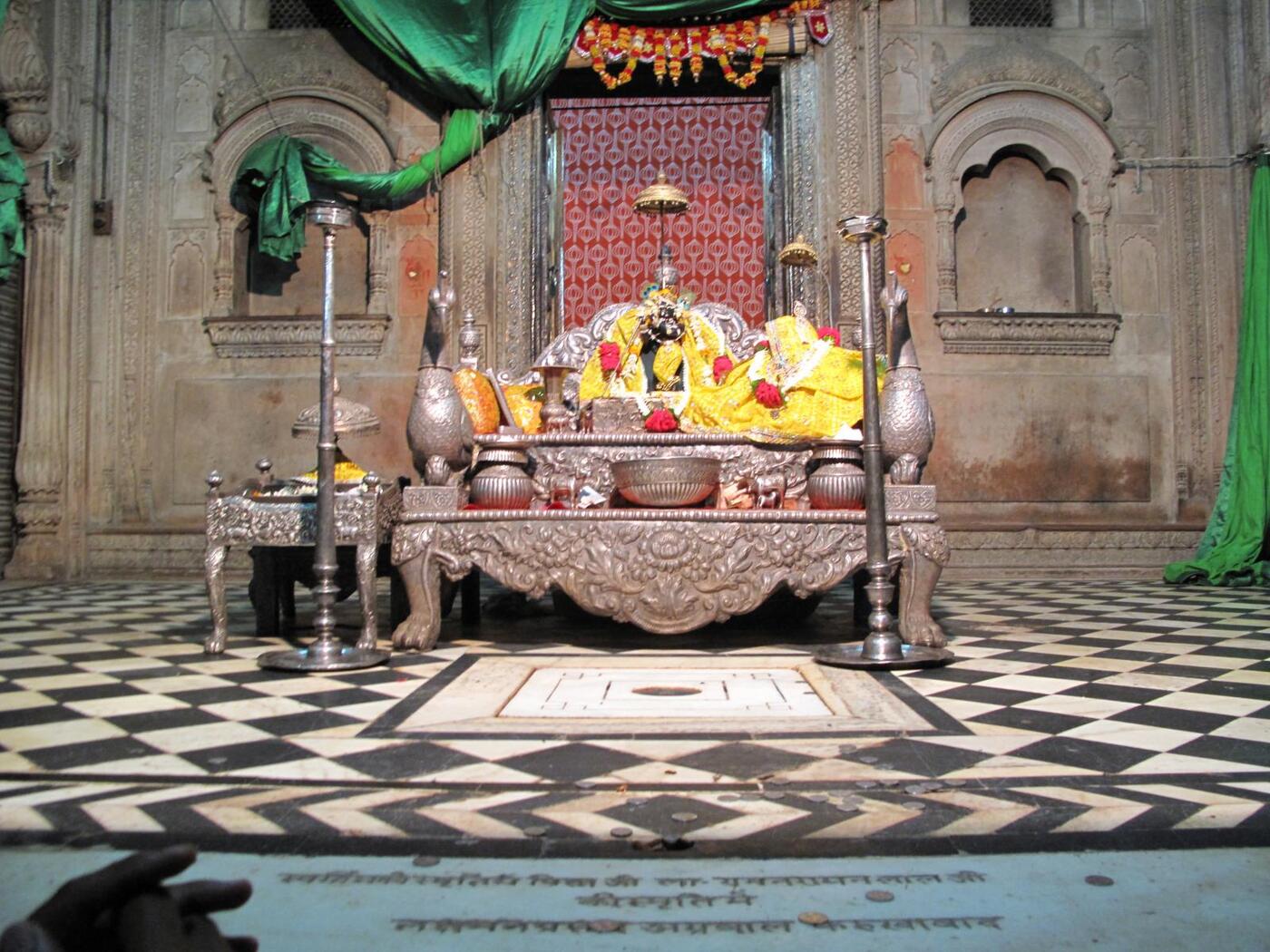
No source records where or when Venkata Bhatta himself passed away. Instead, he left two very different kinds of legacy. One is the great spiritual legacy carried forward by his brother and his son. The other is much smaller, but surprising. It is a thread of continuity at Srirangam itself that lasted into the twentieth century.
Two Brothers, Two Different Paths #
Venkata Bhatta's elder brother, the former Sri Vaishnava sannyasi Prabodhananda Saraswati, left Srirangam within a few years of Mahaprabhu's visit. He settled in Kamyavana, one of the twelve forests of Vraja. In time he became one of the most celebrated Sanskrit poets the Gaudiya tradition produced, and also guru to his own nephew. One point needs to be stated clearly, because people have confused it before. Venkata Bhatta and Prabodhananda Saraswati were two separate brothers, not two names for one person. Even Srila Prabhupada, in an informal 1969 lecture at New Vrindaban, briefly spoke of the two as one. But in his own carefully written purport to Sri Chaitanya-charitamrita, he makes it clear that Prabodhananda had two brothers, Venkata Bhatta and Tirumalaya Bhatta. Of the three, Tirumalaya Bhatta was the eldest and the head of the family, Prabodhananda came next, and Venkata Bhatta was the youngest. It was Venkata Bhatta's home that hosted Mahaprabhu. Prabodhananda Saraswati's own biography already warns about this "case of mistaken identity" as a mistake that later readers have made. The brief mix-up in that informal lecture is itself an example of it, and it shows that the warning is needed.
A Son Among the Six Goswamis #
Venkata Bhatta's son had a still larger destiny. After both his parents had died, Gopala Bhatta traveled to Vrindavana and took initiation from his uncle Prabodhananda Saraswati. He became Gopala Bhatta Goswami, one of the Six Goswamis who gave the Gaudiya Vaishnava tradition its philosophical and devotional foundations. The others were Rupa Gosvami, Sanatana Gosvami, Jiva Goswami, Raghunatha Bhatta Goswami, and Raghunatha Dasa Goswami. Gopala Bhatta went on to compile the Hari-bhakti-vilasa, the Gaudiya tradition's guidebook of Vaishnava conduct and ritual. He also established the worship of Sri Radha Raman in Vrindavana, still one of the seven principal temples of the holy town today. Every part of that later life - and the self-manifested Deity at its center - grew out of Venkata Bhatta's own household in Srirangam, which had, one Chaturmasya, opened its door to a wandering sannyasi.
A Fuller Written Record #
In his own purport to Sri Chaitanya-charitamrita, Srila Prabhupada directs readers who want to know more to the Bhakti-ratnakara of Narahari Chakravarti. This later Gaudiya Vaishnava history gives a fuller account of Gopala Bhatta Goswami's family than Chaitanya-charitamrita itself tries to give. As usual, Chaitanya-charitamrita is less interested in family history than in the moment of transformation itself. That is why so much more can be said about four months in A.D. 1511 than about the decades of Venkata Bhatta's life before and after them.
A House Still Called Mahaprabhu-shala #
The most striking part of Venkata Bhatta's legacy, though, comes from centuries later. In February 1976, two of Srila Prabhupada's own disciples visited Sri Rangam. Later, on a morning walk in Mayapur, they reported back to him. They told him that the leading priest of the great Sri Ranganatha temple there was "the descendant of Venkata Bhatta," and that his family home was still known as Mahaprabhu-shala, the hall of Mahaprabhu. It had this name because it was the very house where Sri Chaitanya Mahaprabhu had stayed four and a half centuries earlier. When Srila Prabhupada heard the name, he immediately connected it to Gopala Bhatta, "Caitanya Mahaprabhu's disciple," and the priest himself had reportedly written a warm letter supporting the preaching work of Prabhupada's students. Venkata Bhatta himself had left this world centuries before, but his family line and the memory of his household had, in a very real and surprising way, simply remained there all along.
Why This Story Survives at All #
We know these details because Krishnadasa Kaviraja Goswami, writing decades later, chose to describe Venkata Bhatta's four months with Mahaprabhu at great length. It is one of the longest single passages about any episode in Sri Chaitanya-charitamrita's account of the South India tour. Read together, Venkata Bhatta's own story, Gopala Bhatta Goswami's own biography, and Prabodhananda Saraswati's tell one family's story from three different sides: a father who stayed, a son who went to Vrindavana, and an uncle-brother who became one of the tradition's finest poets. Few families anywhere in the Gaudiya Vaishnava sampradaya are described from so many sides at once.
- Sri Chaitanya-charitamrita, Madhya-lila, Chapter 9 (vedabase.io)
- Srila Prabhupada, purport to CC Madhya 9.82 (family background, Vadagalai branch)
- Srila Prabhupada, Lecture, Srimad-Bhagavatam 1.5.8-9, New Vrindaban, May 24, 1969
- Srila Prabhupada, Morning Walk conversation, Mayapur, February 18, 1976
- Venkata Bhatta - Gaudiya History (ISKCON Desire Tree)
- Vyenkatta Bhatta - Biography - Gaudiya History (ISKCON Desire Tree)
