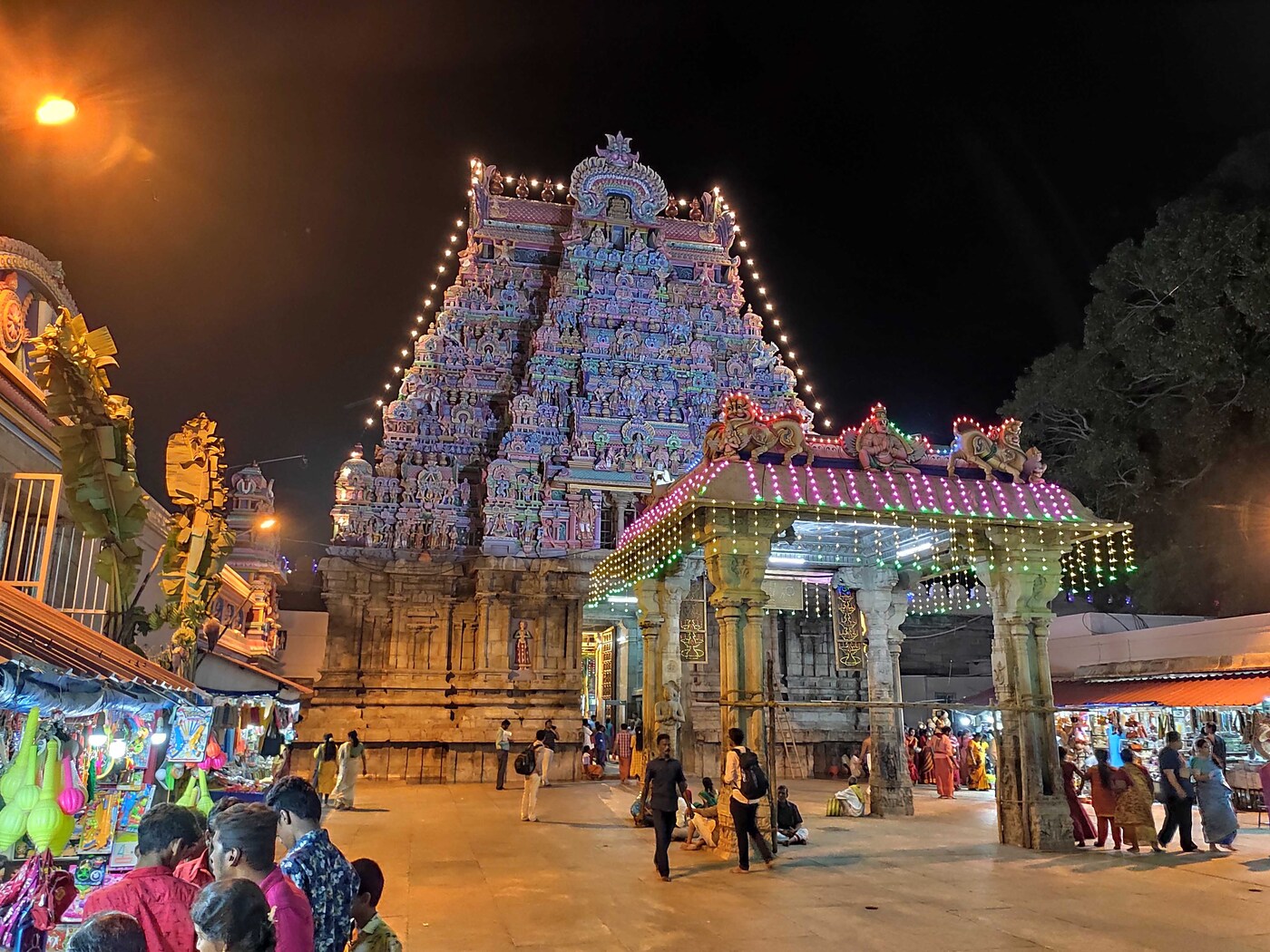
When Sri Chaitanya Mahaprabhu reached Srirangam during his long walking tour of South India, Venkata Bhatta sought Him out and invited Him home with unusual insistence. His own words are recorded in Sri Chaitanya-charitamrita: "Please be merciful to me and stay at my house during Chaturmasya. Speak about Lord Krishna's pastimes and kindly deliver me by Your mercy." It was an extraordinary request from a settled Sri Vaishnava householder to a wandering sannyasi he barely knew, and Mahaprabhu accepted it. The stay that followed lasted four full months. It became the longest single halt of the Lord's entire South Indian pilgrimage. By Srila Prabhupada's dating, it fell in 1433 Sakabda, or A.D. 1511 (a few secondary sources round this to 1510).
Why This Stay Stood Out #
Across the rest of His South Indian tour, Mahaprabhu generally kept to the wandering sannyasi's discipline of brief stops, simple bhiksha, and near-constant movement toward the next holy place. This tour is described more broadly on Sri Chaitanya Mahaprabhu's own South India Tour page. By that standard, a four-month halt in one household was extraordinary. It was long enough for Venkata Bhatta's home to become, in practice, a small, temporary center of sankirtana and Krishna-katha in the middle of Sri Vaishnava Srirangam. The fact that the Lord granted such a long stay at all says something about how quickly He saw Venkata Bhatta's sincerity.
An Unusual Honor #
Venkata Bhatta's deep reverence showed itself at once, in a small but telling detail. He brought Mahaprabhu to his own home, washed His feet, and then had every member of his family drink that water. This is a mark of the highest respect a Vaishnava household can pay a guest. From there the two men fell into an easy, constant companionship. Sri Chaitanya-charitamrita says they talked about Krishna without interruption. It also says that they sometimes simply laughed and joked together like old friends, not like a teacher and student arguing over doctrine. This detail says as much about Mahaprabhu's warmth as about Venkata Bhatta's own character. Mahaprabhu's Visit and a Father's Hospitality, on Gopala Bhatta Goswami's own pages, already tells the fuller story of that friendship from the boy's side. It also tells how Venkata Bhatta's own seven-year-old son served the Lord throughout these months.
A Slow Unveiling, Not a Single Debate #
It would be easy to imagine the whole four months as building toward one dramatic theological debate. But the text itself suggests something gentler and more gradual. Long before Mahaprabhu ever raised His pointed question about Lakshmi and Krishna, Venkata Bhatta was already having quiet devotional experiences he could not fully explain. In his own words, preserved in the text, he describes moments of spontaneous ecstatic happiness that came simply from hearing Krishna's pastimes described. In his mind's eye he saw Krishna instructing Arjuna on the battlefield, and he felt himself flooded with joy at the vision. Chaitanya-charitamrita states plainly that "the mind of the brahmana was purified by the revelation of Lord Krishna, and therefore he could understand the truth of Sri Chaitanya Mahaprabhu in all details". This purification is described as happening across the visit, not in a single conversation. By his tradition's own account, Venkata Bhatta's heart had already been prepared by the time the famous exchange about Lakshmi and Narayana actually took place.
Feeling Krishna's Presence Everywhere #
There is also a smaller, often-overlooked episode from this same stay. Even while He was a guest in Venkata Bhatta's own home, Mahaprabhu felt deep separation from His beloved Lord Jagannatha of Puri. In that mood He carved a small personal set of Jagannatha Deities. These images are still worshipped near the site of the Bhatta family home today. This shows that even during these four months of theological depth, Mahaprabhu's own devotional life never paused. His hosts were simply given a rare chance to see it closely.
Toward the Central Question #
The friendship, the small daily mercies and the slowly growing ecstasy all prepared the way for the conversation that would shape how later generations remember Venkata Bhatta at all. It was a patient, respectful dialogue that in the end brought deep change. The question was whether Krishna's own cowherd form could truly be superior to Lakshmi-Narayana's four-armed majesty. That exchange, verse by verse, is the subject of The Conversation on Krishna and Lakshmi-Narayana.
