No source records where or when Venkata Bhatta himself passed away. Instead, he left two very different kinds of legacy. One is the great spiritual legacy carried forward by his brother and his son. The other is much smaller, but surprising. It is a thread of continuity at Srirangam itself that lasted into the twentieth century.
Two Brothers, Two Different Paths #
Venkata Bhatta's elder brother, the former Sri Vaishnava sannyasi Prabodhananda Saraswati, left Srirangam within a few years of Mahaprabhu's visit. He settled in Kamyavana, one of the twelve forests of Vraja. In time he became one of the most celebrated Sanskrit poets the Gaudiya tradition produced, and also guru to his own nephew. One point needs to be stated clearly, because people have confused it before. Venkata Bhatta and Prabodhananda Saraswati were two separate brothers, not two names for one person. Even Srila Prabhupada, in an informal 1969 lecture at New Vrindaban, briefly spoke of the two as one. But in his own carefully written purport to Sri Chaitanya-charitamrita, he makes it clear that Prabodhananda had two brothers, Venkata Bhatta and Tirumalaya Bhatta. Of the three, Tirumalaya Bhatta was the eldest and the head of the family, Prabodhananda came next, and Venkata Bhatta was the youngest. It was Venkata Bhatta's home that hosted Mahaprabhu. Prabodhananda Saraswati's own biography already warns about this "case of mistaken identity" as a mistake that later readers have made. The brief mix-up in that informal lecture is itself an example of it, and it shows that the warning is needed.
A Son Among the Six Goswamis #
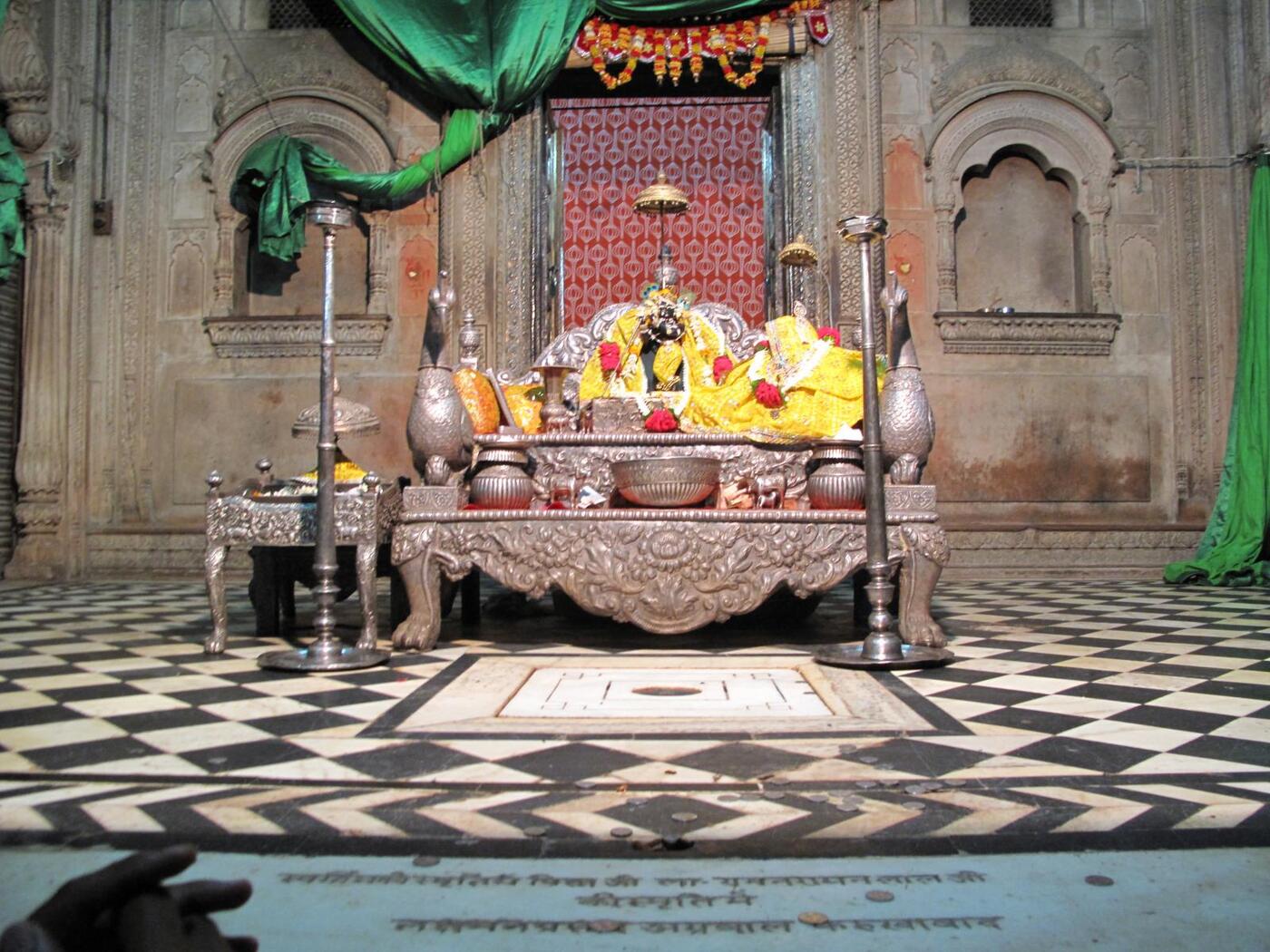
Venkata Bhatta's son had a still larger destiny. After both his parents had died, Gopala Bhatta traveled to Vrindavana and took initiation from his uncle Prabodhananda Saraswati. He became Gopala Bhatta Goswami, one of the Six Goswamis who gave the Gaudiya Vaishnava tradition its philosophical and devotional foundations. The others were Rupa Gosvami, Sanatana Gosvami, Jiva Goswami, Raghunatha Bhatta Goswami, and Raghunatha Dasa Goswami. Gopala Bhatta went on to compile the Hari-bhakti-vilasa, the Gaudiya tradition's guidebook of Vaishnava conduct and ritual. He also established the worship of Sri Radha Raman in Vrindavana, still one of the seven principal temples of the holy town today. Every part of that later life - and the self-manifested Deity at its center - grew out of Venkata Bhatta's own household in Srirangam, which had, one Chaturmasya, opened its door to a wandering sannyasi.
A Fuller Written Record #
In his own purport to Sri Chaitanya-charitamrita, Srila Prabhupada directs readers who want to know more to the Bhakti-ratnakara of Narahari Chakravarti. This later Gaudiya Vaishnava history gives a fuller account of Gopala Bhatta Goswami's family than Chaitanya-charitamrita itself tries to give. As usual, Chaitanya-charitamrita is less interested in family history than in the moment of transformation itself. That is why so much more can be said about four months in A.D. 1511 than about the decades of Venkata Bhatta's life before and after them.
A House Still Called Mahaprabhu-shala #
The most striking part of Venkata Bhatta's legacy, though, comes from centuries later. In February 1976, two of Srila Prabhupada's own disciples visited Sri Rangam. Later, on a morning walk in Mayapur, they reported back to him. They told him that the leading priest of the great Sri Ranganatha temple there was "the descendant of Venkata Bhatta," and that his family home was still known as Mahaprabhu-shala, the hall of Mahaprabhu. It had this name because it was the very house where Sri Chaitanya Mahaprabhu had stayed four and a half centuries earlier. When Srila Prabhupada heard the name, he immediately connected it to Gopala Bhatta, "Caitanya Mahaprabhu's disciple," and the priest himself had reportedly written a warm letter supporting the preaching work of Prabhupada's students. Venkata Bhatta himself had left this world centuries before, but his family line and the memory of his household had, in a very real and surprising way, simply remained there all along.
Why This Story Survives at All #
We know these details because Krishnadasa Kaviraja Goswami, writing decades later, chose to describe Venkata Bhatta's four months with Mahaprabhu at great length. It is one of the longest single passages about any episode in Sri Chaitanya-charitamrita's account of the South India tour. Read together, Venkata Bhatta's own story, Gopala Bhatta Goswami's own biography, and Prabodhananda Saraswati's tell one family's story from three different sides: a father who stayed, a son who went to Vrindavana, and an uncle-brother who became one of the tradition's finest poets. Few families anywhere in the Gaudiya Vaishnava sampradaya are described from so many sides at once.