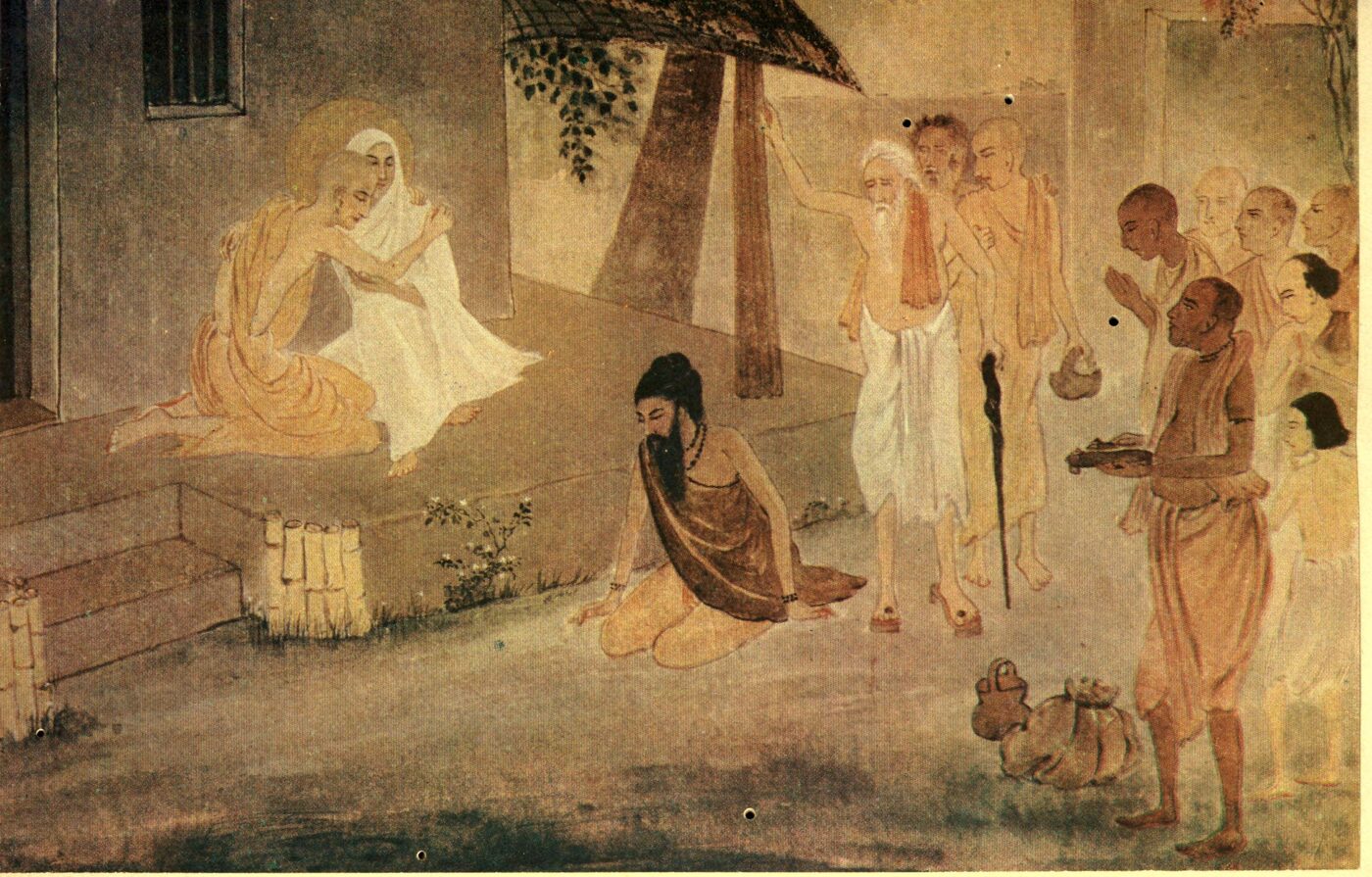
Marriage came to Nimai in the ordinary way and at the ordinary age. The bride was Lakshmipriya, also called Lakshmidevi, the daughter of Vallabhacharya of Nabadwip, from a respectable brahmana family of the town. The Chaitanya-charitamrita places the marriage after the death of Jagannatha Mishra, so Sachi Devi, a widow with little money, arranged it. The biographies say the match was proposed after Sachi Devi saw her son and the girl meeting near the Ganges. They record the wedding as a simple and entirely traditional one. Nimai was in His middle teens, and His wife was younger still.
Detail
Description
First wife
Lakshmipriya, also called Lakshmidevi, daughter of Vallabhacharya of Nabadwip
Her passing
Bitten by a serpent while Nimai was teaching in East Bengal
Second wife
Vishnupriya, daughter of Sanatana Mishra, the raja-pandita
Arranged by
Sachi Devi, after the death of Jagannatha Mishra
Duration
A householder until He accepted sannyasa at twenty-four
What followed was just as ordinary. Nimai was a young brahmana pandit with a school of His own, and He had a widowed mother and a wife to support. He needed an income, and teaching grammar in Nabadwip did not provide much of one. So Nimai did what many Bengali scholars of that time did. He travelled east, into what is now Bangladesh, to teach and to seek the support of wealthy men there. The sixteenth chapter of the Chaitanya-charitamrita records that the journey had three purposes. They were to get financial help, to continue His own study, and to introduce sankirtana, which was important for what was to come. Even at this stage, before the transformation at Gaya, there are signs in the record that He was already teaching people in East Bengal to chant.
On this journey He met Tapana Mishra, a brahmana who was troubled about the goal of life and came to Nimai for guidance. Nimai instructed him in devotional service and told him to go and live at Varanasi. The instruction seems strange until one knows what happened later. Years later, when Mahaprabhu came to Varanasi as a sannyasi to challenge the Mayavadi scholars of that city, He took His meals in Tapana Mishra's house. Tapana Mishra's son Raghunatha served Him there. The tradition reads the episode as an early example of the Lord arranging His own future circumstances well in advance.
While Nimai was still in East Bengal, Lakshmidevi died at home in Nabadwip. The Chaitanya-charitamrita states that she was bitten by a serpent. As he often does, Krishnadasa Kaviraja leaves the phrase open. Gaudiya commentators have long read it as the serpent of separation, meaning that she could not survive being parted from Him. She was very young. In a few short years the household had lost a father, an elder son and a daughter-in-law. Nimai returned to that household, and to a mother whose grief the biographers describe as it was, without any attempt to soften it.
It was Sachi Devi who insisted on a second marriage. Nimai agreed to it out of respect for her, not out of any desire of His own. The bride this time was Vishnupriya, daughter of Sanatana Mishra. Sanatana Mishra was a scholar of high standing who held the position of raja-pandita, court pandit. His household was far richer than that of the widow Sachi Devi. So the marriage was a much grander occasion than the first. Vaishnava accounts describe at length the procession, the assembled pandits, and the astonishment of Nabadwip that the most brilliant young scholar in the town should be marrying into its most distinguished family.
The household life that followed lasted only a few years, and the tradition remembers these years with a special tenderness. As a grihastha, Nimai taught in the morning and came back to a house where His mother and His wife waited. He argued with pandits in the street. In every outward detail His life was quite ordinary. This was the last period in which He belonged to anyone in the ordinary human way. Vaishnavas note that, by every account, He was an attentive son and a considerate husband, and that nothing in His conduct as a householder was lacking or half-hearted. This matters to the tradition because of what came next. When He renounced it all at twenty-four, walking out at night without a farewell, He was not abandoning a life that had disappointed Him or a family He had failed. He was giving up something that was still whole.
Vishnupriya survived Him by many decades. Vaishnava literature records that she remained in Nabadwip after His departure, living in great austerity. She worshipped a Deity of her husband and chanted on tulasi beads. For each round she completed, she set aside one grain of rice, and in the evening she cooked only what she had counted out that day. In Gaudiya Vaishnavism she is honoured not as a wife who was left behind, but as the living form of bhakti in separation. This is the mood in which Mahaprabhu Himself would live for the last years of His life at Puri.
The Lord's own stated reason for marrying: without a wife, household life has no meaning
দৈবে এক দিন প্রভু পড়িয়া আসিতে ।
বল্লভাচার্যের কন্যা দেখে গঙ্গা–পথে ॥ ২৮ ॥
daive eka dina prabhu paḍiyā āsite
vallabhācāryera kanyā dekhe gaṅgā-pathe
Word for word
daive: accidentally; eka dina: one day; prabhu: the Lord; paḍiyā: after studying; āsite: while He was coming back; vallabhācāryera: of Vallabhācārya; kanyā: daughter; dekhe: sees; gaṅgā-pathe: on the way to the Ganges.
One day when the Lord was coming back from school He accidentally saw the daughter of Vallabhācārya on the way to the Ganges.
śacīra iṅgite: by the indication of mother Śacī; sambandha: the relationship; karila: made; ghaṭana: possible; lakṣmīke: unto Lakṣmīdevī; vivāha: marriage; kaila: executed; śacīra nandana: the son of mother Śacī.
Following the indications of Śacīdevī, Vanamālī Ghaṭaka arranged the marriage, and thus in due course the Lord married Lakṣmīdevī.
kata dine kaila prabhu baṅgete gamana
yāhāṅ yāya, tāhāṅ laoyāya nāma-saṅkīrtana
Word for word
kata dine: after a few days; kaila: did; prabhu: the Lord; baṅgete: in East Bengal; gamana: touring; yāhāṅ yāya: wherever He goes; tāhāṅ: there; laoyāya: induces; nāma-saṅkīrtana: the saṅkīrtana movement.
After some days the Lord went to East Bengal, and wherever He went He introduced the saṅkīrtana movement.
He goes to East Bengal and introduces sankirtana wherever He travels
সেই দেশে বিপ্র, নাম—মিশ্র তপন ।
নিশ্চয় করিতে নারে সাধ্য–সাধন ॥ ১০ ॥
sei deśe vipra, nāma — miśra tapana
niścaya karite nāre sādhya-sādhana
Word for word
sei deśe: in that region of East Bengal; vipra: a brāhmaṇa; nāma: named; miśra tapana: Tapana Miśra; niścaya karite: to ascertain; nāre: not able; sādhya: objective; sādhana: process.
In East Bengal there was a brāhmaṇa named Tapana Miśra, who could not ascertain the objective of life or how to attain it.
tāṅra icchā: his desire; prabhu-saṅge: with the Lord; navadvīpe: in Navadvīpa; vasi: I live there; prabhu ājñā dila: but the Lord advised him; tumi: you; yāo: go; vārāṇasī: to Benares.
Tapana Miśra desired to live with the Lord in Navadvīpa, but the Lord asked him to go to Vārāṇasī [Benares].
prabhura: of the Lord; viraha-sarpa: the separation snake; lakṣmīre: Lakṣmīdevī; daṁśila: bit; viraha-sarpa: of the separation snake; viṣe: by the poison; tāṅra: her; para-loka: next world; haila: it so happened.
The snake of separation bit Lakṣmīdevī, and its poison caused her death. Thus she passed to the next world. She went back home, back to Godhead.
ghare: home; āilā: returned; prabhu: the Lord; bahu: much; lañā: bringing; dhana: riches; jana: followers; tattva-jñāne: by transcendental knowledge; kailā: did; śacīra: of Śacīmātā; duḥkha: the unhappiness; vimocana: relieving.
When the Lord returned home, bringing with Him great wealth and many followers, He spoke to Śacīdevī about transcendental knowledge to relieve her of the grief she was suffering.
He returns and speaks transcendental knowledge to console Sachidevi
তবে বিষ্ণুপ্রিয়া–ঠাকুরাণীর পরিণয় ।
তবে ত’ করিল প্রভু দিগ্বিজয়ী জয় ॥ ২৫ ॥
tabe viṣṇupriyā-ṭhākurāṇīra pariṇaya
tabe ta’ karila prabhu digvijayī jaya
Word for word
tabe: after this; viṣṇupriyā: Viṣṇupriyā; ṭhākurāṇīra: of the goddess of fortune; pariṇaya: marriage; tabe ta’: thereafter; karila: did; prabhu: the Lord; dig-vijayī: the champion; jaya: conquer.
Then Lord Caitanya married Viṣṇupriyā, the goddess of fortune, and thereafter He conquered a champion of learning named Keśava Kāśmīrī.
Our editorial team comprises trained devotees and researchers of the Hare Krishna Movement, Kota, who follow this same disciplic tradition in daily practice. Every biography is carefully researched, fact-checked against Vedic scriptures, and cites its sources.
Reviewed by
Temple & Scriptural Research Team
Each biography undergoes a detailed review by our senior devotees and scriptural researchers to verify factual accuracy and ensure alignment with Vaishnava philosophy and Srila Prabhupada's teachings.