Bhojana-thālī (Kāmyavana)
भोजन-थाली (काम्यवन)
Also called Bhojana-sthalī
- What it is
- Bhojana-thālī, "the place of the meal plate", is a rocky hill in Kāmyavana, near Vyomāsura's cave.
- Visiting
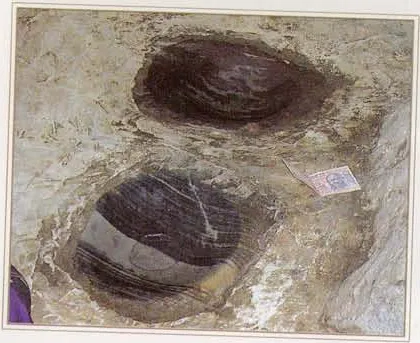
- The guidebooks describe marks in the rock that are still shown to pilgrims: Śrī Vraja-maṇḍala Parikramā (2007) speaks of the marks of a plate (thāla) and of cups on the hill where Kṛṣṇa and His …
- Places here
- Bhojana-thālī Mandira, Bajanī-śilā (Kāmyavana), Avantikā-kuṇḍa, Gupta-gaṅgā, Haridvāra-kuṇḍa +9 more
In short
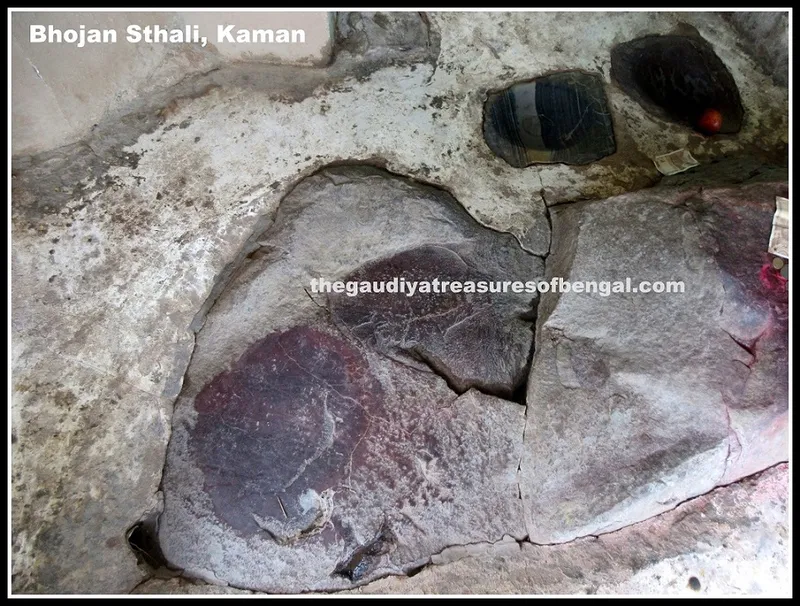
Bhojana-thālī, "the place of the meal plate", is a rocky hill in Kāmyavana, near Vyomāsura's cave.[1 +3] According to the Bhakti-ratnākara, Kṛṣṇa enjoyed a meal here with His friends, and Śrīla Nārāyaṇa Bhaṭṭa Gosvāmī's Vraja-bhakti-vilāsa calls the place a stone marked by the palms of Kṛṣṇa in His eight-year-old form.[4 +2] The modern guidebooks show pilgrims the marks of a plate and cups in the rock.[1 +2] Śrīmad-Bhāgavatam describes such a forest meal of Kṛṣṇa and the cowherd boys on another occasion, on the bank of the Yamunā, and does not name this hill.[7 +2]
Key facts
Divine pastimes
Śrīmad-Bhāgavatam (10.13) tells of a lunch in the forest. The boys set their food on flowers, leaves, bark and rocks, and Kṛṣṇa sat in their midst, joking with them as He ate, while the demigods watched in wonder. This meal took place on the sandy bank of the Yamunā, just before Brahmā stole the calves and boys; no source connects this verse with Kāmyavana, but it is the Bhāgavatam's picture of the kind of meal remembered here.[7 +2]
Holding in His hand a very nice preparation of yogurt and rice, with pieces of suitable fruit between His fingers, He sat like the whorl of a lotus flower, looking forward toward all His friends, personally joking with them and creating jubilant laughter among them as He ate. At that time, the denizens of heaven were watching, struck with wonder at how the Personality of Godhead, who eats only in yajña, was now eating with His friends in the forest.
Translation: Śrīla A.C. Bhaktivedanta Swami PrabhupādaŚrīla Prabhupāda tells the same lunch in his Kṛṣṇa book:[7 +2]
General teaching (does not name the place)“The boys collected flowers, leaves of flowers and the bark of trees and placed their lunch on them, as well as in their lunch boxes, and thus they began to eat their lunch, keeping company with Kṛṣṇa.”
Śrīla Prabhupāda, Kṛṣṇa, the Supreme Personality of Godhead (Kṛṣṇa book), Chapter 13, 'The Stealing of the Boys and Calves by Brahmā' · vedabase.io
The guidebooks connect the meal at Bhojana-thālī with the killing of the demon Vyoma, which the Bhāgavatam (10.37) tells without naming a hill and without any meal afterwards; there Kṛṣṇa frees the boys from the cave and returns to Gokula.[10 +2] Where that killing took place is itself disputed: Śrīla Jīva Gosvāmī and the Bhakti-ratnākara set it at a hill of Kāmyavana, while Śrīla Prabhupāda's Kṛṣṇa book sets it on Govardhana Hill. The accounts are shown on the page of Vyomāsura's cave.[13 +2]
Traditional accounts
According to the Bhakti-ratnākara (Fifth Wave), Śrīla Rāghava Paṇḍita Gosvāmī of Govardhana showed Śrīla Śrīnivāsa Ācārya and …
According to the Bhakti-ratnākara (Fifth Wave), Śrīla Rāghava Paṇḍita Gosvāmī of Govardhana showed Śrīla Śrīnivāsa Ācārya and Śrīla Narottama dāsa Ṭhākura Bhojana-sthalī in Kāmyavana, where Kṛṣṇa enjoyed the fun of a meal with His sakhās, His cowherd friends (summarised here, not translated). The book gives no occasion for the meal.[4]
দেখহ ভোজনস্থলী কৃষ্ণ এই খানে। করিলেন ভোজনকৌতুক সখা সনে॥
dekhaha bhojanasthalī kṛṣṇa ei khāne| karilena bhojanakautuka sakhā sane||
The Vraja-bhakti-vilāsa lists Bhojana-sthala among the places of Kāmyavana right after the place of Vyomāsura's cave. Its prayer for the place, which it ascribes to the Viṣṇu-dharmottara, addresses it as marked by the palms of eight-year-old Kṛṣṇa and as always increasing enjoyment. The book tells the pilgrim to feed the family deities and brāhmaṇas here, and honours a place made by Lalitā on the western side of "the stone of the meal" (summarised here, not translated).[5 +1]
ततो भोजनस्थलप्रार्थनमन्त्रः । विष्णुधर्म्मोत्तरे— अष्टवर्षस्वरूपाढ्य कृ[ष्ण]पाणितलांकित ! । नमोऽस्तु भोजनस्थल सर्वदा भोगवर्द्धन ! … भोजनस्य शिलायां तु भागपश्चिमभूषिते । ललितानिर्म्मिते स्थाने नमस्ते प्रियवल्लभे ! ॥
tato bhojanasthalaprārthanamantraḥ
viṣṇudharmmottare— aṣṭavarṣasvarūpāḍhya kṛ[ṣṇa]pāṇitalāṁkita !
namo'stu bhojanasthala sarvadā bhogavarddhana ! … bhojanasya śilāyāṁ tu bhāgapaścimabhūṣite
lalitānirmmite sthāne namaste priyavallabhe ! ||
The guidebook Vṛndāvana-Dhāma Ki Jaya! (c. 1986) says that Kṛṣṇa and His friends would often take their packed lunch in this part of Vraja and that the marks of His plate can still be seen here.[3 +1]
The Nārada Purāṇa names a Bhojana-sthala in its list of the holy places of Vṛndāvana, but tells no story of it and does not say where it is; no source read connects it with this hill.[19]
Paraśurāma's place of austerities
The place of Lord Paraśurāma is a spot on or near the hill. According to the Bhakti-ratnākara (Fifth Wave) of Śrīla Narahari Cakravartī Ṭhākura, Śrīla Rāghava Paṇḍita Gosvāmī, on his tour of Kāmyavana with Śrīla Śrīnivāsa Ācārya and Śrīla Narottama dāsa Ṭhākura, showed them this place right after the Bājana-śilā. He told them to take darśana of the place where Paraśurāma stayed, where Nārāyaṇa sat on a throne (summarised here, not translated). The couplet does not call it a place of austerities and does not say that it is on the Bhojana-thālī hill.[20]
The modern guidebooks describe it as the place where Paraśurāma performed austerities and worshipped the Lord, and they differ on where it is (see below).[20] Śrīmad-Bhāgavatam tells Paraśurāma's life in its Ninth Canto and closes by saying that he still lives in the mountains called Mahendra, having laid down the weapons of a kṣatriya. This does not rule out a stay in Vraja, but it names no place of his here.[21]
āste 'dyāpi mahendrādrau nyastadaṇḍaḥ praśāntadhīḥ / upagīyamānacaritaḥ siddhagandharvacāraṇaiḥ
Lord Paraśurāma still lives as an intelligent brāhmaṇa in the mountainous country known as Mahendra. Completely satisfied, having given up all the weapons of a kṣatriya, he is always worshiped, adored and offered prayers for his exalted character and activities by such celestial beings as the Siddhas, Cāraṇas and Gandharvas.
Translation: Śrīla A.C. Bhaktivedanta Swami PrabhupādaVisiting today
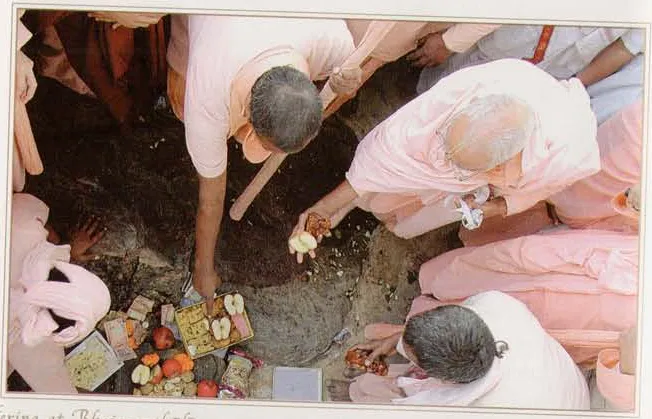
The guidebooks describe marks in the rock that are still shown to pilgrims: Śrī Vraja-maṇḍala Parikramā (2007) speaks of the marks of a plate (thāla) and of cups on the hill where Kṛṣṇa and His friends ate, and shows photographs of them with offerings placed on them; another guide speaks of bowls and plates pressed into the rock. These are reports of the guidebooks, not checked on site.[1 +2]
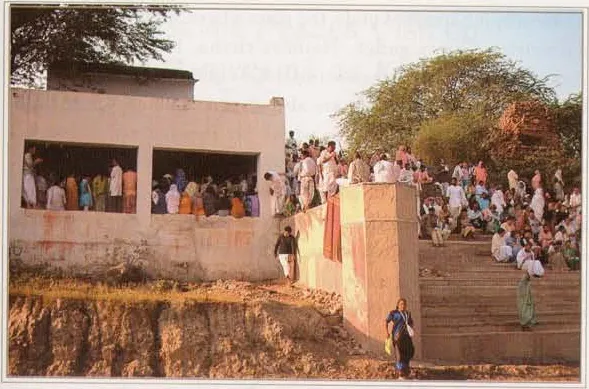
- Bhojana-thālī Temple (Bhojana-thālī Temple): Śrī Vraja-maṇḍala Parikramā (2007) knows it only from a photograph, taken from Kṛṣṇa-kuṇḍa, of a whitewashed building with a long open veranda on a high plinth beside broad stone steps; its text describes no temple here.[1] In 1987 the historian A. W. Entwistle described a Śiva temple above the rocks, with old pieces of sculpture in its walls and a porch whose inscription, he reported, records its construction in 1843. It may be the same building, but he does not say so, and the inscription itself could not be checked.[22]
Location
| Where it is | a short distance from the cave[23] 'Across the road from the rock slide and Vyomasura's cave'[2] |
|---|
Places at Bhojana-thālī (Kāmyavana)
14 places
- ↳Bhojana-thālī Mandiratemple›
- ↳Bajanī-śilā (Kāmyavana)śilā›
- ↳Avantikā-kuṇḍakuṇḍa›
- ↳Gupta-gaṅgākuṇḍa›
- ↳Haridvāra-kuṇḍakuṇḍa›
- ↳Govinda-kuṇḍa (Kāmyavana)kuṇḍa›
- ↳Kṣīrasāgara (Bhojana-thālī)kuṇḍa›
- ↳Matsya-kuṇḍakuṇḍa›
- ↳Naimiṣa-tīrthatīrtha›
- ↳Nṛsiṁha-kuṇḍakuṇḍa›
- ↳Prahlāda-kuṇḍakuṇḍa›
- ↳Śāntanu-kuṇḍa (Kāmyavana)kuṇḍa›
- ↳Paraśurāma's place of austerities (Bhojana-thālī)place of austerities›
- ↳Kṛṣṇa's sitting place (Bhojana-thālī)pastime site›
Nearby places
Vyomāsura's cave · Kṣīrasāgara (Meherāna-gaon)
Pictures
4 pictures
Where the sources differ
Accounts differ What Kṛṣṇa did right after killing Vyomāsura, and on what occasion He ate at Bhojana-thālī.
- Śrīmad-Bhāgavatam 10.37.33Kṛṣṇa freed the boys from the cave and, praised by the demigods and cowherd boys, returned to Gokula; no bath or meal is mentioned.
- Śrīla Prabhupāda, Kṛṣṇa book ch. 37"He again returned to Vṛndāvana with His cows and friends."
- Śrīla Jīva Gosvāmī, Gopāla-campū, Pūrva-campū 10 (vv.24-28)Kṛṣṇa broke open the cave, freed the boys and, met by His friends and seen by the demigods, entered Vraja (v.28); no bath or meal is mentioned.
- Śrī Vraja-maṇḍala Parikramā (2007)After killing Vyomāsura Kṛṣṇa bathed in Kṣīrasāgara (Kṛṣṇa-kuṇḍa) and ate at Bhojana-thālī with the sakhās; then they played music on a stone on a nearby hill.
Accounts differ How far Bhojana-thālī is from Vyomāsura's cave.
- the undated parikramā notes Kāmyavana"Across the road from the rock slide and Vyomasura's cave is Bhojan Sthali."
- Śrī Vraja-maṇḍala Parikramā (2007)"Some distance from Vyomāsura's cave is Bhojana-thālī."
- Vṛndāvana-Dhāma Ki Jaya! (c. 1986)"A short distance from here [the cave] is Bhojana-sthalī."
Where Paraśurāma's place of austerities is: the guidebooks place it differently.[20]
Accounts differ Where Paraśurāma's place is and what it is.
- Śrī Vraja-maṇḍala Parikramā (2007)"On the hill at Bhojana-thālī is the place where Śrī Parasurāma performed austerities and worshipped the Supreme Lord."
- the undated parikramā notes Kāmyavana"Situated nearby on a small hill behind Bhojana Thali is the place where Lord Parashurama once performed austerities."
- Bhakti-ratnākara v.876 (printed p. 217)The place where Paraśurāma stayed (sthiti-sthāna), where Nārāyaṇa sat on a throne; shown after the Bājana-śilā, no hill named.
References
23 references
- Śrī Vraja-maṇḍala Parikramā (2007), PDF p. 159
- the undated parikramā notes Kāmyavana, ¶74
- Vṛndāvana-Dhāma Ki Jaya! (c. 1986), by Dhruva Mahārāja dāsa, PDF p. 46
- Śrīla Narahari Cakravartī, Bhakti-ratnākara, Fifth Wave, 1912 ed. p. 217; Grantha Mandira text v.874, 2nd ed., 1912
- Śrīla Nārāyaṇa Bhaṭṭa, Vraja-bhakti-vilāsa, ch. 2, Kāmyavana list v.47, printed p. 49; Grantha Mandira text (2) part 13 v.47, 1st ed., publ. Bābā Kṛṣṇadāsa, Kusuma-sarovara, Saṁvat 2008
- Śrīla Nārāyaṇa Bhaṭṭa, Vraja-bhakti-vilāsa, ch. 9 vv.16-17, printed p. 192; Grantha Mandira text (9) vv.16-17, 1st ed., publ. Bābā Kṛṣṇadāsa, Kusuma-sarovara, Saṁvat 2008
- Śrīmad-Bhāgavatam 10.13.9, Bhagavata Vidya Pith edition, ed. Bhagavata Rishi and Krishna Shankar Shastri, 1996
- Śrīmad-Bhāgavatam 10.13.11, Bhagavata Vidya Pith edition, ed. Bhagavata Rishi and Krishna Shankar Shastri, 1996
- Śrīla Prabhupāda, Kṛṣṇa, the Supreme Personality of Godhead (Kṛṣṇa book), Chapter 13, 'The Stealing of the Boys and Calves by Brahmā' · vedabase.io
- Śrīmad-Bhāgavatam 10.37.26, Bhagavata Vidya Pith edition, ed. Bhagavata Rishi and Krishna Shankar Shastri, 1996
- Śrīmad-Bhāgavatam 10.37.29, Bhagavata Vidya Pith edition, ed. Bhagavata Rishi and Krishna Shankar Shastri, 1996
- Śrīmad-Bhāgavatam 10.37.33, Bhagavata Vidya Pith edition, ed. Bhagavata Rishi and Krishna Shankar Shastri, 1996
- Gopāla-campū, Pūrva-campū (10) ¶[62]
- Śrīla Narahari Cakravartī, Bhakti-ratnākara, Fifth Wave, 1912 ed. p. 217; Grantha Mandira text v.881, 2nd ed., 1912
- Śrīla Prabhupāda, Kṛṣṇa, the Supreme Personality of Godhead (Kṛṣṇa book), Chapter 38, 'Akrūra's Arrival in Vṛndāvana' · vedabase.io
- Śrīla Narahari Cakravartī, Bhakti-ratnākara, Fifth Wave, 1912 ed. p. 217; Grantha Mandira text v.874, 2nd ed., 1912
- Śrīla Nārāyaṇa Bhaṭṭa, Vraja-bhakti-vilāsa, ch. 9 vv.16-17, printed p. 192; Grantha Mandira text (9) vv.16-17, 1st ed., publ. Bābā Kṛṣṇadāsa, Kusuma-sarovara, Saṁvat 2008
- Vṛndāvana-Dhāma Ki Jaya! (c. 1986), by Dhruva Mahārāja dāsa, PDF p. 47
- Nārada Purāṇa, Uttara-bhāga 80.74
- Śrīla Narahari Cakravartī, Bhakti-ratnākara, Fifth Wave, 1912 ed. p. 217; Grantha Mandira text v.876, 2nd ed., 1912
- Śrīmad-Bhāgavatam ŚB 9.16.26, GRETIL
- A. W. Entwistle, § 'Kaman', part 8 'Bhojan Thari', printed p. 367, Egbert Forsten, Groningen, 1987
- Vṛndāvana-Dhāma Ki Jaya! (c. 1986), by Dhruva Mahārāja dāsa, p. 28