Caraṇa-pahāḍī (Nandagrāma)
चरण-पहाड़ी (नन्दग्राम) Hindi name proposed
- What it is
- Caraṇa-pahāḍī, "the hill of the feet", is a hill west of Nandagrāma.
- Visiting
- Śrī Vraja-maṇḍala Parikramā (2007) reports that devotees still become ecstatic on seeing Kṛṣṇa's footprints at Caraṇa-pahāḍī.
In short
Caraṇa-pahāḍī, "the hill of the feet", is a hill west of Nandagrāma. According to the guidebook Śrī Vraja-maṇḍala Parikramā (2007), its rock melted at the sound of Kṛṣṇa's flute, which He played here to call His cows, and kept the prints of His feet.[1 +1] The Bhakti-ratnākara also shows Kṛṣṇa's footprints on the hill of Nandīśvara, though without this name.[3] The guidebook connects the hill with Akrūra, who saw Kṛṣṇa's footprints when he came to Vraja; the Bhāgavatam tells that pastime without naming a spot, and the sources differ on where it took place.[4 +3]
Key facts
| Kind | hill |
|---|---|
| Region · area | Nandagrāma |
| Ācāryas | Śrīla Rāghava Paṇḍita Gosvāmī of Govardhana, Śrīla Śrīnivāsa Ācārya, Śrīla Narottama dāsa Ṭhākura, Śrīla Narahari Cakravartī Ṭhākura, Śrīla Sanātana Gosvāmī |
Divine pastimes
Akrūra sees the footprints
Śrīmad-Bhāgavatam tells how Akrūra, sent by Kaṁsa to bring Kṛṣṇa and Balarāma to Mathurā, reached Gokula, Nanda's settlement, at sunset. In the cowherd pasture he saw Kṛṣṇa's footprints, marked with the lotus, the barleycorn and the elephant goad; he jumped down from his chariot and rolled among them, crying that this was the dust of his master's feet.[4 +3]
padāni tasyākhila-loka-pāla- kirīṭa-juṣṭāmala-pāda-reṇoḥ
dadarśa goṣṭhe kṣiti-kautukāni vilakṣitāny abja-yavāṅkuśādyaiḥ ||
In the cowherd pasture Akrūra saw the footprints of those feet whose pure dust the rulers of all the planets in the universe hold on their crowns. Those footprints of the Lord, distinguished by such marks as the lotus, barleycorn and elephant goad, made the ground wonderfully beautiful.
Translation: Śrīla Prabhupāda's disciples (BBT)Commenting on these verses (summarised here, not translated), Śrīla Sanātana Gosvāmī says that the Gokula Akrūra reached was Nanda's home, well known as Nandīśvara, thirteen krośas north-west of Mathurā, and that he saw the footprints near it, outside the settlement. Śrīla Jīva Gosvāmī agrees on the second point. Neither names a hill.[9 +1] Read more: Akrūra in Vraja: his arrival at Nandagrāma and Kṛṣṇa's departure →
The Bhāgavatam recalls the same moment in its Third Canto, where Vidura asks Uddhava about Akrūra, who once fell down in ecstasy in the dust of a road marked with Kṛṣṇa's footprints.[11 +1]
kaccid budhaḥ svasty anamīva āste śvaphalka-putro bhagavat-prapannaḥ / yaḥ kṛṣṇa-pādāṅkita-mārga-pāṃsuṣv aceṣṭata prema-vibhinna-dhairyaḥ //
Please tell me whether Akrūra, the son of Śvaphalka, is doing well. He is a faultless soul surrendered unto the Personality of Godhead. He once lost his mental equilibrium due to his ecstasy of transcendental love and fell down on the dust of a road which was marked with the footprints of Lord Kṛṣṇa.
Translation: Śrīla A.C. Bhaktivedanta Swami PrabhupādaAbout this place: Does not name the place. Vidura, asking Uddhava about the Lord's devotees, recalls that Akrūra once fell down in ecstasy in the dust of a road marked with Kṛṣṇa's footprints: the event of ŚB 10.38.25–26 that Śrī Vraja-maṇḍala Parikramā (2007) sets at Caraṇa-pahāḍī.
In his purport Śrīla Prabhupāda places the event in Nanda-grāma, without naming a particular spot:[12]
General teaching (does not name the place)“When Akrūra came to Vṛndāvana in search of Kṛṣṇa, he saw the footprints of the Lord on the dust of Nanda-grāma and at once fell on them in ecstasy of transcendental love.”
Śrīla Prabhupāda, Śrīmad-Bhāgavatam, 3.1.32, purport · vedabase.io
Traditional accounts
In the Fifth Wave of the Bhakti-ratnākara, Śrīla Rāghava Paṇḍita shows Śrīla Śrīnivāsa Ācārya and Śrīla Narottama dāsa Ṭhākura …
The footprints on the hill
In the Fifth Wave of the Bhakti-ratnākara, Śrīla Rāghava Paṇḍita shows Śrīla Śrīnivāsa Ācārya and Śrīla Narottama dāsa Ṭhākura the places of Nandīśvara. Between Karela-kuṇḍa and Madhusūdana-kuṇḍa he says that on the Nandīśvara hill one sees Kṛṣṇa's footprints, and that the elders speak of their great power (summarised here, not translated).[3 +1]
নন্দীশ্বর পর্ব্বতে কৃষ্ণের পদ চিন। দেখয়ে প্রভাব বহু কহয়ে প্রাচীন ॥
nandīśbara parbbate kṛṣṇera pada cina| dekhaẏe prabhāba bahu kahaẏe prācīna ||
The verse does not use the name Caraṇa-pahāḍī; that the hill is this one is this page's inference from the places around it on the tour. On the next page, the same book shows a separate "Akrūra's place", where Akrūra saw Kṛṣṇa's footprints and was overwhelmed with love.[3 +1]
The melting rock
According to Śrī Vraja-maṇḍala Parikramā, the hill melted at the sweet sound of Kṛṣṇa's flute and took the impressions of His feet, and that is why it is called Caraṇa-pahāḍī.[1 +1] Śrīla Rūpa Gosvāmī describes the same power of the flute in his drama Vidagdha-mādhava, without naming a place: when Kṛṣṇa kisses the flute, says Balarāma, the stones melt and become soft (summarised here, not translated).[1 +1]
Visiting today
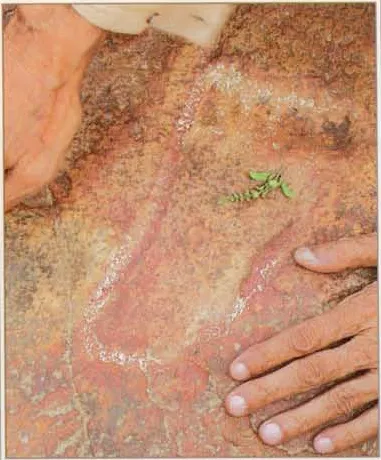
Śrī Vraja-maṇḍala Parikramā (2007) reports that devotees still become ecstatic on seeing Kṛṣṇa's footprints at Caraṇa-pahāḍī. Its photograph of the hill shows a footprint outlined in white on reddish rock.[1]
Location
Nearby places
Nandagrāma
Where the sources differ
Where Akrūra saw Kṛṣṇa's footprints: in the cowherd pasture or on a road (the Bhāgavatam), near Nanda's home outside the settlement (Śrīla Sanātana Gosvāmī), at a separate "Akrūra's place" (the Bhakti-ratnākara), in the dust of Nanda-grāma (Śrīla Prabhupāda), or on this hill and in the sand nearby (the guidebook).[4 +8]
Accounts differ Where Akrūra saw Kṛṣṇa's footprints on his arrival in Vraja.
- Śrīmad-Bhāgavatam 10.38.25'in the cowherd pasture' (goṣṭhe) of Gokula; no place named
- Śrīmad-Bhāgavatam 3.1.32in the dust of a road (mārga) marked with Kṛṣṇa's footprints; no place named
- Śrīla Sanātana Gosvāmī, Bṛhad-vaiṣṇava-toṣaṇīnear Nanda's home Nandīśvara, outside the settlement
- Bhakti-ratnākara, Fifth Waveat 'Akrūra's place' on the Nandīśvara round, listed apart from the footprint hill of v.1014
More on this place
Akrūra in Vraja: his arrival at Nandagrāma and Kṛṣṇa's departure
References
14 references
- Śrī Vraja-maṇḍala Parikramā (2007), PDF p. 200
- Śrīla Rūpa Gosvāmī, Vidagdha-mādhava, Act 1 (veṇu-nāda-vilāsa), v.25
- Śrīla Narahari Cakravartī, Bhakti-ratnākara, Fifth Wave, 1912 ed. p. 228; Grantha Mandira text v.1014, 2nd ed., 1912
- Śrīmad-Bhāgavatam 10.38.24, Bhagavata Vidya Pith edition, ed. Bhagavata Rishi and Krishna Shankar Shastri, 1996
- Śrīmad-Bhāgavatam 10.38.25, Bhagavata Vidya Pith edition, ed. Bhagavata Rishi and Krishna Shankar Shastri, 1996
- Śrīmad-Bhāgavatam 10.38.26, Bhagavata Vidya Pith edition, ed. Bhagavata Rishi and Krishna Shankar Shastri, 1996
- Śrīla Prabhupāda, Kṛṣṇa, the Supreme Personality of Godhead, ch. 38 'Akrūra's Arrival in Vṛndāvana' · vedabase.io
- Śrīmad-Bhāgavatam 10.38.25, Bhagavata Vidya Pith edition, ed. Bhagavata Rishi and Krishna Shankar Shastri, 1996
- Śrīla Sanātana Gosvāmī: commentary on ŚB 10.38.24, Bhagavata Vidya Pith edition, ed. Bhagavata Rishi and Krishna Shankar Shastri, 1996
- Śrīla Sanātana Gosvāmī, Bṛhad-vaiṣṇava-toṣaṇī on Śrīmad-Bhāgavatam 10.38.25, Bhagavata Vidya Pith edition, ed. Bhagavata Rishi and Krishna Shankar Shastri, 1996
- Śrīmad-Bhāgavatam 3.1.32, GRETIL
- Śrīla Prabhupāda, Śrīmad-Bhāgavatam, 3.1.32, purport · vedabase.io
- Śrīla Narahari Cakravartī, Bhakti-ratnākara, Fifth Wave (pañcama taraṅga), printed p. 229 (1912 edition), 2nd ed., 1912
- Śrīla Narahari Cakravartī, Bhakti-ratnākara, Fifth Wave, 1912 ed. p. 228; Grantha Mandira text v.1014, 2nd ed., 1912