Akrūra in Vraja: his arrival at Nandagrāma and Kṛṣṇa's departure
व्रज में अक्रूर: नन्दग्राम में आगमन और कृष्ण का प्रस्थान
In short
Akrūra came to Vraja because King Kaṁsa sent him. His task was to bring Kṛṣṇa and Balarāma to Mathurā. The Bhāgavatam tells that he reached Nanda's village at sunset and rolled in the dust of Kṛṣṇa's footprints. He spent the night in Nanda's house. At sunrise he drove the two brothers away, while the gopīs wept.[1–17]
On this page
At a glance
- Scripture: the Śrīmad-Bhāgavatam, the scripture that tells Kṛṣṇa's pastimes, gives the arrival and the departure in its Tenth Canto (book ten), chapters 38 and 39. Neither chapter names a village or a spot.[4 +10]
- The place: Śrīla Sanātana Gosvāmī says the settlement Akrūra reached was Nanda's home, known as Nandīśvara, at Nandagrāma.[22, 23]
- The footprints: the Bhāgavatam says they were in the cowherd pasture; Śrīla Prabhupāda says, in the dust of Nandagrāma.[6–9, 24]
- The day, according to Śrīla Viśvanātha Cakravartī Ṭhākura: Akrūra arrived on the twelfth day of the dark fortnight (the waning moon) of Phālguna, a month around February–March. Kṛṣṇa had killed Keśī that same morning.[25–33]
- The departure: at sunrise, with Kṛṣṇa's message to the gopīs (the cowherd girls of Vraja) that He would return.[14, 15]
- The villages: the Bhakti-ratnākara places the mounting of the chariot at Bijavārī and the promise at Parsoṅ.[34, 35]
Why Kaṁsa sent Akrūra to Vraja
The Bhāgavatam gives the reason plainly. Nārada Muni told Kaṁsa that Kṛṣṇa and Balarāma were the sons of Vasudeva. So Kaṁsa sent Akrūra to Nanda's Vraja to bring the two boys to Mathurā.[1–5] Śrīla Prabhupāda adds a point in the Kṛṣṇa book, his retelling of the Tenth Canto. Kṛṣṇa's duty was to start for Mathurā, because Nārada had foretold it.[36]
Śrīla Viśvanātha Cakravartī Ṭhākura gives the order of that day in his commentary. It is summarised here, not translated. Kaṁsa held his council on the eleventh day of the dark fortnight of Phālguna. Akrūra stayed awake that night and set out the next morning without breaking his fast. That morning Kṛṣṇa killed the horse demon Keśī. In the afternoon He killed the demon Vyoma, and in the evening Akrūra arrived in Vraja.[25–28] Read more: How Kṛṣṇa killed the horse demon Keśī →
On the road Akrūra thought only of Kṛṣṇa. Śrīla Prabhupāda holds up his journey as the example for anyone who goes to Vṛndāvana. On the way, one should think of the Lord's pastimes. At the border, one should smear the dust of the land on one's body.[37, 38]
Names this place“Actually, one cannot go to Vṛndāvana by purchasing a ticket. The process of going to Vṛndāvana is shown by Akrūra.”
Śrīla Prabhupāda, Kṛṣṇa, the Supreme Personality of Godhead (Kṛṣṇa book), Chapter 38, 'Akrūra's Arrival in Vṛndāvana' · vedabase.io
Akrūra and Kṛṣṇa's footprints at sunset
Akrūra was deep in meditation on Kṛṣṇa. The Bhāgavatam says that he reached Gokula, the cowherd settlement, as the sun was beginning to set.[6] In the cowherd pasture he saw the Lord's footprints. They carried the marks of the lotus, the barleycorn and the elephant goad (the hook used to guide an elephant):
padāni tasyākhila-loka-pāla- kirīṭa-juṣṭāmala-pāda-reṇoḥ
dadarśa goṣṭhe kṣiti-kautukāni vilakṣitāny abja-yavāṅkuśādyaiḥ ||
In the cowherd pasture Akrūra saw the footprints of those feet whose pure dust the rulers of all the planets in the universe hold on their crowns. Those footprints of the Lord, distinguished by such marks as the lotus, barleycorn and elephant goad, made the ground wonderfully beautiful.
Translation: Śrīla Prabhupāda's disciples (BBT)He was overwhelmed by love. His hair stood on end and his eyes were full of tears. He jumped down from the chariot and rolled among the footprints, crying that this was the dust of his master's feet.[6–9]
tad-darśanāhlāda-vivṛddha-sambhramaḥ premṇordhva-romāśru-kalākulekṣaṇaḥ
rathād avaskandya sa teṣv aceṣṭata prabhor amūny aṅghri-rajāṁsy aho iti ||
Increasingly agitated by ecstasy at seeing the Lord’s footprints, his bodily hairs standing on end because of his pure love, and his eyes filled with tears, Akrūra jumped down from his chariot and began rolling about among those footprints, exclaiming, “Ah, this is the dust from my master’s feet!”
Translation: Śrīla Prabhupāda's disciples (BBT)Śrīla Prabhupāda tells the same moment in the Kṛṣṇa book. As soon as Akrūra entered the boundary of Vṛndāvana, he saw the hoofprints of the cows and Kṛṣṇa's footprints. They showed the flag, trident, thunderbolt and lotus marks of His soles. Out of respect, Akrūra jumped down from the chariot.[9, 37]
General teaching (does not name the place)“As soon as he entered the boundary of Vṛndāvana, he saw the hoofprints of the cows and Lord Kṛṣṇa’s footprints, impressed with the signs of His soles – the flag, trident, thunderbolt and lotus flower. … Upon seeing the footprints of Kṛṣṇa, Akrūra immediately jumped down from the chariot out of respect.”
Śrīla Prabhupāda, Kṛṣṇa, the Supreme Personality of Godhead (Kṛṣṇa book), Chapter 38, 'Akrūra's Arrival in Vṛndāvana' · vedabase.io
The Third Canto remembers the same moment
The Bhāgavatam speaks of this scene even before the Tenth Canto tells it. In the Third Canto, Vidura asks Uddhava about the Lord's devotees. Among them he asks about Akrūra, who once fell down in ecstasy in the dust of a road marked with Kṛṣṇa's footprints. The verse names no place.[24, 40]
kaccid budhaḥ svasty anamīva āste śvaphalka-putro bhagavat-prapannaḥ / yaḥ kṛṣṇa-pādāṅkita-mārga-pāṃsuṣv aceṣṭata prema-vibhinna-dhairyaḥ //
Please tell me whether Akrūra, the son of Śvaphalka, is doing well. He is a faultless soul surrendered unto the Personality of Godhead. He once lost his mental equilibrium due to his ecstasy of transcendental love and fell down on the dust of a road which was marked with the footprints of Lord Kṛṣṇa.
Translation: Śrīla A.C. Bhaktivedanta Swami PrabhupādaAbout this place: Does not name the place. Vidura, asking Uddhava about the Lord's devotees, recalls that Akrūra once fell down in ecstasy in the dust of a road marked with Kṛṣṇa's footprints: the event of ŚB 10.38.25–26 that Śrī Vraja-maṇḍala Parikramā (2007) sets at Caraṇa-pahāḍī.
In his own purport (his explanation of the verse), Śrīla Prabhupāda gives the place as Nandagrāma. He does not name a particular spot in it.[24]
General teaching (does not name the place)“When Akrūra came to Vṛndāvana in search of Kṛṣṇa, he saw the footprints of the Lord on the dust of Nanda-grāma and at once fell on them in ecstasy of transcendental love.”
Śrīla Prabhupāda, Śrīmad-Bhāgavatam, 3.1.32, purport · vedabase.io
Śrīla Rūpa Gosvāmī uses the same verse of the Tenth Canto as an example. It shows how the sight of Kṛṣṇa's footprint awakens love. Śrīla Prabhupāda gives the point in The Nectar of Devotion. When Akrūra saw the footprints on the land of Vṛndāvana, his love grew so much that his hair stood on end.[41]
Where the footprints were
The commentators place the scene, but they name no hill. Śrīla Sanātana Gosvāmī says that the Gokula Akrūra reached was Nanda's home, known as Nandīśvara. It lay at the edge of Vraja, thirteen krośas (an old measure of distance) north-west of Mathurā. He says Akrūra saw the footprints near it, outside the settlement, because Kṛṣṇa had just come home from the forest. Śrīla Jīva Gosvāmī agrees on this point about the footprints. Both are summarised here, not translated.[22, 23]
The Bhakti-ratnākara of Śrīla Narahari Cakravartī Ṭhākura is a Bengali book that follows a pilgrimage round Vraja. It shows two different stops on its round of Nandīśvara. At one, Śrīla Rāghava Paṇḍita shows Śrīla Śrīnivāsa Ācārya Kṛṣṇa's footprints on the Nandīśvara hill. The elders speak of their power.[42, 43]
On the next page, the book shows a separate place of Akrūra. Here Akrūra saw the footprints and was overwhelmed with love. The book ends that stop with a play on his name: people call the place krūra, cruel.[43] The gopīs make the same play on the name in the Bhāgavatam. They say that Providence came with the name Akrūra, not cruel, and yet is cruel.[44]
The guidebook Śrī Vraja-maṇḍala Parikramā (2007) gives the scene two spots of its own. It places an Akrūra-sthāna (place of Akrūra), with a footprint of Kṛṣṇa on a rock, between Bijavārī and Nandagrāma (Nandgaon).[45]
The guidebook also tells that the hill Caraṇa-pahāḍī, "the hill of the feet", lies west of the village. It says the hill melted at the sound of Kṛṣṇa's flute and kept His footprints, and it connects the hill with Akrūra. The flute story is told in its own article.[46, 47] Read more: The hills that melted at Kṛṣṇa's flute: the three Caraṇa-pahāḍīs → The same guidebook (2007) reports that devotees became ecstatic on seeing the footprints at Caraṇa-pahāḍī.[46]
The evening in Nanda's house
When Akrūra arrived, Kṛṣṇa and Balarāma were going to the milking place of the village. Kṛṣṇa wore yellow and Balarāma wore blue. Śrīla Prabhupāda writes that Akrūra saw Them supervising the milking of the cows.[9 +2] Akrūra fell at Their feet. Balarāma took his joined hands, and with Kṛṣṇa He led him to the house.[19]
Śrīla Sanātana Gosvāmī and Śrīla Jīva Gosvāmī say that the house was Śrī Nanda's own. They add that Balarāma too thought of it as His home. This is summarised here, not translated.[49] There Akrūra was given water for his feet and a seat. He was fed, and Nanda Mahārāja asked him questions.[6, 9–11] According to Śrīla Viśvanātha Cakravartī Ṭhākura, that meal broke Akrūra's fast of the twelfth day. Śrīla Jīva Gosvāmī agrees on the day.[29–33]
After supper the brothers asked Akrūra why he had come. He told Them about Kaṁsa's plans and his own errand. Then They told Nanda Mahārāja that the king had invited all the cowherds to Mathurā.[4]
śrutvākrūra-vacaḥ kṛṣṇo balaś ca para-vīra-hā / prahasya nandaṃ pitaraṃ rājñā diṣṭaṃ vijajñatuḥ
Lord Kṛṣṇa and Lord Balarāma, the vanquisher of heroic opponents, laughed when They heard Akrūra’s words. The Lords then informed Their father, Nanda Mahārāja, of King Kaṁsa’s orders.
Translation: Śrīla Prabhupāda's disciples (BBT)Nanda then had the journey to Mathurā announced throughout his settlement.[4 +4] The commentators place this house at Nandīśvara. Śrīla Sanātana Gosvāmī says that King Nanda's main home was beside the Nandīśvara hill. Śrīla Jīva Gosvāmī says that Nanda's home was near that hill at the time Kṛṣṇa left.[6 +5]
The gopīs' night of grief
The news reached the young gopīs that same evening, and they were very upset.[12] The Bhāgavatam gives their lament at length. In it they turn against Providence, the power that decides one's fate, which came to them under the name Akrūra:
krūras tvam akrūra-samākhyayā sma naś cakṣur hi dattaṃ harase batājña-vat yenaika-deśe 'khila-sarga-sauṣṭhavaṃ tvadīyam adrākṣma vayaṃ madhu-dviṣaḥ
O Providence, though you come here with the name Akrūra, you are indeed cruel, for like a fool you are taking away what you once gave us — those eyes with which we have seen, even in one feature of Lord Madhudviṣa’s form, the perfection of your entire creation.
Translation: Śrīla Prabhupāda's disciples (BBT)As the night went on, they spoke as if Kṛṣṇa had already left. Hard-hearted Kṛṣṇa had mounted the chariot, they said. The cowherds were hurrying after Him, and even the elders said nothing to stop Him.[13] Śrīla Sanātana Gosvāmī notes that this is the only way the Bhāgavatam tells of the brothers getting onto the chariot. It does not say so directly. This is summarised here, not translated.[54, 55] At last the gopīs forgot all shame. They cried aloud to Kṛṣṇa by His names: Govinda, Dāmodara and Mādhava.[36 +3]
The morning Kṛṣṇa left Vraja
At sunrise the gopīs were still crying. Akrūra finished his morning duties and began to drive the chariot.[14] Śrīla Prabhupāda tells the scene in the Kṛṣṇa book:
General teaching (does not name the place)“As soon as the sun rose, Akrūra finished his morning bath, got on the chariot and started for Mathurā with Kṛṣṇa and Balarāma. … In spite of Kṛṣṇa’s asking the gopīs not to obstruct Their way, they all surrounded the chariot and stood up to see Kṛṣṇa with pitiable eyes.”
Śrīla Prabhupāda, Kṛṣṇa, the Supreme Personality of Godhead, Chapter 39, 'Akrūra’s Return Journey and His Vision of Viṣṇuloka Within the Yamunā River' · vedabase.io
Śrīla Sanātana Gosvāmī explains why the chariot left only after sunrise (summarised here, not translated). One reason was to protect the gopīs. In their grief they might fall in front of it and be struck in the dark. He adds that the journey of twelve krośas, from Nanda's house to the Akrūra-tīrtha (Akrūra's bathing place) on the Yamunā, took until midday. Kṛṣṇa spent a long time consoling the gopīs. The chariot also had to take winding ways around the gopīs and cows who had fallen on the path.[22 +5]
As He left, Kṛṣṇa saw the gopīs crying. He sent them a message of love:
tās tathā tapyatīr vīkṣya sva-prasthāne yadūttamaḥ
sāntvayām āsa sa-premair āyāsya iti dautyakaiḥ
As He departed, that best of the Yadus saw how the gopīs were lamenting, and thus He consoled them by sending a messenger with this loving promise: “I will return.”
Translation: Śrīla Prabhupāda's disciples (BBT)In the Kṛṣṇa book, Śrīla Prabhupāda gives the message as a promise. Kṛṣṇa told them that He was coming back very soon, after finishing His business.[36] Another article tells how that promise is understood. It also gives Śrīla Prabhupāda's teaching that Kṛṣṇa never really leaves Vṛndāvana.[61–63] Read more: Kṛṣṇa's promise to return to Vraja, and Loṭhā Bābā of Pūñcharī →
The gopīs watched the chariot go:
yāvad ālakṣyate ketur yāvad reṇū rathasya ca
anuprasthāpitātmāno lekhyānīvopalakṣitāḥ
Sending their minds after Kṛṣṇa, the gopīs stood as motionless as figures in a painting. They remained there as long as the flag atop the chariot was visible, and even until they could no longer see the dust raised by the chariot wheels.
Translation: Śrīla Prabhupāda's disciples (BBT)Śrīla Prabhupāda writes that they stood still, like painted pictures, until the chariot could not be seen at all. Then they decided that Kṛṣṇa was not coming back at once, and they went home with heavy hearts.[64, 65] The chariot reached the Yamunā at midday. There Akrūra had the vision in the water that is told in its own article.[66–71] Read more: Akrūra's vision in the Yamunā →
The Garga-saṁhitā's different telling
The Garga-saṁhitā, a Sanskrit book of Kṛṣṇa's pastimes, tells the departure in another way. Its account is summarised here, not translated. At sunrise Akrūra mounted his chariot with Rāma and Kṛṣṇa. The gopīs were angry and bewildered. They stood on every path, called Akrūra cruel and blocked the way. They struck the chariot, the horses and the driver, and they pulled Akrūra down from his seat. Then Kṛṣṇa and Balarāma protected him, and Kṛṣṇa promised to return at sunset. This book names no place either.[72, 73]
The villages that remember the departure
The Bhāgavatam does not say where Kṛṣṇa mounted the chariot. No source older than the Bhakti-ratnākara names the spot.[34 +2]
In the Fifth Wave (chapter) of that book, Śrīla Rāghava Paṇḍita shows Śrīla Śrīnivāsa Ācārya the village of Vidyudvāri, called Bijo-āri. He tells him what happened when Akrūra came. The cry went up that Akrūra had come to take Rāma and Kṛṣṇa away. Akrūra spent the night at Nanda's house and set out in the morning with Nanda and the others.[34, 74]
According to the same book, it was here that Kṛṣṇa mounted the chariot, with the gopīs in distress all around Him. They fixed their eyes on His face and cried out to Him as the Lord of their life. Then they fainted, falling to the ground like masses of lightning. The village is named after that lightning (bijurī).[34]
কৃষ্ণেরে দেখিতে ধায় ব্রজাঙ্গনাগণ। নদীর প্রবাহ প্রায় ঝরয়ে নয়ন ॥ সে দশা দেখিতে দারু পাষাণ বিদরে। লক্ষ লক্ষ মুখে তা বর্ণিতে কেহ নারে ॥ চতুর্দ্দিকে ব্যাকুল কৃষ্ণের প্রিয়াগণ। এথা কৃষ্ণ রথেতে করিলা আরোহণ ॥ কৃষ্ণমুখ পদ্মে গোপী নেত্র সমর্পিলা। হা হা প্রাণনাথ বলি মূর্চ্ছিত হইলা ॥ স্থির বিজুরির পুঞ্জ আকাশ হইতে। যৈছে পড়ে তৈছে গোপী পড়ে পৃথিবীতে ॥ বিজুরির পুঞ্জ জ্ঞান হইল সভার। এই হেতু বিজোআরি নাম সে ইহার ॥
kṛṣṇere dekhite dhāẏa brajāṅganāgaṇa| nadīra prabāha prāẏa jharaẏe naẏana
se daśā dekhite dāru pāṣāṇa bidare| lakṣa lakṣa mukhe tā barṇite keha nāre
caturddike byākula kṛṣṇera priẏāgaṇa| ethā kṛṣṇa rathete karilā ārohaṇa
kṛṣṇamukha padme gopī netra samarpilā| hā hā prāṇanātha bali mūrcchita hailā
sthira bijurira puñja ākāśa haite| yaiche paṛe taiche gopī paṛe pṛthibīte
bijurira puñja jñāna haila sabhāra| ei hetu bijoāri nāma se ihāra ||
The guidebook Śrī Vraja-maṇḍala Parikramā (2007) places Bijavārī one and a half miles south-east of Nandagrāma and tells the same scene. It also adds a route that the Bhakti-ratnākara does not give. According to the guidebook, Akrūra drove from Bijavārī through Pīsāī, Sahāra and Jainta to Akrūra-ghāṭa.[45]
Two more villages keep the memory of that morning in their names. According to the Bhakti-ratnākara, Paraśo, the Parsoṅ of today, is named after Kṛṣṇa's oath. Through messengers He promised that He would come back within tomorrow or the day after.[35] The guidebook says that King Vajranābha named Magherā after the Vrajavāsīs, the people of Vraja. They kept gazing along the road as the chariot took Kṛṣṇa and Baladeva to Mathurā.[76]
Where the sources differ
The sources do not agree on two points of this pastime. The first is where Akrūra saw the footprints. The two cantos of the Bhāgavatam say in the cowherd pasture, or on a road. Śrīla Sanātana Gosvāmī says near Nanda's home, outside the settlement. The Bhakti-ratnākara has a separate place of Akrūra. Śrīla Prabhupāda writes, in the dust of Nandagrāma. The guidebook says on Caraṇa-pahāḍī and in the sand nearby.[6 +8]
Accounts differ Where Akrūra saw Kṛṣṇa's footprints on his arrival in Vraja.
- Śrīmad-Bhāgavatam 10.38.25'in the cowherd pasture' (goṣṭhe) of Gokula; no place named
- Śrīmad-Bhāgavatam 3.1.32in the dust of a road (mārga) marked with Kṛṣṇa's footprints; no place named
- Śrīla Sanātana Gosvāmī, Bṛhad-vaiṣṇava-toṣaṇīnear Nanda's home Nandīśvara, outside the settlement
- Bhakti-ratnākara, Fifth Waveat 'Akrūra's place' on the Nandīśvara round, listed apart from the footprint hill of v.1014
The second point is what the gopīs did when the chariot left. In the Bhāgavatam and the Kṛṣṇa book they stand like painted figures and watch. In the Garga-saṁhitā they block and strike the chariot. In the Bhakti-ratnākara and the guidebook they faint at Bijavārī. Each account is given here with its source, without choosing between them.[12 +8]
Accounts differ What the gopīs did when Kṛṣṇa left on Akrūra's chariot.
- Śrīmad-Bhāgavatam 10.39.31-36they wept aloud, followed, waited for a word from Him; Kṛṣṇa sent the message 'I will return'; they stood motionless like figures in a painting as long as the flag and dust could be seen
- Śrīla Sanātana Gosvāmī, Bṛhad-vaiṣṇava-toṣaṇī on 10.39.32 and 10.39.38they might fall in front of the chariot; gopīs and cows had fallen on the path as if dead and the chariot was taken by winding ways
- Garga-saṁhitā, Mathurā-khaṇḍa 4.29-35angry, they blocked the paths, beat the chariot, horses and driver, pulled Akrūra down and beat him, until Kṛṣṇa protected him and promised to return at sunset
- Bhakti-ratnākara, Fifth Wave vv.1183-1186at Bijo-āri, as Kṛṣṇa mounted the chariot, they cried Hā hā Prāṇanātha!, fainted and fell to the earth like masses of lightning
The wording of these accounts is our summary of the sources, not a published translation.
Places in this article
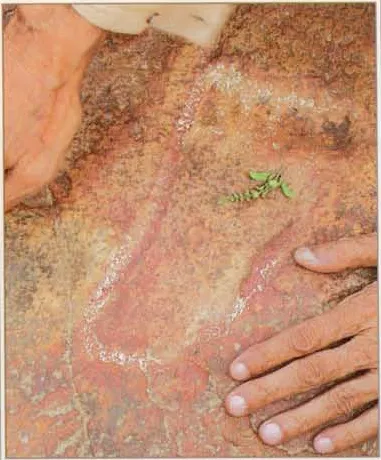
Caraṇa-pahāḍī (Nandagrāma)
चरण-पहाड़ी (नन्दग्राम)Caraṇa-pahāḍī, "the hill of the feet", is a hill west of Nandagrāma.
Bijavārī
बिजवारीBijavārī is a village one and a half miles south-east of Nandagrāma, according to the guidebook Śrī Vraja-maṇḍala Parikramā (2007).
Akrūra-sthāna
अक्रूर-स्थानAkrūra-sthāna, "Akrūra's place", lies between Bijavārī and Nandagrāma.
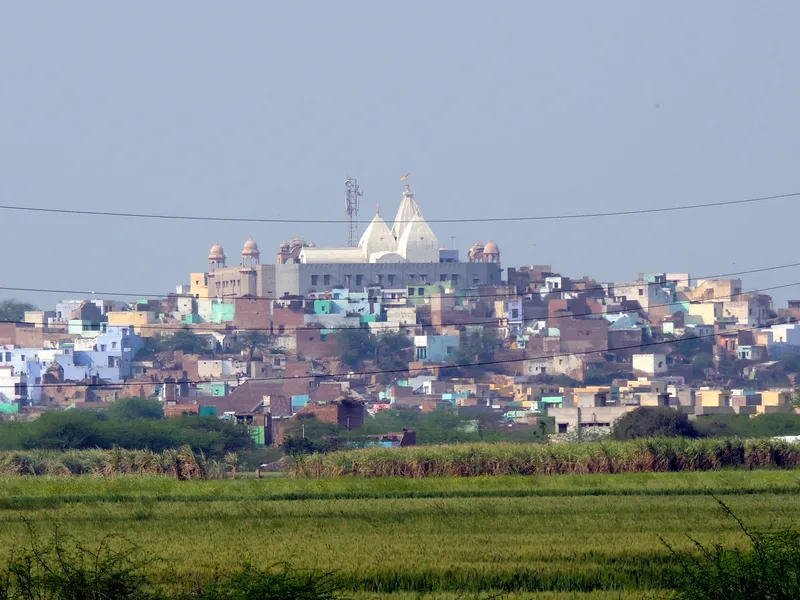
Nandagrāma
नन्दग्रामNandagrāma, today Nandagaon, is the village of Nanda Mahārāja, Kṛṣṇa's father in Vraja, on and around Nandīśvara Hill.
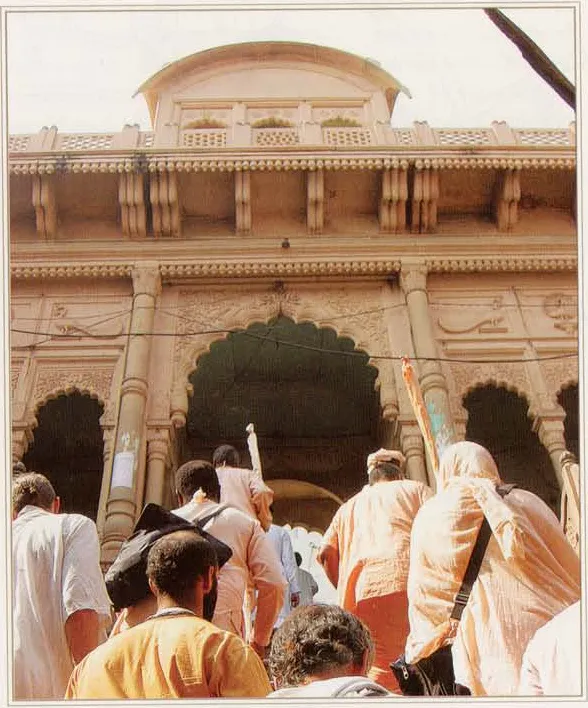
Nanda-bhavana (Nandagrāma)
नन्द-भवन (नन्दग्राम)Nanda-bhavana is the home of Nanda Mahārāja, Kṛṣṇa's father, at Nandīśvara Hill in Nandagrāma.
Parsoṅ
परसोंParsoṅ, the Bhakti-ratnākara's Paraśo, is a village on the road between Govardhana and Varṣāṇā, close to the village of Sī and south of Kāmaī, according to the guidebook …
Magherā
मघेराMagherā is a village of Vraja whose name the Bhakti-ratnākara explains as Magaherā: here everyone gazed at the path by which Kṛṣṇa went away, and people now call it Maghe …
Narī-Semarī
नरी-सेमरीNarī-Semarī is a pair of villages south-east of Chātā (Chatravana).
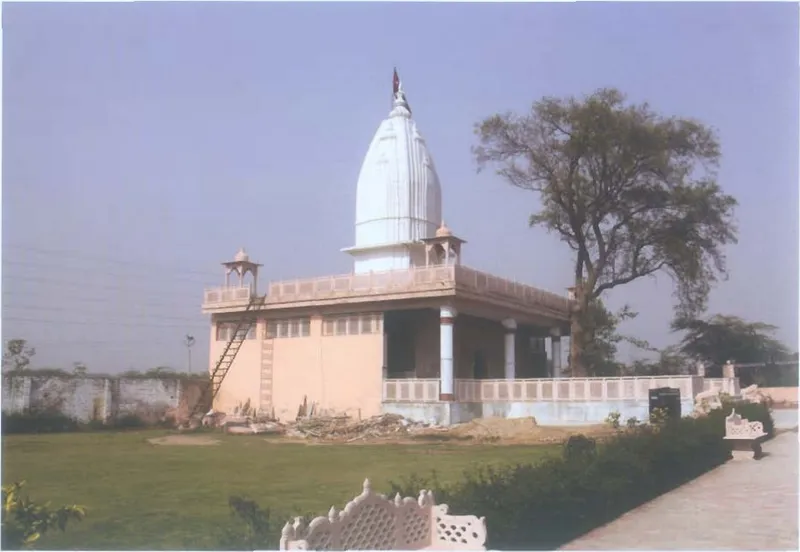
Akrūra-ghāṭa
अक्रूर-घाटAkrūra-ghāṭa, also called Akrūra-tīrtha, is a bathing place on the old bank of the Yamunā, on the road between Vṛndāvana and Mathurā.
Pīsāī
पिसाईPīsāī is a village of Vraja one and a half miles north of Karehlā, according to the guidebook Śrī Vraja-maṇḍala Parikramā (2007).
Sahāra
सहारSahāra, which the older works spell Sāhāra, is a village of Vraja two miles south of Sāṅkhī.
Jainta
जैंतJainta, called Jayeta in the Bhakti-ratnākara, is a village about three miles from Chaṭṭīkarā.
Questions and answers
Nārada told Kaṁsa that Kṛṣṇa and Balarāma were Vasudeva's sons. So Kaṁsa sent Akrūra to bring Them from Nanda's Vraja to Mathurā.[1–5]
At sunset, in the cowherd pasture, he saw Kṛṣṇa's footprints. They had the marks of the lotus, the barleycorn and the elephant goad. He jumped down from the chariot and rolled in their dust.[6–9]
The Bhāgavatam names no spot. Śrīla Sanātana Gosvāmī places them just outside Nanda's settlement at Nandīśvara. The Bhakti-ratnākara shows a place of Akrūra there. The guidebook shows a footprint rock at Akrūra-sthāna and the hill Caraṇa-pahāḍī.[22 +3]
According to the Bhāgavatam, they wept through the night and called Him by His names. After the chariot left, they stood like figures in a painting until its dust could no longer be seen.[16 +4]
It left from Nanda's house, which the commentators place at Nandīśvara. The Bhakti-ratnākara names Bijo-āri, today's Bijavārī, as the spot where Kṛṣṇa mounted the chariot.[22 +5]
Yes. As He left, He sent the gopīs a messenger with the loving promise that He would return. Śrīla Prabhupāda writes that He told them He was coming back very soon.[15, 36]
Sources
- Śrīmad-Bhāgavatam 10.36.17, GRETIL
- Śrīmad-Bhāgavatam 10.36.30, GRETIL
- Śrīmad-Bhāgavatam 10.39.35, GRETIL
- Śrīla Prabhupāda, Kṛṣṇa, the Supreme Personality of Godhead (Kṛṣṇa book), Chapter 39, 'Akrūra’s Return Journey and His Vision of Viṣṇuloka Within the Yamunā River' · vedabase.io
- Śrīla Prabhupāda, Kṛṣṇa, the Supreme Personality of Godhead (Kṛṣṇa book), Chapter 36, 'Kaṁsa Sends Akrūra for Kṛṣṇa' · vedabase.io
- Śrīmad-Bhāgavatam 10.38.24, Bhagavata Vidya Pith edition, ed. Bhagavata Rishi and Krishna Shankar Shastri, 1996
- Śrīmad-Bhāgavatam 10.38.25, Bhagavata Vidya Pith edition, ed. Bhagavata Rishi and Krishna Shankar Shastri, 1996
- Śrīmad-Bhāgavatam 10.38.26, Bhagavata Vidya Pith edition, ed. Bhagavata Rishi and Krishna Shankar Shastri, 1996
- Śrīla Prabhupāda, Kṛṣṇa, the Supreme Personality of Godhead, ch. 38 'Akrūra's Arrival in Vṛndāvana' · vedabase.io
- Śrīmad-Bhāgavatam 10.38.28, Bhagavata Vidya Pith edition, ed. Bhagavata Rishi and Krishna Shankar Shastri, 1996
- Śrīmad-Bhāgavatam 10.38.37, Bhagavata Vidya Pith edition, ed. Bhagavata Rishi and Krishna Shankar Shastri, 1996
- Śrīmad-Bhāgavatam 10.39.13, Bhagavata Vidya Pith edition, ed. Bhagavata Rishi and Krishna Shankar Shastri, 1996
- Śrīmad-Bhāgavatam 10.39.27, Bhagavata Vidya Pith edition, ed. Bhagavata Rishi and Krishna Shankar Shastri, 1996
- Śrīmad-Bhāgavatam 10.39.32, Bhagavata Vidya Pith edition, ed. Bhagavata Rishi and Krishna Shankar Shastri, 1996
- Śrīmad-Bhāgavatam 10.39.35, Bhagavata Vidya Pith edition, ed. Bhagavata Rishi and Krishna Shankar Shastri, 1996
- Śrīmad-Bhāgavatam 10.39.36, Bhagavata Vidya Pith edition, ed. Bhagavata Rishi and Krishna Shankar Shastri, 1996
- Śrīla Prabhupāda, Kṛṣṇa, the Supreme Personality of Godhead, Chapter 39, 'Akrūra’s Return Journey and His Vision of Viṣṇuloka Within the Yamunā River' · vedabase.io
- Śrīmad-Bhāgavatam 10.38.24, GRETIL
- Śrīmad-Bhāgavatam 10.38.37, GRETIL
- Śrīmad-Bhāgavatam 10.39.10, GRETIL
Show all 76 references
- Śrīla Prabhupāda, Kṛṣṇa, the Supreme Personality of Godhead (Kṛṣṇa book), Chapter 38, 'Akrūra’s Arrival in Vṛndāvana' · vedabase.io
- Śrīla Sanātana Gosvāmī: commentary on ŚB 10.38.24, Bhagavata Vidya Pith edition, ed. Bhagavata Rishi and Krishna Shankar Shastri, 1996
- Śrīla Sanātana Gosvāmī, Bṛhad-vaiṣṇava-toṣaṇī on Śrīmad-Bhāgavatam 10.38.25, Bhagavata Vidya Pith edition, ed. Bhagavata Rishi and Krishna Shankar Shastri, 1996
- Śrīla Prabhupāda, Śrīmad-Bhāgavatam, 3.1.32, purport · vedabase.io
- Śrīla Viśvanātha Cakravartī Ṭhākura: commentary on ŚB 10.38.1–2, opening verses, Bhagavata Vidya Pith edition, ed. Bhagavata Rishi and Krishna Shankar Shastri, 1996
- Śrīdhara Svāmī: commentary Śrīla Śrīdhara Svāmī, Bhāvārtha-dīpikā, on ŚB 10.37.26-27, Bhagavata Vidya Pith edition, ed. Bhagavata Rishi and Krishna Shankar Shastri, 1996
- Śrīmad-Bhāgavatam 10.37.25, GRETIL
- Śrīla Prabhupāda, Kṛṣṇa, the Supreme Personality of Godhead (Kṛṣṇa book), Chapter 37, 'Killing the Keśī Demon and Vyomāsura' · vedabase.io
- Śrīla Viśvanātha Cakravartī: commentary on 10.38.1–2, Bhagavata Vidya Pith edition, ed. Bhagavata Rishi and Krishna Shankar Shastri, 1996
- Śrīla Viśvanātha Cakravartī: commentary on 10.38.39, Bhagavata Vidya Pith edition, ed. Bhagavata Rishi and Krishna Shankar Shastri, 1996
- Śrīla Viśvanātha Cakravartī: commentary on 10.45.3, Bhagavata Vidya Pith edition, ed. Bhagavata Rishi and Krishna Shankar Shastri, 1996
- Śrīmad-Bhāgavatam 10.36.26, Bhagavata Vidya Pith edition, ed. Bhagavata Rishi and Krishna Shankar Shastri, 1996
- Śrī Vraja-maṇḍala Parikramā (2007), PDF p. 46
- Śrīla Narahari Cakravartī, Bhakti-ratnākara, Fifth Wave, printed p. 243: Kṛṣṇa mounts the chariot; the name Bijo-āri, 2nd ed., 1912
- Śrīla Narahari Cakravartī, Bhakti-ratnākara, Fifth Wave, printed p. 243: Paraśo, 2nd ed., 1912
- Śrīla Prabhupāda, Kṛṣṇa, the Supreme Personality of Godhead (Kṛṣṇa book), Chapter 39, 'Akrūra's Return Journey and His Vision of Viṣṇuloka Within the Yamunā River' · vedabase.io
- Śrīla Prabhupāda, Kṛṣṇa, the Supreme Personality of Godhead (Kṛṣṇa book), Chapter 38, 'Akrūra's Arrival in Vṛndāvana' · vedabase.io
- Śrīla Prabhupāda, Kṛṣṇa, the Supreme Personality of Godhead (Kṛṣṇa book), Chapter 38, 'Akrūra's Arrival in Vṛndāvana' (lesson for pilgrims) · vedabase.io
- Śrīmad-Bhāgavatam 10.38.25, Bhagavata Vidya Pith edition, ed. Bhagavata Rishi and Krishna Shankar Shastri, 1996
- Śrīmad-Bhāgavatam 3.1.32, GRETIL
- Śrīla Prabhupāda, The Nectar of Devotion, Chapter 26 · vedabase.io
- Śrīla Narahari Cakravartī, Bhakti-ratnākara, Fifth Wave, 1912 ed. p. 228; Grantha Mandira text v.1014, 2nd ed., 1912
- Śrīla Narahari Cakravartī, Bhakti-ratnākara, Fifth Wave (pañcama taraṅga), printed p. 229 (1912 edition), 2nd ed., 1912
- Śrīmad-Bhāgavatam 10.39.21, GRETIL
- Śrī Vraja-maṇḍala Parikramā (2007), PDF p. 226
- Śrī Vraja-maṇḍala Parikramā (2007), PDF p. 200
- Śrīla Rūpa Gosvāmī, Vidagdha-mādhava, Act 1 (veṇu-nāda-vilāsa), v.25
- Śrīla Kṛṣṇadāsa Kavirāja Gosvāmī, Govinda-līlāmṛta, 2.37 and 2.41, after the editions of Haridas Das and Haridas Shastri
- Śrīla Sanātana Gosvāmī: commentary on ŚB 10.38.37, Bhagavata Vidya Pith edition, ed. Bhagavata Rishi and Krishna Shankar Shastri, 1996
- Śrīmad-Bhāgavatam 10.11.35, GRETIL
- Bṛhad-vaiṣṇava-toṣaṇī on Śrīmad-Bhāgavatam 10.11.35 (Śrīla Sanātana Gosvāmī): commentary on ŚB 10.11.35 (Bṛhad-vaiṣṇava-toṣaṇī), Bhagavata Vidya Pith edition, ed. Bhagavata Rishi and Krishna Shankar Shastri, 1996
- Śrīla Jīva Gosvāmī: commentary on 10.11.35 (text label "v.10.11.34, jīva-gosvāmī (laghu-vaiṣṇava-toṣaṇī)"), Bhagavata Vidya Pith edition, ed. Bhagavata Rishi and Krishna Shankar Shastri, 1996
- Śrīla Jīva Gosvāmī: commentary on 10.39.38, Bhagavata Vidya Pith edition, ed. Bhagavata Rishi and Krishna Shankar Shastri, 1996
- Bṛhad-vaiṣṇava-toṣaṇī (Śrīla Sanātana Gosvāmī): commentary on ŚB 10.39.32, Bhagavata Vidya Pith edition, ed. Bhagavata Rishi and Krishna Shankar Shastri, 1996
- Bṛhad-vaiṣṇava-toṣaṇī (Śrīla Sanātana Gosvāmī): commentary on ŚB 10.39.38, Bhagavata Vidya Pith edition, ed. Bhagavata Rishi and Krishna Shankar Shastri, 1996
- Śrīmad-Bhāgavatam ŚB 10.39.31, GRETIL
- Śrīmad-Bhāgavatam 10.39.36, GRETIL
- Śrīmad-Bhāgavatam 10.39.37, GRETIL
- Śrī Vraja-maṇḍala Parikramā (2007), PDF p. 284
- Vṛndāvana-Dhāma Ki Jaya! (c. 1986), by Dhruva Mahārāja dāsa, PDF p. 76
- Śrīla Prabhupāda, Kṛṣṇa, the Supreme Personality of Godhead (Kṛṣṇa book), Chapter 46, 'Uddhava Visits Vṛndāvana' · vedabase.io
- Śrīla Viśvanātha Cakravartī Ṭhākura: commentary on ŚB 10.45.25, Bhagavata Vidya Pith edition, ed. Bhagavata Rishi and Krishna Shankar Shastri, 1996
- Śrīla Jīva Gosvāmī, Śrīla Viśvanātha Cakravartī Ṭhākura, Śrīla Sanātana Gosvāmī: commentary on ŚB 10.39.37, Bhagavata Vidya Pith edition, ed. Bhagavata Rishi and Krishna Shankar Shastri, 1996
- Śrīla Prabhupāda, Kṛṣṇa, the Supreme Personality of Godhead, chapter 39, 'Akrūra's Return Journey and His Vision of Viṣṇuloka Within the Yamunā River' · vedabase.io
- Śrīla Prabhupāda, Kṛṣṇa, the Supreme Personality of Godhead, ch. 39 'Akrūra's Return Journey and His Vision of Viṣṇuloka Within the Yamunā River' · vedabase.io
- Śrīmad-Bhāgavatam 10.39.38, GRETIL
- Śrīmad-Bhāgavatam 10.39.39, GRETIL
- Śrīmad-Bhāgavatam 10.39.40, GRETIL
- Śrīmad-Bhāgavatam 10.39.41, GRETIL
- Śrīmad-Bhāgavatam 10.39.42–43, GRETIL
- Śrīmad-Bhāgavatam 10.39.44–45, GRETIL
- Garga-saṁhitā, Mathurā-khaṇḍa (5) 4.29, Sanskrit Wikisource
- Garga-saṁhitā, Mathurā-khaṇḍa (5) 4.33, Sanskrit Wikisource
- Śrīla Narahari Cakravartī, Bhakti-ratnākara, Fifth Wave, printed p. 242: Vidyudvāri village, 2nd ed., 1912
- Śrīla Narahari Cakravartī, Bhakti-ratnākara, Fifth Wave, printed p. 243: Kṛṣṇa mounts the chariot; the name Bijo-āri, 2nd ed., 1912
- Śrī Vraja-maṇḍala Parikramā (2007), PDF p. 248
Further sources
- Śrīmad-Bhāgavatam, Third Canto, chapter 1 (translation and purports by Śrīla Prabhupāda) and Tenth Canto, chapters 36–39 (translation by the disciples of Śrīla Prabhupāda, BBT).
- Śrīla Prabhupāda, Kṛṣṇa, the Supreme Personality of Godhead, chapters 38–39, and The Nectar of Devotion, chapter 26.
- The Canto 10 commentaries of Śrīla Sanātana Gosvāmī, Śrīla Jīva Gosvāmī and Śrīla Viśvanātha Cakravartī Ṭhākura (Sanskrit), summarised, not translated.
- Bhakti-ratnākara, Fifth Wave (Bengali, 1912 edition) and Garga-saṁhitā, Mathurā-khaṇḍa, chapter 4: summarised here, not translated.