The Pāṇḍavas in Kāmyavana: the Yakṣa's questions and the Pāṇḍava sites
काम्यवन में पाण्डव: यक्ष-प्रश्न और पाण्डवों से जुड़े स्थल
In short
The Pāṇḍavas, the five brothers of the Mahābhārata, spent part of their forest exile in a forest that the epic calls Kāmyaka. The Vraja-bhakti-vilāsa and the guidebooks take it to be Vraja's Kāmyavana. They connect Dharma-kuṇḍa and other ponds there with the brothers. The Mahābhārata, however, sets the Yakṣa's questions at Dvaitavana, after the brothers had left Kāmyaka.[1–5]
On this page
At a glance
- The Mahābhārata names the Kāmyaka forest of the exile but not where it lies. It tells of the questions of the Yakṣa, a semi-divine being, at an unnamed lake near Dvaitavana.[4–6]
- The Vraja-bhakti-vilāsa says Dharma-kuṇḍa is named after the dharma (religious duty) that King Yudhiṣṭhira performed in auspicious Kāmyavana.[1]
- The Bhakti-ratnākara calls Dharma-kuṇḍa the place where Nārāyaṇa sports in the form of Dharma. It shows a kuṇḍa (sacred pond) of the five Pāṇḍavas beside it.[2, 7, 8]
- Śrīla Prabhupāda gives Yudhiṣṭhira's answer on the most wonderful thing in the world. He names the questioner Yamarāja, also called Dharmarāja.[9, 10]
- Śrīla Prabhupāda names a Kāmyavana where the sage Bṛhadaśva first met Yudhiṣṭhira, without saying where it lies.[3]
- The 2007 guidebook Śrī Vraja-maṇḍala Parikramā says that the five Pāṇḍavas lived in Kāmyavana for a long time during their exile.[2 +2]
Kāmyavana in Śrīla Prabhupāda's words
When Śrīla Prabhupāda explains Śrī Caitanya Mahāprabhu's visit to Vraja's Kāmyavana, he quotes the Varāha Purāṇa, an old scripture, in his purport (explanation) to Caitanya-caritāmṛta Madhya 18.55. It calls Kāmyaka the fourth and best of the forests of Vraja. Read more: The twelve forests of Vraja: the lists side by side → This is his translation:
चतुर्थं काम्यकवनं वनानां वनमुत्तमम्।। तत्र गत्वा नरो देवि मम लोके महीयते ॥ 37 ॥ विमलस्य च कुण्डे तु सर्वपापैः प्रमुच्यते ।। यस्तत्र मुंचते प्राणान्मम लोकं स गच्छति ॥ 38 ॥
caturthaṁ kāmyakavanaṁ vanānāṁ vanamuttamam|| tatra gatvā naro devi mama loke mahīyate
37
vimalasya ca kuṇḍe tu sarvapāpaiḥ pramucyate
yastatra muṁcate prāṇānmama lokaṁ sa gacchati || 38 ||
Lord Śiva said, “The best of all forests is the fourth of these, named Kāmyaka. O goddess Devī, any person who goes there is eligible to enjoy the glories of my abode.
Translation: Śrīla A.C. Bhaktivedanta Swami PrabhupādaHe adds, from the Bhakti-ratnākara, that Kṛṣṇa performed enchanting pastimes in Kāmyavana. Its many ponds and sacred places cannot all be described.[14]
He also names a Kāmyavana in connection with the Pāṇḍavas, in his purports to the First Canto, without saying where it lies. The sage Bṛhadaśva, he writes, first met Mahārāja Yudhiṣṭhira at Kāmyavana and told him the history of King Nala.[3] And Jayadratha, on his way to marry in Śalyadeśa, saw Draupadī again on the way to Kāmyavana, while the Pāṇḍavas were in exile.[15]
General teaching (does not name the place)“When he was going to marry in the Śalyadeśa, on the way to Kāmyavana he happened to see Draupadī again and was too much attracted to her. The Pāṇḍavas and Draupadī were then in exile, after losing their empire in gambling,”
Śrīla Prabhupāda, Śrīmad-Bhāgavatam, 1.15.16, purport · vedabase.io
Is the Pāṇḍavas' Kāmyaka the Kāmyavana of Vraja?
The Mahābhārata does not say where its Kāmyaka forest lies. It is summarised here, not translated. It tells, for example, that while the Pāṇḍavas lived in the Kāmyaka forest, they went out hunting. They had left Draupadī behind with the permission of Tṛṇabindu and of their priest Dhaumya. Jayadratha, on his way to marry, came there and saw her standing at the door of the hermitage in the lonely forest.[6] The Padma Purāṇa says that Nārada once went to a Kāmyavana to see the Pāṇḍavas in their suffering. It too does not say where it is.[16]
The link with Vraja's forest comes from the pilgrimage books. The Vraja-bhakti-vilāsa of Śrīla Nārāyaṇa Bhaṭṭa Gosvāmī ties Dharma-kuṇḍa to King Yudhiṣṭhira's dharma in auspicious Kāmyavana.[1] The Vṛndāvana-kathā (1920) says that the Pāṇḍavas stayed in this forest for some days during their exile. It names no source.[17] The 2007 guidebook says that they lived here for a long time. It describes Dharma-kūpa (Dharma's well), Dharma-kuṇḍa and many places nearby as places that seem to be connected with the Pāṇḍavas.[2 +2]
The older Vaiṣṇava books do name Pāṇḍava sites in Kāmyavana. The Bhakti-ratnākara shows a kuṇḍa of the five Pāṇḍavas. The Vraja-bhakti-vilāsa lists five tīrtha-ponds (holy bathing ponds) of the Pāṇḍavas and a darśana (respectful viewing) of the five Pāṇḍavas with Draupadī. But neither tells a story of the exile here.[8 +2]
Dharma-kuṇḍa
Dharma-kuṇḍa is the centre of this tradition. In the Bhakti-ratnākara of Śrīla Narahari Cakravartī Ṭhākura, Śrīla Rāghava Paṇḍita tells Śrīla Śrīnivāsa Ācārya that here Nārāyaṇa sports in the form of Dharma. He says its beauty cannot be described. The book does not mention the Yakṣa or Yudhiṣṭhira.[2, 7]
এই ধর্ম্মকুণ্ড ধর্ম্মরূপে নারায়ণ। এথা বিলসয়ে শোভা না হয় বর্ণন॥ এইত বিশোকা নাম বেদী সবে জানে। পঞ্চপাণ্ডবের কুণ্ড দেখ এই খানে॥
ei dharmmakuṇḍa dharmmarūpe nārāẏaṇa| ethā bilasaẏe śobhā nā haẏa barṇana|| eita biśokā nāma bedī sabe jāne| pañcapāṇḍabera kuṇḍa dekha ei khāne||
The Vraja-bhakti-vilāsa names Dharma-kuṇḍa fifth in its list of Kāmyavana's holy places. It comes after Vimala-kuṇḍa, Gopikā-kuṇḍa, Suvarṇapura and Gayā-kuṇḍa. Then comes a Sahasra-tīrtha lake where the throne of Dharmarāja is seen.[21] Read more: Kāmyavana parikramā: Vimala-kuṇḍa and the eighty-four tīrthas → In its chapter of prayers, the book explains the name. King Yudhiṣṭhira, the son of Dharma, performed dharma at this pond, so it became known as Dharma-kuṇḍa. Dharma done there never perishes, and its fruit is a thousandfold. Its bathing prayer, which the book credits to the Viṣṇu-dharmottara, honours the kuṇḍa as Dharma itself.[1] The 2007 guidebook says likewise that Śrī Nārāyaṇa is present here as dharma.[2, 7]
The Yakṣa's questions
At Dharma-kuṇḍa the guidebooks tell the Mahābhārata's episode of the Yakṣa's questions. A Yakṣa is a kind of semi-divine being. The epic itself sets the episode elsewhere. It is summarised here, not translated. After Draupadī's rescue from Jayadratha, Yudhiṣṭhira and his brothers left Kāmyaka. They went back to Dvaitavana, to the hermitage of Mārkaṇḍeya. There a deer carried off a brāhmaṇa's (priest's) fire-sticks. Chasing it, the brothers came, tired and thirsty, to an unnamed lake.[4, 5] At the lake a voice from the sky questioned them. The four younger brothers drank without answering and fell, and Yudhiṣṭhira answered. At the end the questioner revealed that he was Dharma, Yudhiṣṭhira's father, who had come to test him.[4, 5]
Śrīla Prabhupāda quotes one of Yudhiṣṭhira's answers, from the Vana-parva, to teach that spiritual life is urgent:
General teaching (does not name the place)Yamarāja once asked Mahārāja Yudhiṣṭhira, “What is the most wonderful thing within this world?” Mahārāja Yudhiṣṭhira replied (Mahābhārata, Vana-parva 313.116) … Hundreds and thousands of living entities meet death at every moment, but a foolish living being nonetheless thinks himself deathless and does not prepare for death. This is the most wonderful thing in this world.
Śrīla Prabhupāda, Śrīmad-Bhāgavatam, 7.2.57, purport · vedabase.io
In that purport he names the questioner Yamarāja. In Teachings of Lord Kapila he names him Dharmarāja. In a lecture at Surat in December 1970, he explains that Yamarāja is also called Dharmarāja, a pure servant of God.[9 +3]
General teaching (does not name the place)“Yamarāja is Dharmarāja; another name is Dharmarāja. He is also a representative of God.”
Śrīla Prabhupāda, Śrīmad-Bhāgavatam 6.1.38 lecture, Surat, 20 December 1970 · vedabase.io
So in Śrīla Prabhupāda's usage the two names mean one person.[23] He does not say where the questions were asked.[9, 10]
Other episodes of the exile
The guidebooks set more episodes of the exile in Kāmyavana. One of them, Durvāsā's visit, is told in the Bhāgavatam, in Śrīla Prabhupāda's translation. There Arjuna remembers how Kṛṣṇa saved the Pāṇḍavas in the forest.[24]
yo no jugopa vana etya durantakṛcchrād durvāsaso 'riracitādayutāgrabhug yaḥ / śākānnaśiṣṭam upayujya yatastrilokīṃ tṛptām amaṃsta salile vinimagnasaṅghaḥ
During our exile, Durvāsā Muni, who eats with his ten thousand disciples, intrigued with our enemies to put us in dangerous trouble. At that time He [Lord Kṛṣṇa], simply by accepting the remnants of food, saved us. By His accepting food thus, the assembly of munis, while bathing in the river, felt sumptuously fed. And all the three worlds were also satisfied.
Translation: Śrīla A.C. Bhaktivedanta Swami PrabhupādaIn his purport, Śrīla Prabhupāda tells how Duryodhana sent the sage Durvāsā with his disciples to Yudhiṣṭhira after Draupadī had eaten. Kṛṣṇa ate a particle of vegetable from her pot, and the sages bathing in the river felt fed and went away. Neither the verse nor the purport names the place.[24] The Mahābhārata has the episode only in passages that some manuscripts add. Its critical edition (the scholars' standard text) prints them outside the main text. In one of them Durvāsā comes with ten thousand disciples and goes with them to bathe. In another he goes to bathe in the Gaṅgā. Kṛṣṇa, called by Yudhiṣṭhira's thought, eats a vegetable leaf and declares the three worlds satisfied. Both are summarised here, not translated.[26, 27]
The Pāṇḍava kuṇḍas and images
Around Dharma-kuṇḍa the books name several Pāṇḍava sites, and they do not describe them in the same way. The Bhakti-ratnākara shows the platform named Viśokā and the kuṇḍa of the five Pāṇḍavas beside Dharma-kuṇḍa.[8] The Vraja-bhakti-vilāsa lists the five tīrtha-lakes of the Pāṇḍavas after Yajña-kuṇḍa. The 2007 guidebook calls them the Pañca Tīrtha-sarovara of the Pāṇḍavas.[28]
Writers have also described images of the Pāṇḍavas with Draupadī at Kāmyavana. The Vraja-bhakti-vilāsa gives a darśana of the five Pāṇḍavas with Draupadī at Kuśasthalī, with its own prayer.[8 +2] The historians and the guidebook tell differently what became of the images. Their accounts are set out below with their dates.
Where the sources differ
The main difference is the place of the Yakṣa's questions. The guidebooks tell the episode under Dharma-kuṇḍa, during a long stay in Kāmyavana. The Mahābhārata sets it near Dvaitavana, after the Pāṇḍavas had left Kāmyaka, at a lake it does not name. Each is given with its source.[2 +6]
Accounts differ Where and how the episode of the Yakṣa's questions took place: as Śrī Vraja-maṇḍala Parikramā (2007) and the undated parikramā notes Kāmyavana tell it under Dharma-kuṇḍa, and as the Mahābhārata tells it.
- Śrī Vraja-maṇḍala Parikramā (2007); the undated parikramā notes KāmyavanaUnder the heading Dharma-kuṇḍa: 'The five Pāṇḍavas resided in this attractive Kāmyavana for a long time during their exile to the forest.' In summer, when the ponds had dried up, Yudhiṣṭhira gave Bhīma an empty pot; Bhīma followed the birds to 'a beautiful lake full of clean, fragrant water', not named; then Arjuna, Nakula and Sahadeva were sent one after another; all four fainted, and Yudhiṣṭhira answered the Yakṣa.
- Mahābhārata, Āraṇyakaparvan 3.295.2-3.298.26 (BORI critical edition, constituted text)After Draupadī's rescue from Jayadratha the Pāṇḍavas leave Kāmyaka and go back to Dvaitavana, to Mārkaṇḍeya's āśrama; chasing a deer that has carried off a brāhmaṇa's fire-sticks, they lose it and sit down, tired and thirsty, under a banyan in the deep forest; Nakula, sent up a tree, sees water and goes first, then Sahadeva, Arjuna and Bhīma, and each falls after drinking; the lake (saraḥ) is not named; afterwards the brothers return to the āśrama.
The questioner is also named differently. The guidebook calls the Yakṣa Dharmarāja and explains that name as Śrī Nārāyaṇa. Śrīla Prabhupāda names him Yamarāja and Dharmarāja, one person. In the Mahābhārata he reveals himself as Dharma.[2 +7]
Accounts differ Who the questioner of Yudhiṣṭhira (the Yakṣa) was, in the story Śrī Vraja-maṇḍala Parikramā (2007) and the undated parikramā notes Kāmyavana tell under Dharma-kuṇḍa.
- Śrī Vraja-maṇḍala Parikramā (2007); the undated parikramā notes Kāmyavana"That Yakṣa was none other than Dharmarāja (Śrī Nārāyaṇa) Himself, who had desired to test the dharma of his son Yudhiṣṭhira."
- Śrīla Prabhupāda, ŚB 7.2.57 purport"Yamarāja once asked Mahārāja Yudhiṣṭhira, 'What is the most wonderful thing within this world?'" (citing Mahābhārata, Vana-parva 313.116).
- Śrīla Prabhupāda, Teachings of Lord Kapila ch. 2; lecture on ŚB 6.1.38 (Surat, 20 December 1970)"When Dharmarāja asked Mahārāja Yudhiṣṭhira what the most wonderful thing in the world was …"; "Yamarāja is Dharmarāja; another name is Dharmarāja." In his usage the questioner's two names are one person; he does not call him Nārāyaṇa.
- Mahābhārata (Āraṇyaka/Vana-parva)Not available in the texts at hand; not checked.
The guidebooks also set Durvāsā's visit at Vimala-kuṇḍa. The Bhāgavatam says only that it happened in the forest, by a river.[24 +5] They differ on whether the Pāṇḍavas' kuṇḍa is one pond, five lakes, another name of Dharma-kuṇḍa or a pond of its own.[2 +4]
Accounts differ Whether the Pañca Pāṇḍava-kuṇḍa (Pañca-tīrtha) is the Pāṇḍavas' five lakes, another name of Dharma-kuṇḍa, or a kuṇḍa of its own
- Śrī Vraja-maṇḍala Parikramā (2007)'Pañca Pāṇḍava-kuṇḍa (Pañca-tīrtha)' is one of the places within the area of Dharma-kuṇḍa, listed separately from 'Pañca Pāṇḍava'.
- Śrī Vraja-maṇḍala Parikramā (2007)'The Pañca Tīrtha-sarovara of the Pāṇḍavas' is a separate item after Yajña-kuṇḍa (p. 264) and lies 'nearby' in its Pāṇḍava story (p. 279).
- the undated parikramā notes KāmyavanaHeads its Dharma-kuṇḍa story 'Dharma-Kunda (Pancha Pandava Kunda)': the same kuṇḍa.
- Bhakti-ratnākara 5.842-843Dharma-kuṇḍa, then the Viśokā platform and the kuṇḍa of the five Pāṇḍavas: one kuṇḍa beside Dharma-kuṇḍa.
The wording of these accounts is our summary of the sources, not a published translation.
The images are described differently by date. The 2007 guidebook says that some were stolen and others broken, and that the rest are kept in the nearby temple of Kāmeśvara Mahādeva. Mītal (1966) describes images of the five Pāṇḍavas with Kṛṣṇa, Kuntī and Draupadī in an old temple near Kāmeśvara. He dates them to the late Gupta period. Entwistle (1987) describes images of Draupadī and three of the Pāṇḍavas in a shrine on a small hill. He thought them late medieval or early modern.[11 +2]
Places in this article
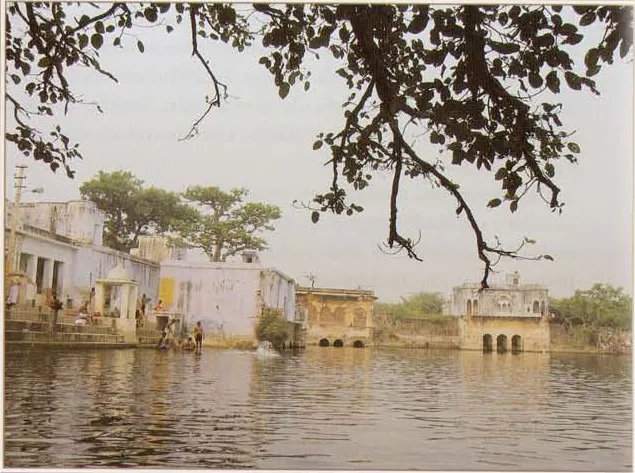
Dharma-kuṇḍa
धर्म-कुण्डDharma-kuṇḍa is a kuṇḍa (sacred pond) in the eastern part of Kāmyavana.
Kāmyavana
काम्यवनKāmyavana, also called Kāmavana, is one of the twelve forests of Vraja, around the town of Kāmā (Kāman).
Vimala-kuṇḍa
विमल-कुण्डVimala-kuṇḍa is the best-known pond of Kāmyavana.
Pañca Tīrtha-sarovara
पंच तीर्थ-सरोवरPañca Tīrtha-sarovara, "the five tīrtha-lakes of the Pāṇḍavas", lies in Kāmyavana near Dharma-kuṇḍa.
Pañca Pāṇḍava-kuṇḍa
पंच पाण्डव-कुण्डViśākhā-vedī
विशाखा-वेदीDeities of the five Pāṇḍavas with Draupadī (Kāmyavana)
द्रौपदी सहित पाँचों पाण्डवों के विग्रह (काम्यवन)Pañca Pāṇḍava (Dharma-kuṇḍa)
पंच पाण्डव (धर्म-कुण्ड)Questions and answers
The Mahābhārata says they lived for a time in a forest called Kāmyaka during their exile. The Vraja-bhakti-vilāsa and the guidebooks take it to be Vraja's Kāmyavana. The Mahābhārata does not say where it lies.[1 +4]
The Mahābhārata sets it at an unnamed lake near Dvaitavana, after the Pāṇḍavas had left Kāmyaka. The guidebooks say that the Pāṇḍavas lived long in Kāmyavana, and they tell it at Dharma-kuṇḍa.[2 +4]
The sources do not settle it. The Mahābhārata, the Padma Purāṇa and Śrīla Prabhupāda's purports name a Kāmyaka or Kāmyavana of the Pāṇḍavas without saying where it is. The link with Vraja's forest is made by the Vraja-bhakti-vilāsa and the guidebooks.[1 +2]
It is a pond of Kāmyavana. The Vraja-bhakti-vilāsa says it is named after Yudhiṣṭhira's dharma there. The Bhakti-ratnākara calls it the place where Nārāyaṇa sports in the form of Dharma.[1, 2, 7]
They are images of the five Pāṇḍavas with Draupadī, which the Vraja-bhakti-vilāsa names among Kāmyavana's darśanas. Later writers describe their place and state differently.[8 +2]
He quotes the Varāha Purāṇa: Kāmyaka is the best of the forests, and one who goes there enjoys the glories of the Lord's abode. He adds from the Bhakti-ratnākara that Kāmyavana's sacred places are too many to describe.[14]
Sources
- Śrīla Nārāyaṇa Bhaṭṭa, Vraja-bhakti-vilāsa, ch. 6 v.6, printed p. 152; Grantha Mandira text (6) v.6, 1st ed., publ. Bābā Kṛṣṇadāsa, Kusuma-sarovara, Saṁvat 2008
- Śrī Vraja-maṇḍala Parikramā (2007), PDF p. 148
- Śrīla Prabhupāda, Śrīmad-Bhāgavatam, 1.9.6-7, purport · vedabase.io
- Mahābhārata, 3.295.2cd-3 (constituted text), BORI critical edition, electronic text, 1999
- Mahābhārata, 3.298.5cd-6 (constituted text), BORI critical edition, electronic text, 1999
- Mahābhārata, 3.248.5-8 (constituted text), BORI critical edition, electronic text, 1999
- Śrīla Narahari Cakravartī, Bhakti-ratnākara, Fifth Wave, 1912 ed. p. 215; Grantha Mandira text vv.842-843, 2nd ed., 1912
- Śrīla Narahari Cakravartī, Bhakti-ratnākara, Fifth Wave, printed p.215, v.843 of the Kāmyavana tour: the kuṇḍa of the five Pāṇḍavas, 2nd ed., 1912
- Śrīla Prabhupāda, Śrīmad-Bhāgavatam, 7.2.57, purport · vedabase.io
- Mahābhārata, appendix I no. 32 after 3.297.61d, part 11 as numbered in our index of the (appendix passage; not in the constituted text), BORI critical edition, electronic text, 1999
- Śrī Vraja-maṇḍala Parikramā (2007), PDF p. 152
- Śrīla Prabhupāda, Śrīmad-Bhāgavatam, 1.9.6-7, purport (on Bṛhadaśva) · vedabase.io
- Varāha Purāṇa, adhyāya 153, verses 37-38, Sanskrit Wikisource
- Śrīla Prabhupāda, Śrī Caitanya-caritāmṛta, Madhya-līlā 18.55, purport · vedabase.io
- Śrīla Prabhupāda, Śrīmad-Bhāgavatam, 1.15.16, purport · vedabase.io
- Padma Purāṇa, Uttara-khaṇḍa (6) 3.1, Sanskrit Wikisource
- Pulinbihārī Datta, ch. 8 (aṣṭama pariccheda), entry 'Kāmyavana', printed p. 124, text lines 7-8 (counted below the running head)
- Śrīla Nārāyaṇa Bhaṭṭa Gosvāmī, Vraja-bhakti-vilāsa, chapter 2 part 13 v.53, printed p.50: the five Pāṇḍavas with Draupadī in the list of Kāmyavana's sites, 1st ed., publ. Bābā Kṛṣṇadāsa, Kusuma-sarovara, Saṁvat 2008
- Śrīla Nārāyaṇa Bhaṭṭa Gosvāmī, Vraja-bhakti-vilāsa, chapter 2 part 13 v.1, printed p.48: the marks (liṅgāni) of Kāmyavana, 1st ed., publ. Bābā Kṛṣṇadāsa, Kusuma-sarovara, Saṁvat 2008
- Śrīla Narahari Cakravartī, Bhakti-ratnākara, Fifth Wave, 1912 ed. p. 215; Grantha Mandira text vv.842-843, 2nd ed., 1912
Show all 39 references
- Śrīla Nārāyaṇa Bhaṭṭa, Vraja-bhakti-vilāsa, ch. 2, Kāmyavana list vv.5-6, printed p. 48; Grantha Mandira text (2) part 13 vv.5-7, 1st ed., publ. Bābā Kṛṣṇadāsa, Kusuma-sarovara, Saṁvat 2008
- Śrīla Prabhupāda, Teachings of Lord Kapila, Chapter 2, "The Transcendental Master and Supreme Yogī" (on ŚB 3.25.2) · vedabase.io
- Śrīla Prabhupāda, Śrīmad-Bhāgavatam 6.1.38 lecture, Surat, 20 December 1970 · vedabase.io
- Śrīla Prabhupāda, Śrīmad-Bhāgavatam, 1.15.11, purport · vedabase.io
- Śrīmad-Bhāgavatam 1.15.11, GRETIL
- Mahābhārata, appendix I no. 25 after 3.247.47d, part 15 as numbered in our index of the (appendix passage; not in the constituted text), BORI critical edition, electronic text, 1999
- Mahābhārata, appendix I no. 30 after 3.295.7b, part 1 as numbered in our index of the (appendix passage; not in the constituted text), BORI critical edition, electronic text, 1999
- Śrīla Nārāyaṇa Bhaṭṭa Gosvāmī, Vraja-bhakti-vilāsa, ch. 2, list of the marks of Kāmavana, v.8, printed p.48, 1st ed., publ. Bābā Kṛṣṇadāsa, Kusuma-sarovara, Saṁvat 2008
- Śrī Vraja-maṇḍala Parikramā (2007), PDF p. 149
- Śrī Vraja-maṇḍala Parikramā (2007), PDF p. 150
- the undated parikramā notes Kāmyavana, ¶38
- the undated parikramā notes Kāmyavana, ¶62
- Śrī Vraja-maṇḍala Parikramā (2007), PDF p. 151
- the undated parikramā notes Kāmyavana, ¶35
- Mahābhārata retold by Kṛṣṇa Dharma dāsa · vedabase.io
- Śrī Vraja-maṇḍala Parikramā (2007), PDF p. 145
- the undated parikramā notes Kāmyavana, ¶37
- Prabhudayāl Mītal, 'Kāmavana', entry 'पंच पांडव', printed p.117
- A. W. Entwistle, § 'Kaman', item 2 'Dharm Kund and other places near Mathura Darwaza', printed p. 364, Egbert Forsten, Groningen, 1987
Further sources
- Śrīmad-Bhāgavatam, First Canto, chapters 9 and 15, and Seventh Canto, chapter 2 (translation and purports by Śrīla Prabhupāda, BBT); Śrī Caitanya-caritāmṛta, Madhya-līlā 18.55 purport; Śrīla Prabhupāda, Teachings of Lord Kapila, chapter 2; lecture on ŚB 6.1.38, Surat, 20 December 1970.
- Mahābhārata, Āraṇyakaparvan (critical edition, Sanskrit); Padma Purāṇa, Uttara-khaṇḍa: summarised, not translated.
- Bhakti-ratnākara, Fifth Wave; Vraja-bhakti-vilāsa; Vṛndāvana-kathā (1920): summarised here, not translated. Historians (Mītal 1966, Entwistle 1987) only for the dated descriptions of the images, paraphrased.