Where and when Kṛṣṇa killed Vyomāsura
The Bhāgavatam, the commentators and the pilgrimage books
In short
Vyomāsura was a magician, the son of the demon Maya. Disguised as a boy, he joined the cowherd boys' game of thieves and herders. He shut most of them in a mountain cave, and Kṛṣṇa killed him and freed them. Śrīla Prabhupāda sets it on Govardhana Hill. Śrīla Jīva Gosvāmī and the Bhakti-ratnākara honour a cave in Kāmyavana forest.[1–8]
On this page
At a glance
- Scripture: Śrīmad-Bhāgavatam 10.37.26–33 tells of the game and the killing on the mountain slopes. It names no hill or forest.[1–5]
- Śrīla Prabhupāda's Kṛṣṇa book sets the game on the top of Govardhana Hill, on the same day that Keśī was killed.[6, 9]
- Śrīla Jīva Gosvāmī's Gopāla-campū sets the killing near the hill of the Kāmyaka forest, in Kṛṣṇa's early childhood.[7 +3]
- The Bhakti-ratnākara shows the hill of the stealing game in Kāmyavana. It also shows the cave at whose door Kṛṣṇa killed Vyomāsura.[8, 13]
- The Vraja-bhakti-vilāsa lists the place of Vyomāsura's cave among the holy places of Kāmyavana, with a prayer.[14, 15]
- The Garga-saṁhitā says that in a former birth Vyoma was King Bhīmaratha of Kāśī, cursed by the sage Pulastya.[16, 17]
The game of thieves and herders in the Bhāgavatam
The Bhāgavatam tells this pastime right after the killing of the horse demon Keśī and the visit of Nārada Muni. One day the cowherd boys were grazing their animals on the mountain slopes. They played the game of stealing and hiding. Some acted as thieves, some as herders and some as sheep.[1–5]
ekadā te paśūn pālāś cārayanto 'dri-sānuṣu / cakrur nilāyana-krīḍāś cora-pālāpadeśataḥ
One day the cowherd boys, while grazing their animals on the mountain slopes, played the game of stealing and hiding, acting out the roles of rival thieves and herders.
Translation: Śrīla Prabhupāda's disciples (BBT)Into the game came a powerful magician named Vyoma, the son of Maya Dānava, dressed as a cowherd boy. He pretended to play a thief and stole most of the boys who were acting as sheep.[1–5]
maya-putro mahā-māyo vyomo gopāla-veṣa-dhṛk / meṣāyitān apovāha prāyaś corāyito bahūn
A powerful magician named Vyoma, son of the demon Maya, then appeared on the scene in the guise of a cowherd boy. Pretending to join the game as a thief, he proceeded to steal most of the cowherd boys who were acting as sheep.
Translation: Śrīla Prabhupāda's disciples (BBT)One by one he carried them into a mountain cave and sealed it with a boulder. At last only four or five boys were left in the game.[1–5] Kṛṣṇa saw what he was doing. He seized him and killed him:
taṃ nigṛhyācyuto dorbhyāṃ pātayitvā mahī-tale / paśyatāṃ divi devānāṃ paśu-māram amārayat
Lord Acyuta clutched Vyomāsura between His arms and threw him to the ground. Then, while the demigods in heaven looked on, Kṛṣṇa killed him in the same way that one kills a sacrificial animal.
Translation: Śrīla Prabhupāda's disciples (BBT)Then Kṛṣṇa smashed the boulder at the entrance of the cave and led the trapped boys out. He returned to His village while the demigods and the cowherd boys sang His glories.[1–5]
guhā-pidhānaṃ nirbhidya gopān niḥsārya kṛcchrataḥ / stūyamānaḥ surair gopaiḥ praviveśa sva-gokulam
Kṛṣṇa then smashed the boulder blocking the cave’s entrance and led the trapped cowherd boys to safety. Thereafter, as the demigods and cowherd boys sang His glories, He returned to His cowherd village, Gokula.
Translation: Śrīla Prabhupāda's disciples (BBT)The Bhāgavatam names neither a hill nor a forest for any of this.[1–5]
Śrīla Prabhupāda's telling: on Govardhana Hill
In the Kṛṣṇa book, his retelling of the Tenth Canto, Śrīla Prabhupāda tells the pastime in his own words, and he gives it a place. Later that morning, after Keśī's killing, Kṛṣṇa went to play with His friends on the top of Govardhana Hill. There they played at being thieves and police. Vyomāsura took away almost all the boys and sealed them in the caves of the mountain.[6] Read more: How Kṛṣṇa killed the horse demon Keśī →
General teaching (does not name the place)“Later that morning, Kṛṣṇa went to play with His cowherd boyfriends on the top of Govardhana Hill. They were imitating the play of thieves and police. … One after another he took away almost all the boys and put them in the caves of the mountain and sealed the mouths of the caves with stones.”
Śrīla Prabhupāda, Kṛṣṇa, the Supreme Personality of Godhead (Kṛṣṇa book), Chapter 37, 'Killing the Keśī Demon and Vyomāsura' · vedabase.io
In the next chapter he explains why the killing comes on the same day as Keśī's. In his prayers after Keśī's death, Nārada Muni did not mention Vyomāsura. This means, Śrīla Prabhupāda says, that Vyomāsura was killed later on the same day, after the boys had gone to tend the cows on Govardhana Hill.[9]
General teaching (does not name the place)“Nārada Muni did not mention Kṛṣṇa’s killing Vyomāsura, which means that he was killed on the same day as the Keśī demon. The Keśī demon was killed in the early morning, and after that the boys went to tend the cows on Govardhana Hill, and it was there that Vyomāsura was killed.”
Śrīla Prabhupāda, Kṛṣṇa, the Supreme Personality of Godhead (Kṛṣṇa book), Chapter 38, 'Akrūra's Arrival in Vṛndāvana' · vedabase.io
The commentator Vaṁśīdhara reads the Bhāgavatam's mountain slopes in the same way, as the high flat lands of Govardhana. This is summarised here, not translated.[18]
Why pilgrims honour the cave of Kāmyavana
Pilgrims also honour a cave in Kāmyavana, because the Gauḍīya pilgrimage books, the books of Śrī Caitanya's followers, tell of it. These books are named here one by one.[14, 15]
The first is Śrīla Jīva Gosvāmī's Gopāla-campū. In his telling, Kaṁsa sent Vyoma after Baka's death. Vyoma looked down from the sky and saw Yaśodā's son near the hill of the Kāmyaka forest. Kṛṣṇa had come without Balarāma, with a crowd of very young boys, and was absorbed in play.[7, 19] The rest is summarised here, not translated. Vyoma hid the boys in a mountain cave and closed its door with stones. Kṛṣṇa seized him as a lion seizes a village dog, threw him down and stopped his breath. Then He followed Vyoma's footprints to the hidden door, broke it open and lit up the cave.[7 +3]
The second is the Bhakti-ratnākara of Śrīla Narahari Cakravartī Ṭhākura. On the tour of Kāmyavana, Śrīla Rāghava Paṇḍita shows Śrīla Śrīnivāsa Ācārya the hill of the stealing game. He tells him that here, at the door of this cave, Kṛṣṇa playfully killed Vyomāsura, and that this hill-top is Kṛṣṇa's place of play.[8, 13] Read more: Kāmyavana parikramā: Vimala-kuṇḍa and the eighty-four tīrthas →
চৌর্য্যখেলা স্থান এ পর্ব্বতে ব্যোমাসুরে। বধিলা কৌতুকে কৃষ্ণ এই গোফা দ্বারে॥
cauryyakhelā sthāna e parbbate byomāsure| badhilā kautuke kṛṣṇa ei gophā dbāre||
The third is the Vraja-bhakti-vilāsa of Śrīla Nārāyaṇa Bhaṭṭa Gosvāmī. It lists the place of Vyomāsura's cave among the sites of Kāmavana, between the sliding stone and the place of the meal. It gives a prayer to be said there eleven times.[14 +3] The book labels the prayer as from the Mahābhārata. The prayer addresses the place of Vyomāsura as made blessed by Kṛṣṇa and as the destroyer of terrible sin. It promises the Vaiṣṇava state, the state of a devotee of Viṣṇu, to one who bows there eleven times. This is summarised here, not translated.[15]
The modern guidebooks place the cave in the middle of the hill near the stone slide. They say it is near the hill of Kṛṣṇa's footprints and across the road from Bhojana-thālī.[23–26] The 2007 guidebook Śrī Vraja-maṇḍala Parikramā adds that the cave is also called the cave of the sage Medhāvī. The sage is said to have worshipped Kṛṣṇa there. No other source gives this name.[23]
The Caitanya-caritāmṛta tells that Śrī Caitanya Mahāprabhu Himself visited the places of Kṛṣṇa's pastimes at Kāmyavana before going on to Nandīśvara. It names none of them.[27–30]
When was Vyomāsura killed?
The Bhāgavatam tells the killing right after Keśī's. It begins with the words "one day" and fixes no day. The ācāryas (the teachers of the tradition) explain the time in different ways. Their explanations are given here side by side.[1–5]
Śrīla Śrīdhara Svāmī asks why the killing of Vyoma is told here at all, since Nārada did not mention it. He gives two answers. Either Kṛṣṇa went herding again after Keśī's death that morning and killed Vyoma, or Vyoma was killed earlier. In that case he is told here because he too was a demon in disguise. This is summarised here, not translated.[31] Śrīla Prabhupāda's Kṛṣṇa book follows the first answer.[9]
Śrīla Jīva Gosvāmī gives reasons for the second answer. Nārada did not mention Vyoma. The words "one day" do not fit a killing on that same day. And such play suits only Kṛṣṇa's early childhood. He adds that this is why the gopīs (the cowherd girls), on the night of the rāsa dance (Kṛṣṇa's circle dance with them), can already thank Kṛṣṇa for saving them from the son of Maya.[32]
viṣa-jalāpyayād vyāla-rākṣasād varṣa-mārutād vaidyutānalāt / vṛṣa-mayātmajād viśvato bhayād ṛṣabha te vayaṃ rakṣitā muhuḥ
O greatest of personalities, You have repeatedly saved us from all kinds of danger — from poisoned water, from the terrible man-eater Agha, from the great rains, from the wind demon, from the fiery thunderbolt of Indra, from the bull demon and from the son of Maya Dānava.
Translation: Śrīla Prabhupāda's disciples (BBT)Śrīla Sanātana Gosvāmī, Śrīla Viśvanātha Cakravartī Ṭhākura and Śrīla Baladeva Vidyābhūṣaṇa read the gopīs' words in another way. For them, the killing was still to come. The gopīs speak of it as past because they had heard it foretold by Garga and others, when Kṛṣṇa's birth-chart was read.[34]
Balarāma, and Vyoma's former birth
The Garga-saṁhitā tells the same pastime in the hill country, in its own words, summarised here. Kṛṣṇa played the hiding game together with Balarāma. Vyomāsura, the son of Maya, put the boys in a mountain cave closed with a stone. Kṛṣṇa threw him to the ground, and the demon's light merged into Kṛṣṇa.[35, 36] In Śrīla Jīva Gosvāmī's Gopāla-campū, by contrast, Kṛṣṇa had come without Balarāma. The Bhāgavatam does not mention Balarāma in this episode.[1–5, 7]
The Garga-saṁhitā also tells who Vyoma had been. King Bhīmaratha of Kāśī was practising austerities and did not rise to greet the sage Pulastya. So the sage cursed him to become a demon. When the king fell at his feet, the sage promised that he would be freed by Kṛṣṇa's arms in Vraja, at the end of Dvāpara (the age before ours). He was born as the son of Maya, and Kṛṣṇa freed him.[16, 17]
Where the sources differ
The place is disputed. The Bhāgavatam names none. Śrīla Prabhupāda's Kṛṣṇa book and Vaṁśīdhara say Govardhana. Śrīla Jīva Gosvāmī's Gopāla-campū, the Bhakti-ratnākara, the Vraja-bhakti-vilāsa and the guidebooks say a hill of Kāmyavana.[6 +14] Śrī Murāri Gupta's biography of Śrī Caitanya names Vyoma's death in its verses on the Picchala hill of the Kāmya forest, without a cave or a game. It is summarised here, not quoted.[40, 41]
Accounts differ Where Kṛṣṇa killed Vyomāsura and played the game of thieves and herders with the boys
- Śrīmad-Bhāgavatam 10.37.26, 29, 33 (translation by Śrīla Prabhupāda's disciples)The boys were grazing their animals 'on the mountain slopes' (adri-sānuṣu); Vyoma hid them in 'a mountain cave' (giri-darī) sealed with a boulder; no hill or forest is named.
- Śrīla Prabhupāda, Kṛṣṇa book ch. 37 and ch. 38The game was played 'on the top of Govardhana Hill'; the boys were put 'in the caves of the mountain'; 'the boys went to tend the cows on Govardhana Hill, and it was there that Vyomāsura was killed'.
- Garga-saṁhitā, Mādhurya-khaṇḍa 24.1–2Once, in the hill country (śaila-deśeṣu); a mountain cave (adri-darī); no hill named.
- Vaṁśīdhara, Bhāvārtha-dīpikā-prakāśa on ŚB 10.37.26adri-sānuṣu = govardhana-prastheṣu, on the slopes of Govardhana.
The wording of these accounts is our summary of the sources, not a published translation.
The same book of Śrīla Nārāyaṇa Bhaṭṭa Gosvāmī tells a different story in another chapter. There a Vyomāsura, an enemy of Baladeva, is killed by Baladeva in a forest called Gaḍha between Nandagrāma and Uccagrāma. It names neither a cave nor Kāmyavana.[21, 22]
The time is disputed too. Śrīla Prabhupāda's Kṛṣṇa book says the same day as Keśī's. Śrīla Jīva Gosvāmī says Kṛṣṇa's early childhood. Śrīla Viśvanātha Cakravartī Ṭhākura and others say after the rāsa.[31 +4]
Accounts differ When Vyomāsura was killed: on the day Keśī was killed, after the rāsa dance, or earlier, in Kṛṣṇa's early childhood.
- Śrīmad-Bhāgavatam 10.37.25–33Tells the killing of Vyoma right after Keśī's killing and Nārada's visit, beginning 'one day' (ekadā); it fixes no day.
- Śrīla Śrīdhara Svāmī on ŚB 10.37.26–27Either the same morning, after Keśī and Nārada's words, or earlier (told here as another killing of a demon in disguise); some read the passage before Śaṅkhacūḍa's killing.
- Śrīla Prabhupāda, Kṛṣṇa book ch. 38Because Nārada did not mention it, Vyomāsura was killed on the same day as Keśī, when the boys were tending the cows on Govardhana Hill.
- Śrīla Jīva Gosvāmī, Laghu-vaiṣṇava-toṣaṇī on ŚB 10.37.26 and 10.31.3 (Vaṁśīdhara on 10.37.26 gives the same reasons)Earlier: such play suits the end of Kṛṣṇa's kaumāra age; the killing of Vyoma is a deed of very early childhood, so in the rāsa night (ŚB 10.31.3) the gopīs can say they were protected from Maya's son. Śrīla Jīva's Gopāla-campū tells it with the killing of Vatsa and Baka (Pūrva 10).
The books also differ on whether Balarāma was present. The Garga-saṁhitā places Him in the game, but the Gopāla-campū says Kṛṣṇa came without Him. The Bhāgavatam and the Kṛṣṇa book do not mention Him.[7 +2]
Accounts differ Whether Balarāma was present, and who killed Vyomāsura.
- Śrīmad-Bhāgavatam 10.37.26–33Kṛṣṇa seized and killed Vyoma; Balarāma is not mentioned in the episode.
- Śrīla Prabhupāda, Kṛṣṇa book ch. 37Kṛṣṇa caught the demon and killed him; Balarāma is not mentioned.
- Garga-saṁhitā 4.24.1 and 8.6.16Kṛṣṇa played the game and killed Vyomāsura with Balarāma (sabalaḥ) (sabala could also mean with strength; the Garga-saṁhitā uses the same word for Kṛṣṇa together with Balarāma at 8.6.10 and 8.7.2, Garga-saṁhitā, 10591).
- Śrīla Jīva Gosvāmī, Gopāla-campū, Pūrva 10Kṛṣṇa had come to the hill with very young boys 'without Śrī Rohiṇī's son' (Balarāma was not there).
The wording of these accounts is our summary of the sources, not a published translation.
Places in this article
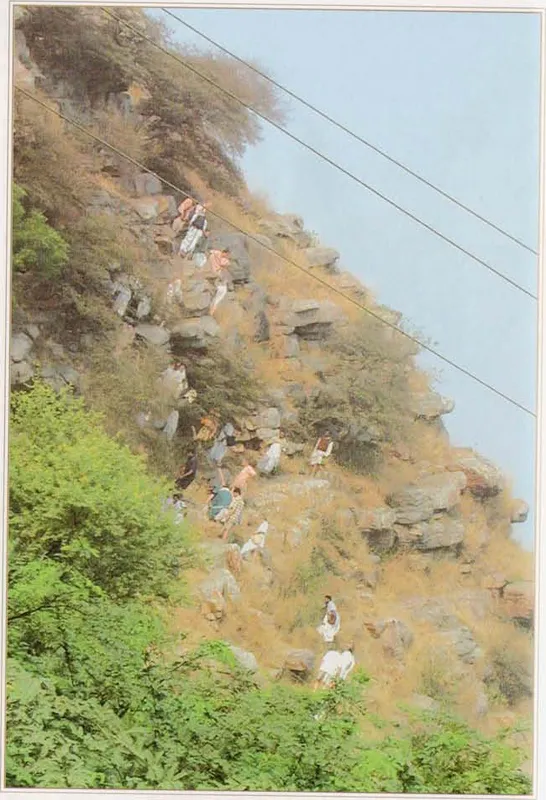
Vyomāsura's cave
व्योमासुर की गुफाVyomāsura's cave is shown in the hill of Kāmyavana, near the stone slide called Phisalanī-śilā.
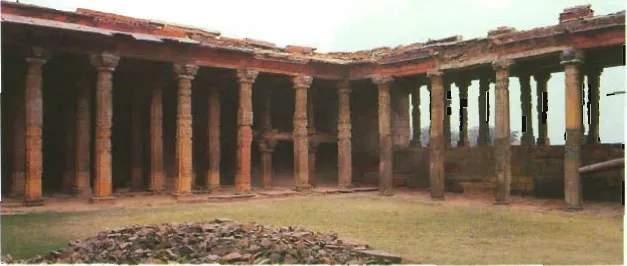
Kāmyavana
काम्यवनKāmyavana, also called Kāmavana, is one of the twelve forests of Vraja, around the town of Kāmā (Kāman).
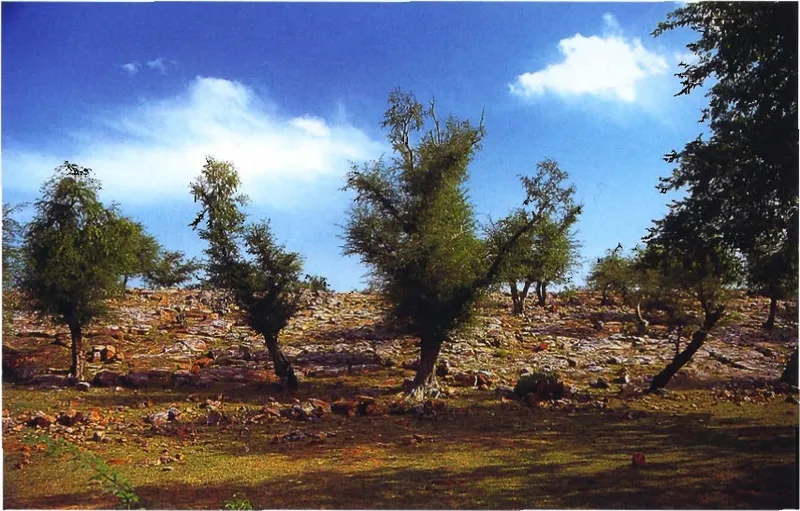
Govardhana
गोवर्धनGovardhana is the hill that Kṛṣṇa lifted with one hand and held up for seven days, so that the people and cows of Vraja could shelter under it from Indra's rain.
Indrasena Hill
इन्द्रसेन पर्वत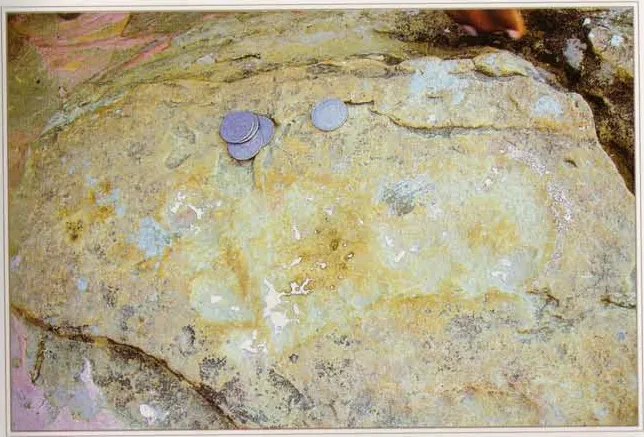
Footprint of Baladeva Prabhu (Kāmyavana)
बलदेव प्रभु का चरण-चिह्न (काम्यवन)The footprint of Baladeva Prabhu (Balarāma, Kṛṣṇa's elder brother) is shown in Kāmyavana, near Vyomāsura's cave, and modern guidebooks connect it with the killing of the …
Bhojana-thālī (Kāmyavana)
भोजन-थाली (काम्यवन)Bhojana-thālī, "the place of the meal plate", is a rocky hill in Kāmyavana, near Vyomāsura's cave.
Gaḍha
गढ़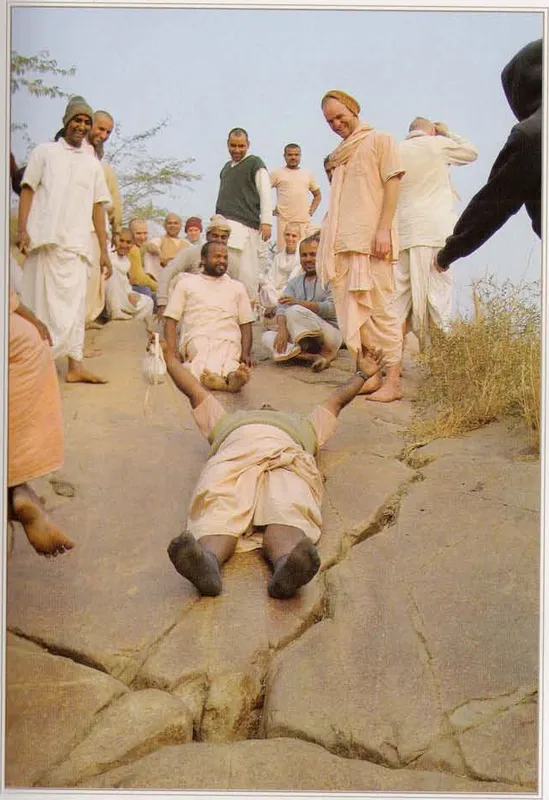
Phisalanī-śilā (Kāmyavana)
फिसलनी-शिला (काम्यवन)Phisalanī-śilā, the "slippery stone", is a sloping rock on a hill of Kāmyavana, down which Kṛṣṇa and His cowherd friends slid in play.
Questions and answers
He was a powerful magician, the son of the demon Maya, who joined the cowherd boys' game dressed as a boy. The Garga-saṁhitā adds that he had been King Bhīmaratha of Kāśī, cursed by the sage Pulastya.[1 +6]
It was a game of stealing and hiding. Some boys played thieves, some herders and some sheep. Śrīla Prabhupāda calls it a game of thieves and police.[1–6]
The Bhāgavatam names no place. Śrīla Prabhupāda's Kṛṣṇa book says Govardhana Hill. Śrīla Jīva Gosvāmī's Gopāla-campū and the Bhakti-ratnākara honour a hill and cave in Kāmyavana.[1–8]
The Bhāgavatam and the Kṛṣṇa book do not mention Him. The Garga-saṁhitā says Kṛṣṇa played the game with Balarāma. The Gopāla-campū says He came without Balarāma.[1 +7]
Śrīla Prabhupāda says yes: Nārada did not mention Vyomāsura, so he was killed later the same day. Śrīla Jīva Gosvāmī places the killing in Kṛṣṇa's early childhood. The ācāryas' explanations stand side by side.[9, 32]
It is in the hills of Kāmyavana, according to the Bhakti-ratnākara and the Vraja-bhakti-vilāsa. The guidebooks place it near the stone slide, across the road from Bhojana-thālī.[8 +6]
Sources
- Śrīmad-Bhāgavatam 10.37.26, GRETIL
- Śrīmad-Bhāgavatam 10.37.28, GRETIL
- Śrīmad-Bhāgavatam 10.37.29, GRETIL
- Śrīmad-Bhāgavatam 10.37.32, GRETIL
- Śrīmad-Bhāgavatam 10.37.33, GRETIL
- Śrīla Prabhupāda, Kṛṣṇa, the Supreme Personality of Godhead (Kṛṣṇa book), Chapter 37, 'Killing the Keśī Demon and Vyomāsura' · vedabase.io
- Gopāla-campū, Pūrva-campū (10) ¶[62]
- Śrīla Narahari Cakravartī, Bhakti-ratnākara, Fifth Wave vv.881 and 883, printed p. 217, 2nd ed., 1912
- Śrīla Prabhupāda, Kṛṣṇa, the Supreme Personality of Godhead (Kṛṣṇa book), Chapter 38, 'Akrūra's Arrival in Vṛndāvana' · vedabase.io
- Gopāla-campū, Pūrva-campū 10 ¶[63], end
- Gopāla-campū, Pūrva-campū 10 ¶[64] v.23 and ¶[65] v.24
- Śrīla Prabhupāda, Śrī Caitanya-caritāmṛta, Madhya-līlā 1.44, purport · vedabase.io
- Śrīla Narahari Cakravartī, Bhakti-ratnākara, Fifth Wave (pañcama taraṅga) vv.818–819 and 833–834, printed p. 214, 2nd ed., 1912
- Śrīla Nārāyaṇa Bhaṭṭa, Vraja-bhakti-vilāsa, ch. 2, the same list, vv.33–35 and 46–47 (finding aid: '(2) [part 13] v.33–35, 46–47'), printed p. 49, 1st ed., publ. Bābā Kṛṣṇadāsa, Kusuma-sarovara, Saṁvat 2008
- Śrīla Nārāyaṇa Bhaṭṭa, Vraja-bhakti-vilāsa, ch. 9 vv.14–15, printed p. 192, 1st ed., publ. Bābā Kṛṣṇadāsa, Kusuma-sarovara, Saṁvat 2008
- Garga-saṁhitā, Mādhurya-khaṇḍa (4) 24.11–14, Sanskrit Wikisource
- the undated parikramā notes Kāmyavana, ¶80
- Vaṁśīdhara: commentary Vaṁśīdhara, Bhāvārtha-dīpikā-prakāśa, on ŚB 10.37.26, Bhagavata Vidya Pith edition, ed. Bhagavata Rishi and Krishna Shankar Shastri, 1996
- Śrīla Jīva Gosvāmī, Gopāla-campū, Pūrva-campū, tenth pūraṇa, ¶[60] and ¶[62]
- Śrīla Narahari Cakravartī, Bhakti-ratnākara, Fifth Wave, 1912 ed. p. 217; Grantha Mandira text v.881, 2nd ed., 1912
Show all 43 references
- Śrīla Nārāyaṇa Bhaṭṭa, Vraja-bhakti-vilāsa, ch. 4 v.29 (beginning), printed p. 92, 1st ed., publ. Bābā Kṛṣṇadāsa, Kusuma-sarovara, Saṁvat 2008
- Śrīla Nārāyaṇa Bhaṭṭa, Vraja-bhakti-vilāsa, ch. 4 vv.30 and 32, printed p. 93, 1st ed., publ. Bābā Kṛṣṇadāsa, Kusuma-sarovara, Saṁvat 2008
- Śrī Vraja-maṇḍala Parikramā (2007), PDF p. 157
- Vṛndāvana-Dhāma Ki Jaya! (c. 1986), by Dhruva Mahārāja dāsa, PDF p. 46
- the undated parikramā notes Kāmyavana, ¶74
- the undated parikramā notes Kāmyavana, ¶78
- Śrīla Kṛṣṇadāsa Kavirāja Gosvāmī, Śrī Caitanya-caritāmṛta, CC Madhya-līlā 18.55, online edition · vedabase.io
- Śrīla Kṛṣṇadāsa Kavirāja Gosvāmī, Śrī Caitanya-caritāmṛta, CC Madhya-līlā 18.57, online edition · vedabase.io
- Śrīla Prabhupāda, Śrī Caitanya-caritāmṛta, Madhya-līlā 18.55, purport · vedabase.io
- Śrīla Prabhupāda, Śrīmad-Bhāgavatam, Canto 1, Introduction, Introduction (life of Śrī Caitanya Mahāprabhu) · vedabase.io
- Śrīmad-Bhāgavatam canto 10 with commentaries: Śrīdhara Svāmī: commentary Śrīla Śrīdhara Svāmī, Bhāvārtha-dīpikā, on ŚB 10.37.26-27, Bhagavata Vidya Pith edition, ed. Bhagavata Rishi and Krishna Shankar Shastri, 1996
- Śrīmad-Bhāgavatam canto 10 with commentaries: Śrīla Jīva Gosvāmī: commentary Śrīla Jīva Gosvāmī, Laghu-vaiṣṇava-toṣaṇī, on ŚB 10.37.26, Bhagavata Vidya Pith edition, ed. Bhagavata Rishi and Krishna Shankar Shastri, 1996
- Śrīmad-Bhāgavatam 10.31.3, GRETIL
- Śrīmad-Bhāgavatam canto 10 with commentaries: Śrīla Viśvanātha Cakravartī Ṭhākura: commentary Viśvanātha Cakravartī Ṭhākura, Sārārtha-darśinī on ŚB 10.31.3
- Garga-saṁhitā, Mādhurya-khaṇḍa (4) 24.1–5 (chapter 'vyomāsura-ariṣṭa-vadham'), Sanskrit Wikisource
- Garga-saṁhitā, Balabhadra-khaṇḍa (8) 6.16 (prose), Sanskrit Wikisource
- Śrī Vraja-maṇḍala Parikramā (2007), PDF p. 158
- Śrī Vraja-maṇḍala Parikramā (2007), PDF p. 166
- the undated parikramā notes Kāmyavana, ¶77
- Kṛṣṇa-caitanya-caritāmṛta, 4.10.16-17
- Kṛṣṇa-caitanya-caritāmṛta, 4.10.18
- Śrīmad-Bhāgavatam canto 10 with commentaries: Śrīla Jīva Gosvāmī: commentary Jīva Gosvāmī, Laghu-vaiṣṇava-toṣaṇī on ŚB 10.31.3
- Kṛṣṇa-caitanya-caritāmṛta, 4.12.17
Further sources
- Śrīmad-Bhāgavatam, Tenth Canto, chapters 31 and 37 (translation by the disciples of Śrīla Prabhupāda, BBT); Śrīla Prabhupāda, Kṛṣṇa, chapters 37–38.
- The Canto 10 commentaries of Śrīla Śrīdhara Svāmī, Śrīla Sanātana Gosvāmī, Śrīla Jīva Gosvāmī, Śrīla Viśvanātha Cakravartī Ṭhākura, Śrīla Baladeva Vidyābhūṣaṇa and Vaṁśīdhara, and Śrīla Jīva Gosvāmī's Gopāla-campū (Sanskrit), summarised, not translated.
- Bhakti-ratnākara, Fifth Wave; Vraja-bhakti-vilāsa; Garga-saṁhitā, Mādhurya-khaṇḍa 24: summarised here, not translated.