Gomā-ṭīlā
गोमा-टीला Hindi name proposed
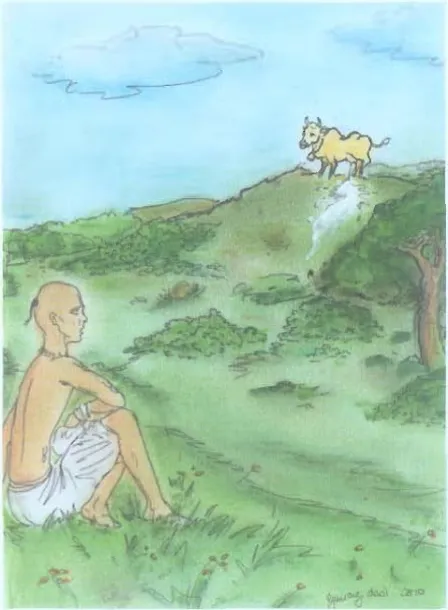
- What it is
- Gomā-ṭīlā is the hillock in Vṛndāvana where, according to the Bhakti-ratnākara, Śrīla Rūpa Gosvāmī found the Deity of Śrī Govinda.
- Visiting
- According to The Color Guide to Vṛndāvana (2000), the Yogapīṭha chapel to the left of the main altar of the old Govinda temple is the very spot where Śrīla Rūpa Gosvāmī found the Deity.
- Places here
- Rādhā-Govinda Mandira (Vṛndāvana, old)
In short
Gomā-ṭīlā is the hillock in Vṛndāvana where, according to the Bhakti-ratnākara, Śrīla Rūpa Gosvāmī found the Deity of Śrī Govinda. A cow gave her milk there every forenoon, the villagers dug the ground, and Govinda appeared.[1 +5] The Bhakti-ratnākara calls the hill the yogapīṭha of Vṛndāvana, the seat of Rādhā and Kṛṣṇa's pastimes.[1 +1] The guidebooks say that the great red-sandstone Govinda temple was later built on top of it.[7 +4] No source explains the name, and no Purāṇa or statement of Śrīla Prabhupāda found names the hill.[1 +9]
Key facts
| Kind | hill |
|---|---|
| Region · area | Vṛndāvana |
| Ācāryas | Śrīla Rūpa Gosvāmī, Śrīla Narahari Cakravartī Ṭhākura, Śrīla Raghunātha Bhaṭṭa Gosvāmī |
Divine pastimes
Śrī Govinda appears
Śrī Caitanya Mahāprabhu ordered Śrīla Rūpa Gosvāmī to make known the lost holy places of Vraja:[4 +3]
ব্রজে যাই রসশাস্ত্র করিহ নিরূপণ ।
লুপ্ত-তীর্থ সব তাহাঁ করিহ প্রচারণ ॥ ২১৮ ॥
vraje yāi rasa-śāstra kariha nirūpaṇa
lupta-tīrtha saba tāhāṅ kariha pracāraṇa
“When you go to Vṛndāvana, stay there, preach transcendental literature and excavate the lost holy places.
Translation: Śrīla A.C. Bhaktivedanta Swami PrabhupādaThe Caitanya-caritāmṛta says that Śrīla Rūpa Gosvāmī and Śrīla Sanātana Gosvāmī began the service of Govinda in Vṛndāvana, without naming the hill.[4 +3] The Bhakti-ratnākara of Śrīla Narahari Cakravartī Ṭhākura tells how He was found, quoting the older Sādhana-dīpikā of Śrī Rādhā-kṛṣṇa Gosvāmī (summarised here, not translated). After Śrīla Rūpa Gosvāmī had searched everywhere in vain, a beautiful person in the form of a Vrajavāsī came to him. He said that at Gomā-ṭīlā, the yogapīṭha, a cow gave her milk every forenoon, and that Śrī Govinda was hidden there. He took Śrīla Rūpa Gosvāmī to the spot and vanished. Śrīla Rūpa Gosvāmī fainted, then understood and told the Vrajavāsīs. Young and old came, dug the ground, and Govinda, the son of the King of Vraja, appeared in the middle of the yogapīṭha.[1 +6]
As soon as Govinda appeared, according to the Bhakti-ratnākara, Śrīla Rūpa Gosvāmī sent a letter to Śrī Caitanya Mahāprabhu at Purī, and the Lord and His associates read it with great joy. So the finding took place in Mahāprabhu's lifetime, though no year is given.[3] Read more: How Śrīla Rūpa Gosvāmī found Śrī Govinda on Gomā-ṭīlā →
The yogapīṭha
In one of his readings of the verse that ends the rāsa dance (ŚB 10.33.38), Śrīla Śrīnātha Cakravartī says that the gopīs, not wishing to go home, went to an eternal place in Vṛndāvana called the yogapīṭha (summarised here, not translated). He does not name Gomā-ṭīlā, and no source says that the two are the same.[1 +1] Śrīla Sanātana Gosvāmī calls Śrī Govindadeva the presiding Deity of Vṛndāvana, and on ŚB 10.37 he places the killing of Keśī on the Yamunā "north of Śrī Govindadeva", near Keśī-ghāṭa. Neither comment says where Śrī Govindadeva stood.[21 +2]
Songs
Śrīla Bhaktivinoda Ṭhākura sings of Rādhā and Kṛṣṇa seated on the yoga-pīṭha in a kadamba grove of Vṛndāvana, surrounded by the …
Śrīla Bhaktivinoda Ṭhākura sings of Rādhā and Kṛṣṇa seated on the yoga-pīṭha in a kadamba grove of Vṛndāvana, surrounded by the eight sakhīs. The song does not name Gomā-ṭīlā, which the Bhakti-ratnākara calls the yogapīṭha.[1 +2]
joga-pīṭhopari-sthita aṣṭa-sakhī-subeṣṭita
bṛndāraṇye kadamba-kānane
rādhā-saha baṁśī-dhārī biśwa-jana-citta-hārī
prāṇa mora tāhāra caraṇe
Visiting today
According to The Color Guide to Vṛndāvana (2000), the Yogapīṭha chapel to the left of the main altar of the old Govinda temple is the very spot where Śrīla Rūpa Gosvāmī found the Deity. A small Deity of Yogamāyā and Govinda's footprints are kept there, and the pūjārī gives darśana on request.[8]
Location
| Where it is | 'a nearby hillock' (the boy's words to Rūpa Gosvāmī, who sat by the bank of the Yamunā)[26] |
|---|
Places at Gomā-ṭīlā
1 places
History
The Caitanya-caritāmṛta says that Śrīla Raghunātha Bhaṭṭa Gosvāmī had his disciples build a temple for Govinda, without naming the site.[7 +2] Vṛndāvana, the Playground of God (2010) says that he had the red-sandstone temple built on top of Goma-ṭilā by Mān Singh of Jaipur, whom it calls his disciple (no older source found says so), and installed the Deity in 1590. The Color Guide to Vṛndāvana (2000) also says that it was built on top of the hill where the Deity was first discovered, and completed in 1590.[7 +4] Śrīla Prabhupāda writes that Śrīla Rūpa Gosvāmī built the Govindajī temple (a general statement that does not name the hill):[4 +3]
General teaching (does not name the place)“When Rūpa Gosvāmī and Sanātana Gosvāmī went to Vṛndāvana, there was not a single temple, but by their preaching they were gradually able to construct various temples. Sanātana Gosvāmī constructed the Madana-mohana temple, and Rūpa Gosvāmī constructed the Govindajī temple.”
Śrīla Prabhupāda, Śrī Caitanya-caritāmṛta, Ādi-līlā 7.164, purport · vedabase.io
Where the sources differ
How the finding of Govinda on the hill is told.
How the finding of Govinda on the hill is told.[6 +5]
Accounts differ How the finding of Govinda on the hill is told.
- Bhakti-ratnākara, Second Wave pp. 88-90 (quoting the Sādhana-dīpikā)Rūpa, staying on the Yamunā bank after searching everywhere, is approached by someone beautiful in the form of a Vrajavāsī, who tells him that a cow gives milk every forenoon at Gomā-ṭīlā, the yogapīṭha, takes him there and vanishes; Rūpa faints on hearing him and seeing his form; young and old Vrajavāsīs dig/clear the ground and Govinda appears in the middle of the yogapīṭha.
- Śrī Vraja-maṇḍala Parikramā (2007)During his daily parikramā Rūpa sits weeping under a tree on the Yamunā bank; a beautiful Vrajavāsī boy, also doing parikramā, brings him to Gomā-ṭīlā: every day just before noon a cow comes to the mound and irrigates it with her milk; the boy disappears; Rūpa faints thinking of the boy; the Vrajavāsīs dig and find Govinda 'a little under the ground'.
- Vṛndāvana, the Playground of God (2010)An extraordinarily attractive Vrajavāsī tells of a hill named Goma-ṭilā, on top of which a cow releases her milk every day, takes Rūpa there and vanishes; later the cow comes and Rūpa sees her milk pour out, then faints; the people dig at the top of the hill and find Govinda and also a small Deity of Yogamāyā.
- The Color Guide to Vṛndāvana (2000)Rūpa, by the Yamunā, weeps calling 'Ha Chaitanya'; Lord Krishna in the guise of a beautiful brijvasi boy tells him of a cow emptying its milk into a hole on a nearby hillock; the boy disappears; Rūpa looks into the milk-drenched hole and faints; the local people excavate the hole and find Govinda.
The wording of these accounts is our summary of the sources, not a published translation.
The Bengali Vṛndāvana-kathā (1920) describes Gomā-ṭīlā as a mound about 20 to 25 feet high, west of the road from Mathurā, with the old temple on it; what it says remained of the temple differs from other sources (see the old Govinda temple).[25]
More on this place
How Śrīla Rūpa Gosvāmī found Śrī Govinda on Gomā-ṭīlā
References
26 references
- Śrīla Narahari Cakravartī, Bhakti-ratnākara, Second Wave (dvitīya taraṅga), 1912 ed. p. 89, 2nd ed., 1912
- Śrīla Narahari Cakravartī, Bhakti-ratnākara, Second Wave, quoting the Sādhana-dīpikā, 1912 ed. p. 90, 2nd ed., 1912
- Śrīla Narahari Cakravartī, Bhakti-ratnākara, Second Wave (dvitīya taraṅga), 1912 ed. p. 91, 2nd ed., 1912
- Śrīla Kṛṣṇadāsa Kavirāja Gosvāmī, Śrī Caitanya-caritāmṛta, Antya-līlā 1.218, online edition · vedabase.io
- Śrīla Kṛṣṇadāsa Kavirāja Gosvāmī, Śrī Caitanya-caritāmṛta, Madhya-līlā 1.32, online edition · vedabase.io
- Śrī Vraja-maṇḍala Parikramā (2007), PDF p. 323
- Vṛndāvana, the Playground of God (2010), Bhakti Caitanya Svāmī, PDF p. 34
- The Color Guide to Vṛndāvana (2000), Written and Photographed by Rājaśekhara dāsa Brahmacārī, PDF p. 146
- the undated parikramā notes Vṛndāvana, ¶268
- Śrī Vraja-maṇḍala Parikramā (2007), PDF p. 324
- Śrīla Kṛṣṇadāsa Kavirāja Gosvāmī, Śrī Caitanya-caritāmṛta, CC Antya-līlā 13.131, online edition · vedabase.io
- Śrī Vraja-maṇḍala Parikramā (2007), PDF p. 322
- Vṛndāvana, the Playground of God (2010), Bhakti Caitanya Svāmī, PDF p. 30
- The Color Guide to Vṛndāvana (2000), Written and Photographed by Rājaśekhara dāsa Brahmacārī, PDF p. 140
- Vṛndāvana-Dhāma Ki Jaya! (c. 1986), by Dhruva Mahārāja dāsa, PDF p. 74
- Śrīla Prabhupāda, Śrī Caitanya-caritāmṛta, Ādi-līlā 10.90, purport · vedabase.io
- Śrīla Prabhupāda, Śrī Caitanya-caritāmṛta, Ādi-līlā 7.164, purport · vedabase.io
- Śrīla Narahari Cakravartī, Bhakti-ratnākara, Second Wave (dvitīya taraṅga), 1912 ed. p. 88, 2nd ed., 1912
- Śrīla Narahari Cakravartī, Bhakti-ratnākara, Second Wave, quoting the Sādhana-dīpikā of Rādhā-kṛṣṇa Gosvāmī, 1912 ed. p. 90, 2nd ed., 1912
- Śrīla Śrīnātha Cakravartī: commentary on ŚB 10.33.38
Show all 26 references
- Śrīla Sanātana Gosvāmī: commentary on ŚB 10.11.28–29, Bhagavata Vidya Pith edition, ed. Bhagavata Rishi and Krishna Shankar Shastri, 1996
- Śrīla Sanātana Gosvāmī: commentary Śrīla Sanātana Gosvāmī, Bṛhad-vaiṣṇava-toṣaṇī, on ŚB 10.37.2, Bhagavata Vidya Pith edition, ed. Bhagavata Rishi and Krishna Shankar Shastri, 1996
- Śrīla Jīva Gosvāmī: commentary Śrīla Jīva Gosvāmī, Laghu-vaiṣṇava-toṣaṇī, on ŚB 10.37.2, Bhagavata Vidya Pith edition, ed. Bhagavata Rishi and Krishna Shankar Shastri, 1996
- Joga-pīṭhopari Sthita Aṣṭa-sakhī Subeṣṭita (Bhaktivinoda Ṭhākura (as the song book credits it; Gītāvalī)) · song book
- Vṛndāvana-kathā, chapter 2 (dvitīya pariccheda), printed p. 34
- the undated parikramā notes Vṛndāvana, ¶266