Śṛṅgāravaṭa (Vṛndāvana)
शृंगारवट (वृन्दावन) Hindi name proposed
Also called Śṛngāravaṭa
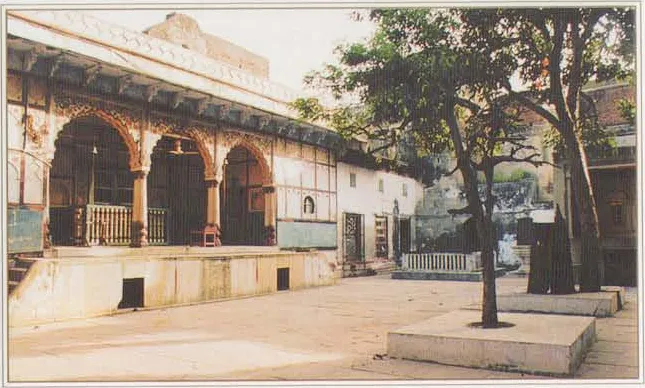
- What it is
- Śṛṅgāravaṭa, "the banyan of adornment", is a banyan with a temple on the bank of the Yamunā in Vṛndāvana, a little east of Imlītalā towards Keśī-ghāṭa and near the Rādhā-Dāmodara temple.
- Visiting
- Śrī Vraja-maṇḍala Parikramā (2007) places Śṛṅgāravaṭa a little east of Imlītalā, towards Keśī-ghāṭa, on the bank of the Yamunā, and in its list of the three banyans of Vṛndāvana, near the …
- Places here
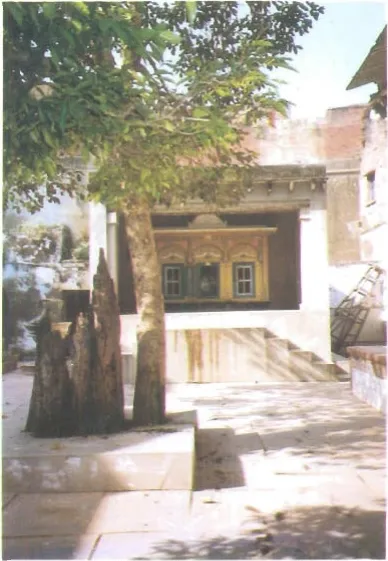
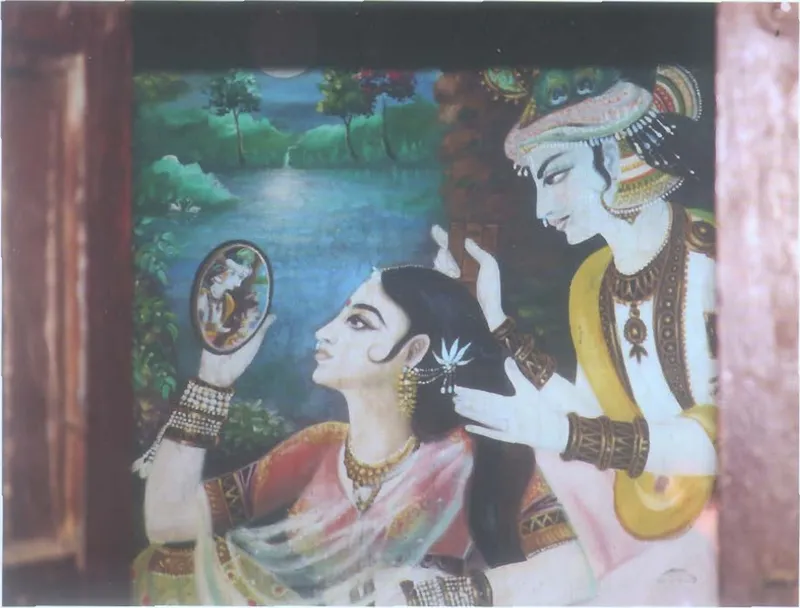
- Temple of Kṛṣṇa decorating Rādhārāṇī (Śṛṅgāravaṭa), Rādhā-Kṛṣṇa, Gaura-Nitāi and Jagannātha Mandira (Śṛṅgāravaṭa), Place where Rādhā was decorated by Kṛṣṇa (Śṛṅgāravaṭa), Ancient banyan tree (Śṛṅgāravaṭa)
In short
Śṛṅgāravaṭa, "the banyan of adornment", is a banyan with a temple on the bank of the Yamunā in Vṛndāvana, a little east of Imlītalā towards Keśī-ghāṭa and near the Rādhā-Dāmodara temple.[1 +5] The Bhakti-ratnākara calls it the banyan where Kṛṣṇa's dressing pastimes delighted Subala and His other friends, and says that some call it Nityānanda-vaṭa, for Śrī Nityānanda Prabhu sat and played under it.[7 +2] A commentator on the Bhāgavatam and Śrīla Viśvanātha Cakravartī Ṭhākura connect a Śṛṅgāra banyan with Kṛṣṇa adorning His beloved, without saying where it stood, and the guidebooks set that pastime here in different ways.[10 +1] A temple of Gaura-Nitāi stands at the site.[12 +5]
Key facts
| Kind | pastime site |
|---|---|
| Region · area | Vṛndāvana |
| Also part of | Yamunā |
| Ācāryas | Śrī Nityānanda Prabhu, Śrīla Śrīnivāsa Ācārya, Śrīla Rāghava Paṇḍita Gosvāmī of Govardhana, Śrīla Narahari Cakravartī Ṭhākura, Śrīla Viśvanātha Cakravartī Ṭhākura |
Divine pastimes
Kṛṣṇa's dressing pastimes with His friends
Śrīmad-Bhāgavatam tells of the forest decorations of Kṛṣṇa, Balarāma and the cowherd boys without naming a place. The boys, already adorned by their mothers, decorated themselves further with fruits, leaves, flowers, peacock feathers and soft minerals; Kṛṣṇa, Balarāma and Their friends danced, wrestled and sang in such ornaments; and the gopīs sang of Kṛṣṇa playing along the Yamunā with the cowherd boys, His dress adorned with a jasmine garland. No verse found has the boys decorate Kṛṣṇa or Balarāma.[18 +6]
kunda-dāma-kṛta-kautuka-veṣo gopa-godhana-vṛto yamunāyām / nanda-sūnur anaghe tava vatso narma-daḥ praṇayiṇāṃ vijahāra
O sinless Yaśodā, your darling child, the son of Mahārāja Nanda, has festively enhanced His attire with a jasmine garland, and He is now playing along the Yamunā in the company of the cows and cowherd boys, amusing His dear companions.
Translation: Śrīla Prabhupāda's disciples (BBT)Commenting on the verse of the jasmine garland, Śrīla Viśvanātha Cakravartī Ṭhākura says that Kṛṣṇa bathed in the Yamunā, sat on its bank and put on a playful dress to delight His own people, then walked on joking with His friends (summarised here, not translated). He names no place on the bank.[25]
The Bhakti-ratnākara of Śrīla Narahari Cakravartī Ṭhākura is the oldest source found that names this place. On Śrīla Śrīnivāsa Ācārya's round of Vraja, his guide shows him a wonderful banyan on the bank of the Yamunā, which everyone calls Śṛṅgāravaṭa: here Kṛṣṇa's many pastimes of dressing increased the joy of Subala and His other friends (summarised here, not translated).[7 +2]
দেখ এ অপূর্ব্ব বট যমুনার তীরে। সকলে শৃঙ্গারবট কহয়ে ইহারে॥ এথা শ্রীকৃষ্ণের নানা বেশাদি বিলাস। বাঢ়াইলা সুবলাদি সখার উল্লাস॥ ইহারেও নিত্যানন্দবট কেহো কয়। যে যাহা কহয়ে তাহা সব সত্য হয়॥ নিত্যানন্দ এথা যৈছে কৈলা আগমন। সংক্ষেপে কহিয়ে তাহা করহ শ্রবণ॥
dekha e apūrbba baṭa yamunāra tīre| sakale śṛṅgārabaṭa kahaẏe ihāre|| ethā śrīkṛṣṇera nānā beśādi bilāsa| bāṛhāilā subalādi sakhāra ullāsa|| ihāreo nityānandabaṭa keho kaẏa| ye yāhā kahaẏe tāhā saba satya haẏa|| nityānanda ethā yaiche kailā āgamana| saṁkṣepe kahiẏe tāhā karaha śrabaṇa||
The book does not say who dressed whom. According to Śrī Vraja-maṇḍala Parikramā (2007), Subala and the other sakhās (friends) decorated Kṛṣṇa here with colours and ornaments while grazing the cows; The Color Guide to Vṛndāvana (2000) says that the cowherd boys decorated Kṛṣṇa and Balarāma at this very spot.[1 +3] In The Nectar of Devotion Śrīla Prabhupāda describes, in general, Kṛṣṇa's friend Subala decorating Him with a garland.[28 +1]
Kṛṣṇa adorns Śrī Rādhā
Śrīmad-Bhāgavatam tells that on the night of the rāsa dance Kṛṣṇa disappeared from the gopīs when they grew proud of their good fortune, to curb their pride and show them mercy, and that one gopī had gone with Him: reading the footprints, the others said that Govinda had led Her to a secluded place.[30 +2] Following the footprints, they found where He had put Her down to gather flowers, where He had picked them standing on His toes, and where He had sat with Her to arrange Her hair and crown Her with the flowers. The verses name no place.[1 +4]
atra prasūnāvacayaḥ priyārthe preyasā kṛtaḥ / prapadākramaṇa ete paśyatāsakale pade
Just see how in this place dear Kṛṣṇa collected flowers for His beloved. Here He has left the impression of only the front part of His feet because He was standing on His toes to reach the flowers.
Translation: Śrīla Prabhupāda's disciples (BBT)The Gauḍīya commentators say that this gopī was Śrī Rādhā, and Śrīla Prabhupāda's Kṛṣṇa book names Her Rādhārāṇī.[36 +3] Śrīla Viśvanātha Cakravartī Ṭhākura explains that Rādhā was hurt because Kṛṣṇa treated all the gopīs alike, and that Kṛṣṇa took Her away and pacified Her. He adds that Kṛṣṇa put Her down so that an aśoka tree, touched by Her foot, would blossom at once, and that the hair was dressed with a comb given by the goddess of that forest. He names no place (summarised here, not translated).[1 +5] Śrīla Śrīdhara Svāmī, Śrīla Jīva Gosvāmī and Śrīla Viśvanātha Cakravartī Ṭhākura explain how the gopīs recognised the spot; none of them names a place.[10 +1]
Two later texts connect the pastime with the name Śṛṅgāravaṭa. Vaṁśīdhara, a commentator whom the editor of the text places in the nineteenth century, says that the spot where Kṛṣṇa arranged His beloved's hair is now well known as Śṛṅgāravaṭa. It is the only Canto 10 commentary found that names the place, and it does not say which Śṛṅgāravaṭa is meant (summarised here, not translated).[10]
Śrīla Viśvanātha Cakravartī Ṭhākura's Vraja-rīti-cintāmaṇi, in its round of the places of Vṛndāvana, says that the banyan under which, in a kuñja (bower), Kṛṣṇa adorned His dearest beloved is still sung of by the name Śṛṅgāra (summarised here, not translated). The verse stands between the well of the rāsa night and Vaṁśīvaṭa and Dhīra-samīra, but it names no bank or village.[11]
The Garga-saṁhitā sets the adornment of that night at a banyan it calls the saṅketa-vaṭa (meeting banyan), not Śṛṅgāravaṭa, and the Bhakti-ratnākara tells Kṛṣṇa's dressing of Rādhikā at another Śṛṅgāravaṭa, near Tiloyāra.[7 +3] The guidebooks set the adornment here, each on a different occasion: on the rāsa night after Śrī Rādhā had left the dance in māna, before Rādhā and Kṛṣṇa went to Nidhuvana for the rāsa, or on another occasion. The Color Guide and the undated parikramā notes Vṛndāvana place a temple of Kṛṣṇa decorating Rādhārāṇī behind the banyan, and behind that the place where Śrī Rādhā sat.[12 +3] Read more: Śrī Rādhā's māna at the autumn rāsa and how it was broken →
राधेशो राधया सार्धं संकेतवटमाविशत् । प्रियायाः कबरीपुष्परचनां स चकार ह ॥
rādheśo rādhayā sārdhaṁ saṁketavaṭamāviśat
priyāyāḥ kabarīpuṣparacanāṁ sa cakāra ha ||
Accounts differ Which pastime the name Śṛṅgāravaṭa recalls, on what occasion Kṛṣṇa decorated Rādhārāṇī here, and which Śṛṅgāra-vaṭa the older texts mean (this one on the Yamunā in Vṛndāvana or the village near Tiloyāra).
- Bhakti-ratnākara, Fifth WaveKṛṣṇa's pastimes of dressing here increased the joy of Subala and the other friends; Rādhikā is not mentioned at this banyan (Kṛṣṇa dressing Rādhikā is told at the Śṛṅgāravaṭa near Tiloyāra).
- Śrī Vraja-maṇḍala Parikramā (2007)The sakhās decorated Kṛṣṇa here while grazing the cows; and in the rāsa night, after Rādhikā had left in māna, Kṛṣṇa decorated Her with flowers He had picked, then vanished when She asked to be carried.
- The Color Guide to Vṛndāvana (2000) and the undated parikramā notes VṛndāvanaKṛṣṇa decorated Rādhārāṇī with jewels, flowers and ornaments before They went to Nidhuvana for the rāsa; The Color Guide to Vṛndāvana (2000) adds that the cowherd boys decorated Kṛṣṇa and Balarāma here.
- Vṛndāvana, the Playground of God (2010)While Rādhārāṇī was being dressed, Kṛṣṇa took over braiding Her hair, and She saw Him in Her mirror.
The rest of the rāsa night
The Bhāgavatam goes on: the proud gopī asked Kṛṣṇa to carry Her, He told Her to climb on His shoulder and vanished, and She cried out for Him; the searching gopīs found Her close by, and later they all came back to the bank of the Yamunā. Śrī Vraja-maṇḍala Parikramā tells this at Śṛṅgāravaṭa, while two other guidebooks set Kṛṣṇa's leaving Her at Jhāḍū-maṇḍala.[12 +6] In the Caitanya-caritāmṛta, Śrī Caitanya Mahāprabhu says that Kṛṣṇa stole Rādhā away from the rāsa, and Śrīla Rāmānanda Rāya that She left the circle of the dance and Kṛṣṇa searched for Her; neither names a place.[54 +1]
Accounts differ Where Kṛṣṇa left His beloved after she asked to be carried, and where the gopīs found her (the Bhāgavatam's account first)
- Śrīmad-Bhāgavatam 10.30.37–40 and 10.30.44 (translation by Śrīla Prabhupāda's disciples)After the flower-picking and the hair-dressing (10.30.31–33), 'having gone to a part of the forest' (vanoddeśam), the proud gopī asked to be carried; He told her to climb on His shoulder and disappeared; she cried out; the searching gopīs found her 'not far away', bewildered by separation; later they all came back to the bank of the Kālindī. No place is named.
- The canto 10 commentators on ŚB 10.30.37–40Viśvanātha: in an excellent part of the forest, while Kṛṣṇa was braiding her hair, after He proposed to go on far ahead of the others; Śrīla Nārāyaṇa Bhaṭṭa: they had gone from the place of their enjoyment to another part of the forest because the searching gopīs were expected there; Śrīdhara: He vanished just as she was about to climb; the Bṛhat-krama-sandarbha: He vanished right there, seeing her unseen; Jīva (Laghu-toṣaṇī): she fainted and fell to the ground; Sanātana: the gopīs surrounded her, wept and slowly revived her. None names a place; Vaṁśīdhara names Śṛṅgāra-vaṭa only for the hair-dressing.
- Viṣṇu Purāṇa 5.13.34–36Reading the footprints, the gopīs say: here Dāmodara picked flowers high up (only the front of His feet is marked); sitting here He adorned some girl with flowers; she grew proud of that honour, and He left her and went on by this path. No request to be carried, and no girl or place named. (Editorial summary; no published translation used.)
- Garga-saṁhitā, Vṛndāvana-khaṇḍa 21.17–41After decorating Rādhā at the saṅketa-vaṭa, Kṛṣṇa went on by Bhadravana, Khadiravana and Bilvavana to the forest called Kokila; there, hearing the gopīs' clamour, He told Rādhā to hurry; proud, She said She could not walk; He told Her to climb on His shoulder and disappeared; Kīrti's daughter wept aloud in that forest, and the gopīs who came bathed, fanned and consoled Her. (Editorial summary of the Sanskrit; the published English translation, Garga Samhita, Danavir Goswami, on wisdomlib.org, was not consulted for these verses.)
Traditional accounts
The Vraja-bhakti-vilāsa of Śrīla Nārāyaṇa Bhaṭṭa Gosvāmī counts a Śṛṅgāravaṭa among the sixteen banyans of Vraja, the third of …
The Vraja-bhakti-vilāsa of Śrīla Nārāyaṇa Bhaṭṭa Gosvāmī counts a Śṛṅgāravaṭa among the sixteen banyans of Vraja, the third of the eight on the south bank of the Yamunā. Citing the Skanda Purāṇa, it marks this banyan by two temples, a Śṛṅgāra-mandira (temple of adornment) on its right and a Śayyā-mandira (temple of the bed) on its left. It does not say where the banyan stands, so it may mean this one or the one near Tiloyāra.[56 +1]
According to the Bengali Vṛndāvana-kathā (1920), the gosvāmīs of the temple explained the name in their own way: Śrī Rādhā Ṭhākurāṇī used to sit here under the banyan and dress and adorn Herself, and so the place is called Śṛṅgāravaṭa.[58]
The Gosvāmīs and ācāryas
According to the Bhakti-ratnākara, Śrī Nityānanda Prabhu came to Mathurā for some days, wandered through Vraja and, having seen …
Śrī Nityānanda Prabhu
According to the Bhakti-ratnākara, Śrī Nityānanda Prabhu came to Mathurā for some days, wandered through Vraja and, having seen all the forests, came to Vṛndāvana, playing on the sandbank of the Yamunā. Under this banyan He would sit one moment and rise the next, roll in the dust, dress Himself with flowers and cry, "Where is Kānāi, My life?" Then He came to know that Śrī Gaurasundara was openly showing His pastimes in Navadvīpa, and He left from here for Navadvīpa. The book calls this His play-place and says that whoever sees it is most fortunate (summarised here, not translated).[7 +5]
দেখিয়া সকল বন আসি বৃন্দাবনে। খেলয়ে অদ্ভুত খেলা যমুনাপুলিনে॥ এই যে অপূর্ব্ব বটবৃক্ষের তলাতে। ক্ষণে বৈসে ক্ষণে উঠে লোটায় ধূলাতে॥ ক্ষণে নানা পুষ্পে বেশ করে আপনার। ক্ষণে কহে কোথা প্রাণ কানাই আমার॥ নিত্যানন্দ ভাবাবেশে করে টলমল। অশ্রুজলে পূর্ণ দীর্ঘ নয়নযুগল॥ ঐছে নিত্যানন্দ বৃন্দাবনেতে বিহরে। নিত্যানন্দ চেষ্টা কে বুঝিতে শক্তি ধরে॥ জানিলেন শ্রীগৌরসুন্দর নবদ্বীপে। গুপ্তরূপে বিহরি বিহরে ব্যক্তরূপে॥
dekhiẏā sakala bana āsi bṛndābane| khelaẏe adbhuta khelā yamunāpuline|| ei ye apūrbba baṭabṛkṣera talāte| kṣaṇe baise kṣaṇe uṭhe loṭāẏa dhūlāte|| kṣaṇe nānā puṣpe beśa kare āpanāra| kṣaṇe kahe kothā prāṇa kānāi āmāra|| nityānanda bhābābeśe kare ṭalamala| aśrujale pūrṇa dīrgha naẏanayugala|| aiche nityānanda bṛndābanete bihare| nityānanda ceṣṭā ke bujhite śakti dhare|| jānilena śrīgaurasundara nabadbīpe| guptarūpe bihari bihare byaktarūpe||
The guidebooks say that He stayed here when He visited Vṛndāvana: for a few days, in the mood of Baladeva, asking where Kanhaiyā was (Śrī Vraja-maṇḍala Parikramā); for some time before Śrī Caitanya Mahāprabhu began His saṅkīrtana, chanting the holy names under the banyan (Vṛndāvana, the Playground of God, 2010); as His favourite place, where He did bhajana (The Color Guide). The Vṛndāvana-kathā (1920) also says that He took shelter under this tree for some time on His pilgrimage.[12 +5]
Śrīla Prabhupāda writes that it is said that Śrī Nityānanda Prabhu lived for many days at Mathurā and there heard of Śrī Caitanya Mahāprabhu's pastimes in Navadvīpa. The sources differ on how He learned of them (see below).[67]
General teaching (does not name the place)“Nityānanda Prabhu traveled on many pilgrimages with the sannyāsī. It is said that for many days He lived at Mathurā with him, and at that time He heard about Lord Caitanya Mahāprabhu’s pastimes in Navadvīpa. Therefore He came down to Bengal to see the Lord.”
Śrīla Prabhupāda, Śrī Caitanya-caritāmṛta, Ādi-līlā 17.12, purport · vedabase.io
Śrīla Prabhupāda
No statement of Śrīla Prabhupāda about Śṛṅgāravaṭa as a place of pastimes has been found in the works searched.
No statement of Śrīla Prabhupāda about Śṛṅgāravaṭa as a place of pastimes has been found in the works searched. In his Kṛṣṇa book he tells the adornment of Śrī Rādhā on the rāsa night as the gopīs read its signs, naming no place:[36 +1]
General teaching (does not name the place)“Kṛṣṇa must have picked some flowers in this spot to satisfy Rādhārāṇī, because here, where He stood erect to get the flowers from the high branches of the tree, we find only half the impression of His feet. Dear friends, just see how Kṛṣṇa must have sat down here with Rādhārāṇī and tried to set flowers in Her hair.”
Śrīla Prabhupāda, Kṛṣṇa, the Supreme Personality of Godhead (Kṛṣṇa book), Chapter 30, 'Kṛṣṇa’s Hiding from the Gopīs' · vedabase.io
He tells the same moment once more in the gopīs' words, and he tells how the episode began: when the gopīs grew proud of their fortune, Kṛṣṇa disappeared to show them His mercy and to curb their pride (a general passage; it names no place):[30 +2]
General teaching (does not name the place)“Lord Kṛṣṇa, who is known as Keśava, could immediately understand their pride caused by their great fortune of enjoying Him personally, and in order to show them His causeless mercy and to curb their false pride, He immediately disappeared from the scene, exhibiting His opulence of renunciation.”
Śrīla Prabhupāda, Kṛṣṇa, the Supreme Personality of Godhead (Kṛṣṇa book), Chapter 29, 'The Rāsa Dance: Introduction' (end) · vedabase.io
Twice in 1976 he spoke of a temple kept up from a village across the Yamunā. In a Vṛndāvana lecture he said that there is still one temple "constructed by Jahangir", and that the village of Jahangir-pura on the other side of the river was given to the brāhmaṇas to maintain it; in a talk in Hyderabad he named the village again and asked about "Sringarpat Goswami".[69 +1] He names no temple. Growse lists the same village in the endowment of the Śṛṅgāravaṭa temple, but the sources differ on which emperor gave it (see below).[71]
Names this place“Aurangzeb gave some land, Jahangir gave some land. There is still one temple, it was constructed by Jahangir, and the other side of the Yamunā there is a village called Jahangir-pura. That village was given to the brāhmaṇas for maintaining the temple.”
Śrīla Prabhupāda, Lecture on Śrīmad-Bhāgavatam 1.7.16, Vṛndāvana, 14 September 1976 · vedabase.io
Speaking in general, Śrīla Prabhupāda counts the worship of sacred trees such as the banyan among the first ten items of devotional service.[72 +1]
Visiting today
Śrī Vraja-maṇḍala Parikramā (2007) places Śṛṅgāravaṭa a little east of Imlītalā, towards Keśī-ghāṭa, on the bank of the Yamunā, and in its list of the three banyans of Vṛndāvana, near the Rādhā-Dāmodara temple.[1 +5]
The temple
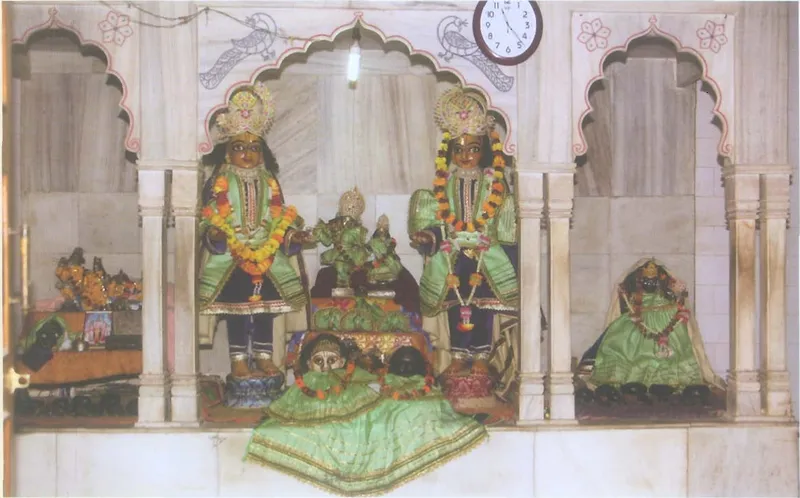
On the left of the courtyard is the temple of Rādhā-Kṛṣṇa, Gaura-Nitāi and Jagannātha, as The Color Guide to Vṛndāvana (2000) and the undated notes Vṛndāvana describe it; The Color Guide adds Baladeva and Subhadrā.[17 +1] Śrī Vraja-maṇḍala Parikramā names its presiding Deities as Śrī Nitāi-Gaura and Śrī Rādhā-Kṛṣṇa, and Vṛndāvana, the Playground of God (2010) describes large Gaura-Nitāi Deities, small Rādhā-Kṛṣṇa Deities, a set of human-like Jagannātha Deities and, on the far right, old Deities of Lakṣmī-Nārāyaṇa.[1 +3] Śrī Vraja-maṇḍala Parikramā counts Śrī Gaura-Nitāi at Śṛṅgāravaṭa among the principal ancient temples of Vṛndāvana, though no dated record of the building has been found, so its age is not certain.[13]
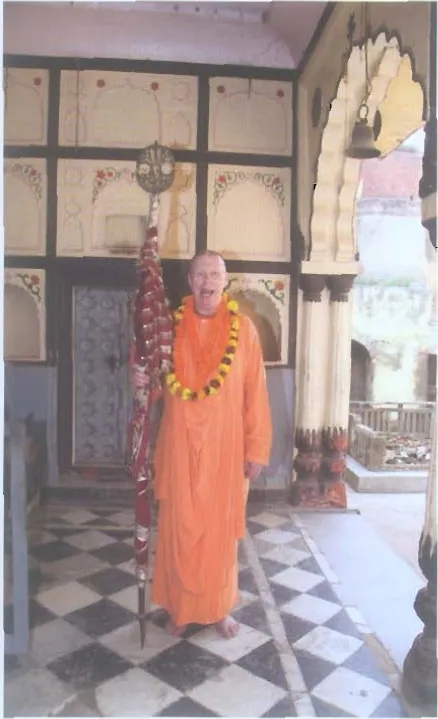
Vṛndāvana, the Playground of God says that devotees of the Nityānanda-vaṁśa, the family that traces its descent to Śrī Nityānanda Prabhu, run the temple, and that the pūjārīs show a metal saṅkīrtana banner which they say He used when He went out on harināma; that is their account and is not certain.[15 +1]
The banyan and the painting
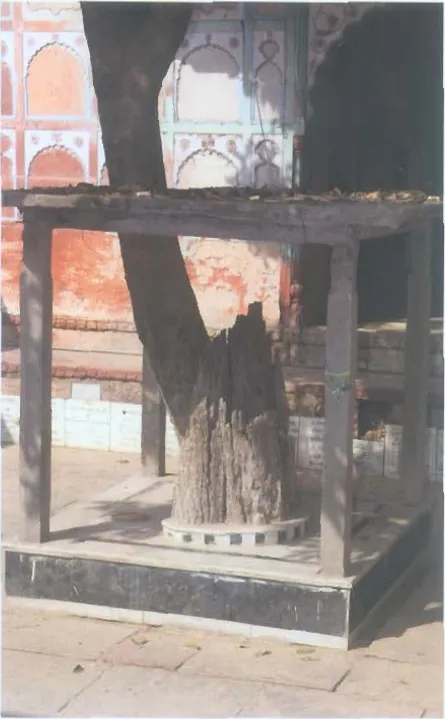
The old banyan near the temple is described differently over the years. In 1920 the Vṛndāvana-kathā found that the Śṛṅgāravaṭa that had stood on the platform had perished, and that another large banyan grown from its seed stood beside the steps of the ghāṭa.[59] The Color Guide (2000) photographs the tall split remains of an old stump beside a younger trunk, and Vṛndāvana, the Playground of God (2010) the broken stump in a wooden shelter with a living trunk behind it; the guidebooks differ on the tree (see below).[1 +2]
Śrī Vraja-maṇḍala Parikramā says that under an ancient banyan near the temple is a painting of Kṛṣṇa decorating Śrīmatī Rādhikā; Vṛndāvana, the Playground of God describes a picture of the pastime in a raised shrine about fifteen metres to the right of the main altar. Whether the two are the same has not been checked.[12 +3]
The temple of Kṛṣṇa decorating Rādhārāṇī
Behind the banyan stands a temple that The Color Guide to Vṛndāvana (2000) and the undated parikramā notes Vṛndāvana call a temple dedicated to Kṛṣṇa's decorating Rādhārāṇī; behind it is the place where She sat (below). No source names its Deity, its builder or its date.[17 +1] The pastime it recalls is told above: the Bhāgavatam names no place for it, a later commentator says that the spot is now known as Śṛṅgāravaṭa, and the sources differ on the occasion of the decoration.[10 +4] The guidebooks describe the memorial of the pastime in different ways: besides this temple, the picture in a raised shrine and the painting under an ancient banyan told above. Vṛndāvana, the Playground of God (2010) shows a wall painting of Kṛṣṇa placing a flower in Rādhārāṇī's hair as She looks into a mirror. The books do not say whether they mean the same shrine.[12 +2] Śrīla Prabhupāda does not speak of this temple by name.
The place where Rādhā was decorated by Kṛṣṇa
Behind the temple of the decoration is a place that The Color Guide to Vṛndāvana (2000) and the undated parikramā notes Vṛndāvana call the spot where Rādhārāṇī sat while Kṛṣṇa decorated Her; The Color Guide prints a photograph of it. No source says when or by whom the place was marked.[17 +1] Śrīmad-Bhāgavatam tells how, on the night of the rāsa dance, Kṛṣṇa sat down with His beloved and dressed Her hair with flowers He had picked, but it names no place (see above).[35 +1] Śrīla Prabhupāda does not speak of this place by name.
Location
| Where it is | on the bank of the Yamunā near Śrī Rādhā-Dāmodara Temple (Banyan trees list)[74] painting shrine 'about fifteen meters to the right of the main altar area'[75] |
|---|
Places at Śṛṅgāravaṭa (Vṛndāvana)
4 places
Nearby places
Imlītalā (Vṛndāvana) · Rādhā-Dāmodara Mandira (Vṛndāvana) · Śṛṅgāra-ghāṭa · Mīrābai Mandira
Pictures
5 pictures
History
The Vṛndāvana-kathā (1920) says that a sannyāsī of Śrī Nityānanda Prabhu's family, Paramānanda Gosvāmī, came from the village of Puraṇiyā in Bāṅkuḍā and first set up a temple here, and that his son Rasikānanda settled in Vṛndāvana with his family in the reign of the emperor Jahāṅgīr. The book names no document, so these details may not be certain.[59] In 1920, it says, descendants of Śrī Nityānanda Prabhu's family owned the temple, which was very old but not in ruins; its main Deities were Nitāi and Caitanya, and Rādhā-Kṛṣṇa were served with them.[59]
The historian A. W. Entwistle (1987) reports, citing an earlier book, that early in his reign the emperor Aurangzeb issued a firman (decree) granting the villages of Sakraya, Jahangirpur and others, on the east bank of the Yamunā, to Gosvāmī Pūrṇānanda of Śṛṅgāravaṭa. The firman itself could not be checked.[60]
F. S. Growse's book on Mathurā (1883) calls it the Bengali temple of Śṛṅgāravaṭa, near the Madana-mohana temple, of ancient date but often renewed. Its yearly income of 13,500 rupees was shared by three shareholders, each of whom took the services for four months; the village of Jahangirpur across the river, with the sacred grove of Bel-ban, belonged to its endowment.[61] Growse also records that the Nandotsava, the festival of Nanda Mahārāja, was held at Śṛṅgāravaṭa through the night of Bhādon Badi 9 with music and dancing.[62] The district gazetteer of 1911 names Gosāīṁ Kesonand as the priest of the temple.[63] Growse, the Vṛndāvana-kathā and The Color Guide also name the gosvāmīs of Śṛṅgāravaṭa as the builders of the nearby Śṛṅgāra-ghāṭa, which may be so, though none gives a year.[64] Read more: The temple of Śṛṅgāravaṭa and its gosvāmīs →
Where the sources differ
How Kṛṣṇa came to be alone with His beloved in the rāsa night, and on what occasion He decorated Her here
Accounts differ How Kṛṣṇa came to be alone with His beloved in the rāsa night, and on what occasion He decorated Her here
- Śrīmad-Bhāgavatam 10.29.48, 10.30.28, 10.30.31–33 (translation by Śrīla Prabhupāda's disciples)Seeing the gopīs proud of their good fortune, Kṛṣṇa disappeared from among them and led one gopī away to a secluded place; on the way He put her down, picked flowers for her standing on His toes and sat with her to arrange her hair and crown her with the flowers. No gopī and no place is named.
- Śrīla Viśvanātha Cakravartī on ŚB 10.29.48Because Kṛṣṇa treated all the gopīs alike, Vṛṣabhānu's daughter became māninī; Kṛṣṇa disappeared to calm the others' pride and took Her away with Him to pacify Her, which He did by dressing Her hair. No place is named.
- Vaṁśīdhara (nineteenth century) on ŚB 10.30.33The place where Kṛṣṇa arranged His beloved's hair is now famous as Śṛṅgāra-vaṭa (he does not say which).
- Caitanya-caritāmṛta, Madhya 8.102 and 8.105–107 (Śrīla Prabhupāda's translation)Śrī Caitanya Mahāprabhu: Kṛṣṇa stole Rādhārāṇī away from the rāsa. Rāmānanda Rāya: finding Herself treated equally with the other gopīs, Rādhārāṇī left the circle of the rāsa, and Kṛṣṇa, missing Her, wandered through the forest searching for Her; the Gīta-govinda verses he quotes (3.1–2) have Kṛṣṇa search for Her along the banks of the Yamunā and lament in the bushes of Vṛndāvana. …
The wording of these accounts is our summary of the sources, not a published translation.
The same question, with how She sat, was recorded once more for the temple of the decoration and the place where She sat; that record sets out the same accounts as above, and adds that Śrīla Śrīdhara Svāmī and Śrīla Viśvanātha Cakravartī Ṭhākura explain how the gopīs knew the spot by the mark of Her sitting.[10 +2]
On what occasion Kṛṣṇa decorated Rādhārāṇī here, and whether the oldest account sets it at this Śṛṅgāravaṭa at all, was also recorded once more for the temple and the seat; the accounts are those of the name of Śṛṅgāravaṭa, set out above with the pastime.[27 +1]
Where Kṛṣṇa dressed His beloved's hair on the rāsa night: the Bhāgavatam names no place; Vaṁśīdhara says only that the place is now known as Śṛṅgāravaṭa, without saying which; and the Bhakti-ratnākara links this Śṛṅgāravaṭa with Kṛṣṇa's dressing among His friends and tells His dressing of Rādhikā at the other Śṛṅgāravaṭa, near Tiloyāra.[10 +4]
Accounts differ Where Kṛṣṇa dressed His beloved's hair in the rāsa night: the Canto 10 commentators beside the guidebooks
- Śrīmad-Bhāgavatam 10.30.4, 10.30.24 and 10.30.31–33 (translation by Śrīla Prabhupāda's disciples)The gopīs search for Kṛṣṇa 'throughout the Vṛndāvana forest' (10.30.4), see His footprints 'in a corner of the forest' (vanoddeśe, 10.30.24) and, following them, find 'here' (atra, iha) the places where He had put His beloved down, gathered flowers on tiptoe and sat with her to dress her hair (10.30.31–33). No place is named.
- Vaṁśīdhara on ŚB 10.30.33That place is now famous as Śṛṅgāra-vaṭa (he does not say which Śṛṅgāra-vaṭa).
- Śrīla Śrīdhara Svāmī, Śrīla Sanātana Gosvāmī, Śrīla Jīva Gosvāmī, Śrīla Nārāyaṇa Bhaṭṭa and Śrīla Viśvanātha Cakravartī on ŚB 10.30.33No place is named: the gopīs knew the spot by the marks where she had sat (Śrīla Śrīdhara Svāmī, Śrīla Viśvanātha Cakravartī); Śrīla Viśvanātha Cakravartī speaks of a comb given by the forest goddess of this place; Śrīla Nārāyaṇa Bhaṭṭa takes 'here' (iha) as a second, secluded spot.
- Śrī Vraja-maṇḍala Parikramā (2007), p. 660At Śṛṅgāra-ghāṭa, when She was māninī (no source cited).
The wording of these accounts is our summary of the sources, not a published translation.
Accounts differ How and where Nityānanda learned that Śrī Caitanya had appeared, before He left Vraja for Navadvīpa.
- Śrī Vraja-maṇḍala Parikramā (2007)Near Śṛṅgāravaṭa 'He heard an aerial voice announce, "Your Kanhaiyā as Śacīnandana Gaurahari in Nadiyā is waiting for You to come to Him."'
- Bhakti-ratnākara, Fifth WaveWhile sporting in Vṛndāvana under this banyan He came to know (jānilena) that Gaurasundara now sported openly in Navadvīpa, and went to Navadvīpa from here; no voice is mentioned (earlier on the same page he spends some days in Mathurā: 'কথোদিন আসি প্রভু মথুরা নগরে').
- Śrīla Prabhupāda, CC Ādi 17.12 purport'It is said that for many days He lived at Mathurā with him [the sannyāsī], and at that time He heard about Lord Caitanya Mahāprabhu's pastimes in Navadvīpa.'
- Vṛndāvana, the Playground of God (2010)He stayed here 'prior to Lord Caitanya's beginning His saṅkīrtana movement'; how He learned of it is not said.
The wording of these accounts is our summary of the sources, not a published translation.
Accounts differ The state, and the meaning, of the old banyan.
- Śrī Vraja-maṇḍala Parikramā (2007)'Just near the temple under an ancient banyan tree is a unique painting' of Kṛṣṇa decorating Rādhikā.
- Vṛndāvana, the Playground of God (2010)The old tree, under which Lord Nityānanda would sit, has died; devotees planted a branch of it shortly before, and a new banyan grows there beside the old stump.
- The Color Guide to Vṛndāvana (2000) and the undated parikramā notes VṛndāvanaThe original banyan under which the Divine Couple sat has almost vanished, leaving a large stump; a branch from it was planted and has grown into a large tree.
- Vṛndāvana-kathā (Pulinbihārī Datta, 1920), p. 187The Śṛṅgāra-vaṭa that formerly stood on the platform (vedī) has perished with time; another large banyan grown from its seed stands beside the steps of the ghāṭa.
Accounts differ Which Mughal emperor the sources connect with the temple maintained from the village of Jahangirpur across the Yamunā and with the grant of the village.
- Śrīla Prabhupāda, lecture on Śrīmad-Bhāgavatam 1.7.16, Vṛndāvana, 14 September 1976After 'Aurangzeb gave some land, Jahangir gave some land': 'There is still one temple, it was constructed by Jahangir, and the other side of the Yamunā there is a village called Jahangir-pura. That village was given to the brāhmaṇas for maintaining the temple.' He names no temple and does not say who gave the village.
- Śrīla Prabhupāda, room conversation, Hyderabad, 19 August 1976After 'Aurangzeb gave many contributions to the Vṛndāvana temples' and right after 'Aurangzeb's grandfather, Jahangir, he gave so many temples to many brāhmaṇas': a village just opposite Vṛndāvana, 'Keśīghāṭa = Jahangipura', 'was given to a brāhmaṇa', who maintained a temple from its income; then 'And Aurangzeb... You know Sringarpat Goswami?', and the subject is broken off.
- A. W. Entwistle (1987), a historian, citing ShyamdasEntwistle says that early in his reign Aurangzeb issued some firmans in favour of Braj devotees, one of them granting Gosvāmī Pūrṇānanda of Śṛṅgāravaṭa in Vṛndāvana the villages of Sakraya, Jahāṅgīrpur and others on the east bank of the Yamunā. He names no temple or builder.
- F. S. Growse, Mathurá (1883), a historianGrowse says that the village of Jahāṅgīrpur across the river, with the sacred grove of Bel-vana, belongs to the endowment of the Bengali temple of Śṛṅgāravaṭa, which he counts, like the smaller temples, as old and often renewed. He names no builder or grantor.
More on this place
Śrī Rādhā's māna at the autumn rāsa and how it was broken · The temple of Śṛṅgāravaṭa and its gosvāmīs
References
75 references
- Śrī Vraja-maṇḍala Parikramā (2007), PDF p. 310
- Śrī Vraja-maṇḍala Parikramā (2007), PDF p. 346
- Śrī Vraja-maṇḍala Parikramā (2007), PDF p. 298
- Śrī Vraja-maṇḍala Parikramā (2007), PDF p. 344
- Vṛndāvana, the Playground of God (2010), Bhakti Caitanya Svāmī, PDF p. 170
- Vṛndāvana-Dhāma Ki Jaya! (c. 1986), by Dhruva Mahārāja dāsa, PDF p. 100
- Śrīla Narahari Cakravartī, Bhakti-ratnākara, taraṅga 5, printed p. 318, 2nd ed., 1912
- Śrīla Narahari Cakravartī, Bhakti-ratnākara, Fifth Wave (pañcama taraṅga), 1912 ed. p. 324, text lines 16-23 (from 'দেখিয়া সকল বন'; the running head is not counted), 2nd ed., 1912
- Śrīla Narahari Cakravartī, Bhakti-ratnākara, Fifth Wave (pañcama taraṅga), 1912 ed. p. 325, text lines 1-5 (the running head is not counted), 2nd ed., 1912
- Vaṁśīdhara: commentary on ŚB 10.30.33
- Śrīla Viśvanātha Cakravartī Ṭhākura, Vraja-rīti-cintāmaṇi, dvitīya sarga (chapter 2) v. 82
- Śrī Vraja-maṇḍala Parikramā (2007), PDF p. 311
- Śrī Vraja-maṇḍala Parikramā (2007), PDF p. 322
- Vṛndāvana, the Playground of God (2010), Bhakti Caitanya Svāmī, PDF p. 164
- Vṛndāvana, the Playground of God (2010), Bhakti Caitanya Svāmī, PDF p. 165
- Vṛndāvana, the Playground of God (2010), Bhakti Caitanya Svāmī, PDF p. 166
- The Color Guide to Vṛndāvana (2000), Written and Photographed by Rājaśekhara dāsa Brahmacārī, PDF p. 94
- Śrīmad-Bhāgavatam ŚB 10.12.4, GRETIL
- Śrīmad-Bhāgavatam ŚB 10.18.9, GRETIL
- Śrīmad-Bhāgavatam ŚB 10.35.20, GRETIL
Show all 75 references
- Śrīla Prabhupāda, Kṛṣṇa, the Supreme Personality of Godhead, Chapter 12 (The Killing of the Aghāsura Demon) · vedabase.io
- Śrīla Prabhupāda, Kṛṣṇa, the Supreme Personality of Godhead, Chapter 18 (Killing the Demon Pralambāsura) · vedabase.io
- Śrīla Prabhupāda, Kṛṣṇa, the Supreme Personality of Godhead, Chapter 35 (The Gopīs’ Feelings of Separation) · vedabase.io
- Śrīla Prabhupāda, Kṛṣṇa, the Supreme Personality of Godhead, chapter 18, 'Killing the Demon Pralambāsura' · vedabase.io
- Śrīla Viśvanātha Cakravartī Ṭhākura: commentary on ŚB 10.35.20, Bhagavata Vidya Pith edition, ed. Bhagavata Rishi and Krishna Shankar Shastri, 1996
- Śrīla Narahari Cakravartī, Bhakti-ratnākara, taraṅga 5, printed p. 318, 2nd ed., 1912
- Śrīla Narahari Cakravartī, Bhakti-ratnākara, Fifth Wave (pañcama taraṅga), 1912 ed. p. 318, lines 5-8, 2nd ed., 1912
- Śrīla Prabhupāda, The Nectar of Devotion, chapter 41, 'Fraternal Devotion' · vedabase.io
- Śrīla Prabhupāda, The Nectar of Devotion, chapter 42, 'Fraternal Loving Affairs' · vedabase.io
- Śrīmad-Bhāgavatam 10.29.48, GRETIL
- Śrīmad-Bhāgavatam 10.30.28, GRETIL
- Śrīla Prabhupāda, Kṛṣṇa, the Supreme Personality of Godhead (Kṛṣṇa book), Chapter 29, 'The Rāsa Dance: Introduction' (end) · vedabase.io
- Śrīmad-Bhāgavatam ŚB 10.30.31, GRETIL
- Śrīmad-Bhāgavatam 10.30.32, GRETIL
- Śrīmad-Bhāgavatam 10.30.33, GRETIL
- Śrīla Prabhupāda, Kṛṣṇa, the Supreme Personality of Godhead (Kṛṣṇa book), Chapter 30, 'Kṛṣṇa’s Hiding from the Gopīs' · vedabase.io
- Śrīla Viśvanātha Cakravartī Ṭhākura: commentary on ŚB 10.29.48
- Śrīla Viśvanātha Cakravartī Ṭhākura: commentary on ŚB 10.30.28
- Bṛhat-krama-sandarbha: commentary on ŚB 10.30.38
- Śrīla Viśvanātha Cakravartī Ṭhākura: commentary on ŚB 10.30.31 (second half) and 10.30.32
- Śrī Vraja-maṇḍala Parikramā (2007), PDF p. 343
- Vaṁśīdhara: commentary on ŚB 10.30.33
- Śrīla Viśvanātha Cakravartī Ṭhākura, Vraja-rīti-cintāmaṇi, dvitīya sarga (chapter 2) v. 82
- Garga-saṁhitā, Vṛndāvana-khaṇḍa (2) 21.17 in the Wikisource text (= 2.21.18 in the Danavir Goswami edition), Sanskrit Wikisource
- Śrīla Narahari Cakravartī, Bhakti-ratnākara, Fifth Wave (pañcama taraṅga), 1912 ed. p. 256, text lines 19-21 (from 'দেখহ কদম্বখণ্ডী'; the running head is not counted), 2nd ed., 1912
- the undated parikramā notes Vṛndāvana, ¶181
- Garga-saṁhitā, Vṛndāvana-khaṇḍa (2) 21.17 in the Wikisource text (= 2.21.18 in the Danavir Goswami edition), Sanskrit Wikisource
- Śrīmad-Bhāgavatam ŚB 10.30.37, GRETIL
- Śrīmad-Bhāgavatam ŚB 10.30.38, GRETIL
- Śrīmad-Bhāgavatam ŚB 10.30.39, GRETIL
- Śrīmad-Bhāgavatam ŚB 10.30.40, GRETIL
- Śrīmad-Bhāgavatam ŚB 10.30.44, GRETIL
- Śrīla Prabhupāda, Kṛṣṇa, the Supreme Personality of Godhead, Chapter 30 (Kṛṣṇa’s Hiding from the Gopīs) · vedabase.io
- Śrīla Prabhupāda, Śrī Caitanya-caritāmṛta, Madhya-līlā 8.102, translation and purport · vedabase.io
- Śrīla Prabhupāda, Śrī Caitanya-caritāmṛta, Madhya-līlā 8.105, translation · vedabase.io
- Śrīla Nārāyaṇa Bhaṭṭa, Vraja-bhakti-vilāsa, Second chapter: the sixteen banyans (ṣoḍaśa-vaṭa) of the north and south banks of the Yamunā, introduced as from the Bhaviṣyottara; printed p. 36, paragraph 20; Hindi rendering on the same page, 1st ed., publ. Bābā Kṛṣṇadāsa, Kusuma-sarovara, Saṁvat 2008
- Śrīla Nārāyaṇa Bhaṭṭa, Vraja-bhakti-vilāsa, Second chapter (liṅga-kathana), the marks of the sixteen banyans; printed p. 53; Hindi rendering on p. 54, 1st ed., publ. Bābā Kṛṣṇadāsa, Kusuma-sarovara, Saṁvat 2008
- Pulinbihārī Datta, ch. 16 (ṣoḍaśa pariccheda), section 3 'Śṛṅgāra-baṭa', printed p. 186
- Pulinbihārī Datta, ch. 16 (ṣoḍaśa pariccheda), section 3 'Śṛṅgāra-baṭa', printed p. 187, first paragraph
- A. W. Entwistle, §5.25 'The exodus of deities from Braj', printed p. 183 with n. 255, Egbert Forsten, Groningen, 1987
- Growse, Mathurá
- Growse
- Muttra gazetteer
- The Color Guide to Vṛndāvana (2000), Written and Photographed by Rājaśekhara dāsa Brahmacārī, PDF p. 31
- Śrīla Narahari Cakravartī, Bhakti-ratnākara, Fifth Wave (pañcama taraṅga), 1912 ed. p. 324, text lines 16-23 (from 'দেখিয়া সকল বন'; the running head is not counted), 2nd ed., 1912
- Vṛndāvana-Dhāma Ki Jaya! (c. 1986), by Dhruva Mahārāja dāsa, PDF p. 68
- Śrīla Prabhupāda, Śrī Caitanya-caritāmṛta, Ādi-līlā 17.12, purport · vedabase.io
- Śrīla Prabhupāda, Kṛṣṇa, the Supreme Personality of Godhead, Chapter 30, 'Kṛṣṇa’s Hiding from the Gopīs' · vedabase.io
- Śrīla Prabhupāda, Lecture on Śrīmad-Bhāgavatam 1.7.16, Vṛndāvana, 14 September 1976 · vedabase.io
- Śrīla Prabhupāda, Room Conversation About Māyāpur Construction, Hyderabad, 19 August 1976 · vedabase.io
- F. S. Growse, Mathurá: A District Memoir
- Śrīla Prabhupāda, The Nectar of Devotion, Chapter 6 (How to Discharge Devotional Service) · vedabase.io
- Śrīla Prabhupāda, Śrī Caitanya-caritāmṛta, Madhya-līlā 22.117, translation · vedabase.io
- Śrī Vraja-maṇḍala Parikramā (2007), p. 666-667
- Vṛndāvana, the Playground of God (2010), Bhakti Caitanya Svāmī, p. 164