Cīra-ghāṭa (Vṛndāvana)
चीर-घाट (वृन्दावन)
Also called Cira Ghāṭa, Cayana-ghāṭa
- What it is
- Cīra-ghāṭa is a bathing place on the Yamunā in Vṛndāvana, close to Keśī-ghāṭa.
- Visiting
- The guidebooks place Cīra-ghāṭa on the Yamunā close to Keśī-ghāṭa, with Bhramara-ghāṭa between them and the Jhāḍū-maṇḍala nearby.
- Places here
- Kadamba tree (Cīra-ghāṭa, Vṛndāvana)
In short
Cīra-ghāṭa is a bathing place on the Yamunā in Vṛndāvana, close to Keśī-ghāṭa. It is also called Caina- or Cayana-ghāṭa, "the ghāṭa of rest".[1 +8] Śrīla Jīva Gosvāmī writes that Kṛṣṇa and the people of Vraja rested here after Kṛṣṇa killed the horse-demon Keśī.[6] The Caitanya-caritāmṛta tells that Śrī Caitanya Mahāprabhu bathed here.[5 +3] The name Cīra, "clothes", recalls Kṛṣṇa's taking of the gopīs' clothes, but whether that happened here or at another Cīra-ghāṭa up the river, the sources differ.[13 +6]
Key facts
| Kind | ghāṭa |
|---|---|
| Region · area | Vṛndāvana |
| Also part of | Yamunā |
| Ācāryas | Śrī Caitanya Mahāprabhu, Śrīla Jīva Gosvāmī, Śrīla Raghunātha dāsa Gosvāmī, Śrīla Narahari Cakravartī Ṭhākura, Śrīla Lokanātha Gosvāmī |
Why it is glorified
Śrīla Raghunātha dāsa Gosvāmī's Vraja-vilāsa-stava praises the Cīra-ghāṭa where Kṛṣṇa took the clothes of the girls bathing for …
Śrīla Raghunātha dāsa Gosvāmī's Vraja-vilāsa-stava praises the Cīra-ghāṭa where Kṛṣṇa took the clothes of the girls bathing for the worship of Kātyāyanī. The verse does not say where that ghāṭa is, but in the hymn it stands between Praskandana and Keśī-tīrtha, two holy places of Vṛndāvana.[20]
कात्यायन्यतुलार्चनार्थममले कृष्णाजले मज्जतः
कन्यानां प्रकरस्य चीरनिकरं संरक्षितं तीरतः ।
हृत्वाऽऽरुह्य कदम्बमुज्ज्वलपरीहासेन तं लज्जयन्
स्मेरंस्तं प्रददौ सुभङ्गिमुरजित्तं चीरघङ्क्तं श्रये ॥ ८४॥
kātyāyany-atulārcanārtham amale kṛṣṇā-jale majjataḥ / kanyānāṁ prakarasya cīra-nikaraṁ saṁrakṣitaṁ tīrataḥ / hṛtvā''ruhya kadambam ujjvala-parīhāsena taṁ lajjayan / smeras taṁ pradadau subhaṅgi murajit taṁ cīra-ghaṅktaṁ [sic] śraye // 84 //
Śrīla Nārāyaṇa Bhaṭṭa Gosvāmī's Vraja-bhakti-vilāsa, a pilgrims' manual, names Cīra-ghāṭa among the stations of Vṛndāvana, after Kāliya-hrada and Keśī-ghāṭa and before Vaṁśīvaṭa, and says that it takes this list from the Padma Purāṇa.[21] At this ghāṭa the manual gives a prayer to Kṛṣṇa, the beloved of the gopīs, "adorned with cloths of many colours", and tells the pilgrim to offer cloth there: yellow, red, white and black.[22]
Divine pastimes
The gopīs' clothes
Śrīmad-Bhāgavatam (10.22) tells that in the first month of winter the unmarried girls of Vraja kept a month-long vow to the goddess Kātyāyanī. Every day they bathed in the Yamunā at sunrise and worshipped an image of the goddess made of sand. One day, as they played in the water, Kṛṣṇa took the clothes they had left on the bank and climbed a kadamba tree. At the end He promised that they would enjoy the coming nights with Him. The Bhāgavatam names the Yamunā but no ghāṭa.[13 +5]
tāsāṃ vāsāṃsy upādāya nīpam āruhya satvaraḥ / hasadbhiḥ prahasan bālaiḥ parihāsam uvāca ha
Taking the girls’ garments, He quickly climbed to the top of a kadamba tree. Then, as He laughed loudly and His companions also laughed, He addressed the girls jokingly.
Translation: Śrīla Prabhupāda's disciples (BBT)About this place: Kṛṣṇa took the girls' garments and quickly climbed a nīpa (kadamba) tree, then joked with them while His companions laughed. This is the pastime that the kadamba trees remembered at Cīra-ghāṭa commemorate; the Bhāgavatam does not say where the tree stood or name a ghāṭa.
Explaining how the night of the rāsa dance kept this promise, Śrīla Prabhupāda places the pastime at Cīra-ghāṭa, without saying which one:[19]
Names this place“When Kṛṣṇa stole the garments of the gopīs while they were taking a bath at Cīraghāṭa on the Yamunā, He promised to fulfill their desire in some future night.”
Śrīla Prabhupāda, Kṛṣṇa, the Supreme Personality of Godhead, Chapter 33, 'Description of the Rāsa Dance' (last paragraph) · vedabase.io
In his commentary on the Bhāgavatam, Śrīla Jīva Gosvāmī says that the girls bathed and set up the image at a ghāṭa of Vraja that was known in his day by the name of the goddess Ghaṭṭa-vāsinī, "she who dwells at the ghāṭa" (summarised here, not translated). He does not call it Cīra-ghāṭa or say where it was.[14 +1] Śrīla Viśvanātha Cakravartī Ṭhākura's Vraja-rīti-cintāmaṇi places the pastime in Vṛndāvana, at a shrine of Bhadrakālī under a kadamba "in the north-west corner", also without naming a ghāṭa.[24] Śrīla Rūpa Gosvāmī's play Vidagdha-mādhava (Act 3) recalls the pastime through the kadamba tree of a Bhadrakālī-tīrtha, also without naming a ghāṭa (summarised here, not translated).[25]
The guidebooks disagree. Śrī Vraja-maṇḍala Parikramā (2007) accepts both this ghāṭa and the Cīra-ghāṭa near Śergarh, saying that the same pastime took place in different ages, while two other guidebooks report only that "some" claim this ghāṭa.[1 +2] The Bhakti-ratnākara tells the Kātyāyanī pastime at the Cīra-ghāṭa up the river, and a different pastime here (see below).[7 +1] Read more: The Kātyāyanī vow and the gopīs' clothes: the pastime and its places →
Accounts differ Whether Kṛṣṇa stole the gopīs' clothes (Kātyāyanī vow, ŚB 10.22) at this Vṛndāvana Cīra-ghāṭa or at the Cīra-ghāṭa further up the Yamunā.
- Śrī Vraja-maṇḍala Parikramā (2007)Both this place and the Cīra-ghāṭa near Śergarh are Cīra-ghāṭa; the same pastime takes place in different kalpas.
- Vṛndāvana, the Playground of God (2010)'Said by some' to be the place; 'more generally accepted' further up the Yamunā where there is a Kātyāyanī deity.
- The Color Guide to Vṛndāvana (2000)'Some people claim' it, 'but according to Jīva Gosvāmī, Cira-ghāṭa is eight miles up-river.'
- Bhakti-ratnākara, Fifth WaveTells the Kātyāyanī-vow clothes pastime at the Cīra-ghāṭa near Tapovana, Gopī-ghāṭa and Nanda-ghāṭa (printed p. 269); at Vṛndāvana's Cīra-ghāṭa it sets a different clothes pastime of Rādhā, Kṛṣṇa and the sakhīs after the rāsa (printed p. 325).
Kṛṣṇa rests after killing Keśī
Śrīmad-Bhāgavatam (10.37) tells how Kṛṣṇa killed Keśī without any pride at the easy victory, how the demigods showered flowers, and how He then went on tending the cows with His friends. It tells no bath or rest after the killing and names no ghāṭa.[28 +2] Śrīla Sanātana Gosvāmī and Śrīla Jīva Gosvāmī, in their commentaries, place the killing on the Yamunā north of Śrī Govinda's place, at the ghāṭa known as Keśī-ghāṭa, and say that Kṛṣṇa killed the demon without tiring, as a pastime (summarised here, not translated).[6 +3]
Śrīla Jīva Gosvāmī's Gopāla-campū goes further. After Keśī's death, he writes, Kṛṣṇa and the people of Vraja bathed at the ghāṭa still known as Keśī-tīrtha, then rested at another ghāṭa a little way upstream. The old people called it Cena-ghaṭṭa, cena being the Mathurā word for the pleasure of rest, and the people of his day Cīra-ghaṭṭa.[6] The guidebooks also say that Kṛṣṇa rested here after killing Keśī.[2 +3]
Accounts differ What happened right after Kṛṣṇa killed Keśī: the Bhāgavatam and the Kṛṣṇa book tell no bath or rest; Śrīla Jīva Gosvāmī's Gopāla-campū and the guidebooks tell a rest at this ghāṭa.
- Śrīmad-Bhāgavatam 10.37.8–9 and 10.37.25Kṛṣṇa withdrew His arm without pride at having killed the enemy effortlessly, and the demigods worshipped Him with showers of flowers; Nārada then came to Him in a solitary place and praised Him; after killing Keśī He went on tending the cows with His cowherd friends. No bath and no rest are mentioned.
- Śrīla Prabhupāda, Kṛṣṇa book ch. 37After killing Keśī, Kṛṣṇa 'returned to tending the cows with His friends in the forest as though nothing had happened.'
- Śrīla Sanātana Gosvāmī and Śrīla Jīva Gosvāmī on ŚB 10.37.8 (with Viṣṇu Purāṇa 5.16.16); Śrīla Viśvanātha Cakravartī on the same verseKṛṣṇa killed Keśī without fatigue and stood there unwearied and smiling; Viśvanātha: the demigods also rained drops of water to remove fatigue.
- Śrīla Jīva Gosvāmī, Gopāla-campū, Pūrva 32After the killing, Kṛṣṇa and the Vrajavāsīs bathed at the ghāṭa still frequented as Keśī-tīrtha and then rested at another ghāṭa a little way upstream to calm that exertion; the old people called it Cena-ghaṭṭa, the people of his day Cīra-ghaṭṭa.
The bath after the rāsa
Śrīmad-Bhāgavatam (10.33) tells that after the rāsa dance Kṛṣṇa entered the Yamunā with the gopīs to relieve their tiredness and then strolled with them along the bank. It names no ghāṭa and tells of no hidden clothes.[33 +1] According to the Bhakti-ratnākara, Rādhā, Kṛṣṇa and the sakhīs came to this ghāṭa to bathe after the rāsa, and the book sets here both their rest from tiredness and a pastime of the clothes, so joining the two names of the ghāṭa in one pastime (summarised here, not translated).[7]
Accounts differ Whether the bath after the rāsa that the Bhakti-ratnākara sets at this Cīra-ghāṭa is the bath after the rāsa told in the Bhāgavatam, which names no ghāṭa: neither text links the two, and the accounts differ.
- Śrīmad-Bhāgavatam 10.33.22–24After the rāsa dance Kṛṣṇa entered the Yamunā's water with the gopīs to dispel their fatigue; they splashed Him while the demigods showered flowers; then He strolled with them through a small forest (upavana) on the bank of the Yamunā. No ghāṭa is named and no clothes are hidden.
- Śrīla Prabhupāda, Kṛṣṇa book ch. 33Kṛṣṇa and the gopīs entered the Yamunā to relieve their fatigue from the rāsa dance, then came out and strolled along the bank.
- Bhakti-ratnākara, Fifth WaveOne day, after the rāsa, Rādhā, Kṛṣṇa and the sakhīs came to this Cīra-ghāṭa to bathe, and the cool Yamunā relieved their tiredness; the book sets here a clothes pastime of Rādhā, Kṛṣṇa and the sakhīs.
Śrī Caitanya Mahāprabhu
The Caitanya-caritāmṛta (Madhya 18) tells that while He stayed at Akrūra-tīrtha, Śrī Caitanya Mahāprabhu came to Vṛndāvana in the morning, bathed at Cīra-ghāṭa and then rested under the old tamarind tree at Teṅtulī-talā.[5 +3]
প্রাতে বৃন্দাবনে কৈলা ‘চীরঘাটে’ স্নান ।
তেঁতুলী-তলাতে আসি’ করিলা বিশ্রাম ॥ ৭৫ ॥
prāte vṛndāvane kailā ‘cīra-ghāṭe’ snāna / teṅtulī-talāte āsi’ karilā viśrāma
The next morning Śrī Caitanya Mahāprabhu returned to Vṛndāvana and took His bath at Cīra-ghāṭa. He then went to Teṅtulī-talā, where He took rest.
Translation: Śrīla A.C. Bhaktivedanta Swami PrabhupādaThe Gosvāmīs and ācāryas
According to the Prema-vilāsa, Śrī Caitanya Mahāprabhu, still at Navadvīpa, told Śrīla Lokanātha Gosvāmī to live in Vṛndāvana by …
According to the Prema-vilāsa, Śrī Caitanya Mahāprabhu, still at Navadvīpa, told Śrīla Lokanātha Gosvāmī to live in Vṛndāvana by Cīra-ghāṭa and the place of the rāsa, in a grove on its eastern side with tamāla, bakula and banyan trees. When Śrīla Lokanātha Gosvāmī came to Vṛndāvana with Śrīla Bhūgarbha Gosvāmī, they reached Cīra-ghāṭa, looked through its forests and settled there. The book gives no date.[37 +1]
Songs
A song in praise of the holy places of Vraja names Cīra-ghāṭa beside the Yamunā.
A song in praise of the holy places of Vraja names Cīra-ghāṭa beside the Yamunā.[39]
Visiting today
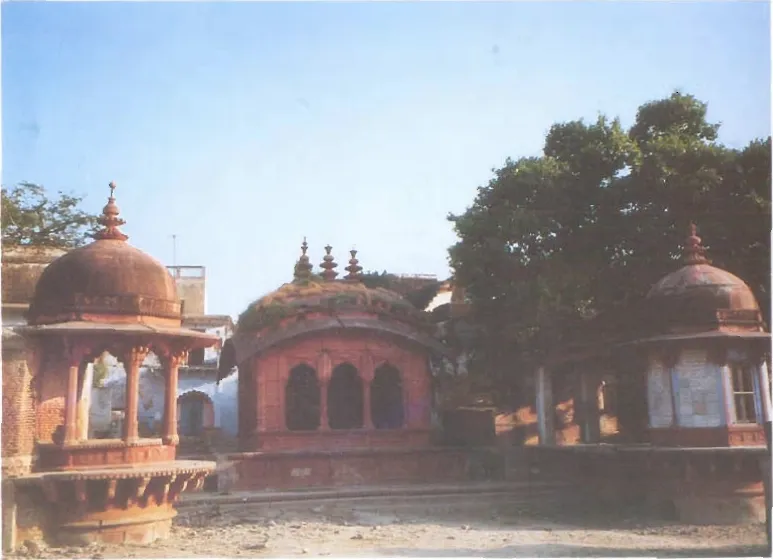
The guidebooks place Cīra-ghāṭa on the Yamunā close to Keśī-ghāṭa, with Bhramara-ghāṭa between them and the Jhāḍū-maṇḍala nearby. The Color Guide to Vṛndāvana (2000) shows three domed stone pavilions and a large tree.[1 +7]
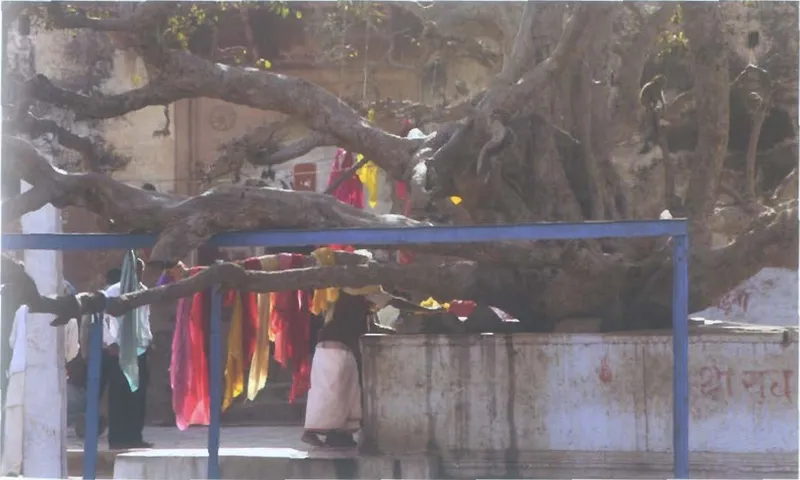
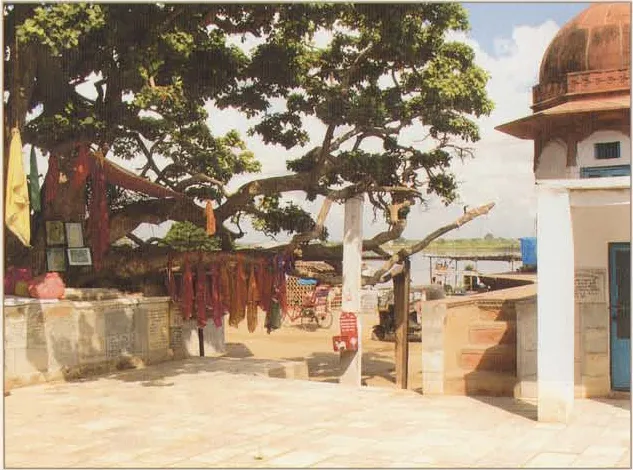
Śrī Vraja-maṇḍala Parikramā (2007) says that an ancient kadamba tree stands on the bank here, and its photograph and that of Vṛndāvana, the Playground of God (2010) show a large old tree hung with cloths beside the river. The Bhāgavatam does not say where Kṛṣṇa's kadamba stood.[1 +3]
Location
| Where it is | Keśi-ghāṭa 'very close by'[43] |
|---|
Places at Cīra-ghāṭa (Vṛndāvana)
1 places
Nearby places
Keśī-ghāṭa · Jhāḍū-maṇḍala · Bhramara-ghāṭa · Nidhuvana
Pictures
2 pictures
History
Two lists name different builders of the ghāṭa: The Color Guide to Vṛndāvana (2000) names Malhār Rāo Holkar, and the Bengali Vṛndāvana-kathā (1920) names Ahalyābāī, the queen of Indore. Neither gives a date or a source, so the builder is not certain.[35]
Accounts differ Who built Cīra-ghāṭa (Caina-ghāṭa): Malhār Rāo Holkar or Ahalyābāī.
- F. S. Growse, Mathurá (1883), a historianGrowse's list of river ghāṭas names Cīra-ghāṭa, also called Caina-ghāṭa, as built by Malhār Rāo Holkar; The Color Guide to Vṛndāvana (2000) gives the same builder. No date is given.
- Vṛndāvana-kathā (Pulinbihārī Datta, 1920), printed pp. 238 and 276Built by Ahalyābāī, with her money; her kuñja stands above the ghāṭa (printed p. 233). No date.
The historian A. W. Entwistle (1987) reports that the French traveller Jean Law de Lauriston saw Cīra-ghāṭa in 1785, but that year does not agree with his own book's dates for that traveller, so it may be wrong.[36]
Where the sources differ
Where Śrī Caitanya rested after bathing at Cīra-ghāṭa.
Accounts differ Where Śrī Caitanya rested after bathing at Cīra-ghāṭa.
- Śrī Caitanya-caritāmṛta Madhya 18.75–77He bathed at Cīra-ghāṭa and then went to Teṅtulī-talā (the old tamarind tree) and took rest there.
- The Color Guide to Vṛndāvana (2000)'Lord Chaitanya also rested at this same ghāṭa' (Chir Ghāṭa).
Accounts differ When Kṛṣṇa's promise at the end of the clothes pastime ('in My company you will enjoy these nights', ŚB 10.22.27) was to be fulfilled: the commentators read 'imāḥ kṣapāḥ' (these nights) differently.
- Śrīmad-Bhāgavatam 10.22.27 (BBT translation)'Your desire is fulfilled, for in My company you will enjoy the coming nights.' No season or full moon is named.
- Vaṁśīdhara (Bhāvārtha-dīpikā-prakāśa)The coming nights belonging to the autumn, before the year was complete, since it was then Hemanta (citing ŚB 10.29.1).
- Śrīla Sanātana Gosvāmī (Bṛhad-vaiṣṇava-toṣaṇī)Several readings: the nights of the coming autumn, called 'these' as if near, to console the girls; or the lengthening nights of the next month of Hemanta; or, taking 'satīḥ' with the nights, autumnal, moonlit nights free from cold and heat.
- Śrīla Śrīnātha Cakravartī (Caitanya-mata-mañjuṣā); Śrīla Jīva Gosvāmī (Bṛhat-krama-sandarbha)All the nights from tonight on.
The wording of these accounts is our summary of the sources, not a published translation.
Which side of Cīra-ghāṭa Keśī-ghāṭa lies on is told in two ways in Śrī Vraja-maṇḍala Parikramā; the accounts are set side by side on the page of Keśī-ghāṭa.[1 +4]
More on this place
The Kātyāyanī vow and the gopīs' clothes: the pastime and its places
References
43 references
- Śrī Vraja-maṇḍala Parikramā (2007), PDF p. 312
- Śrī Vraja-maṇḍala Parikramā (2007), PDF p. 343
- Vṛndāvana, the Playground of God (2010), Bhakti Caitanya Svāmī, PDF p. 177
- Vṛndāvana, the Playground of God (2010), Bhakti Caitanya Svāmī, PDF p. 178
- The Color Guide to Vṛndāvana (2000), Written and Photographed by Rājaśekhara dāsa Brahmacārī, PDF p. 102
- Śrīla Jīva Gosvāmī, Gopāla-campū, Pūrva-campū, pūraṇa 32 (keśi-dhvaṃsana-śaṃsana), section 23, GRETIL
- Śrīla Narahari Cakravartī, Bhakti-ratnākara, Fifth Wave, printed p. 325 (1912 edition), 2nd ed., 1912
- Śrī Vraja-maṇḍala Parikramā (2007), PDF p. 344
- Pulinbihārī Datta, ch. 19 (ūnaviṁśa pariccheda), section on Rāṇī Ahalyābāī of Indore, printed p. 238
- Śrīla Kṛṣṇadāsa Kavirāja Gosvāmī, Śrī Caitanya-caritāmṛta, Madhya-līlā 18.75, online edition · vedabase.io
- Śrīla Prabhupāda, Śrī Caitanya-caritāmṛta, Madhya-līlā 18.75, translation · vedabase.io
- Śrīla Prabhupāda, Śrī Caitanya-caritāmṛta, Madhya-līlā, Chapter 18, chapter summary · vedabase.io
- Śrīmad-Bhāgavatam 10.22.1, GRETIL
- Śrīmad-Bhāgavatam 10.22.2–3, GRETIL
- Śrīmad-Bhāgavatam 10.22.7, GRETIL
- Śrīmad-Bhāgavatam 10.22.4, GRETIL
- Śrīmad-Bhāgavatam 10.22.9, GRETIL
- Śrīmad-Bhāgavatam 10.22.27, GRETIL
- Śrīla Prabhupāda, Kṛṣṇa, the Supreme Personality of Godhead, Chapter 33, 'Description of the Rāsa Dance' (last paragraph) · vedabase.io
- Śrīla Raghunātha dāsa Gosvāmī, Vraja-vilāsa-stava, verse 84
Show all 43 references
- Śrīla Nārāyaṇa Bhaṭṭa, Vraja-bhakti-vilāsa, printed p. 51, Hindi text after the section mark ॥ ५४ ॥, 1st ed., publ. Bābā Kṛṣṇadāsa, Kusuma-sarovara, Saṁvat 2008
- Śrīla Nārāyaṇa Bhaṭṭa Gosvāmī, Vraja-bhakti-vilāsa, printed p. 227, section 73 (circuit of Vṛndāvana in the vana-yātrā), 1st ed., publ. Bābā Kṛṣṇadāsa, Kusuma-sarovara, Saṁvat 2008
- Śrīla Jīva Gosvāmī: commentary on ŚB 10.22.2, Bhagavata Vidya Pith edition, ed. Bhagavata Rishi and Krishna Shankar Shastri, 1996
- Śrīla Viśvanātha Cakravartī, Vraja-rīti-cintāmaṇi, sarga 2 (dvitīyaḥ sargaḥ), v. 78
- Śrīla Rūpa Gosvāmī, Vidagdha-mādhava, Act 3 (tṛtīyo 'ṅkaḥ, 'rādhā-saṅgaḥ'), prose dialogue before v.30 veṇu-nāda-vilāsaḥ v.30')
- Śrī Vraja-maṇḍala Parikramā (2007), PDF p. 243
- Śrīla Narahari Cakravartī, Bhakti-ratnākara, Fifth Wave, printed p. 269 (1912 edition), 2nd ed., 1912
- Śrīmad-Bhāgavatam 10.37.8, GRETIL
- Śrīmad-Bhāgavatam 10.37.25, GRETIL
- Śrīla Prabhupāda, Kṛṣṇa, the Supreme Personality of Godhead (Kṛṣṇa book), Chapter 37, 'Killing the Keśī Demon and Vyomāsura' · vedabase.io
- Śrīla Jīva Gosvāmī: commentary Śrīla Jīva Gosvāmī, Laghu-vaiṣṇava-toṣaṇī, on ŚB 10.37.2, Bhagavata Vidya Pith edition, ed. Bhagavata Rishi and Krishna Shankar Shastri, 1996
- Śrīla Sanātana Gosvāmī: commentary Śrīla Sanātana Gosvāmī, Bṛhad-vaiṣṇava-toṣaṇī, on ŚB 10.37.8, Bhagavata Vidya Pith edition, ed. Bhagavata Rishi and Krishna Shankar Shastri, 1996
- Śrīmad-Bhāgavatam 10.33.22, GRETIL
- Śrīla Prabhupāda, Kṛṣṇa, the Supreme Personality of Godhead (Kṛṣṇa book), Chapter 33, 'Description of the Rāsa Dance' · vedabase.io
- The Color Guide to Vṛndāvana (2000), Written and Photographed by Rājaśekhara dāsa Brahmacārī, PDF p. 31
- A. W. Entwistle, ch. 8 §66.15 'Chir Ghat', printed p. 406, Egbert Forsten, Groningen, 1987
- Prema-vilāsa, seventh vilāsa, printed p. 45, left column, Kolkata, 1913
- Prema-vilāsa, seventh vilāsa, printed p. 47, right column, lines 3-8, Kolkata, 1913
- Jaya Jaya Madana Gopāla Baṁśī Dhārī (Narottama dāsa Ṭhākura (as the song book credits it)) · song book
- Śrī Vraja-maṇḍala Parikramā (2007), PDF p. 298
- Pulinbihārī Datta, ch. 19 (ūnaviṁśa pariccheda), section on Sawai Jai Singh of Jaipur, printed p. 221
- Śrī Vraja-maṇḍala Parikramā (2007), PDF p. 346
- Vṛndāvana, the Playground of God (2010), Bhakti Caitanya Svāmī, p. 177