Jhūlana-talā (Rādhā-kuṇḍa)
झूलन-तला (राधा-कुण्ड) Hindi name proposed
Also called Jhulana Sthali
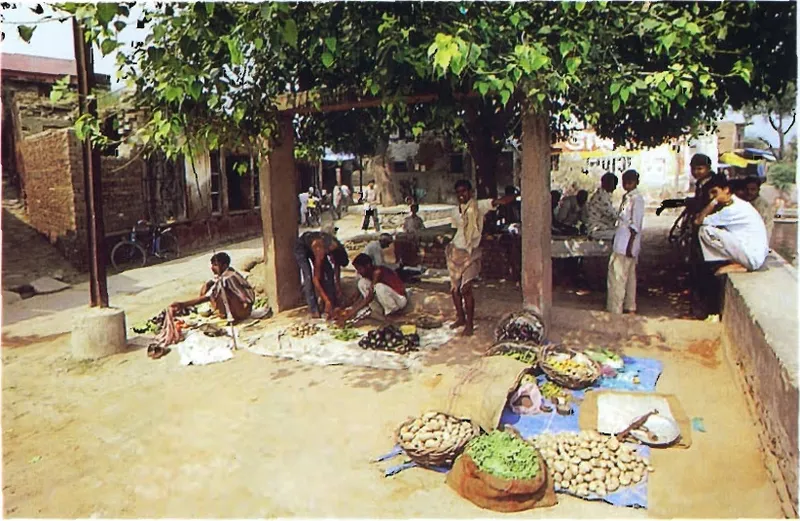
- What it is
- Jhūlana-talā is a spot on the western side of Rādhā-kuṇḍa, in the village of Rādhā-kuṇḍa.
- Visiting
- Śrī Vraja-maṇḍala Parikramā (2007) marks Jhūlana-talā on its town map at the north-west corner of Rādhā-kuṇḍa.
- Places here
- Vajranābha's banyan (Jhūlana-talā)
In short
Jhūlana-talā is a spot on the western side of Rādhā-kuṇḍa, in the village of Rādhā-kuṇḍa. A photograph in The Colour Guide to Rādhā-kuṇḍa (1999) shows a stone frame of two pillars there, under a large spreading tree beside a village lane.[1 +1] According to the local tradition recorded in that book, the frame marks the place where Rādhā and Kṛṣṇa enjoyed Their swing pastimes, and a banyan planted by King Vajranābha stood here; no older source says so, so this is not certain.[2 +1] No older text found names Jhūlana-talā: the Govinda-līlāmṛta hangs swings on all four sides of the kuṇḍa, and the books differ on which pastimes and which tree belong to this spot.[4 +1]
Key facts
| Kind | pastime site |
|---|---|
| Region · area | Rādhā-kuṇḍa |
| Also part of | Rādhā-kuṇḍa (village) |
| Ācāryas | Śrīla Sanātana Gosvāmī, Śrīla Rūpa Gosvāmī |
Divine pastimes
Swings around Rādhā-kuṇḍa
Śrīla Kṛṣṇadāsa Kavirāja Gosvāmī's Govinda-līlāmṛta (7.2–5) describes Rādhā-kuṇḍa as Kṛṣṇa comes there to meet Rādhā. Four jewelled tīrthas, bathing places, lie in the four directions, each with a jewelled pavilion above it and swings hanging from the trees beside it. The swings are tied to two campaka trees in the south, two nīpa (kadamba) trees in the east, two mango trees in the west and two bakula trees in the north (summarised here, not translated). The verses name no ghāṭa and no swing place; by this scheme the swings of the western side, where the guidebooks put Jhūlana-talā, hang from mango trees.[1 +2]
The guidebook Śrī Vraja-maṇḍala Parikramā (2007) gives the same scheme, as described in the Kṛṣṇa-bhāvanāmṛta and the Govinda-līlāmṛta, and says that Kṛṣṇa plays on these swings with Rādhikā and the sakhīs, Her companions.[4 +1] A song of Śrīla Narahari Cakravartī Ṭhākura in the Bhakti-ratnākara also describes tall jewelled swings hung on the blossoming mango, kadamba, bakula and campaka trees around the lake, which the kuñjas (groves) of Lalitā and the other sakhīs surround. It names no side of the kuṇḍa and no single spot (summarised here, not translated).[5] Read more: The kuñjas of the sakhīs around Rādhā-kuṇḍa →
The lotus swing Madanāndolana, in Lalitā's kuñja
The Govinda-līlāmṛta sets this swing not at Jhūlana-talā but in Lalitā's kuñja. In the same chapter (7.55–64) it describes a swing named Madanāndolana in the south-east part of Lalitā's kuñja, on the north side of the kuṇḍa, hung from the meeting branches of two bakula trees. Its seat is shaped like a sixteen-petalled lotus, the friends sit on its eight petals, and Vṛndā-devī, the forest goddess, swings Rādhā and Kṛṣṇa in the middle; the swing makes the Two face everyone. Later in the poem (14.49–76), when Rādhā and Kṛṣṇa sit on a lotus swing, all the sakhīs see Them facing each of them (summarised here, not translated).[7 +2] Only The Colour Guide (1999) connects this swing with Jhūlana-talā (see below).[7 +2]
Traditional accounts
According to the local tradition recorded in The Colour Guide to Rādhā-kuṇḍa (1999), a stone structure shaped like an upside-down …
The swing and Vajranābha's banyan
According to the local tradition recorded in The Colour Guide to Rādhā-kuṇḍa (1999), a stone structure shaped like an upside-down "U" marks the place on the bank of Rādhā-kuṇḍa where Rādhā and Kṛṣṇa enjoyed Their swing pastimes (jhūlana-līlā). No older text names this spot, so it is not certain.[2] The same book says that five thousand years ago King Vajranābha planted a banyan here, that only its stump remains and that another banyan is growing in its place. It names no source for this, so it is not certain.[3]
The guidebooks' Vajranābha is Vajra, the son of Aniruddha and great-grandson of Kṛṣṇa, whom Mahārāja Yudhiṣṭhira placed on the throne at Mathurā, as Śrīmad-Bhāgavatam (1.15.39) tells.[10] The Bhāgavata-māhātmya of the Skanda Purāṇa tells that Vajra, with Parīkṣit's help and Śāṇḍilya's grace, came to know the places of the pastimes of Kṛṣṇa, the gopas and the gopīs, named them, settled villages and made kuṇḍas and wells (summarised here, not translated). It names no place at Rādhā-kuṇḍa and says nothing about planting trees.[11]
वज्रस्तु तत्सहायेन शाण्डिल्यस्याप्यनुग्रहात् । गोविन्दगोपगोपीनां लीलास्थानान्यनुक्रमात् ॥ … विज्ञायाभिधयाऽऽस्थाप्य ग्रामानावासयद् बहून् । कुण्डकूपादिपूर्तेन शिवादिस्थापनेन च ॥ … गोविन्दहरिदेवादि स्वरूपारोपणेन च । कृष्णाइकभक्तिं स्वे राज्ये ततान च मुमोद ह ॥
vajrastu tatsahāyena śāṇḍilyasyāpyanugrahāt
govindagopagopīnāṁ līlāsthānānyanukramāt
… vijñāyābhidhayā''sthāpya grāmānāvāsayad bahūn
kuṇḍakūpādipūrtena śivādisthāpanena ca
… govindaharidevādi svarūpāropaṇena ca
kṛṣṇāikabhaktiṁ sve rājye tatāna ca mumoda ha ||
The vision of the braid
Śrīla Rūpa Gosvāmī's Cāṭu-puṣpāñjali, a prayer in his Stava-mālā, opens with a verse that compares Śrī Rādhā's jewelled braid to the hood of a female serpent (veṇī-vyālāṅganā-phaṇā).[12 +5] According to the Bhakti-ratnākara and the guidebooks, Śrīla Sanātana Gosvāmī doubted the comparison until he saw such a braid himself at Rādhā-kuṇḍa. One guidebook tells that he saw it here; where it happened, the books tell differently (see below).[12 +6] Read more: Śrīla Sanātana Gosvāmī's vision of Śrī Rādhā's braid →
Śrīla Prabhupāda
No statement of Śrīla Prabhupāda about Jhūlana-talā has been found in the works searched.
No statement of Śrīla Prabhupāda about Jhūlana-talā has been found in the works searched. In a general passage, not about this place, he tells who Vajra was:[10]
General teaching (does not name the place)“Then he posted Vajra, the son of Aniruddha [grandson of Lord Kṛṣṇa], at Mathurā as the King of Śūrasena. … after posting Vajra, the great-grandson of Lord Kṛṣṇa, as the King of Mathurā”
Śrīla Prabhupāda, Śrīmad-Bhāgavatam, Canto 1, 1.15.39, translation and purport · vedabase.io
Visiting today
Śrī Vraja-maṇḍala Parikramā (2007) marks Jhūlana-talā on its town map at the north-west corner of Rādhā-kuṇḍa. The photograph in The Colour Guide (1999) shows the two-pillared stone structure under a large spreading tree beside a village lane where vendors sit with vegetables. The books describe the place as it was in 1999 and 2007.[1 +1]
Location
| Where it is | Western side of Śrī Rādhā-kuṇḍa; map key 1 at the north-west corner of Rādhā-kuṇḍa[27] On the banks of Rādhā-kuṇḍa, by Jhulana-ghāṭa.[28] |
|---|
Places at Jhūlana-talā (Rādhā-kuṇḍa)
1 places
Nearby places
Rādhā-kuṇḍa · Jhūlana-ghāṭa
History
In 1987 the historian A. W. Entwistle reported that a banyan at Rādhā-kuṇḍa that sources of the Puṣṭimārga, the Vallabha sampradāya, mention, and which he said is also called by the name of this place, had beside it a swing built by the Rājā of Manipur. He gave no date and named no document, and what stands there now has not been checked. No source says whether this swing is the two-pillared stone frame in the 1999 photograph, so that is not certain.[19]
Where the sources differ
Where Śrīla Sanātana Gosvāmī saw the braid: Śrī Vraja-maṇḍala Parikramā (2007) says that it was here, where he saw a young …
Where Śrīla Sanātana Gosvāmī saw the braid: Śrī Vraja-maṇḍala Parikramā (2007) says that it was here, where he saw a young cowherd girl swinging from a kadamba tree while her friends sang, but in its list of ghāṭas it puts the vision at Govinda-ghāṭa on the eastern bank. The Bhakti-ratnākara and The Colour Guide (1999) also tell it at Govinda-ghāṭa, and the Hindi Bhaktamāla (1904) and the Bengali Bhaktamāla of Kṛṣṇadāsa Bābājī (1905) only on the bank of Rādhā-kuṇḍa, with a swing on a tree.[6 +9]
Accounts differ Where Śrīla Sanātana Gosvāmī had the vision that confirmed Śrīla Rūpa Gosvāmī's braid-and-serpent simile, and what he saw.
- Bhakti-ratnākara, Fifth Wave (1912 ed. p. 210)At Govinda-ghāṭa, told under this tree: Sanātana came down into the water and saw girls playing under the tree, their braids hanging down their backs; he took them for snakes; they smiled and vanished. No swing, no tree species, Rādhā not named in the lines read.
- The Colour Guide to Rādhā-kuṇḍa (1999), entry 50 Govinda-ghāṭaAt Govinda-ghāṭa on the eastern bank, 'where a large neem tree hangs over the water's edge': at noon some girls were playing on a swing under a nearby tree; one girl's braid looked like a snake; she turned, smiled and vanished.
- Śrī Vraja-maṇḍala Parikramā (2007), list of ghāṭasAt Govinda-ghāṭa on the eastern bank Sanātana saw Śrīmatī Rādhikā playing on a swing.
- Śrī Vraja-maṇḍala Parikramā (2007), Jhūlana-talāAt Jhūlana-talā on the western side: a young cowherd girl swinging from a kadamba tree, her friends singing mallāra-rāga, a black female serpent on her tresses; 'It is at this Jhūlana-talā that Śrī Sanātana Gosvāmī had darśana of Śrī Rādhā.'
The wording of these accounts is our summary of the sources, not a published translation.
On which tree the swing at Jhūlana-talā hangs: The Colour Guide (1999) says a banyan. Śrī Vraja-maṇḍala Parikramā (2007) tells of a kadamba in its story of the braid, but by the Govinda-līlāmṛta's scheme, which the same guidebook repeats, the swings of this western side hang from mango trees.[2 +7]
Accounts differ On which tree the swing at Jhūlana-talā hangs.
- The Colour Guide to Rādhā-kuṇḍa (1999)In the unmanifest pastimes Vṛndā Devī's lotus swing hangs from the branch of a banyan at this spot; Vajranābha planted a banyan here, of which only the stump remains.
- Śrī Vraja-maṇḍala Parikramā (2007), Jhūlana-talā storySanātana saw the girl on a swing hanging from the branches of a kadamba tree.
- Śrī Vraja-maṇḍala Parikramā (2007), description 'from Kṛṣṇa-bhāvanāmṛta and Govinda-lilāmṛta'Swings hang on all sides of Rādhā-kuṇḍa: from campaka trees to the south, kadamba to the east, mango to the west and bakula to the north (so the western side, where the book puts Jhūlana-talā, has mango swings).
- Bhakti-ratnākara, Śrīla Narahari's song (rāga Sāraṅga)Jewelled swings hang on mango, nīpa (kadamba), bakula and campaka trees around the lake; no side or spot is named.
Where Vṛndā-devī's lotus swing hangs: The Colour Guide (1999) says that in the unmanifest pastimes (aprakaṭa-līlā) it hangs here from the branch of a banyan, and that the swing pastimes here go on "as confirmed by all the ācāryas", though it names no ācārya. The Govinda-līlāmṛta puts it in the south-east part of Lalitā's kuñja, among bakula trees, and so does the Bengali Kuñja-varṇana, a rendering of that chapter ascribed, doubtfully, to Śrīla Narottama dāsa Ṭhākura, which names the place Madana-dola.[2 +5]
Accounts differ Where Vṛndā-devī's lotus swing, which makes the Couple face every sakhī, is, and on which tree it hangs.
- The Colour Guide to Rādhā-kuṇḍa (1999), Jhulana SthaliIn the unmanifest pastimes it hangs at Jhulana Sthali from the branch of a banyan (where Vajranābha planted a banyan, of which only the stump remains); shaped like a sixteen-petalled lotus; the sakhīs and mañjarīs each see the Couple facing her.
- Govinda-līlāmṛta 7.55–64 and 14.49–76 (Śrīla Kṛṣṇadāsa Kavirāja Gosvāmī)The swing Madanāndolana stands in the south-east petal-kuñja of Lalitā's kuñja on the north side of Rādhā-kuṇḍa, hung from the meeting branches of two bakula trees; Vṛndā swings the Two, and it makes them face everyone (Śrīla Vṛndāvana Cakravartī's ṭīkā on 15.99 and 15.136 treats the petals of this kuñja as its corner kuñjas).
- Kuñja-varṇana c.170–184 (Bengali; attribution to Śrīla Narottama dāsa Ṭhākura doubtful)In the south-east corner of the Lalitānandadā kuñja, among bakula trees; a sixteen-petalled lotus; named Madana-dola; Rādhā and Kṛṣṇa play jhulanā there.
- Śrī Vraja-maṇḍala Parikramā (2007), Jhūlana-talāJhūlana-talā is on the western side of Rādhā-kuṇḍa; it tells there only Śrīla Sanātana's vision of a girl on a kadamba swing, no lotus swing; its own scheme gives the western side mango swings.
More on this place
Śrīla Sanātana Gosvāmī's vision of Śrī Rādhā's braid · The kuñjas of the sakhīs around Rādhā-kuṇḍa
References
28 references
- Śrī Vraja-maṇḍala Parikramā (2007), PDF p. 101
- The Colour Guide to Rādhā-kuṇḍa (1999), Rājaśekhara dāsa Brahmacārī, PDF p. 66
- The Colour Guide to Rādhā-kuṇḍa (1999), Rājaśekhara dāsa Brahmacārī, PDF p. 67
- Śrīla Kṛṣṇadāsa Kavirāja Gosvāmī, Govinda-līlāmṛta, sarga 7, vv. 2–6), after the editions of Haridas Das and Haridas Shastri
- Śrīla Narahari Cakravartī, Bhakti-ratnākara, Fifth Wave, 1912 ed. p. 192, first song (gīte yathā, rāga sāraṅga), 2nd ed., 1912
- Śrī Vraja-maṇḍala Parikramā (2007), PDF p. 89
- Śrīla Kṛṣṇadāsa Kavirāja Gosvāmī, Govinda-līlāmṛta, sarga 7, vv. 55–56, after the editions of Haridas Das and Haridas Shastri
- Śrīla Kṛṣṇadāsa Kavirāja Gosvāmī, Govinda-līlāmṛta, sarga 7, vv. 63–64, after the editions of Haridas Das and Haridas Shastri
- Śrīla Kṛṣṇadāsa Kavirāja Gosvāmī, Govinda-līlāmṛta, sarga 7, vv. 31–34, after the editions of Haridas Das and Haridas Shastri
- Śrīla Prabhupāda, Śrīmad-Bhāgavatam, Canto 1, 1.15.39, translation and purport · vedabase.io
- Śrīmad-Bhāgavata-māhātmya, Skanda version, adhyāya 2, verses 4-6, Sanskrit Wikisource
- Śrīla Rūpa Gosvāmī, Cāṭu-puṣpāñjali, verse 1
- Śrīla Rūpa Gosvāmī, Cāṭu-puṣpāñjali, colophon
- Śrī Vraja-maṇḍala Parikramā (2007), PDF p. 90
- The Colour Guide to Rādhā-kuṇḍa (1999), Rājaśekhara dāsa Brahmacārī, PDF p. 164
- the undated parikramā notes Rādhā-kuṇḍa, ¶120-122
- Śrīla Rūpa Gosvāmī, Cāṭu-puṣpāñjali, Stava-mālā, Cāṭu-puṣpāñjali v. 1 with Baladeva Vidyābhūṣaṇa's ṭīkā, after the edition of Bhakti Saranga Goswami and Purushottam Das, Vrindavan, 1959
- Śrīla Narahari Cakravartī, Bhakti-ratnākara, Fifth Wave, 1912 ed. p. 210, lines 6-8 and 12-14, 2nd ed., 1912
- A. W. Entwistle, printed p. 340, Egbert Forsten, Groningen, 1987
- The Colour Guide to Rādhā-kuṇḍa (1999), Rājaśekhara dāsa Brahmacārī, PDF p. 165
Show all 28 references
- Śrī Vraja-maṇḍala Parikramā (2007), PDF p. 97
- the undated parikramā notes Rādhā-kuṇḍa, ¶125
- Bhaktamāla, Priyādāsa's kavitta no. 452 of this edition ('(४५२) टीका । कवित्त'), printed p. 870
- Bhaktamāla, Rūpakalā's vārtika tilaka on Priyādāsa's kavitta 452, printed p. 871
- Śrī Śrī Bhaktamāla grantha, printed p. 242, left column
- Kuñja-varṇana, c.170–173, after the Calcutta University edition, 1975
- Śrī Vraja-maṇḍala Parikramā (2007), p. 152-153
- The Colour Guide to Rādhā-kuṇḍa (1999), Rājaśekhara dāsa Brahmacārī, p. 62