Śrīla Sanātana Gosvāmī's vision of Śrī Rādhā's braid
श्रील सनातन गोस्वामी को श्री राधा की वेणी का दर्शन
In short
Śrīla Rūpa Gosvāmī wrote a verse comparing Śrī Rādhā's braid to the hood of a female snake. His elder brother, Śrīla Sanātana Gosvāmī, doubted it. Then, the Bhakti-ratnākara says, at Govinda-ghāṭa on Rādhā-kuṇḍa (Radha Kund) he saw girls whose braids looked like snakes, and they vanished. Later books tell it in other ways.[1–11]
On this page
At a glance
- The verse, as its closing line shows, is the first verse of Śrīla Rūpa Gosvāmī's Cāṭu-puṣpāñjali, a prayer to Śrī Rādhā in his collection of hymns, the Stava-mālā.[1–6, 12]
- The Bhakti-ratnākara tells the story at Govinda-ghāṭa, under a tree, and mentions no swing.[4 +4]
- The Hindi and Bengali Bhaktamāla books set the vision on the bank of Rādhā-kuṇḍa and add a swing.[14, 15]
- A guidebook of 1999 describes a large neem tree hanging over the water at Govinda-ghāṭa, but no source says it is the tree of the story.[4 +2]
- In the Bhakti-ratnākara, Śrīla Rāghava Paṇḍita Gosvāmī tells the story to Śrīla Śrīnivāsa Ācārya while guiding him around the kuṇḍas.[7]
- Jhūlana-talā, a small stone structure at the north-west corner of the kuṇḍa, is shown in the guidebooks as a place of swing pastimes.[17, 18]
What does Śrīla Rūpa Gosvāmī's verse say?
The story begins with one verse. It is the first verse of Śrīla Rūpa Gosvāmī's Cāṭu-puṣpāñjali, a prayer to Śrī Rādhā. The prayer belongs to his collection of hymns, the Stava-mālā, and its closing line names him as the author.[1–6, 12]
The verse praises Śrī Rādhā as fair like fresh gorocanā, a bright yellow pigment, and dressed in cloth the colour of the finest blue lotus. Her braid, shining with clusters of jewels, is pictured as the hood of a female serpent. We quote only the translations of the Bhaktivedanta Book Trust (BBT), so it is summarised here, not translated.[8, 9]
Śrīla Baladeva Vidyābhūṣaṇa wrote a commentary on the Stava-mālā. He says that here Śrī Rūpa pleases Śrī Rādhā with sweet, flattering words, which is what cāṭu means. He then explains the picture: the braid is the serpent, the parting of the hair is its hood, and the jewels are the jewel on its hood. He adds that the sentence begun in this verse is finished only in verse 12, with obeisances to the queen of Vṛndāvana (summarised here, not translated).[6, 12]
Neither the verse nor the commentary tells the story of the doubt, and neither names a place.[9]
How does the Bhakti-ratnākara tell the story?
The fullest early telling is in the Bhakti-ratnākara, a Bengali book by Śrīla Narahari Cakravartī Ṭhākura. It is the only early telling that names a spot. In its Fifth Wave, or chapter, Śrīla Rāghava Paṇḍita Gosvāmī is guiding Śrīla Śrīnivāsa Ācārya around the kuṇḍas, the sacred ponds.[7 +2]
He bathes at Śrī Govinda-ghāṭa, a bathing place that the book calls very dear to Govinda. Then he tells what happened under this tree (summarised here, not translated).[7–10]
- One day Śrīla Sanātana Gosvāmī came from Govardhana to see Śrīla Rūpa Gosvāmī and Śrīla Raghunātha dāsa Gosvāmī.[10] Read more: Śrīla Raghunātha dāsa Gosvāmī's life at Rādhā-kuṇḍa →
- Śrīla Rūpa Gosvāmī had written a verse comparing a braid to the hood of a female serpent, and Śrīla Sanātana Gosvāmī doubted the comparison.[7, 10]
- Going down into the water, he saw girls playing under the tree. Their braids hung down their backs, and he took them for snakes.[11]
- He hurried to warn them. Seeing him so worried, they all smiled a little and vanished.[11]
- Overwhelmed at that very place, he went to Śrīla Rūpa Gosvāmī and told him that what he had written was true. After a while he went back to Govardhana.[10, 11]
What this telling leaves out is worth noticing. It does not name the prayer, and it does not name Śrī Rādhā among the girls. It mentions no swing, and it does not say what kind of tree it was.[3 +6]
How do the Bhaktamāla books tell it?
The story also travelled in books about the lives of devotees. Nābhā dāsa's Hindi Bhaktamāla, the garland of devotees, has commentaries in verse and prose, and later Bengali books follow it. These tellings set the vision only on the bank of Rādhā-kuṇḍa and name no ghāṭa (all summarised here, not translated).[14, 15]
- Priyādāsa's verse, printed in Banaras in 1904 and usually dated 1712, says that they swing on the bank of the kuṇḍa, holding a tree's branch. Seeing the braid with his own eyes, Śrī Sanātana knew that the poem was true, and he came to his younger brother and held his feet.[14]
- Rūpakalā's prose explanation in the same 1904 book turns the brothers round. Here Śrī Sanātana writes the comparison and Śrī Rūpa dislikes it, and one day he sees the sakhīs, Śrī Rādhā's friends, swinging Her on a swing in a tree.[22]
- The Bengali Bhaktamāla of Kṛṣṇadāsa Bābājī (Kolkata, 1905) says that Śrīla Sanātana Gosvāmī was pained to see Śrī Rādhā compared with a creature that holds poison. So Kṛṣṇa arranged a pastime to show him, and from some distance he saw Her braid move like a black serpent on a swing hung from a tree. Then he praised his brother's verse.[15, 23]
- The Bengali Vṛndāvana-kathā (1920) quotes the verse beside a marble picture of Śrī Rādhā in a Vṛndāvana temple. It cites an unnamed parikramā book: walking by Rādhā-kuṇḍa, Śrīla Sanātana Gosvāmī saw a girl of Vraja whose braid hung over her shoulder like a snake.[24]
What do the guidebooks show at Govinda-ghāṭa and Jhūlana-talā?
The modern guidebooks connect the story with two spots on the kuṇḍa. One is Govinda-ghāṭa on the eastern bank. A guidebook of 1999 describes a large neem tree hanging over the water's edge there, and other notes place a neem tree beside the path in the same area.[4, 16]
That neem tree is a natural place to remember the story. But the Bhakti-ratnākara says only under this tree, and no source says that the tree of the story is the present one.[4, 13]
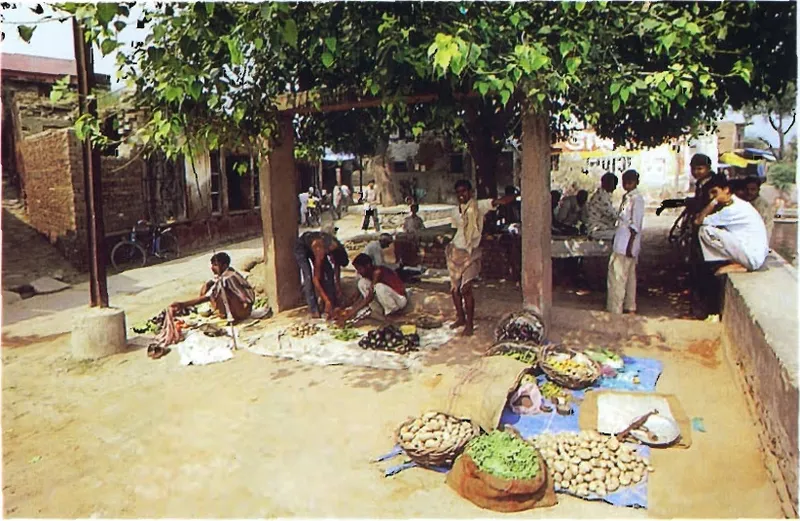
The other spot is Jhūlana-talā. Jhūlana means swinging, and talā means the place under a tree. A map of 2007 marks it at the north-west corner of Rādhā-kuṇḍa. A photo of 1999 shows a stone structure with two pillars under a large spreading tree, beside a village lane.[17, 18] Read more: The swing pastimes of Rādhā and Kṛṣṇa →
According to the guidebook of 1999, this upside-down U of stone marks the place where Rādhā and Kṛṣṇa are said to have enjoyed Their swing pastimes. The historian Entwistle (1987) reports that a nearby tree is also called Jhulan Tala, and that the Raja of Manipur built a swing beside it. Both reports may be local tradition.[18, 25]
The older books also speak of swings at the kuṇḍa in general. The Govinda-līlāmṛta gives each of its four bathing places swings hanging from the trees beside it. A song in the Bhakti-ratnākara describes jewelled swings on mango, kadamba, bakula and campaka trees around the lake. Neither names Jhūlana-talā.[26, 27]
Where the sources differ
The tellings agree on the main point of the story, but they differ on the details. Each is given here as its book tells it, and none is set aside.[3 +7]
Who wrote, and who doubted. In every telling Śrīla Rūpa Gosvāmī wrote and Śrīla Sanātana Gosvāmī doubted, except Rūpakalā's prose, which turns them round. Yet the same prose has the one who saw the braid go to his younger brother, which fits Śrīla Sanātana Gosvāmī, the elder. Rūpakalā may have mixed up the names; the sources do not settle it.[2 +5]
Accounts differ Who wrote the simile of Rādhā's braid as a female serpent's hood, and who doubted it and then saw the braid.
- Bhakti-ratnākara, Fifth Wave (1912 ed. p. 210)Śrī Rūpa wrote the verse comparing the braid to a female serpent's hood; Sanātana doubted it, saw the girls' braids at Govinda-ghāṭa and told Rūpa that what he wrote was true.
- Priyādāsa's kavitta, the Hindi Bhaktamāla (1904)Seeing the braid, Śrī Sanātana knew it to be as the poem says and came to his younger brother (Rūpa).
- Rūpakalā's prose tilaka, same edition (p. 871)Śrī Sanātana wrote the simile; Śrī Rūpa disliked the comparison, later saw the braid at Rādhā-sara and went to his younger brother.
- the Bengali Bhaktamāla of Kṛṣṇadāsa Bābājī (1905)Rūpa compared the braid to a serpent and Sanātana was pained; seeing the braid, Sanātana praised Śrīla Rūpa's description.
Who was present. In the Bhakti-ratnākara Śrīla Sanātana Gosvāmī came from Govardhana to see the other two. A guidebook of 1999 has all three Gosvāmīs sitting together at Govinda-ghāṭa. A guidebook of 2007 says, perhaps from local memory, that the two brothers were sitting near Śrīla Raghunātha dāsa Gosvāmī's bhajana-kuṭī, his hut for chanting.[1 +6]
Accounts differ Where the Gosvāmīs were and who was present when Sanātana questioned the simile.
- The Colour Guide to Rādhā-kuṇḍa (1999)Śrīla Rūpa, Śrīla Sanātana and Śrīla Raghunātha dāsa were sitting together at Govinda-ghāṭa.
- Bhakti-ratnākara, Fifth WaveSanātana came from Govardhana to see Rūpa and Raghunātha; Rūpa was composing the verse.
- Śrī Vraja-maṇḍala Parikramā (2007)Sanātana and Rūpa were sitting near Śrīla Raghunātha dāsa Gosvāmī's bhajana-kuṭī on the north-eastern side of Rādhā-kuṇḍa.
Where he saw the braid, and what he saw. The Bhakti-ratnākara and the 1999 guidebook say Govinda-ghāṭa. The 2007 guidebook says Jhūlana-talā on the western side in one passage, and Govinda-ghāṭa in its list of ghāṭas. The Bhaktamāla books say only the bank of the kuṇḍa, and they add the swing.[3 +9]
Accounts differ Where Śrīla Sanātana Gosvāmī had the vision that confirmed Śrīla Rūpa Gosvāmī's braid-and-serpent simile, and what he saw.
- Bhakti-ratnākara, Fifth WaveAt Govinda-ghāṭa, going into the water, he saw girls playing under a tree, one girl's braid hanging down her back like a snake; they vanished smiling. No swing is mentioned.
- The Colour Guide to Rādhā-kuṇḍa (1999)At Govinda-ghāṭa at noon, girls playing on a swing under a nearby tree; one girl turned, smiled and vanished.
- Śrī Vraja-maṇḍala Parikramā (2007) (Famous ghāṭas)At Govinda-ghāṭa he saw Śrīmatī Rādhikā playing on a swing.
- Śrī Vraja-maṇḍala Parikramā (2007) (Jhūlana-talā)At Jhūlana-talā on the western side of the kuṇḍa, a young cowherd girl swinging from a kadamba tree, her friends pushing and singing; a black serpent seemed to slither on her tresses; 'It is at this Jhūlana-talā that Śrī Sanātana Gosvāmī had darśana of Śrī Rādhā.'
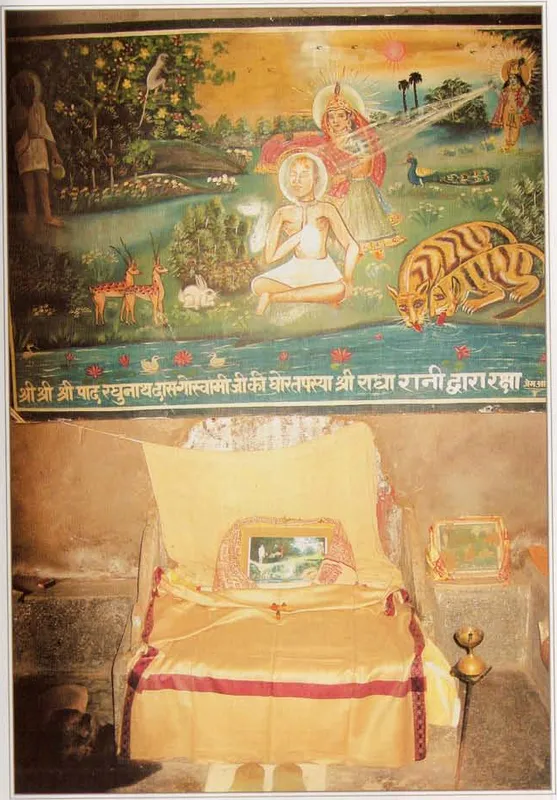
No source places the vision at Śrīla Sanātana Gosvāmī's sitting place itself, although undated pilgrim notes tell the story under that heading.[3 +5] According to the local tradition recorded in the 1999 guidebook, Rādhā and Kṛṣṇa are said to enjoy swing pastimes at Govinda-ghāṭa from time to time. No older source is known to say this.[4, 16]
Places in this article
Govinda-ghāṭa (Rādhā-kuṇḍa)
गोविन्द-घाट (राधा-कुण्ड)Govinda-ghāṭa is a bathing place on the eastern bank of Rādhā-kuṇḍa, between Śrī Gopāla Bhaṭṭa Gosvāmī's bhajana-kuṭī and the Bihārījī temple, where a large neem tree han …
Jhūlana-talā (Rādhā-kuṇḍa)
झूलन-तला (राधा-कुण्ड)Jhūlana-talā is a spot on the western side of Rādhā-kuṇḍa, in the village of Rādhā-kuṇḍa.
Neem tree (Govinda-ghāṭa, Rādhā-kuṇḍa)
नीम वृक्ष (गोविन्द-घाट, राधा-कुण्ड)A large neem tree stands at Govinda-ghāṭa on the eastern bank of Rādhā-kuṇḍa.
Sanātana Gosvāmī's baiṭhaka (Rādhā-kuṇḍa)
सनातन गोस्वामी की बैठक (राधा-कुण्ड)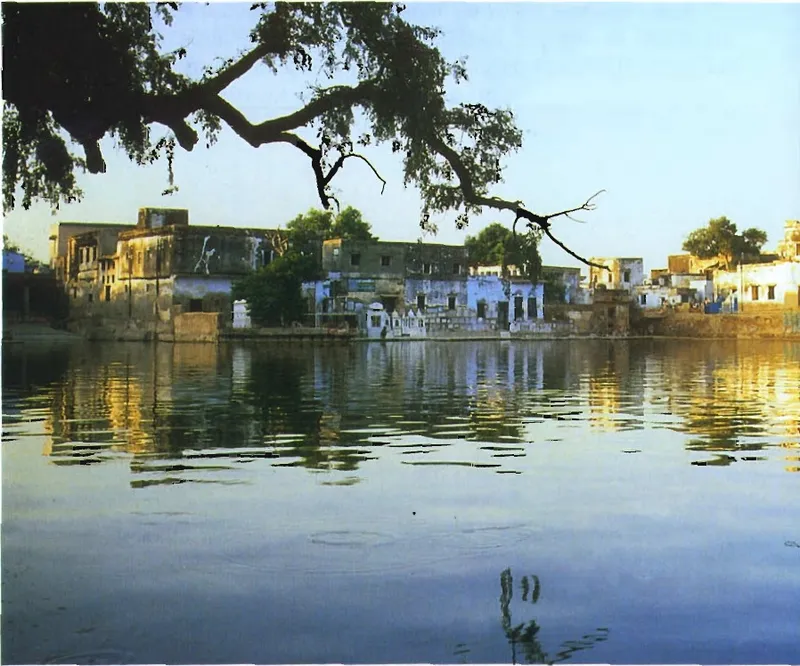
Rādhā-kuṇḍa
राधा-कुण्डRādhā-kuṇḍa is the lake of Śrī Rādhā at the foot of Govardhana Hill, in the village of Āriṭa.
Raghunātha dāsa Gosvāmī's bhajana-kuṭī
रघुनाथ दास गोस्वामी की भजन-कुटीŚrīla Raghunātha dāsa Gosvāmī's bhajana-kuṭī, his hut for chanting and prayer, stands between Rādhā-kuṇḍa and Śyāma-kuṇḍa, next to the kuṭīs of Śrī Gopāla Bhaṭṭa Gosvāmī …
Questions and answers
According to the Bhakti-ratnākara, he saw girls playing under a tree at Govinda-ghāṭa, their braids hanging down like snakes. When he hurried to warn them, they smiled and vanished, and he told Śrīla Rūpa Gosvāmī that his verse was true.[7–9, 11]
The first verse of Śrīla Rūpa Gosvāmī's Cāṭu-puṣpāñjali, a prayer in his Stava-mālā. It pictures Śrī Rādhā's jewelled braid as the hood of a female serpent.[1–6]
A guidebook map of 2007 marks it at the north-west corner of Rādhā-kuṇḍa. A photo of 1999 shows a stone structure with two pillars there, under a large tree beside a village lane.[17, 18]
A large neem tree that hangs over the water at Govinda-ghāṭa on the eastern bank, as a guidebook of 1999 describes it. No source says that it is the tree of the story.[4 +2]
Not in the Bhakti-ratnākara, which has girls playing under a tree. The swing first appears in the Bhaktamāla books, which set the vision on the bank of the kuṇḍa.[4 +2]
In the Bhakti-ratnākara, Śrīla Rāghava Paṇḍita Gosvāmī told it to him at Govinda-ghāṭa while guiding him around Rādhā-kuṇḍa.[7 +2]
Sources
- Śrīla Rūpa Gosvāmī, Cāṭu-puṣpāñjali, verse 1
- Śrīla Rūpa Gosvāmī, Cāṭu-puṣpāñjali, colophon
- Śrī Vraja-maṇḍala Parikramā (2007), PDF p. 90
- The Colour Guide to Rādhā-kuṇḍa (1999), Rājaśekhara dāsa Brahmacārī, PDF p. 164
- the undated parikramā notes Rādhā-kuṇḍa, ¶120-122
- Śrīla Rūpa Gosvāmī, Cāṭu-puṣpāñjali, Stava-mālā, Cāṭu-puṣpāñjali v. 1 with Baladeva Vidyābhūṣaṇa's ṭīkā, after the edition of Bhakti Saranga Goswami and Purushottam Das, Vrindavan, 1959
- Śrīla Narahari Cakravartī, Bhakti-ratnākara, Pañcama-taraṅga (5th wave), printed page 210, 2nd ed., 1912
- Śrīla Rūpa Gosvāmī, Cāṭu-puṣpāñjali, verse 1 (song book slug catu-puspanjali) · song book
- Śrīla Rūpa Gosvāmī, Cāṭu-puṣpāñjali, Stava-mālā, Cāṭu-puṣpāñjali v. 1 and the ṭīkā on it, after the edition of Bhakti Saranga Goswami and Purushottam Das, Vrindavan, 1959
- Śrīla Narahari Cakravartī, Bhakti-ratnākara, Fifth Wave, 1912 ed. p. 210, lines 6-11 of the 24 text lines below the running head, 2nd ed., 1912
- Śrīla Narahari Cakravartī, Bhakti-ratnākara, Fifth Wave, 1912 ed. p. 210, lines 13-23 of the 24 text lines below the running head, 2nd ed., 1912
- Śrīla Rūpa Gosvāmī, Stava-mālā, part 20 ('cāṭupuṣpāñjaliḥ'), v.1 and the ṭīkā after it, after the edition of Bhakti Saranga Goswami and Purushottam Das, Vrindavan, 1959
- Śrīla Narahari Cakravartī, Bhakti-ratnākara, Fifth Wave, 1912 ed. p. 210, lines 6-8 and 12-14, 2nd ed., 1912
- Bhaktamāla, Priyādāsa's kavitta no. 452 of this edition ('(४५२) टीका । कवित्त'), printed p. 870
- Śrī Śrī Bhaktamāla grantha, printed p. 242, left column
- the undated parikramā notes Rādhā-kuṇḍa, ¶127
- Śrī Vraja-maṇḍala Parikramā (2007), PDF p. 101
- The Colour Guide to Rādhā-kuṇḍa (1999), Rājaśekhara dāsa Brahmacārī, PDF p. 66
- Śrī Vraja-maṇḍala Parikramā (2007), PDF p. 89
- Śrī Vraja-maṇḍala Parikramā (2007), PDF p. 97
Show all 30 references
- Nandgram Dham Vaiṣṇava song book, ‘Catu Puspanjali’ · song book
- Bhaktamāla, Rūpakalā's vārtika tilaka on Priyādāsa's kavitta 452, printed p. 871
- Śrī Śrī Bhaktamāla grantha, printed page 242, left column, lines 7–10
- Vṛndāvana-kathā, printed p. 272, in the description of the marble pictures on the veranda of a Vṛndāvana temple
- A. W. Entwistle, printed p. 340, Egbert Forsten, Groningen, 1987
- Śrīla Kṛṣṇadāsa Kavirāja Gosvāmī, Govinda-līlāmṛta, sarga 7, vv. 2–6), after the editions of Haridas Das and Haridas Shastri
- Śrīla Narahari Cakravartī, Bhakti-ratnākara, Fifth Wave, 1912 ed. p. 192, first song (gīte yathā, rāga sāraṅga), 2nd ed., 1912
- The Colour Guide to Rādhā-kuṇḍa (1999), Rājaśekhara dāsa Brahmacārī, PDF p. 165
- the undated parikramā notes Rādhā-kuṇḍa, ¶119
- the undated parikramā notes Rādhā-kuṇḍa, ¶125
Further sources
- Śrīla Rūpa Gosvāmī, Stava-mālā, Cāṭu-puṣpāñjali 1 and colophon, with Śrīla Baladeva Vidyābhūṣaṇa's commentary (Sanskrit): summarised here, not translated.
- Bhakti-ratnākara, Fifth Wave (Bengali, 1912 edition): summarised here, not translated.
- Nābhā dāsa, Bhaktamāla, with Priyādāsa's verses and Rūpakalā's prose (Hindi, Banaras, 1904); Kṛṣṇadāsa Bābājī, Śrī Śrī Bhaktamāla (Bengali, Kolkata, 1905); Pulinbihārī Datta, Vṛndāvana-kathā (Bengali, 1920): summarised here, not translated.
- The Colour Guide to Rādhā-kuṇḍa (1999); Śrī Vraja-maṇḍala Parikramā (2007); undated parikramā notes Rādhā-kuṇḍa. Historian cited by name only: A. W. Entwistle (1987).