How Śrīla Prabhupāda built the Kṛṣṇa-Balarāma Mandira
श्रील प्रभुपाद ने कृष्ण-बलराम मन्दिर कैसे बनवाया
In short
Śrīla Prabhupāda built the Kṛṣṇa-Balarāma Mandira (Krishna Balaram Mandir) on land given to him in Ramaṇa-reti, Vṛndāvana. He opened it on Śrī Rāma-navamī (the appearance day of Lord Rāma), 20 April 1975. He chose Kṛṣṇa and Balarāma because Vṛndāvana had no prominent temple of Them, and to show that Gaura-Nitāi are Kṛṣṇa-Balarāma.[1–14]
On this page
At a glance
- The place: Ramaṇa-reti, a sandy area on the Chattikara road at the western edge of Vṛndāvana. It had no public temple before.[15–21]
- The land: given by gift deed in 1972. The biography says the deed was signed in Mathurā in March 1972 and the cornerstone laid two days later.[1 +3]
- The reason for the Deities (the sacred forms worshipped in the temple): in Śrīla Prabhupāda's words, to show the world that worship of Gaura-Nitāi (Śrī Caitanya and Śrī Nityānanda) is the same as worship of Kṛṣṇa-Balarāma.[9–14]
- The building: permissions and materials by July 1973, funds from the American temples in 1974, and a guesthouse of 44 rooms by 1975.[2 +5]
- The opening: planned for Janmāṣṭamī 1974, called off, and held on Rāma-navamī, 20 April 1975.[3–8]
- Afterwards: Śrīla Prabhupāda lived there, and he left this world in his room there on 14 November 1977.[14 +5]
Where is the Kṛṣṇa-Balarāma Mandira?
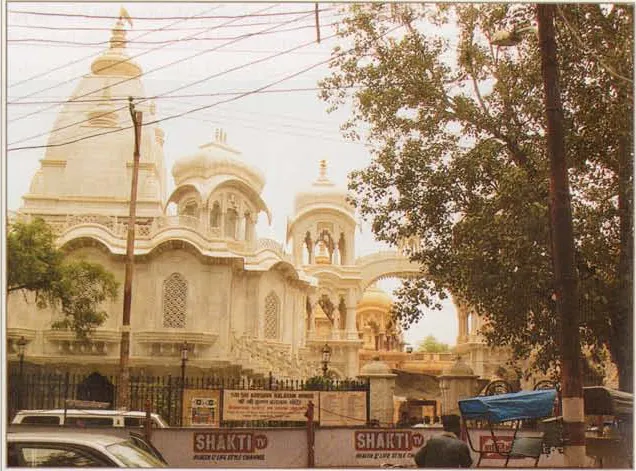
The temple stands in Ramaṇa-reti, a sandy area on the western edge of Vṛndāvana. It is beside the Chattikara road, an old road into the town that leaves the Delhi–Agra road at Chattikara.[15–20] Śrīla Prabhupāda described the spot to a French professor in June 1974:
Names this place“There is a place, Ramaṇa-reti. Did you see that Oriental Philosophical Institution? … Ramaṇa-reti, there is a road from Vṛndāvana to..., connecting with the road from Delhi to Agra. That road is called Chattikara, Chattikara Road. So on that road we have got our temple. It is locally known as Ramaṇa-reti.”
Śrīla Prabhupāda, Room Conversation with Professor Olivier Lacombe, Paris, 14 June 1974 · vedabase.io
His biography says that in 1971 Ramaṇa-reti was mostly forest, with a few āśramas (places where devotees live) and empty fields. It lay next to the parikramā path, the path pilgrims walk around Vṛndāvana.[20] One of those āśramas was Śrī Bhāgavat-nivāsa. There, according to Śrī Vraja-maṇḍala Parikramā (2007), Śrī Bhakti Hṛdaya Bon Mahārāja, a disciple of Śrīla Bhaktisiddhānta Sarasvatī Ṭhākura, set up a college. Śrīla Prabhupāda's land lay just in front of that college.[1 +4] In 1976 he said that before his temple there had been no temple in Ramaṇa-reti.[21]
Kṛṣṇa and Balarāma in the sands of the Yamunā
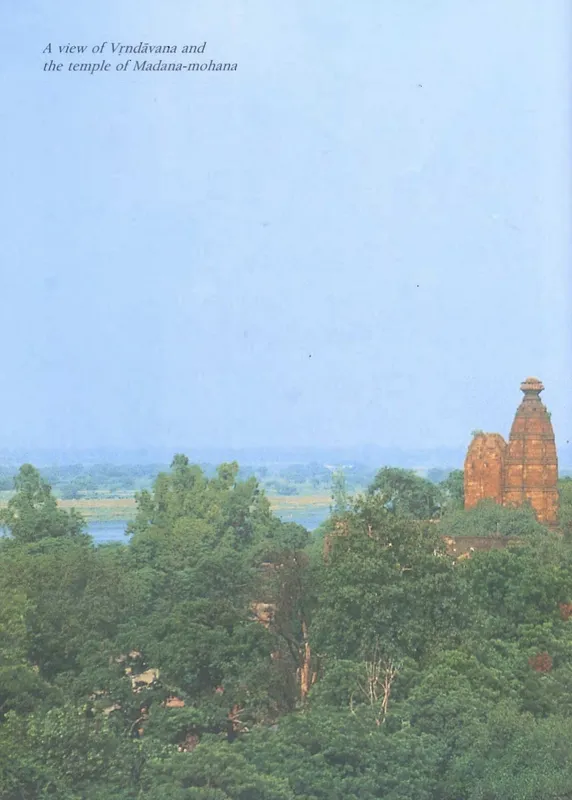
The Bhāgavatam tells how the cowherds settled in Vṛndāvana. Then Kṛṣṇa and Balarāma were delighted to see Vṛndāvana, Govardhana and the banks of the Yamunā.[34–39]
vṛndāvanaṃ govardhanaṃ yamunā-pulināni ca / vīkṣyāsīd uttamā prītī rāma-mādhavayor nṛpa
O King Parīkṣit, when Rāma and Kṛṣṇa saw Vṛndāvana, Govardhana and the banks of the river Yamunā, They both enjoyed great pleasure.
Translation: Śrīla A.C. Bhaktivedanta Swami PrabhupādaNot far from the village They tended the calves and played with the other cowherd boys. They played Their flutes and threw stones to bring down fruits. They played ball with bael and āmalakī fruits and copied the cows and bulls, exactly like two ordinary human children.[35, 36] Śrīla Sanātana Gosvāmī explains why the verse names Govardhana and the Yamunā's sandbanks apart from Vṛndāvana: each is well known for its own beauty. He adds that the calves grazed within calling distance of the village (summarised here, not translated).[40, 41] None of these verses names Ramaṇa-reti or any particular spot.[34–39]
The guidebooks and Śrīla Prabhupāda's biographer record the tradition that Kṛṣṇa and Balarāma played with Their friends in the soft sands of Ramaṇa-reti.[19 +5] In one verse Kṛṣṇa praises a Yamunā bank with clean, soft sand as the best place for play. In his purport (his explanation) to that verse, Śrīla Prabhupāda writes that the same sounds and atmosphere are still found where the temple stands.[39, 47] Read more: Brahmā's theft of the calves and cowherd boys →
Names this place“The same sounds and atmosphere still prevail in the area where our Kṛṣṇa-Balarāma temple is situated. Everyone who visits this temple is pleased to hear the chirping of the birds as described here (kūjat-kokila-haṁsa-sārasa).”
Śrīla Prabhupāda, Śrīmad-Bhāgavatam, 10.13.5, purport · vedabase.io
How was the land obtained?
Land in Ramaṇa-reti first appears in Śrīla Prabhupāda's letters in July 1971. He was glad to hear that one gentleman was willing to give land there.[48] The land he actually received came from another family. According to his biography, he asked for land at a public reception in Vṛndāvana in late 1971. Then a donor, whom the book calls only "Mr. S.", offered a plot that his family had kept for a religious purpose.[20, 22]
The biography says that the deed was completed at the magistrate's court in Mathurā in March 1972. Two days later Śrīla Prabhupāda held the cornerstone ceremony on the land, with about a hundred people present, and placed a Deity of Ananta in the foundation pit.[20, 22] His own letter of December 1972 confirms that the land was held by a gift deed and that the building work had made good progress.[1, 2] In London in July 1972 he told a visitor about the new land:
Names this place“And in Vṛndāvana, some gentleman has given us the land. … No, it is just in front of Bon Mahārāja's college. … The best place in Vṛndāvana. All aristocratic quality.”
Śrīla Prabhupāda, Room Conversation with Sumati Morarjee, London, 11 July 1972 · vedabase.io
From August 1972 a saṅkīrtana party (a group chanting the holy names together) went every day to the new land from the Rādhā-Dāmodara temple, where he had his rooms. That story belongs to his years at that temple.[49] Read more: Śrīla Prabhupāda at the Rādhā-Dāmodara temple →
Why did Śrīla Prabhupāda install Kṛṣṇa and Balarāma?
Śrīla Prabhupāda gives his reason in a purport to the Caitanya-caritāmṛta, written while the temple was being built. The temple, he writes, is for Kṛṣṇa and Balarāma together with Rādhā-Kṛṣṇa and Guru-Gaurāṅga (the spiritual master and Śrī Caitanya). He quotes the line of Śrīla Narottama dāsa Ṭhākura that the son of the king of Vraja has become the son of Śacī, Śrī Caitanya's mother.[9–14]
Names this place“Since there is no prominent Kṛṣṇa-Balarāma temple in Vṛndāvana, we are attempting to construct one so that people will be attracted to Kṛṣṇa-Balarāma, or Nitāi-Gauracandra. … To propagate this fundamental principle, we are establishing a Kṛṣṇa-Balarāma temple to broadcast to the world that worship of Gaura-Nitāi is the same as worship of Kṛṣṇa-Balarāma.”
Śrīla Prabhupāda, Śrī Caitanya-caritāmṛta, Madhya-līlā 16.281, purport · vedabase.io
In the Śrīmad-Bhāgavatam he gives a second purpose. The temple would be a place where the members of his society and outsiders could come and live peacefully in Vṛndāvana's spiritual atmosphere.[10] In another purport he says that foreigners were being drawn to the Keśavajī temple in Mathurā, and they would now also be attracted by the Kṛṣṇa-Balarāma temple.[11]
He also linked the choice with the place. On a morning walk in August 1975 a disciple spoke of the sands of Ramaṇa-reti, where Kṛṣṇa and Balarāma enjoyed Their pastimes. Śrīla Prabhupāda answered:
Names this place“The sands of Raman Reti where Kṛṣṇa and Balarāma would enjoy Their pastimes. … Oh. Therefore we have established Kṛṣṇa-Balarāma temple.”
Śrīla Prabhupāda, Morning Walk, Vṛndāvana, 28 August 1975 · vedabase.io
His biography gives the same reason. It adds that most temples of Vṛndāvana were of Rādhā and Kṛṣṇa.[50]
The name and the Deities
The Deities were decided early. In April 1972 he wrote that Kṛṣṇa may be black and Balarāma white. In July of that year he wrote that the sign on the land could call the place the ISKCON Krsna-Balarama Temple.[50–55] In 1973 he suggested sending a model to Jaipur for carving the Kṛṣṇa-Balarāma Deities. In 1976 he said that all the temple's Deities had been ordered from Jaipur.[53, 54] In 1975 an advertisement invited people to stay at the "Kṛṣṇa-Balarāma āśrama". He corrected it: a temple, not an āśrama.[55]
The guidebooks, from 1986 to 2010, describe three altars. Kṛṣṇa-Balarāma stand in the centre, Rādhā-Śyāmasundara with Lalitā and Viśākhā on the right, and Gaura-Nitāi on the left.[13 +5]
Śrīla Prabhupāda wrote in 1976 and 1977 that his mūrti (sacred image) and that of his spiritual master, Śrīla Bhaktisiddhānta Sarasvatī Ṭhākura, are worshipped there together, placed with Gaura-Nitāi.[13 +3]
Names this place“You should make a murti of Srila Bhaktisiddhanta Sarasvati and then they may be worshiped together as is now being done in our Krishna Balarama Temple. They should be placed with Gaura Nitai—Guru Gauranga.”
Śrīla Prabhupāda, Letter to Karandhara, letter dated 29 January 1976, Mayapur · vedabase.io
Building the temple, 1972–1975
His letters let us follow the building step by step. The letter of April 1972 that settled the colour of the Deities also discussed the design, with the old Govindajī temple as a model.[51] By July 1973 all the building permissions had been obtained and the materials were ready.[2 +5] In November 1973 he wrote from Vṛndāvana that he was staying in his house on the Ramaṇa-reti land.[27]
In January 1974 he told his bank that one hundred thousand dollars had been sent to build the temple, as a gift from his temples in the U.S.A.[2 +5] By September 1975 a guesthouse with forty-four guest rooms stood beside the temple. In November 1975 he asked that the domes of another temple be made like those of the Kṛṣṇa-Balarāma Mandira.[2 +5]
Why was the 1974 opening called off?
The first opening was planned for Janmāṣṭamī (Kṛṣṇa's appearance day) 1974. In July of that year he wrote that the temple would be opened by installing the Deities at a very big festival on that day.[6] According to his biography, he arrived in Vṛndāvana in August 1974 and found the building unfinished, so he called the opening off. He then chose Rāma-navamī (the appearance day of Lord Rāma) in April, when the devotees gathered for the yearly festival in Māyāpur and Vṛndāvana.[3–8]
His letters fix the new day. In December 1974 he told the devotees to get visas that would let them stay until the installation on 20 April. In February 1975 he wrote:
Names this place“Our Vrindavana temple is going to be formally opened on the Sri Rama-Navami day (April 20th, 1975). … I have invited Dr. Channa Reddy, the present Governor of Uttar Pradesh, to become the chief guest in Vrindavana at the opening ceremony.”
Śrīla Prabhupāda, Letter to Akbar Ali Khan, letter dated 24 February 1975 · vedabase.io
The opening on Rāma-navamī, 20 April 1975
Two days before the opening, lecturing at the temple, he explained why so much was being spent on installing Kṛṣṇa-Balarāma. It was so that people could see the Lord present in the temple and think of Him.[12]
Names this placeSo we are expending so much money for installing Kṛṣṇa-Balarāma here. What is this purpose? The purpose is that you will be able to see Him present in this temple, and therefore, "You can think of Me." That is very natural.
Śrīla Prabhupāda, Śrīmad-Bhāgavatam 1.7.6 lecture, Vṛndāvana, 18 April 1975 · vedabase.io
According to his biography, he installed the Deities on 20 April 1975. Almost a thousand disciples were present, and the Governor of Uttar Pradesh was the guest of honour.[3–8] He himself described one side of the ceremonies in a purport. Brāhmaṇas (priests) performed costly Vedic rites, because the smārta-brāhmaṇas of Vṛndāvana (priests who follow the ritual law books) would not accept his Western disciples as brāhmaṇas. At the same time the devotees performed loud saṅkīrtana, which he considered more important.[60]
Names this place“Recently, when we established a large Kṛṣṇa-Balarāma temple in Vṛndāvana, we were obliged to have Vedic ceremonies enacted by brāhmaṇas because the inhabitants of Vṛndāvana, especially the smārta-brāhmaṇas, would not accept Europeans and Americans as bona fide brāhmaṇas.”
Śrīla Prabhupāda, Śrīmad-Bhāgavatam, 6.3.25, purport · vedabase.io
In May 1975 he apologised to a correspondent for a late reply. He had been very busy in Vṛndāvana with the opening ceremony.[5]
The first years of the temple
Within a year the temple was drawing crowds. In May 1976 he called it the best attraction in Vṛndāvana. In March 1976 he said that it was locally known as the "angrezi" (English) temple because it was full of foreigners. In January 1977 he said that thousands were coming.[21 +5]
He lived and wrote there. He signed the preface of The Nectar of Instruction at the Kṛṣṇa-Balarāma Mandira, Ramaṇa-reti, on 20 September 1975. The draft of his will in June 1977 described him as living there.[14 +5] He left this world in his room at the temple on 14 November 1977. According to the guidebooks, his samādhi (memorial tomb) stands in front of the temple, and his house at the back was a museum when they were written.[3 +9]
In a purport of those years he also noted a tamāla tree (a dark-barked tree of Vraja) in the courtyard:
Names this place“In our Kṛṣṇa-Balarāma Temple in Vṛndāvana, there is a tamāla tree that covers an entire corner of the courtyard. Before there was a temple the tree was lying neglected, but now it has developed very luxuriantly, covering the whole corner of the courtyard. This is a sign of bhūri-puṇya.”
Śrīla Prabhupāda, Śrīmad-Bhāgavatam, 10.13.49, purport · vedabase.io
Why the road is called Bhaktivedanta Swami Marg
His letters show the change of address. In 1975 and 1976 the temple's address was Chattikara Road, Raman Reti. A letter of December 1976 has Bhaktivedanta Swami Road, and by July 1977 the address is Bhaktivedanta Swami Marg, Ramanareti.[15 +5]
In an interview of February 1977, held in his presence, his disciples said that the Vṛndāvana Municipality had renamed the main road, the Chattikara Road, after him.[68] No source gives the date of the Municipality's decision.[15 +5]
Where the sources differ
Śrīla Prabhupāda's purport links the Yamunā sandbank of the Bhāgavatam with the temple's area. His biographer applies it to Kṛṣṇa and Balarāma's play at Ramaṇa-reti. But the sources tell differently whether Balarāma was with Kṛṣṇa on the day Kṛṣṇa praised the sandbank, the day of Aghāsura (ŚB 10.12–13). Śrīla Viśvanātha Cakravartī Ṭhākura and Śrīla Baladeva Vidyābhūṣaṇa say that His mother kept Him at home for the rites of His birth-star (summarised here, not translated). Śrīla Prabhupāda's Kṛṣṇa book names Balarāma among the boys whom Aghāsura meant to swallow.[39 +3]
Accounts differ Whether Balarāma was with Kṛṣṇa and the cowherd boys on the day of Aghāsura and of the lunch on the Yamunā sandbank (ŚB 10.12.1–10.13.11), the sandbank scene of ŚB 10.13.5 that Śrīla Prabhupāda's purport connects with the Kṛṣṇa-Balarāma temple's area and his biographer with Ramaṇa-reti.
- Śrīmad-Bhāgavatam 10.12.1–10.13.27, with Śrīla Prabhupāda's translation of 10.12.14names Kṛṣṇa and the cowherd boys for that day, not Balarāma; 'sa-balam' in 10.12.14 is translated 'along with His assistants, the other cowherd boys'; Balarāma is named again in 10.13.28 ('sa-rāmaḥ'), five or six days before the end of the year
- Śrīla Viśvanātha Cakravartī and Śrīla Baladeva Vidyābhūṣaṇa (on ŚB 10.12.1); Vaṁśīdhara (on 10.12.2 and 10.12.14)Balarāma did not go to the forest that day: His mother kept Him at home for the propitiatory bath of His birth-star; Vaṁśīdhara: the 'bala' of 'sa-balam' does not mean Baladeva, who did not go (Śrīla Śrīdhara Svāmī, Viśvanātha and Baladeva explain 'sa-balam' as with His army)
- Śrīla Prabhupāda, Kṛṣṇa book ch. 12'Desiring to swallow all the boys at once, including Kṛṣṇa and Balarāma, he sat on the path.'
The wording of these accounts is our summary of the sources, not a published translation.
Timeline
- 1971
His biography says that in 1971 Ramaṇa-reti was mostly forest, with a few āśramas (places where devotees live) and empty fields.
Read in the article: Where is the Kṛṣṇa-Balarāma Mandira? → - 1972
The biography says that the deed was completed at the magistrate's court in Mathurā in March 1972.
Read in the article: How was the land obtained? → - 1973
In 1973 he suggested sending a model to Jaipur for carving the Kṛṣṇa-Balarāma Deities.
Read in the article: Why did Śrīla Prabhupāda install Kṛṣṇa and Balarāma? → - 1974
In January 1974 he told his bank that one hundred thousand dollars had been sent to build the temple, as a gift from his temples in the U.S.A.
Read in the article: Building the temple, 1972–1975 → - 1975
By September 1975 a guesthouse with forty-four guest rooms stood beside the temple.
Read in the article: Building the temple, 1972–1975 → - 1976
In 1976 he said that all the temple's Deities had been ordered from Jaipur.
Read in the article: Why did Śrīla Prabhupāda install Kṛṣṇa and Balarāma? → - 1977
The draft of his will in June 1977 described him as living there.
Read in the article: The first years of the temple →
Places in this article
Kṛṣṇa-Balarāma Mandira (Ramaṇa-retī)
कृष्ण-बलराम मन्दिर (रमण-रेती)The Kṛṣṇa-Balarāma Mandira is the temple that Śrīla Prabhupāda built in Ramaṇa-reti, a sandy area on the western edge of Vṛndāvana, and opened on Śrī Rāma-navamī, 20 Apri …
Ramaṇa-reti (Vṛndāvana)
रमण-रेती (वृन्दावन)Ramaṇa-reti, "the pleasing sands", is a sandy area on the western edge of Vṛndāvana, on the old Chattikara road.
Vṛndāvana
वृन्दावनVṛndāvana is the forest on the bank of the Yamunā where Kṛṣṇa spent His childhood and youth, and the town of temples that stands in that forest today.
Rādhā-Dāmodara Mandira (Vṛndāvana)
राधा-दामोदर मन्दिर (वृन्दावन)The Rādhā-Dāmodara Mandira is one of the seven old temples of the Gauḍīya Vaiṣṇavas in Vṛndāvana, in the Sevā-kuñja quarter.
Prabhupāda Samādhi
प्रभुपाद समाधिPrabhupāda's house (Kṛṣṇa-Balarāma Mandira)
प्रभुपाद का निवास (कृष्ण-बलराम मन्दिर)Śrīla Prabhupāda's house stands within the Kṛṣṇa-Balarāma Mandira in Ramaṇa-reti, Vṛndāvana, at the rear of the temple.
Bhāgavat-nivāsa
भागवत-निवासŚrī Bhāgavat-nivāsa is an āśrama in Ramaṇa-reti, Vṛndāvana, beside the Kṛṣṇa-Balarāma Mandira.
Questions and answers
On Śrī Rāma-navamī, 20 April 1975, when Śrīla Prabhupāda installed the Deities. An earlier opening planned for Janmāṣṭamī 1974 had been called off.[3–8]
He wrote that Vṛndāvana had no prominent Kṛṣṇa-Balarāma temple. He wanted to show the world that worship of Gaura-Nitāi is the same as worship of Kṛṣṇa-Balarāma. He also said that this was why the temple stands in Ramaṇa-reti, where Kṛṣṇa and Balarāma played.[9 +7]
It was given by gift deed. According to Śrīla Prabhupāda's biography, a donor offered the plot after his appeal for land in Vṛndāvana in late 1971. The deed was signed in Mathurā in March 1972, and the cornerstone was laid two days later.[1 +3]
According to his biography, Śrīla Prabhupāda arrived for the Janmāṣṭamī opening of 1974 and found the building unfinished. He stopped the preparations and chose Rāma-navamī of April 1975 instead.[7]
The Vṛndāvana Municipality renamed the Chattikara Road after Śrīla Prabhupāda. His letters use the new name from December 1976. No known source gives the date of the decision.[15 +5]
In 1976 he called it the best attraction in Vṛndāvana. He said it was known locally as the "angrezi" temple, full of foreigners. In 1977 he said that thousands were coming.[21 +5]
Sources
- Śrīla Prabhupāda, Room Conversation with Sumati Morarjee, London, 11 July 1972 · vedabase.io
- Śrīla Prabhupāda, Letter to Ksirodakasayi, letter dated 28 December 1972, Bombay · vedabase.io
- Śrīla Prabhupāda, Letter to Akbar Ali Khan, letter dated 24 February 1975 · vedabase.io
- Śrīla Prabhupāda, Letter to Rupanuga, letter dated 18 December 1974, Bombay · vedabase.io
- Śrīla Prabhupāda, Letter to Prof. O.P. Goel, letter dated 10 May 1975, Perth · vedabase.io
- Śrīla Prabhupāda, Letter to Cyavana, letter dated 3 July 1974, Melbourne · vedabase.io
- Satsvarūpa dāsa Gosvāmī, Śrīla Prabhupāda-līlāmṛta, vol. 2, ch. 44, 4 August 1974 · vedabase.io
- Satsvarūpa dāsa Gosvāmī, Śrīla Prabhupāda-līlāmṛta, vol. 2, ch. 45, 20 April 1975 · vedabase.io
- Śrīla Prabhupāda, Śrī Caitanya-caritāmṛta, Madhya-līlā 16.281, purport · vedabase.io
- Śrīla Prabhupāda, Śrīmad-Bhāgavatam, 5.13.8, purport · vedabase.io
- Śrīla Prabhupāda, Śrī Caitanya-caritāmṛta, Madhya-līlā 17.156, purport · vedabase.io
- Śrīla Prabhupāda, Śrīmad-Bhāgavatam 1.7.6 lecture, Vṛndāvana, 18 April 1975 · vedabase.io
- Vṛndāvana, the Playground of God (2010), Bhakti Caitanya Svāmī, PDF p. 112
- Vṛndāvana, the Playground of God (2010), Bhakti Caitanya Svāmī, PDF p. 113
- Śrīla Prabhupāda, Room Conversation with Professor Olivier Lacombe, Paris, 14 June 1974 · vedabase.io
- Śrī Vraja-maṇḍala Parikramā (2007), PDF p. 298
- Śrī Vraja-maṇḍala Parikramā (2007), PDF p. 339
- Śrī Vraja-maṇḍala Parikramā (2007), PDF p. 340
- Vṛndāvana-Dhāma Ki Jaya! (c. 1986), by Dhruva Mahārāja dāsa, PDF p. 62
- Satsvarūpa dāsa Gosvāmī, Śrīla Prabhupāda-līlāmṛta, vol. 2, ch. 37, November 1971 · vedabase.io
Show all 71 references
- Śrīla Prabhupāda, Prabhupāda Visits Palace and Garden, New Vrindaban, 22 June 1976 · vedabase.io
- Satsvarūpa dāsa Gosvāmī, Śrīla Prabhupāda-līlāmṛta, vol. 2, ch. 39, March 1972 · vedabase.io
- Śrīla Prabhupāda, Letter to Gurudasa, letter dated 4 July 1973, Calcutta · vedabase.io
- Śrīla Prabhupāda, Letter to Manager of Punjab National Bank, letter dated 19 January 1974, Honolulu · vedabase.io
- Śrīla Prabhupāda, Letter to Sri Ramchandra Chabriaji, letter dated 11 September 1975, Vrindaban · vedabase.io
- Śrīla Prabhupāda, Letter to Deoji Punja, letter dated 4 November 1975, Bombay · vedabase.io
- Śrīla Prabhupāda, Letter to Bhagavan, letter dated 19 November 1973, Vrindaban · vedabase.io
- Śrīla Prabhupāda, The Nectar of Instruction, Preface, signature, 20 September 1975 · vedabase.io
- Śrīla Prabhupāda, Discussions Will & Affidavit, Vṛndāvana, 2 June 1977 · vedabase.io
- Vṛndāvana, the Playground of God (2010), Bhakti Caitanya Svāmī, PDF p. 116
- The Color Guide to Vṛndāvana (2000), Written and Photographed by Rājaśekhara dāsa Brahmacārī, PDF p. 48
- Śrī Vraja-maṇḍala Parikramā (2007), PDF p. 341
- The Colour Guide to Rādhā-kuṇḍa (1999), Rājaśekhara dāsa Brahmacārī, PDF p. 113
- Śrīmad-Bhāgavatam 10.11.36, GRETIL
- Śrīmad-Bhāgavatam 10.11.38, GRETIL
- Śrīmad-Bhāgavatam 10.11.39-40, GRETIL
- Śrīmad-Bhāgavatam 10.15.1, Bhagavata Vidya Pith edition, ed. Bhagavata Rishi and Krishna Shankar Shastri, 1996
- Śrīmad-Bhāgavatam 10.15.15, GRETIL
- Śrīmad-Bhāgavatam, 10.13.5, online edition · vedabase.io
- Śrīla Sanātana Gosvāmī: commentary on ŚB 10.11.36, Bhagavata Vidya Pith edition, ed. Bhagavata Rishi and Krishna Shankar Shastri, 1996
- Śrīla Sanātana Gosvāmī: commentary on ŚB 10.11.38, Bhagavata Vidya Pith edition, ed. Bhagavata Rishi and Krishna Shankar Shastri, 1996
- Vṛndāvana, the Playground of God (2010), Bhakti Caitanya Svāmī, PDF p. 121
- The Color Guide to Vṛndāvana (2000), Written and Photographed by Rājaśekhara dāsa Brahmacārī, PDF p. 51
- the undated parikramā notes Vṛndāvana, ¶13
- Śrīla Prabhupāda, Morning Walk, Vṛndāvana, 28 August 1975 · vedabase.io
- Śrīla Prabhupāda, Morning Walk, Vṛndāvana, 9 December 1975 · vedabase.io
- Śrīla Prabhupāda, Śrīmad-Bhāgavatam, 10.13.5, purport · vedabase.io
- Śrīla Prabhupāda, Letter to Yamuna, letter dated 21 July 1971, Brooklyn · vedabase.io
- Śrīla Prabhupāda, Letter to Acyutananda, letter dated 5 August 1972, London · vedabase.io
- Satsvarūpa dāsa Gosvāmī, Śrīla Prabhupāda-līlāmṛta, vol. 2, ch. 43, April 1972 · vedabase.io
- Śrīla Prabhupāda, Letter to Gurudasa, Yamuna, letter dated 25 April 1972, Tokyo · vedabase.io
- Śrīla Prabhupāda, Letter to Gurudasa, letter dated 14 July 1972, London · vedabase.io
- Śrīla Prabhupāda, Letter to Jayapataka, Bhavananda, letter dated 9 May 1973, Los Angeles · vedabase.io
- Śrīla Prabhupāda, Śrīmad-Bhāgavatam 1.7.45-46 lecture, Vṛndāvana, 5 October 1976 · vedabase.io
- Śrīla Prabhupāda, Morning Walk, Vṛndāvana, 18 September 1975 · vedabase.io
- The Color Guide to Vṛndāvana (2000), Written and Photographed by Rājaśekhara dāsa Brahmacārī, PDF p. 40
- Vṛndāvana-Dhāma Ki Jaya! (c. 1986), by Dhruva Mahārāja dāsa, PDF p. 16
- Śrīla Prabhupāda, Letter to Karandhara, letter dated 29 January 1976, Mayapur · vedabase.io
- Śrīla Prabhupāda, Letter to Sudama, letter dated 13 January 1977, Allahabad · vedabase.io
- Śrīla Prabhupāda, Śrīmad-Bhāgavatam, 6.3.25, purport · vedabase.io
- Śrīla Prabhupāda, Letter to Kashinath Mullick, letter dated 4 May 1976, Honolulu · vedabase.io
- Śrīla Prabhupāda, Conversation on Train to Allahabad, India, 11 January 1977 · vedabase.io
- Śrīla Prabhupāda, Śrīmad-Bhāgavatam 7.5.23-24 lecture, Vṛndāvana, 31 March 1976 · vedabase.io
- Vṛndāvana, the Playground of God (2010), Bhakti Caitanya Svāmī, PDF p. 141
- Śrīla Prabhupāda, Letter to Manager, Central Bank of India, letter dated 2 April 1976 (sender's address) · vedabase.io
- Śrīla Prabhupāda, Letter to Postmaster, letter dated 4 July 1977 (sender's address) · vedabase.io
- Vṛndāvana-Dhāma Ki Jaya! (c. 1986), by Dhruva Mahārāja dāsa, PDF p. 100
- Śrīla Prabhupāda, Interview, Māyāpur, 26 February 1977 · vedabase.io
- Śrīla Viśvanātha Cakravartī Ṭhākura: commentary on ŚB 10.12.1, Bhagavata Vidya Pith edition, ed. Bhagavata Rishi and Krishna Shankar Shastri, 1996
- Śrīmad-Bhāgavatam 10.12.14, Bhagavata Vidya Pith edition, ed. Bhagavata Rishi and Krishna Shankar Shastri, 1996
- Śrīla Prabhupāda, Kṛṣṇa, the Supreme Personality of Godhead (Kṛṣṇa book), Chapter 12, 'The Killing of the Aghāsura Demon' · vedabase.io
Further sources
- Śrīla Prabhupāda's books (Caitanya-caritāmṛta Madhya 16.281 and 17.156 purports; Śrīmad-Bhāgavatam 5.13.8, 6.3.25, 10.13.5 and 10.13.49 purports), letters and recorded talks, BBT.
- Śrīla Prabhupāda-līlāmṛta by Satsvarūpa dāsa Goswami, volume 2, used and named as a biography.