Raṅga Mahal (Sevā-kuñja)
रंग महल (सेवा-कुंज) Hindi name proposed
Also called Rang Mahal
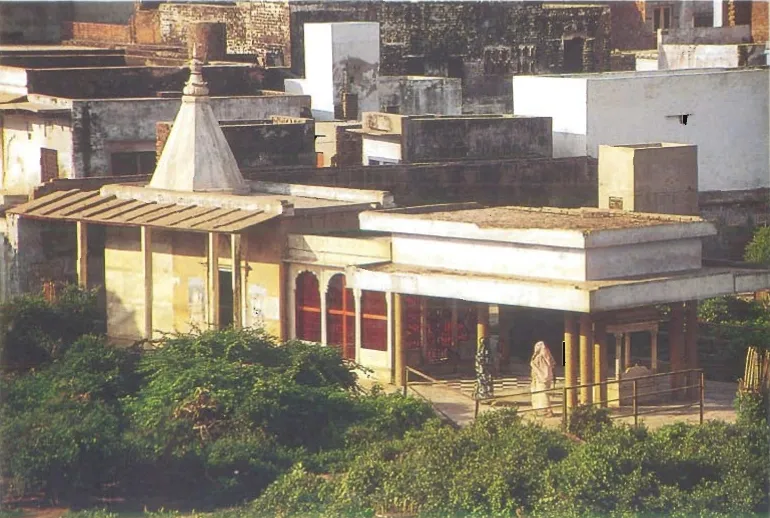
- What it is
- The Raṅga Mahal is a small temple on the far side of the Sevā-kuñja garden in Vṛndāvana.
- Visiting
- The plan of Sevā-kuñja in The Color Guide to Vṛndāvana (2000) marks the Raṅga Mahal as number 2, with the Rāsa-sthalī as number 1 and Lalitā-kuṇḍa as number 3.
In short
The Raṅga Mahal is a small temple on the far side of the Sevā-kuñja garden in Vṛndāvana. According to the local tradition recorded in Vṛndāvana, the Playground of God (2010), it marks where Kṛṣṇa served Śrīmatī Rādhārāṇī when She was tired from the rāsa dance, and a picture on its altar shows this service; The Color Guide to Vṛndāvana (2000) calls it the place where He decorated Her.[1 +2] The Bhāgavatam tells of a gopī's tiredness in the rāsa night but names no temple and does not tell the guidebooks' pastime.[4 +5] A Bengali book of 1920 already describes a small white-stone temple with this painting in the garden.[10]
Key facts
| Kind | temple |
|---|---|
| Region · area | Vṛndāvana · Sevā-kuñja |
Divine pastimes
Rādhā tired in the rāsa night
Śrīmad-Bhāgavatam tells of a gopī's tiredness twice in the rāsa night. In the gopīs' search (10.30.37–38) the special gopī, proud, tells Kṛṣṇa that She cannot walk any further and asks to be carried; He says "Climb on My shoulder" and disappears. In the dance itself (10.33.10) one gopī, tired, takes hold of His shoulder, and later (10.33.20) Kṛṣṇa wipes the faces of all the tired gopīs. The Bhāgavatam names neither gopī and names no grove; Śrīla Prabhupāda's Kṛṣṇa book names the gopī of the search Rādhārāṇī.[4 +5]
kācid rāsa-pariśrāntā pārśva-sthasya gadā-bhṛtaḥ / jagrāha bāhunā skandhaṃ ślathad-valaya-mallikā
When one gopī grew tired from the rāsa dance, She turned to Kṛṣṇa, standing at Her side holding a baton, and grasped His shoulder with Her arm. The dancing had loosened Her bracelets and the flowers in Her hair.
Translation: Śrīla Prabhupāda's disciples (BBT)The commentators (summarised here, not translated) take the tired gopī of 10.33.10 to be Śrī Rādhā. Śrīla Viśvanātha Cakravartī Ṭhākura adds that "wiped" in 10.33.20 also means that Kṛṣṇa fanned and served the tired gopīs. None of them names this temple or tells the guidebooks' pastime.[11 +2]
The twenty verses on the origin of Rādhā-kuṇḍa that Śrīla Viśvanātha Cakravartī Ṭhākura sets down in his comment on ŚB 10.36.15 also praise Kṛṣṇa's service to Śrī Rādhā; that scene is at Rādhā-kuṇḍa, not here.[11 +2]
Śrīla Rūpa Gosvāmī's Ujjvala-nīlamaṇi (5.91–93) also speaks of Kṛṣṇa decorating Śrī Rādhā, with a verse of the Gīta-govinda. No place is named.[14]
The flowers in Her hair
In the gopīs' search the Bhāgavatam (10.30.33) also tells that Kṛṣṇa sat down with His beloved to arrange Her hair and made Her a crown of flowers. It names no place, and Śrīla Prabhupāda's Kṛṣṇa book names Her Rādhārāṇī.[15 +1]
General teaching (does not name the place)“Dear friends, just see how Kṛṣṇa must have sat down here with Rādhārāṇī and tried to set flowers in Her hair. You can be certain that both of Them sat together here.”
Śrīla Prabhupāda, Kṛṣṇa, the Supreme Personality of Godhead (Kṛṣṇa book), Chapter 30, 'Kṛṣṇa’s Hiding from the Gopīs' · vedabase.io
The commentator Vaṁśīdhara says that the spot is now known as Śṛṅgāravaṭa; the other commentators on the verse name no place.[17] The guidebooks differ on where this decorating happened (see below).
Traditional accounts
According to the local tradition recorded in Vṛndāvana, the Playground of God (2010), Kṛṣṇa served Śrīmatī Rādhārāṇī at the Raṅga …
According to the local tradition recorded in Vṛndāvana, the Playground of God (2010), Kṛṣṇa served Śrīmatī Rādhārāṇī at the Raṅga Mahal when She became tired during the rāsa dance, and the picture on the altar shows this service; no scripture tells it, and it is not certain.[1] The Color Guide to Vṛndāvana (2000) calls the Raṅga Mahal the place where Kṛṣṇa decorated Rādhārāṇī; the undated parikramā notes Vṛndāvana repeat its sentence without those words.[2 +1]
Śrī Vraja-maṇḍala Parikramā (2007) says that a painting of Kṛṣṇa serving Śrīmatī Rādhikā is worshipped in a small temple in Sevā-kuñja, without naming the temple. It quotes a couplet of the poet Bhakta Rasakhāna, who says that he saw this service of Kṛṣṇa at this very place; no edition of his poems was available to check it.[18 +1]
Visiting today
The plan of Sevā-kuñja in The Color Guide to Vṛndāvana (2000) marks the Raṅga Mahal as number 2, with the Rāsa-sthalī as number 1 and Lalitā-kuṇḍa as number 3. Vṛndāvana, the Playground of God (2010) places it on the far side of the garden.[1 +1] A Raṅga Mahal also stands in Nidhuvana; that one is the shrine with the bed (see Raṅga Mahal (Nidhuvana)).[1 +3]
History
The Bengali Vṛndāvana-kathā (1920) describes, in the garden of Nikuñjavana that people call Sevā-kuñja, a small temple of white stone in which a painting of Rādhikā is worshipped, showing Śrī Kṛṣṇa serving Śrī Rādhā. It gives the temple no name.[10]
The historian A. W. Entwistle (1987) reports that the present building may date from a restoration in 1931; he cites no inscription for the year.[20] He also reports a tradition that the first shrine is said to have been built in about 1575 by a merchant, Puhukardas, a disciple of a Goswami Damodar. No older source for this was found.[20]
Where the sources differ
Where Kṛṣṇa decorated Śrīmatī Rādhārāṇī: the Bhāgavatam names no place, and the commentators and guidebooks name different ones.
Where Kṛṣṇa decorated Śrīmatī Rādhārāṇī: the Bhāgavatam names no place, and the commentators and guidebooks name different ones.[15 +2]
Accounts differ Where Kṛṣṇa decorated Śrīmatī Rādhārāṇī (the hair-decoration of ŚB 10.30.33 and similar services).
- Śrīmad-Bhāgavatam 10.30.33On the gopīs' search path ('here'): Kṛṣṇa sat with His beloved to arrange her hair and made her a crown of flowers; no place is named.
- Śrī Vraja-maṇḍala Parikramā (2007)At Śṛṅgāra-vaṭa, where Rādhikā hid after leaving the rāsa, Kṛṣṇa decorated Her with flowers He had picked; the book quotes ŚB 10.30.33 for this.
- The Color Guide to Vṛndāvana (2000); the undated parikramā notes VṛndāvanaIn Sevā-kuñja Kṛṣṇa decorated Rādhārāṇī's hair with flowers; The Color Guide to Vṛndāvana (2000) names the Raṅga Mahal as 'where Lord Krishna decorated Śrīmati Rādhārānī' (the undated parikramā notes Vṛndāvana leaves this out). No scripture is cited.
- Vṛndāvana-Dhāma Ki Jaya! (c. 1986)'It is said' that Kṛṣṇa decorated Rādhārāṇī's hair with flowers in Sevā-kuñja; at Nityānanda-vaṭa (Śṛṅgāra-vaṭa) Kṛṣṇa decorated Her with jewels and fine cloth.
What Kṛṣṇa did when Śrī Rādhā was tired in the rāsa, and where: the Bhāgavatam and its commentators name no place and tell no service at this temple, and the guidebooks set one here.[4 +8]
References
23 references
- Vṛndāvana, the Playground of God (2010), Bhakti Caitanya Svāmī, PDF p. 154
- The Color Guide to Vṛndāvana (2000), Written and Photographed by Rājaśekhara dāsa Brahmacārī, PDF p. 70
- the undated parikramā notes Vṛndāvana, ¶111
- Śrīmad-Bhāgavatam 10.30.37, GRETIL
- Śrīmad-Bhāgavatam 10.30.38, GRETIL
- Śrīmad-Bhāgavatam 10.33.10, GRETIL
- Śrīmad-Bhāgavatam 10.33.20, GRETIL
- Śrīla Prabhupāda, Kṛṣṇa, the Supreme Personality of Godhead, Chapter 30, 'Kṛṣṇa’s Hiding from the Gopīs' · vedabase.io
- Śrīla Prabhupāda, Kṛṣṇa, the Supreme Personality of Godhead, Chapter 33, 'Description of the Rāsa Dance' · vedabase.io
- Vṛndāvana-kathā, chapter 17 (saptadaśa pariccheda), section 2 'udyāna' (gardens), twelfth garden, printed p. 196
- Śrīla Viśvanātha Cakravartī Ṭhākura: commentary on ŚB 10.33.10
- Śrīla Viśvanātha Cakravartī Ṭhākura: commentary on ŚB 10.33.20
- Śrīla Viśvanātha Cakravartī Ṭhākura: commentary on ŚB 10.36.15, verses xii–xiii of the twenty verses, Bhagavata Vidya Pith edition, ed. Bhagavata Rishi and Krishna Shankar Shastri, 1996
- Śrīla Rūpa Gosvāmī, Ujjvala-nīlamaṇi 5.91-5.93, GRETIL
- Śrīmad-Bhāgavatam 10.30.33, GRETIL
- Śrīla Prabhupāda, Kṛṣṇa, the Supreme Personality of Godhead (Kṛṣṇa book), Chapter 30, 'Kṛṣṇa’s Hiding from the Gopīs' · vedabase.io
- Vaṁśīdhara: commentary on ŚB 10.30.33
- Śrī Vraja-maṇḍala Parikramā (2007), PDF p. 303
- Śrī Vraja-maṇḍala Parikramā (2007), PDF p. 305
- A. W. Entwistle, ch. 8, §66.10 'Seva Kunj', printed p. 405, Egbert Forsten, Groningen, 1987
- The Color Guide to Vṛndāvana (2000), Written and Photographed by Rājaśekhara dāsa Brahmacārī, PDF p. 165
- Vṛndāvana, the Playground of God (2010), Bhakti Caitanya Svāmī, p. 154
- The Color Guide to Vṛndāvana (2000), Written and Photographed by Rājaśekhara dāsa Brahmacārī, p. 56