Rūpa Gosvāmī Samādhi (Rādhā-Dāmodara)
रूप गोस्वामी समाधि (राधा-दामोदर) Hindi name proposed
Also called Samādhi of Rūpa Gosvāmi, Rupa Gosvami Samadhi
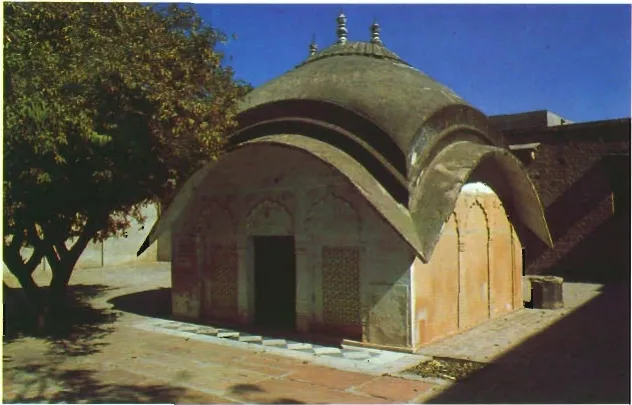
- What it is
- The samādhi (tomb) of Śrīla Rūpa Gosvāmī stands in the courtyard of the Rādhā-Dāmodara temple in Vṛndāvana, opposite his bhajana-kuṭī, with Śrīla Bhūgarbha Gosvāmī's samādhi next to it.
- Visiting
- The guidebooks place the samādhi in the northern part of the temple grounds, opposite the bhajana-kuṭī, with Śrīla Bhūgarbha Gosvāmī's samādhi beside it; Śrīla Prabhupāda's rooms face it across the …
In short
The samādhi (tomb) of Śrīla Rūpa Gosvāmī stands in the courtyard of the Rādhā-Dāmodara temple in Vṛndāvana, opposite his bhajana-kuṭī, with Śrīla Bhūgarbha Gosvāmī's samādhi next to it.[1 +5] Śrīla Prabhupāda wrote that the actual samādhi tombs of Śrīla Rūpa Gosvāmī and Śrīla Jīva Gosvāmī are laid at this spot, and he said that Śrīla Rūpa Gosvāmī's body is entombed here.[1 +6] According to the Bhakti-ratnākara and the Narottama-vilāsa, the samādhi stood at Śrīla Jīva Gosvāmī's residence beside his Deities, Śrī Śrī Rādhā-Dāmodara, and the ācāryas who came after the Gosvāmīs wept before it.[13 +5] Śrīla Prabhupāda had his place of bhajana behind it until 1965 and lectured daily in its courtyard in 1972.[1 +6]
Key facts
| Kind | samādhi |
|---|---|
| Region · area | Vṛndāvana · Rādhā-Dāmodara Mandira (Vṛndāvana) |
| Ācāryas | Śrīla Rūpa Gosvāmī, Śrīla Jīva Gosvāmī, Śrīla Śrīnivāsa Ācārya, Śrīla Rāmacandra Kavirāja |
Traditional accounts
The samādhi in the Bhakti-ratnākara
The Bhakti-ratnākara tells that when Śrīla Śrīnivāsa Ācārya first came to Vṛndāvana, Śrīla Jīva Gosvāmī offered him at the feet of Rādhā-Dāmodara. Śrīla Rūpa Gosvāmī's samādhi was at that very place, and Śrīla Jīva Gosvāmī took him there himself; seeing it, Śrīla Śrīnivāsa Ācārya wept and fell to the ground (summarised here, not translated).[13 +4]
শ্রীজীবগোস্বামী শ্রীনিবাসে কৃপা কৈল । রাধাদামোদরের চরণে সমর্পিল ॥ শ্রীরূপগোস্বামির সমাধি সেই থানে । তথা শ্রীনিবাসে লৈয়া গেলেন আপনে ॥ শ্রীনিবাস শ্রীসমাধি দর্শন করিয়া । নেত্রজলে ভাসে ভূমে পড়ে প্রণমিয়া ॥
śrījībagosbāmī śrīnibāse kṛpā kaila
rādhādāmodarera caraṇe samarpila
śrīrūpagosbāmira samādhi sei thāne
tathā śrīnibāse laiẏā gelena āpane
śrīnibāsa śrīsamādhi darśana kariẏā
netrajale bhāse bhūme paṛe praṇamiẏā ||
Before Śrīla Śrīnivāsa Ācārya left for Bengal with the Gosvāmīs' books, Śrīla Jīva Gosvāmī took him again to his own residence. He prayed before the samādhi and, with Śrīla Rūpa Gosvāmī's blessing, went from it to see Rādhā-Dāmodara, the Deities who were Śrīla Jīva Gosvāmī's life and soul.[13 +4] Later Śrīla Jīva Gosvāmī brought Śrīla Rāmacandra Kavirāja to the darśana of Rādhā-Dāmodara; seeing Śrīla Rūpa Gosvāmī's samādhi there, he lost all composure and rolled on the ground.[13 +4] When Śrīla Jāhnavā-devī took leave of Vraja, she wept at the samādhis of Śrīla Raghunātha Bhaṭṭa Gosvāmī, Śrī Kāśīśvara Paṇḍita, Śrīla Sanātana Gosvāmī and Śrīla Rūpa Gosvāmī; that passage does not say where the samādhi stands.[13 +4]
The Narottama-vilāsa, by the same author, tells the same of Śrīla Narottama dāsa Ṭhākura. Śrīla Jīva Gosvāmī brought him to his residence to see Rādhā-Dāmodara; at the sight of Śrīla Rūpa Gosvāmī's samādhi he rolled on the ground in tears, and Śrīla Jīva Gosvāmī then took him to his own hut.[18]
Śrīla Rūpa Gosvāmī
Śrīla Prabhupāda writes, citing the Gaura-gaṇoddeśa-dīpikā, that Śrīla Rūpa Gosvāmī is the gopī Śrī Rūpa-mañjarī in Kṛṣṇa's pastimes; the samādhi entries of the guidebooks give the same identity.[26 +4] The guidebooks say that Śrīla Jīva Gosvāmī placed Śrīla Rūpa Gosvāmī's body in samādhi here, opposite his bhajana-kuṭī; the Bhakti-ratnākara shows the samādhi at Śrīla Jīva Gosvāmī's residence but does not tell of the burial.[2 +1] The year of his passing is given as 1563, 1564 or 1568 (see below).
Śrīla Prabhupāda
In The Nectar of Devotion (1969) Śrīla Prabhupāda describes the two structures in the courtyard and his own place beside them …
In The Nectar of Devotion (1969) Śrīla Prabhupāda describes the two structures in the courtyard and his own place beside them:[1 +3]
Names this place“The place of Rūpa Gosvāmī’s bhajana, his execution of devotional service, is commemorated still. There are two different tomblike structures at the Rādhā-Dāmodara temple: one structure is called his place of bhajana, and in the other his body is entombed. Behind this very tomb I have my place of bhajana, but since 1965 I have been away.”
Śrīla Prabhupāda, The Nectar of Devotion, Concluding Words, 30 June 1969 · vedabase.io
On a walk at the temple in October 1972 he pointed out the tomb and said that it holds Śrīla Rūpa Gosvāmī's original body, not flowers from it, as the later puṣpa-samādhis do.[1 +3] In 1967 he asked a co-sevāit to save the temple, because people from all over the world would soon come to see it:[7 +2]
Names this place“Any way please try to save temple of Jiva Goswami because in very near future many people all parts of the world will come to see the Temple and Samadhi of Jiva Goswami and Rupa Goswami.”
Śrīla Prabhupāda, Letter to Nripen Babu, 67-03-18, 18 March 1967 · vedabase.io
According to his biography, Śrīla Prabhupāda-līlāmṛta, he often chanted japa before the samādhi while he lived at the temple, and from his kitchen he could see it through the latticework as he cooked and ate.[32 +7] A flyer he printed for Janmāṣṭamī in 1964, quoted in the biography, announced the festival at "the Samadhi ground" of Śrīla Rūpa Gosvāmī and Śrīla Jīva Gosvāmī at the Rādhā-Dāmodara temple.[34 +1] A disciple remembers that in 1971 he told her to chant at the samādhi and said that this corner of the temple was like the hub of the wheel of the spiritual world.[33 +3] Read more: Śrīla Prabhupāda at the Rādhā-Dāmodara temple →
In the month of Kārttika 1972 he stayed in his rooms and spoke every morning and evening in the courtyard, from The Nectar of Devotion. He wrote on 2 November:[19 +5]
Names this place“Now we are in Vrindaban, and the programme for speaking daily morning and evening in the courtyard samadhi-place at Radha-Damodara temple is very much being appreciated by the devotees.”
Śrīla Prabhupāda, Letter to Mukunda, letter 72-11-02, 2 November 1972 · vedabase.io
Visiting today
The guidebooks place the samādhi in the northern part of the temple grounds, opposite the bhajana-kuṭī, with Śrīla Bhūgarbha Gosvāmī's samādhi beside it; Śrīla Prabhupāda's rooms face it across the courtyard.[1 +11] Inside is a samādhi-mūrti, a form of Śrīla Rūpa Gosvāmī: The Color Guide to Vṛndāvana (2000) shows a draped marble altar with a small arched shrine on top, and Vṛndāvana, the Playground of God (2010) a life-size seated figure. They do not say whether the arrangement changed between the two.[5 +3]
The Bengali Vṛndāvana-kathā (1920) describes the tomb in a house with a curved Bengali roof under a large tamarind tree, on the north side of the temple. It adds that in its day his disappearance festival was held every year on the twelfth day of the bright fortnight of Śrāvaṇa.[1 +6]
Location
| Where it is | at Rādhā Dāmodara; Prabhupāda's kitchen looked across the courtyard at it (33I)[47] 'opposite his bhajana-kuṭira in the courtyard of the Rādhā-Dāmodara Temple'[2] |
|---|
Nearby places
Rūpa Gosvāmī's bhajana-kuṭī (Rādhā-Dāmodara) · Prabhupāda's rooms (Rādhā-Dāmodara) · Bhūgarbha Gosvāmī's samādhi (Rādhā-Dāmodara) · Jīva Gosvāmī's foot-washing place
Pictures
3 pictures
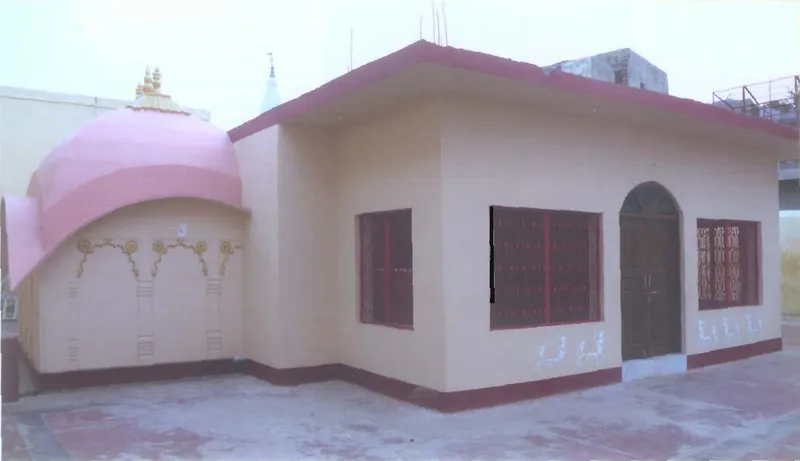
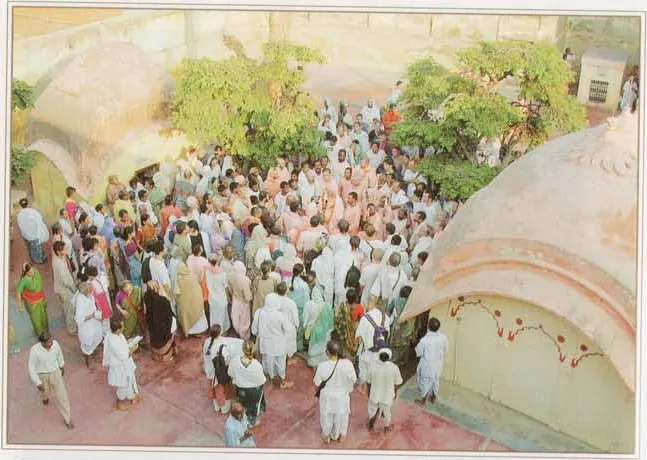
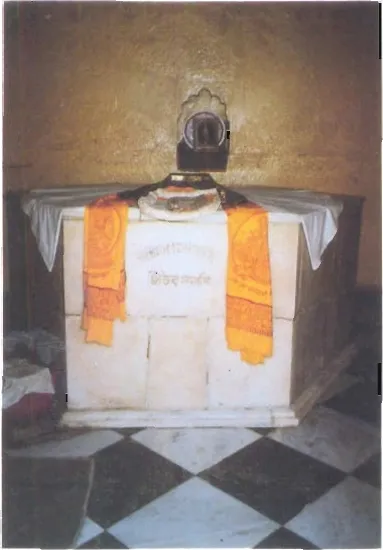
Where the sources differ
Accounts differ The year of Śrīla Rūpa Gosvāmī's passing (entry into samādhi)
- the undated parikramā notes Vṛndāvana; The Color Guide to Vṛndāvana (2000), entry 33 and both chronologies1564
- Vṛndāvana-kathā (1920), citing the Bengali encyclopaedia 'Viśvakoṣa'born A.D. 1489, died A.D. 1563
- Vṛndāvana-kathā (1920), footnote citing Vanamālī Gosvāmī's 'Sevā-prākaṭya' manuscriptborn saṁvat 1550 (A.D. 1493); iṣṭa-lābha saṁvat 1625 (A.D. 1568), aged 75
- A. W. Entwistle (1987), a historian, citing S. K. DeEntwistle gives no exact year: Śrīla Rūpa and Śrīla Sanātana Gosvāmīs passed away within a few years after Akbar came to the throne in 1556.
The wording of these accounts is our summary of the sources, not a published translation.
Accounts differ With whom Śrīla Rūpa Gosvāmī first came to Vṛndāvana
- the undated parikramā notes Vṛndāvana, bhajana-kuṭī entrycame to Vṛndāvana 'with his elder brother, Sanātana Gosvāmī around 1516' on Caitanya's order
- The Color Guide to Vṛndāvana (2000), samādhi entry and chronology'first arrived in Vṛndāvana along with his elder brother Sanātana Gosvāmī in the year 1516'; chronology: '1516 Rūpa and Sanātana come to Vṛndāvana'
- Vṛndāvana, the Playground of God (2010)left home and headed for Vṛndāvana with Anupama, meeting Caitanya at Prayāga on the way
- Śrī Caitanya-caritāmṛta, Madhya 25.211-216Rūpa and Anupama went by the road along the Ganges and Sanātana by the public road, so they did not meet; Sanātana remained in Vṛndāvana and Rūpa and Anupama returned to Vārāṇasī
More on this place
Śrīla Prabhupāda at the Rādhā-Dāmodara temple
References
47 references
- Śrīla Prabhupāda, The Nectar of Devotion, Concluding Words, 30 June 1969 · vedabase.io
- the undated parikramā notes Vṛndāvana, ¶154
- Śrī Vraja-maṇḍala Parikramā (2007), PDF p. 331
- Śrī Vraja-maṇḍala Parikramā (2007), PDF p. 345
- Vṛndāvana-Dhāma Ki Jaya! (c. 1986), by Dhruva Mahārāja dāsa, PDF p. 76
- The Color Guide to Vṛndāvana (2000), Written and Photographed by Rājaśekhara dāsa Brahmacārī, PDF p. 165
- Śrīla Prabhupāda, Śrīmad-Bhāgavatam, 2.2.5, purport · vedabase.io
- Śrīla Prabhupāda, Letter to Nripen Babu, 67-03-18, 18 March 1967 · vedabase.io
- Śrīla Prabhupāda, Letter to Radhavallabha, 75-05-26, 26 May 1975 · vedabase.io
- Śrīla Prabhupāda, Morning Walk, Vṛndāvana, 15 October 1972 · vedabase.io
- Śrīla Prabhupāda, Morning Walk, Vṛndāvana, 15 October 1972 · vedabase.io
- Śrīla Prabhupāda, The Nectar of Devotion, Bombay, 8 January 1973 · vedabase.io
- Śrīla Narahari Cakravartī, Bhakti-ratnākara, Fourth Wave, 1912 ed. p. 139; vv.298–300 in the 1913 numbering, 2nd ed., 1912
- Śrīla Narahari Cakravartī, Bhakti-ratnākara, Sixth Wave, 1912 ed. p. 471; vv.281–283 in the 1913 numbering (Bhakti-ratnākara, taraṅgas 1–8), 2nd ed., 1912
- Śrīla Narahari Cakravartī, Bhakti-ratnākara, Sixth Wave, 1912 ed. pp. 473-474; vv.307–309 in the 1913 numbering (Bhakti-ratnākara, taraṅgas 1–8), 2nd ed., 1912
- Śrīla Narahari Cakravartī, Bhakti-ratnākara, Ninth Wave, 1912 ed. p. 576; vv.197–199 in the 1913 numbering, 2nd ed., 1912
- Śrīla Narahari Cakravartī, Bhakti-ratnākara, Eleventh Wave, 1912 ed. p. 673; vv.251–258 in the 1913 numbering, 2nd ed., 1912
- Śrīla Narahari Cakravartī, Narottama-vilāsa, Second Vilāsa (dvitīya vilāsa), vv.284–286 and 288, 1st ed. (c. 1907) printed p. 17, 1st ed., Baṅgābda 1314
- Śrīla Prabhupāda, Letter to Tejiyas, Gurudasa, letter 72-08-16, 16 August 1972 · vedabase.io
- Śrīla Prabhupāda, Letter to Kirtanananda, 72-10-27, 27 October 1972 · vedabase.io
Show all 47 references
- Śrīla Prabhupāda, Letter to Mukunda, letter 72-11-02, 2 November 1972 · vedabase.io
- Śrīla Prabhupāda, Letter to Puri Maharajji, 72-11-05 (vedabase page code LT_721105_E2), 5 November 1972 · vedabase.io
- Śrīla Prabhupāda, The Nectar of Devotion, Vṛndāvana, 21 October 1972 · vedabase.io
- Śrīla Prabhupāda, The Nectar of Devotion, Vṛndāvana, 6 November 1972 · vedabase.io
- Śrīla Narahari Cakravartī, Bhakti-ratnākara, Fourth Wave, 1912 ed. p. 139; vv.298–300 in the 1913 numbering, 2nd ed., 1912
- Śrīla Prabhupāda, Śrī Caitanya-caritāmṛta, Ādi-līlā 10.84, purport · vedabase.io
- Vṛndāvana, the Playground of God (2010), Bhakti Caitanya Svāmī, PDF p. 61
- The Color Guide to Vṛndāvana (2000), Written and Photographed by Rājaśekhara dāsa Brahmacārī, PDF p. 89
- Vṛndāvana-Dhāma Ki Jaya! (c. 1986), by Dhruva Mahārāja dāsa, PDF p. 75
- Gaura-gaṇoddeśa-dīpikā, v.180
- The Color Guide to Vṛndāvana (2000), Written and Photographed by Rājaśekhara dāsa Brahmacārī, PDF p. 85
- Satsvarūpa dāsa Gosvāmī, Śrīla Prabhupāda-līlāmṛta, vol. 1, ch. 10 · vedabase.io
- Satsvarūpa dāsa Gosvāmī, Śrīla Prabhupāda-līlāmṛta, vol. 2, ch. 37 · vedabase.io
- Vṛndāvana, the Playground of God (2010), Bhakti Caitanya Svāmī, PDF p. 63
- Vṛndāvana-Dhāma Ki Jaya! (c. 1986), by Dhruva Mahārāja dāsa, PDF p. 67
- Śrīla Prabhupāda, Room Conversation, London, 26 July 1976 · vedabase.io
- Vṛndāvana, the Playground of God (2010), Bhakti Caitanya Svāmī, PDF p. 62
- Vṛndāvana, the Playground of God (2010), Bhakti Caitanya Svāmī, PDF p. 64
- Vṛndāvana, the Playground of God (2010), Bhakti Caitanya Svāmī, PDF p. 65
- Satsvarūpa dāsa Gosvāmī, Śrīla Prabhupāda-līlāmṛta, vol. 1, ch. 11 (quoting a flyer printed by Bhaktivedanta Swami), 31 August 1964 (date printed on the flyer) · vedabase.io
- The Color Guide to Vṛndāvana (2000), Written and Photographed by Rājaśekhara dāsa Brahmacārī, PDF p. 77
- the undated parikramā notes Vṛndāvana, ¶138
- Vṛndāvana, the Playground of God (2010), Bhakti Caitanya Svāmī, PDF p. 58
- The Color Guide to Vṛndāvana (2000), Written and Photographed by Rājaśekhara dāsa Brahmacārī, PDF p. 88
- Vṛndāvana, the Playground of God (2010), Bhakti Caitanya Svāmī, PDF p. 59
- Vṛndāvana-kathā, account of Rūpa Gosvāmī, printed p. 50
- The Color Guide to Vṛndāvana (2000), Written and Photographed by Rājaśekhara dāsa Brahmacārī, p. 71