Saṅket, the meeting place of Rādhā and Kṛṣṇa
What the texts say and what the traditions add
In short
Saṅket is a village between Varṣāṇā and Nandagrāma (Nandgaon). Its name, saṅketa, means a signal or an agreed meeting place. The books remember it as the place where Śrī Rādhā and Kṛṣṇa met. The Bhakti-ratnākara says that Their first brief meeting after pūrva-rāga, the attraction that comes before meeting, took place here.[1–6]
On this page
At a glance
- Where: between Varṣāṇā and Nandagrāma, according to the guidebooks. Śrīla Viśvanātha Cakravartī Ṭhākura places it between Nandīśvara and Śrī Vṛṣabhānu's hill.[1–3, 7]
- The name: the books explain it from the signal of the sakhīs (Śrī Rādhā's girl friends) or messengers, or from the constant coming together of Rādhā and Kṛṣṇa there.[1, 4–6]
- Purāṇas (old scriptures): the Padma Purāṇa and the Nārada Purāṇa name Saṅketa among the places of Kṛṣṇa's play, without saying where it is.[8–10]
- Saṅketa-vaṭa: the Garga-saṁhitā tells that Kṛṣṇa entered a banyan (vaṭa) of this name with Rādhā and arranged flowers in Her braid.[11–14]
- The pilgrimage: the Vraja-bhakti-vilāsa names Saṅketa-vaṭa as one of the twelve adhivanas (holy groves) of Vraja, with darśana (respectful viewing) in the month of Bhādra (August–September).[15–20]
- The ācāryas: Śrīla Viśvanātha Cakravartī Ṭhākura calls Saṅketa the very love of the Divine Couple in bodily form.[7]
How the meeting pastimes are told here
Saṅket is remembered for the meetings of Rādhā and Kṛṣṇa. Śrīla Prabhupāda warned that Kṛṣṇa's dealings with Śrī Rādhā are very confidential, not for ordinary people. He said that to present them as ordinary things is distortion.[21] So this article tells simply what the texts say about the place, its name and its history. It leaves out the fuller stories.[21]
The Bhāgavatam's own background for these meetings is its account of the rāsa dance, as Śrīla Prabhupāda tells it in the Kṛṣṇa book. It took place on the cool sandy bank of the Yamunā. Seeing the gopīs' pride, Kṛṣṇa disappeared to curb it and to show them mercy.[22] The gopīs searched for Him. They found the place where He had gathered flowers for Rādhārāṇī and sat with Her to set them in Her hair.[23–25] Read more: Śrī Rādhā's māna at the autumn rāsa and how it was broken →
General teaching (does not name the place)“Kṛṣṇa must have picked some flowers in this spot to satisfy Rādhārāṇī, because here, where He stood erect to get the flowers from the high branches of the tree, we find only half the impression of His feet. Dear friends, just see how Kṛṣṇa must have sat down here with Rādhārāṇī and tried to set flowers in Her hair.”
Śrīla Prabhupāda, Kṛṣṇa, the Supreme Personality of Godhead (Kṛṣṇa book), Chapter 30, 'Kṛṣṇa’s Hiding from the Gopīs' · vedabase.io
The Bhāgavatam names neither that gopī nor the place. Śrīla Prabhupāda names her Rādhārāṇī.[23–25]
What the name Saṅketa means
Saṅketa is an everyday Sanskrit word for a sign or signal. So it also means a meeting place agreed by a signal. Śrīla Prabhupāda translates a verse of the Caitanya-caritāmṛta in which Kṛṣṇa calls Śrī Rādhā to a bower by a signal on His flute.[26] The Padma Purāṇa describes Kṛṣṇa's daily pastimes. In it, saṅketaka is simply the meeting place. Kṛṣṇa goes there at midday with two or three friends. His beloved goes to the forest saying that she will worship the sun or gather flowers. The Purāṇa does not say where it is.[2 +3]
The books that explain the village's name give different reasons. The Bhakti-ratnākara of Śrīla Narahari Cakravartī Ṭhākura says that in this Saṅketa-kuñja (bower) the sakhīs brought Rādhā and Kṛṣṇa together by a signal. It says Their first brief meeting in pūrva-rāga took place here. It quotes the definition of pūrva-rāga from Śrīla Rūpa Gosvāmī's Ujjvala-nīlamaṇi.[1 +4] This is Śrīla Prabhupāda's translation of that definition:
এ সঙ্কেত কুঞ্জে সখী সঙ্কেত করিয়া। রাই কাণু দোঁহারে আনেন যত্ন পাইয়া ॥ অলক্ষিত প্রথম গমন শুভক্ষণে। পূর্ব্বরাগে সঙ্ক্ষেপ মিলন এই খানে ॥ পূর্ব্বরাগে যে কৌতুক কহিল না হয়। পূর্ব্বরাগলক্ষণ শাস্ত্রেতে নিরূপয় ॥ তথাহি উজ্জ্বলনীলমণৌ বিপ্রলম্ভপ্রকরণে ৫ শ্লোকঃ ॥ রতির্যা সঙ্গমাৎ পূর্ব্বং দর্শনশ্রবণাদিজা। তয়োরুন্মীলতি প্রাজ্ঞৈঃ পূর্ব্বরাগঃ স উচ্যতে ॥
e saṅketa kuñje sakhī saṅketa kariẏā| rāi kāṇu dom̐hāre ānena yatna pāiẏā
alakṣita prathama gamana śubhakṣaṇe| pūrbbarāge saṅkṣepa milana ei khāne
pūrbbarāge ye kautuka kahila nā haẏa| pūrbbarāgalakṣaṇa śāstrete nirūpaẏa
tathāhi ujjbalanīlamaṇau bipralambhaprakaraṇe 5 ślokaḥ
ratiryā saṅgamāt pūrbbaṁ darśanaśrabaṇādijā| taẏorunmīlati prājñaiḥ pūrbbarāgaḥ sa ucyate ||
When attachment produced in the lover and beloved before their meeting by seeing, hearing and so on becomes very palatable by the mixture of four ingredients, such as vibhāva and anubhāva, this is called pūrva-rāga.
Translation: Śrīla A.C. Bhaktivedanta Swami PrabhupādaAbout this place: Right after Vihvala-kuṇḍa the Bhakti-ratnākara names the Saṅketa-kuñja: here, by a signal (saṅketa), the sakhīs first brought Rādhā and Kṛṣṇa together at the time of Their first attraction (pūrva-rāga). It then quotes the Ujjvala-nīlamaṇi's definition of pūrva-rāga.
The Bengali Bhaktamāla of Kṛṣṇadāsa Bābājī says the same of the first meeting, with the messengers giving the signal under the banyan.[1, 4–6] The Vraja-bhakti-vilāsa of Śrīla Nārāyaṇa Bhaṭṭa Gosvāmī explains the name in another way. It quotes a verse that it gives from the Kūrma Purāṇa. The place is called Saṅketaka, it says, because Rādhā and Kṛṣṇa always come together there.[20]
Saṅketa in the Purāṇas and the Garga-saṁhitā
The Purāṇas name Saṅketa but tell nothing more of it. The Padma Purāṇa lists Saṅketa among the groves of Vraja and the places of Kṛṣṇa's play. It makes it the secret second petal of the lotus of Gokula, to the south-east.[8, 9] The Nārada Purāṇa names Hari's Saṅketa-sthānaka among the tīrthas (holy places) of Vṛndāvana, without saying where it is.[10]
The Garga-saṁhitā tells a pastime at a place called Saṅketa-vaṭa. It is summarised here, not translated. During a rāsa at Nandīśvara the gopīs became proud, and Kṛṣṇa disappeared with Rādhā. He entered Saṅketa-vaṭa with Her and arranged flowers in Her braid, and She in turn dressed His hair. The book does not say where Saṅketa-vaṭa is.[11–14] The historians record that a great banyan called Saṅket-vaṭ once stood in the village, beside the Saṅket-devī temple. It no longer stands.[32, 33]
The pilgrimage and the ācāryas' Saṅket
The Vraja-bhakti-vilāsa gives Saṅketa a fixed place in the pilgrimage of Vraja. It makes Saṅketa-vaṭaka the twelfth adhivana of Vraja, with Rādhā-ramaṇa as its presiding Deity. It lists Saṅketa-vaṭa first among the banyans of the Yamunā's southern bank. Its marks are a rāsa-maṇḍala (a circle of the rāsa dance) with a swing, and a kuṇḍa (sacred pond) beside it. The book asks for its darśana in the month of Bhādra, with a prayer.[15–20] In his closing instructions, Śrīla Nārāyaṇa Bhaṭṭa Gosvāmī asks that the daily worship of his book be done sitting facing north and facing Saṅketa.[34]
Śrīla Viśvanātha Cakravartī Ṭhākura gives the place a verse of its own in his Vraja-rīti-cintāmaṇi. This is summarised here, not translated. Between Nandīśvara and Śrī Vṛṣabhānu's hill is the place named Saṅketa. It is the object of his deepest meditation, and he takes it to be the very love of the Divine Couple in bodily form.[7] The Sādhana-dīpikā of Śrī Rādhākṛṣṇa Gosvāmī of the Govinda temple describes a meditation. In it Śrī Rādhā is seated in the shade of Saṅketa-vaṭa. The book asks for the worship of Saṅketa together with Vṛṣabhānupura and Nandīśvara.[35–39]
The Bhakti-ratnākara adds the path. Saṅketa, it says, is the place of countless pastimes, with a Kṛṣṇa-kuṇḍa. The people of Nandīśvara and Varṣāṇā come and go by this path. Śrī Rādhikā goes this way from Her father's house to Jāvaṭa.[1, 30]
A later tradition connects Saṅket with Śrīla Viśvanātha Cakravartī Ṭhākura himself. The Vṛndāvana-kathā (1920) tells that he once answered an argument about the nature of Śrī Rādhā's relationship with Kṛṣṇa. He did it by pointing to this village between Nandīśvara and Varṣāṇā. It is a story told about him, not his own words.[40–42]
Śrīla Lokanātha Gosvāmī and Śrīla Bhūgarbha Gosvāmī at Saṅket
The Prema-vilāsa brings two of Śrī Caitanya's companions to Saṅket. Śrī Caitanya Mahāprabhu sent Śrīla Lokanātha Gosvāmī to Vraja. He named the quiet kuñjas at Saṅketa among the places of the pastimes where Lokanātha should live. Later, the book says, Śrīla Lokanātha Gosvāmī came with Śrīla Bhūgarbha Gosvāmī to the Saṅketa-kuñja. There the two lost outer awareness, crying the name of Rādhā, and stayed that whole day.[43–45] Read more: How Śrīla Lokanātha Gosvāmī came to Vraja and stayed there → Scholars debate who wrote the later chapters of the Prema-vilāsa, so this is told only as that book's account.[43–45]
গিরিকুণ্ড গোবর্দ্ধন জাবট বর্ষাণ। সঙ্কেতে নিভৃত কুঞ্জ যত লীলা-স্থান ॥ বাস কর সেই স্থানে সুখ পাবা মনে। মোর মায়া ছাড়ি পথে করহ গমনে ॥
girikuṇḍa gobarddhana jābaṭa barṣāṇa| saṅkete nibhṛta kuñja yata līlā-sthāna
bāsa kara sei sthāne sukha pābā mane| mora māẏā chāṛi pathe karaha gamane ||
Two other Gosvāmīs are remembered in the village. The guidebooks show the bhajana-kuṭī (prayer hut) of Śrīla Gopāla Bhaṭṭa Gosvāmī at Saṅket, east of the rāsa-maṇḍala. The historians Mītal (1966) and Entwistle (1987) record a sitting place of Gopāl Bhaṭṭ there. That he did his bhajana (worship) here is the books' tradition.[29 +3] The 2007 guidebook Śrī Vraja-maṇḍala Parikramā says that Śrī Caitanya Mahāprabhu Himself rested at Saṅket on His tour of the forests. The Caitanya-caritāmṛta does not name the village, and no older source says so.[47, 48]
What the guidebooks and historians describe at Saṅket
The 2007 guidebook lists these sites at Saṅket:[47]
- the temple of Saṅket-bihārī;[47]
- a rāsa-maṇḍala and the place of a swing;[47]
- Śrīla Gopāla Bhaṭṭa Gosvāmī's bhajana-kuṭī and the temple of Saṅket-devī;[47]
- Vihvala-kuṇḍa, and a Kṛṣṇa-kuṇḍa west of the village with a sitting place of Śrī Vallabhācārya.[47]
Growse (1883) and Mītal (1966) describe what happens when the Braj pilgrimage halts at Saṅket. According to them, Kṛṣṇa's wedding is performed as a scene of the rāsa-līlā drama. It is a play of remembrance, not a claim that a wedding took place here. In Mītal's account, Saṅket is the eleventh halt of the pilgrimage, on the sixth day of the bright half of Āśvina (a month around September–October).[32, 49] From Saṅket, Mītal says, the pilgrimage goes on by way of Rīṭhaurā to Nandagrāma.[32, 47]
Where the sources differ
The books explain the name in different ways. The 2007 guidebook says it comes from the signal of messengers. The Bhakti-ratnākara says the sakhīs' signal, and the Bengali Bhaktamāla the messengers' signal under the banyan. The Vraja-bhakti-vilāsa explains it from the constant meeting of the Couple. In the Padma Purāṇa, saṅketaka is simply the meeting place.[1 +5]
Accounts differ Why the place is called Saṅket (Saṅketa).
- Śrī Vraja-maṇḍala Parikramā (2007)Vṛndā-devī, Vīrā-devī and Subala Sakhā, as messengers, arranged the Couple's meetings 'through signals (saṅket)'.
- Bhakti-ratnākara, Fifth Wave v.923–924In this Saṅketa-kuñja the sakhīs, making a signal (saṅketa), bring Rāi and Kānu; here was Their brief first meeting in pūrva-rāga (no messengers are named).
- the Bengali Bhaktamāla of Kṛṣṇadāsa Bābājī (1905)At the first meeting the dūtīs made the signal under the vaṭa; at the end of dusk Kṛṣṇa came and the dūtīs brought Kiśorī.
- Vraja-bhakti-vilāsa, ch. 5 v.29, citing the 'Kaurma'The place is called Saṅketaka because the meeting of Rādhā and Kṛṣṇa always takes place there, from the joining of (Their) comings.
The wording of these accounts is our summary of the sources, not a published translation.
They also set the rāsa from which Kṛṣṇa went away with Rādhā in different places and seasons. The Bhāgavatam has it on the Yamunā's bank in autumn. The Garga-saṁhitā has a spring rāsa at Nandīśvara, and the Caitanya-caritāmṛta has springtime near Govardhana. These may be different occasions, and they are given side by side.[11 +5]
Accounts differ Where and when the rāsa took place from which Kṛṣṇa disappeared with Rādhā (one gopī), before He adorned Her.
- Śrīmad-Bhāgavatam 10.29.1, 10.29.45, 10.29.48, 10.30.28On autumn nights, on the cool sandy bank of the Yamunā; there Kṛṣṇa disappeared and took one gopī, not named, to a secluded place.
- Śrīla Prabhupāda, Kṛṣṇa book ch. 30The same pastime; the gopī is Rādhārāṇī; no other place is named.
- Śrīla Prabhupāda, Kṛṣṇa book ch. 29Kṛṣṇa and the gopīs reached the cool, sandy bank of the Yamunā; seeing the gopīs' pride, Kṛṣṇa disappeared.
- Garga-saṁhitā 2.20.40–41, 2.21.9–10 and 2.21.18In its Vaiśākha (spring) rāsa series, a rāsa on the 'great slope/peak' of Nandīśvara; there Kṛṣṇa disappeared with Rādhā and entered Saṅketa-vaṭa with Her.
Where Kṛṣṇa adorned His beloved with flowers is remembered at several places. The Garga-saṁhitā says Saṅketa-vaṭa. A Bhāgavatam commentary and the Bhakti-ratnākara say Śṛṅgāra-vaṭa, and a guidebook says Kadamba-khaṇḍī. The Bhāgavatam names no place.[5 +5]
Accounts differ Where Kṛṣṇa gathered flowers and adorned His beloved (Rādhā), and with which flowers.
- Śrīmad-Bhāgavatam 10.30.32–33On the path from the rāsa, at spots the gopīs point to ('here'); the gopī and the flowers are not named.
- Śrīla Prabhupāda, Kṛṣṇa book ch. 30Kṛṣṇa picked flowers to satisfy Rādhārāṇī and set them in Her hair; no place is named.
- Śrīla Viśvanātha Cakravartī, Sārārtha-darśinī on ŚB 10.30.32The flowers came from an aśoka tree that blossomed at once at the touch of her foot.
- Vaṁśīdhara, Bhāvārtha-dīpikā-prakāśa on ŚB 10.30.33That place is now known as Śṛṅgāra-vaṭa.
The wording of these accounts is our summary of the sources, not a published translation.
The sources also differ on the goddess of the village. She is Śrī Vīrā-devī in the 2007 guidebook and Paurṇamāsī in another guidebook. In the Vraja-bhakti-vilāsa she is Saṅketeśvarī Ambikā, protector of Saṅketa.[3 +4]
The historians differ on the buildings. Growse (1883) calls the main temple Rādhā-Raman and says that Rūp Rām Kaṭārā of Varṣāṇā rebuilt it. Mītal (1966) calls it Rādhā-bihārī. Entwistle (1987) reports a Rādhā-ramaṇa temple founded by Śrīla Nārāyaṇa Bhaṭṭa Gosvāmī. All three record a Bihārī temple in a walled garden built by a Rājā of Burdwan.[32 +3]
Places in this article
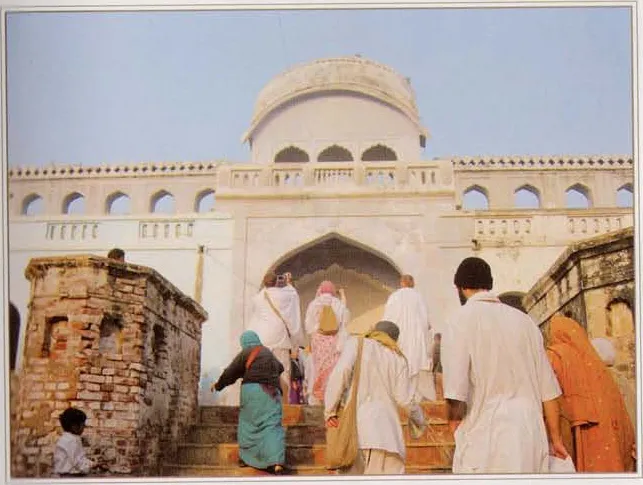
Saṅket
संकेतSaṅket is the village between Nandagrāma, Kṛṣṇa's home, and Varṣāṇā, the home of Śrī Rādhā.
Saṅketvaṭa
संकेतवटGopāla Bhaṭṭa Gosvāmī's bhajana-kuṭī (Saṅket)
गोपाल भट्ट गोस्वामी की भजन-कुटी (संकेत)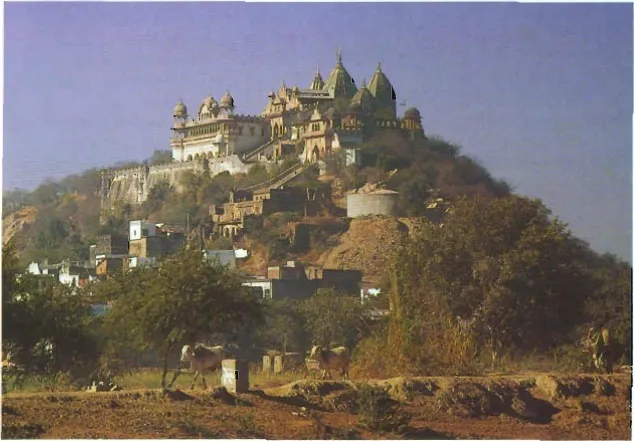
Varṣāṇā
बरसानाVarṣāṇā is the town of Vṛṣabhānu, Śrī Rādhā's father, on and around the hill of Brahma-parvata.
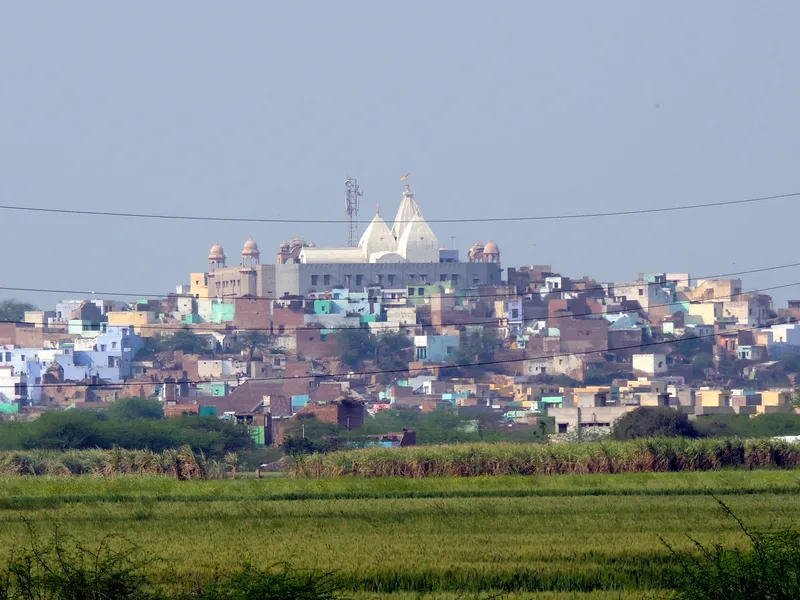
Nandagrāma
नन्दग्रामNandagrāma, today Nandagaon, is the village of Nanda Mahārāja, Kṛṣṇa's father in Vraja, on and around Nandīśvara Hill.
Questions and answers
Saṅketa means a signal, and so an agreed meeting place. The Bhakti-ratnākara says the sakhīs brought Rādhā and Kṛṣṇa together here by a signal. The Vraja-bhakti-vilāsa explains the name from Their constant meeting there.[1 +4]
It lies between Varṣāṇā and Nandagrāma, according to the guidebooks. Śrīla Viśvanātha Cakravartī Ṭhākura places it between Nandīśvara and Śrī Vṛṣabhānu's hill.[1–3, 7]
According to the Bhakti-ratnākara and the Bengali Bhaktamāla, the first meeting of Rādhā and Kṛṣṇa after pūrva-rāga took place here. It was arranged by a signal.[1, 4–6]
It is a banyan where, according to the Garga-saṁhitā, Kṛṣṇa arranged flowers in Rādhā's braid. The Vraja-bhakti-vilāsa makes it one of the twelve adhivanas of Vraja. A banyan of that name once stood in the village.[11 +11]
The Bhakti-ratnākara says the sakhīs, and the Bengali Bhaktamāla says the messengers. The 2007 guidebook names Vṛndā-devī, Vīrā-devī and Subala. The Govinda-līlāmṛta shows Vṛndā-devī arranging the Couple's meetings.[1 +6]
According to the Prema-vilāsa, Śrī Caitanya Mahāprabhu told him to live at places such as the quiet kuñjas of Saṅketa. Later he came there with Śrīla Bhūgarbha Gosvāmī, and both lost outer awareness, crying the name of Rādhā.[43–45]
Sources
- Śrī Vraja-maṇḍala Parikramā (2007), PDF p. 183
- Vṛndāvana-Dhāma Ki Jaya! (c. 1986), by Dhruva Mahārāja dāsa, PDF p. 50
- The Color Guide to Vṛndāvana (2000), Written and Photographed by Rājaśekhara dāsa Brahmacārī, PDF p. 75
- Śrīla Narahari Cakravartī, Bhakti-ratnākara, Fifth Wave, 1912 ed. p. 220; Grantha Mandira text v.923–926, 2nd ed., 1912
- Śrī Śrī Bhaktamāla grantha, printed p. 324, right column
- Śrīla Prabhupāda, Śrī Caitanya-caritāmṛta, Madhya-līlā 23.63, purport · vedabase.io
- Śrīla Viśvanātha Cakravartī Ṭhākura, Vraja-rīti-cintāmaṇi, sarga 1 v.82
- Padma Purāṇa, Pātāla-khaṇḍa (5) 69.21, Sanskrit Wikisource
- Padma Purāṇa, Pātāla-khaṇḍa (5) 69.27, Sanskrit Wikisource
- Nārada Purāṇa, Uttara-bhāga 80.74
- Garga-saṁhitā, Vṛndāvana-khaṇḍa (2) 21.10, first half, Sanskrit Wikisource
- Garga-saṁhitā, Vṛndāvana-khaṇḍa (2) 21.10, second half, Sanskrit Wikisource
- Garga-saṁhitā, Vṛndāvana-khaṇḍa (2) 21.18 (English edition: Canto 2, Chapter 21, Verse 2.21.18), online edition
- Garga-saṁhitā, Vṛndāvana-khaṇḍa (2) 21.19 (English edition: Canto 2, Chapter 21, Verse 2.21.19), online edition
- Śrīla Nārāyaṇa Bhaṭṭa, Vraja-bhakti-vilāsa, the twelve adhivanas, v.32, printed p. 3, 1st ed., publ. Bābā Kṛṣṇadāsa, Kusuma-sarovara, Saṁvat 2008
- Śrīla Nārāyaṇa Bhaṭṭa, Vraja-bhakti-vilāsa, list of the presiding deities of the twelve adhivanas, item 12, printed p. 6, 1st ed., publ. Bābā Kṛṣṇadāsa, Kusuma-sarovara, Saṁvat 2008
- Śrīla Nārāyaṇa Bhaṭṭa, Vraja-bhakti-vilāsa, ch. 2 v.20, printed p. 36, 1st ed., publ. Bābā Kṛṣṇadāsa, Kusuma-sarovara, Saṁvat 2008
- Śrīla Nārāyaṇa Bhaṭṭa, Vraja-bhakti-vilāsa, ch. 2 v.21, printed p. 36, 1st ed., publ. Bābā Kṛṣṇadāsa, Kusuma-sarovara, Saṁvat 2008
- Śrīla Nārāyaṇa Bhaṭṭa, Vraja-bhakti-vilāsa, ch. 2 v.56 (opening), printed p. 53, 1st ed., publ. Bābā Kṛṣṇadāsa, Kusuma-sarovara, Saṁvat 2008
- Śrīla Nārāyaṇa Bhaṭṭa, Vraja-bhakti-vilāsa, ch. 5 v.29 (Grantha Mandira (5) v.29), printed p. 121, 1st ed., publ. Bābā Kṛṣṇadāsa, Kusuma-sarovara, Saṁvat 2008
Show all 64 references
- Śrīla Prabhupāda, Room Conversation with Film Producer about Kṛṣṇa Lila, Bhubaneswar, 22 January 1977 · vedabase.io
- Śrīla Prabhupāda, Kṛṣṇa, the Supreme Personality of Godhead (Kṛṣṇa book), chapter 29, 'The Rāsa Dance: Introduction' · vedabase.io
- Śrīmad-Bhāgavatam 10.30.32, GRETIL
- Śrīmad-Bhāgavatam 10.30.33, GRETIL
- Śrīla Prabhupāda, Kṛṣṇa, the Supreme Personality of Godhead (Kṛṣṇa book), Chapter 30, 'Kṛṣṇa’s Hiding from the Gopīs' · vedabase.io
- Śrīla Prabhupāda, Śrī Caitanya-caritāmṛta, Antya-līlā 17.24, translation · vedabase.io
- Padma Purāṇa, Pātāla-khaṇḍa (5) 83.45–47, Sanskrit Wikisource
- Padma Purāṇa, Pātāla-khaṇḍa (5) 83.101b–102, Sanskrit Wikisource
- Vṛndāvana-Dhāma Ki Jaya! (c. 1986), by Dhruva Mahārāja dāsa, PDF p. 51
- Śrīla Narahari Cakravartī, Bhakti-ratnākara, Fifth Wave, 1912 ed. pp. 220–221; Grantha Mandira text v.927–929, 2nd ed., 1912
- Śrīla Narahari Cakravartī, Bhakti-ratnākara, Fifth Wave, 1912 ed. p. 220; Grantha Mandira text v.923–926, 2nd ed., 1912
- Prabhudayāl Mītal, printed p. 122
- A. W. Entwistle, printed p. 376, Egbert Forsten, Groningen, 1987
- Śrīla Nārāyaṇa Bhaṭṭa, Vraja-bhakti-vilāsa, ch. 13 v.22 (opening; Grantha Mandira (13) v.22), printed p. 263, 1st ed., publ. Bābā Kṛṣṇadāsa, Kusuma-sarovara, Saṁvat 2008
- Śrīla Rādhākṛṣṇa Gosvāmī, Sādhana-dīpikā, (4) part 4 v.8
- Śrīla Rādhākṛṣṇa Gosvāmī, Sādhana-dīpikā, (4) part 5 v.6
- Śrīla Rādhākṛṣṇa Gosvāmī, Sādhana-dīpikā, (4) part 6 v.15
- Śrīla Rādhākṛṣṇa Gosvāmī, Sādhana-dīpikā, (4) part 6 v.26
- Śrīla Rādhākṛṣṇa Gosvāmī, Sādhana-dīpikā, (4) part 10 v.4
- Pulinbihārī Datta, printed p. 102
- The Color Guide to Vṛndāvana (2000), Written and Photographed by Rājaśekhara dāsa Brahmacārī, PDF p. 116
- The Color Guide to Vṛndāvana (2000), Written and Photographed by Rājaśekhara dāsa Brahmacārī, PDF p. 115
- Prema-vilāsa, Seventh Vilāsa (সপ্তম বিলাস), printed p. 45, left column, Kolkata, 1913
- Prema-vilāsa, Seventh Vilāsa, printed p. 47, left column, Kolkata, 1913
- Prema-vilāsa, Sixteenth Vilāsa, printed p. 126, right column, Kolkata, 1913
- Prema-vilāsa, Seventh Vilāsa (সপ্তম বিলাস), printed p. 45, left column, Kolkata, 1913
- Śrī Vraja-maṇḍala Parikramā (2007), PDF p. 185
- Śrīla Prabhupāda, Śrī Caitanya-caritāmṛta, Madhya-līlā 18.57, translation · vedabase.io
- Mathurá (1883), F. S. Growse, B.C.S., M.A. Oxon., C.I.E. (as the title page gives him, p. 76
- Garga-saṁhitā, Vṛndāvana-khaṇḍa (2) 20.40–41, Sanskrit Wikisource
- Śrīmad-Bhāgavatam 10.29.1, GRETIL
- Śrīmad-Bhāgavatam 10.29.45, GRETIL
- Śrīmad-Bhāgavatam 10.29.48, GRETIL
- Śrīmad-Bhāgavatam 10.30.28, GRETIL
- Vṛndāvana-Dhāma Ki Jaya! (c. 1986), by Dhruva Mahārāja dāsa, PDF p. 47
- Vaṁśīdhara: commentary on ŚB 10.30.33
- Śrīla Narahari Cakravartī, Bhakti-ratnākara, Fifth Wave, 1912 ed. p. 256; Grantha Mandira text v.1412, 2nd ed., 1912
- Śrīmad-Bhāgavatam 10.30 with Śrīla Viśvanātha Cakravartī's Sārārtha-darśinī: commentary on ŚB 10.30.32 (vedabase numbering; Grantha Mandira 10.30.33)
- Śrī Vraja-maṇḍala Parikramā (2007), PDF p. 184
- Śrīla Nārāyaṇa Bhaṭṭa, Vraja-bhakti-vilāsa, ch. 10 vv.41 (end)–44, printed p. 220, 1st ed., publ. Bābā Kṛṣṇadāsa, Kusuma-sarovara, Saṁvat 2008
- Śrīla Nārāyaṇa Bhaṭṭa, Vraja-bhakti-vilāsa, ch. 2 v.54 (Grantha Mandira (2) part 13 v.54), printed p. 51, 1st ed., publ. Bābā Kṛṣṇadāsa, Kusuma-sarovara, Saṁvat 2008
- A. W. Entwistle, printed p. 167, Egbert Forsten, Groningen, 1987
- Śrīla Kṛṣṇadāsa Kavirāja Gosvāmī, Govinda-līlāmṛta, sarga 20 v.5, after the editions of Haridas Das and Haridas Shastri
- Śrī Vraja-maṇḍala Parikramā (2007), PDF p. 201
Further sources
- Śrīla Prabhupāda, Kṛṣṇa, chapters 29–30; Śrī Caitanya-caritāmṛta, Madhya-līlā 23.63 and Antya-līlā 17.24 (translation and purports by Śrīla Prabhupāda, BBT).
- Padma Purāṇa, Pātāla-khaṇḍa 69 and 83; Nārada Purāṇa; Garga-saṁhitā, Vṛndāvana-khaṇḍa 21: summarised from the Sanskrit unless a published translation is shown.
- Bhakti-ratnākara, Vraja-bhakti-vilāsa, Vraja-rīti-cintāmaṇi, Sādhana-dīpikā, Prema-vilāsa, Bengali Bhaktamāla, Vṛndāvana-kathā (1920): summarised here, not translated.