The Śrījī (Lāḍilījī) temple of Varṣāṇā
Its hill, its Deity and its buildings
In short
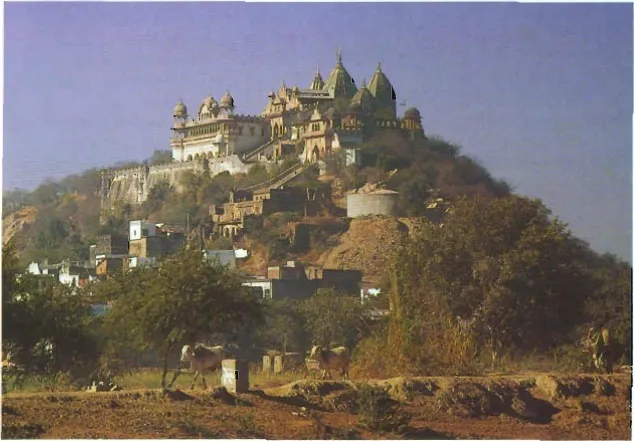
The Śrījī or Lāḍilījī temple is the temple of Śrī Rādhā on Brahma-parvata, the hill of Varṣāṇā (Barsana). The guidebooks and the historian A. W. Entwistle say Śrīla Nārāyaṇa Bhaṭṭa Gosvāmī founded it. Historians date the old building to about 1618–19 and the present one to the 1950s. Śrīla Prabhupāda was carried up to it in 1971.[1–10]
On this page
At a glance
- The temple stands on the hill that the Vraja-bhakti-vilāsa calls Brahma-parvata, the hill of Brahmā.[11–14]
- That book names temples of Rādhā-Kṛṣṇa and of Rādhā on the hilltop, but not the Śrījī temple.[11–14]
- The sources tell in five ways where the Deity (the sacred form of Śrī Rādhā worshipped there) came from, and none of them is backed by a document.[1–4, 15]
- Mītal (1966): Rājā Vīrasiṁha Deva of Orchhā founded the old temple in Saṁvat 1675 of the Indian calendar (about AD 1618–19).[5]
- Entwistle (1987): the present temple, built by Seṭh Hargulāl, was completed in the early 1950s.[5–8]
- On 28 November 1971, Śrīla Prabhupāda's disciples carried him by palanquin up the steps to the temple.[9, 10]
The hill of Brahmā
The temple's hill has a story of its own. It is told in the pilgrimage book of Śrīla Nārāyaṇa Bhaṭṭa Gosvāmī, the Vraja-bhakti-vilāsa. Citing the Padma Purāṇa, an old scripture, the book describes Vṛṣabhānupura as two hills facing each other, named Brahma and Viṣṇu. Sāṅkarī-khor, a narrow pass, runs between them. It is not certain that the passage is in the Padma Purāṇa.[11 +5]
According to the same book, as its Hindi edition gives the verse, Brahmā made a request of Hari (Kṛṣṇa) at the end of the Kṛta-yuga, the first age. He asked Hari to perform the rāsa, His circle dance with the gopīs (cowherd girls) of Vraja, upon him. Hari told him to become a hill at Vṛṣabhānupura, from which he would see His pastimes. The verses are cited from the Varāha and the Padma Purāṇas, but it is not certain that they are in either.[13 +3] The guidebooks repeat the story. Two of them add that the hill's four peaks are Brahmā's four heads.[3 +2]
Śrīmad-Bhāgavatam does not tell that Brahmā became a hill. It tells of his prayer for any birth in the forest of Gokula, so that the dust of the devotees' feet might touch him. Śrīla Prabhupāda gives this prayer in the Kṛṣṇa book:[24–26]
Names this place“I am most humbly praying at Your lotus feet for You to please give me any sort of birth within this Vṛndāvana forest so that I may be able to be favored by the dust of the feet of some of the devotees of Vṛndāvana.”
Śrīla Prabhupāda, Kṛṣṇa, the Supreme Personality of Godhead (Kṛṣṇa book), Chapter 14, 'Prayers Offered by Lord Brahmā to Lord Kṛṣṇa' · vedabase.io
The hilltop in the Vraja-bhakti-vilāsa
Śrīla Nārāyaṇa Bhaṭṭa Gosvāmī places two temples on top of Brahma-parvata. One is a temple of Śrī Rādhā-Kṛṣṇa, where one has Their darśana (sight of the Deities). The other is a temple of Rādhā, with a circle for dance in front of it. He gives a prayer for the darśana of Rādhā-Kṛṣṇa at Vṛṣabhānupura, and a meditation on Kṛṣṇa with Rādhā standing on Brahma-parvata. But he never names the Śrījī temple.[11–14]
ततो राधाकृष्णदर्शनप्रार्थनमन्त्रः— नमः प्रियायै राधायै ब्रह्मणो वरदायिने । सर्वेष्टफलरम्याय राधाकृष्णाय मूर्तये ॥ इति मन्त्रमुदाहृत्य सप्तभिः प्रणमेप्रियाम् । वाञ्छितं फलमाप्नोति विचरन् ब्रजमण्डले ॥ मुक्तिभागीभवेल्लोको नित्यदर्शनकारकः ॥ ५१ ॥
tato rādhākṛṣṇadarśanaprārthanamantraḥ— namaḥ priyāyai rādhāyai brahmaṇo varadāyine
sarveṣṭaphalaramyāya rādhākṛṣṇāya mūrtaye
iti mantramudāhṛtya saptabhiḥ praṇamepriyām
vāñchitaṁ phalamāpnoti vicaran brajamaṇḍale
muktibhāgībhavelloko nityadarśanakārakaḥ || 51 ||
In another chapter he says that Rādhā made Her own mandira (temple-house) for pastimes on the hill named Brahma.[17] He counts Vṛṣabhānupura as the sixth of the twelve adhivanas, the smaller forests of Vraja, with Rādhā-Kṛṣṇa as its presiding Deity.[14, 19]
His forest pilgrimage reaches Vṛṣabhānupura on its third day. The pilgrims walk around the hill, stay a night and worship the goddess Gaurī. A prayer offers obeisances to Kīrtidā, Rādhā's mother.[16 +2] The book does not say whether either of his hilltop temples stood where the Śrījī temple stands today.[11–14]
Vṛṣabhānupura in the older Vaiṣṇava books
The Bhakti-ratnākara of Śrīla Narahari Cakravartī Ṭhākura is the oldest known text that gives the town both names. This Vṛṣabhānupura, it says, is called Varṣāṇa, and Vṛṣabhānu's home is near the hill.[29] The book remembers the hill for Kṛṣṇa's pastimes with Śrī Rādhikā, such as the toll pastime, and for Her childhood play with Her friends. This article only names those pastimes.[29, 30]
Śrīla Viśvanātha Cakravartī Ṭhākura's Vraja-rīti-cintāmaṇi places Vṛṣabhānu's home on a hill named after him, south of Nandīśvara. Saṅketa lies between the two hills.[31, 32] Read more: Saṅket, the meeting place of Rādhā and Kṛṣṇa →
Visitors of the Gauḍīya tradition came here too. The Bhakti-ratnākara and the Narottama-vilāsa record their visits: Śrīla Śrīnivāsa Ācārya and Śrīla Narottama dāsa Ṭhākura, Śrī Vīracandra Prabhu, and Śrī Jāhnavā Mātā.[29 +5] At Vṛṣabhānupura, the Bhakti-ratnākara says, Śrī Vīracandra Prabhu was shown King Vṛṣabhānu's home. He was told of Śrī Rādhā's birthday festival there, to which Nanda's family came.[34 +2] According to the Prema-vilāsa, Śrīla Lokanātha Gosvāmī and Śrīla Bhūgarbha Gosvāmī saw the places on the hill. They bathed in its lake, walked round it and stayed in the village.[38]
Śrīla Murāri Gupta wrote a life of Śrī Caitanya. In it, the Lord's guide Kṛṣṇadāsa points out Vṛṣabhānu-pura to Him as the place where Rādhā, the queen of Vṛndāvana, appeared. The verse is summarised here, not translated.[39]
Śrīla Bhaktivinoda Ṭhākura's song Dekhite dekhite gives the town a place in the devotee's own hope (summarised here, not translated). He prays to take birth in Vṛṣabhānupura as a girl of Vraja, so that the gopīs' mood becomes his own nature.[40]
Vṛṣabhānu's palace and the temple
The sources do not agree on where Vṛṣabhānu's home stood. The Vraja-bhakti-vilāsa puts Vṛṣabhānu's mandira, with Vṛṣabhānu, Kīrtidā and Śrīdāmā, in the lower part of the hill, below the hilltop temple.[11] The undated parikramā notes Varṣāṇā say that the Śrījī temple itself is built on the site of the palace where Rādhārāṇī used to live.[2]
On the hill in 1971, Śrīla Prabhupāda called the place Rādhārāṇī's father's place. He remarked that royal palaces were made on the hills. He did not say where the home stood.[10] In 1987 Entwistle recorded a temple of Vṛṣabhānu at the foot of the hill, with images of Rādhā, Her parents and Śrīdāmā.[41] The positions are set out on the page Palace of Mahārāja Vṛṣabhānu.
Accounts differ Where Vṛṣabhānu's palace (home) at Varṣāṇā was: near the hill, below the hilltop temple, or on the hilltop where the Śrījī temple stands.
- Bhakti-ratnākara, Fifth Wave, p. 218Vṛṣabhānu's home (ālaya) is near the hill (parvata-samīpe).
- Bhakti-ratnākara, Fifth Wave, p. 285 (at Rāval)At the village of Rāval, a matchless residence (vasati) of Vṛṣabhānu, where Śrī Rādhikā appeared (a second home of Vṛṣabhānu, not at Varṣāṇā).
- Vraja-bhakti-vilāsa ch. 2 v.47 (citing the Padma)On top of Brahma-parvata a temple of Śrī Rādhā-Kṛṣṇa, and in the lower part below it (tad-adho-bhāge) the mandira of Vṛṣabhānu, with darśana of Vṛṣabhānu, Kīrtidā and Śrīdāmā.
- Vraja-bhakti-vilāsa ch. 4 v.54 (with the edition's Hindi)On top of the hill named Brahma, Rādhā made Her own mandira (the Hindi: 'महल', palace) for pastimes.
The wording of these accounts is our summary of the sources, not a published translation.
Where did the Deity come from?
The temple's own Deity, Lāḍilījī (the beloved daughter), has several stories of origin. Each is given here with its source. According to the guidebook Śrī Vraja-maṇḍala Parikramā (2007), the present Deity appeared through Śrīla Nārāyaṇa Bhaṭṭa Gosvāmī's special prayers in 1570. The day was the second of the bright fortnight of Āṣāḍha (June–July). The book calls this well known but names no source, so the date is not certain.[42, 43]
The introduction to the Hindi edition of the Vraja-bhakti-vilāsa has a chronology of his life. It puts the appearance of Śrījī on the same lunar day, in a Saṁvat year of the 1620s whose last digit cannot be read. So it is not certain that the two agree. It does not say how the Deity appeared.[42, 43]
The historian Prabhudayāl Mītal (1966) gives another account. He writes that the old image of Śrī Rādhā was brought here from Rāval after a Yamunā flood in the seventeenth century damaged the temple there. He names no document.[15] Two guidebooks give still other accounts. One says that Śrīla Nārāyaṇa Bhaṭṭa Gosvāmī discovered the Deities. The other says that King Vajranābha installed the Deity, and Śrīla Nārāyaṇa Bhaṭṭa Gosvāmī later worshipped this Deity.[1–4]
Accounts differ Where the Deity of the Śrījī (Lāḍilī) temple came from.
- Śrī Vraja-maṇḍala Parikramā (2007)'It is well known' that the present Deity manifested through Śrīla Nārāyaṇa Bhaṭṭa's special prayers, on Āṣāḍha śukla dvitīyā in 1570.
- the undated parikramā notes VarṣāṇāŚrīla Nārāyaṇa Bhaṭṭa discovered the Deities Larily and Lala at Varsana and built the original temple with Rājā Ṭoḍaramal's help.
- Vṛndāvana-Dhāma Ki Jaya! (c. 1986), pp. 47–48The Deity was installed by Vajranābha; thousands of years later Śrīla Nārāyaṇa Bhaṭṭa worshipped this Deity and established the Larily Lāl temple.
- Hindi edition of the Vraja-bhakti-vilāsa, introduction, p. (5) (based, it says, on the Nārāyaṇa-bhaṭṭa-caritāmṛta)In its chronology of Śrīla Nārāyaṇa Bhaṭṭa's life: the manifestation (prākaṭya) of Śrījī from Āṣāḍha śukla dvitīyā of Saṁvat 162x; the manner is not stated.
Śrīla Nārāyaṇa Bhaṭṭa Gosvāmī and the temple's servants
Every account of the temple names Śrīla Nārāyaṇa Bhaṭṭa Gosvāmī, though his own book is silent about it. His Vraja-bhakti-vilāsa describes Vṛṣabhānupura at length. It tells of the two hills and the story of Brahmā's hill. It gives the prayers on seeing the town, and its place among the adhivanas and in the forest pilgrimage.[11 +5]
The introduction to the book's Hindi edition gives him two more credits. He first showed the yearly Holī of Barsānā and Nandagrāma, it says, and he made known the tīrthas (holy places) of Barsānā, from Bhānukhora to Sāṅkarī-khor. This rests on the modern introduction alone, so it is not certain.[44]
The service of the Deity is also told in two ways. The Hindi introduction and Entwistle (1987) say that the Gosvāmīs who serve Lāḍilījī descend from Nārāyaṇadāsa Śrotrī. He was Śrīla Nārāyaṇa Bhaṭṭa Gosvāmī's disciple, and the introduction calls him Śrījī's sevaka (servant). Śrī Vraja-maṇḍala Parikramā says instead that the priests take initiation from Śrīla Nārāyaṇa Bhaṭṭa Gosvāmī's descendants. None of them cites a document.[7 +2]
The buildings: what the historians record
No inscription or dated document for the temple is known. So the building history rests on three historians, named and summarised here. Mītal (1966) writes that no record tells when the oldest Lāḍilī temple was built. He says that Rājā Vīrasiṁha Deva of Orchhā laid the foundation of the building known in his day as the old temple. That was on the fifth day of the bright half of Māgha (January–February), Saṁvat 1675, and it was finished about Saṁvat 1680.[5]
In 1883 Growse saw a series of temples to Lāḍilījī on the summit. They had been built within the previous two hundred years, each grander than the last. He named Rūp Rām as the founder of one of them and of the stone staircase.[46] Entwistle (1987) says that Varṣāṇā was a hamlet of Ūñcāgaon until the mid-eighteenth century. Then it flourished under Rūp Rām Kaṭārā, who built a new Lāḍilījī temple on the hill, since replaced.[6, 47]
Mītal calls Rūprām Kaṭārā the purohita, or family priest, of the Jāṭ ruler Sūrajmal. He credits him with temples, gardens and chhatrīs (domed pavilions) at Barsānā, and with the steps of the old Lāḍilī temple.[48]
The town's fortunes changed with the wars of the time. According to Entwistle, Najaf Khan plundered Varṣāṇā after he routed the Jāṭs there in 1774. In 1812 its zamindārs, the landholders, transferred the whole estate to Lālā Bābū for 602 rupees.[49] The temple in which the Deity now stands was built beside the older ones by Seṭh Hargulāl. By Entwistle's reckoning it was completed in the early 1950s. Mītal also credits it to Seṭh Haragūlāl of Vṛndāvana.[5–8]
On the terrace in front of the temples, Entwistle described a chatrī built by a Mahārāja of Gwalior. On Hariyālī Tīj, a festival in the month of Śrāvaṇa (July–August), he wrote, the image of Rādhā was placed under it. Mītal called the marble chatrī Śrījī's sitting place.[5, 50]
Entwistle also reports a verse of the poet Nehī Nāgarīdās, who settled at Varṣāṇā in the late sixteenth century. The verse names a hilltop temple of Rādhā. Entwistle reports it from books that quote it, so this is not certain. He does not say that it is the present building.[51]
Śrīla Prabhupāda at Varṣāṇā
In November 1971, on his parikramā (pilgrimage tour) of Vraja, Śrīla Prabhupāda came to Varṣāṇā with his disciples. As his biography tells, they carried him up the steps to the temple in a palanquin.[9, 10]
From his biography“At Varṣāṇā, the birthplace of Rādhārāṇī, the devotees carried Prabhupāda on a palanquin up the many steep steps to the temple. … Kṛṣṇa used to come down that hill. Rādhā would come down this hill, and They would meet in the middle.”
Satsvarūpa dāsa Gosvāmī, Śrīla Prabhupāda-līlāmṛta, vol. 2, ch. 37 · vedabase.io
According to the transcript of that day, at the hill temple he spoke of the spot of Rādhārāṇī's birth and of Her appearance day.[9, 10]
Names this place“Rādhārāṇī was born there. … This is the spot … where Rādhārāṇī was born. … Rādhāṣṭamī. Fifteen days younger than Kṛṣṇa.”
Śrīla Prabhupāda, Parikramā on the Way to Gokula, Vṛndāvana, 28 November 1971 · vedabase.io
The sources differ on where Śrī Rādhā was born, and this website gives each with its source. Śrīla Raghunātha dāsa Gosvāmī and the Bhakti-ratnākara name Rāval, while Śrīla Prabhupāda spoke these words at Varṣāṇā. The traditions are set side by side in their own article.[9 +3] Read more: The appearance of Śrī Rādhā: the traditions of Rāvala and Varṣāṇā →
Śrīla Prabhupāda kept Varṣāṇā in his disciples' pilgrimages. In 1974 he asked that buses take the visiting devotees one day to Govardhana, Rādhā-kuṇḍa, Nandagrām and Varṣāṇā. In October 1977 he approved a parikramā plan that included Barṣāṇā.[54, 55] He was once asked how Rādhā, Kṛṣṇa and the cowherd boys could meet at places as far apart as Varṣāṇā and the others. He answered:[56]
General teaching (does not name the place)“That is distance for you, not for them. Just like a small ant, it goes from here to here. It is a great, three hundred miles, but for you, one step. … Kṛṣṇa can do anything, so His associates.”
Śrīla Prabhupāda, Morning Walk in the Vṛndāvana Municipal Park [partially recorded], Vṛndāvana, 2 April 1976 · vedabase.io
Festivals on the hill
According to the Padma Purāṇa, Rādhāṣṭamī, the appearance day of Śrī Rādhā, falls on the eighth day of the bright fortnight of Bhādra (August–September).[57] Entwistle reported that in 1987 the most popular festivals at Varṣāṇā were Holī, Rādhāṣṭamī and the būṛhī-līlā performances.[49]
The Holī is shared with Nandagrāma. Mītal (1966) describes it. The party of Varṣāṇā arrives at Nandagrāma, and the Gosvāmīs of both towns sing Holī songs together in the Nanda-bhavan Mandira. The two sides play Holī in its courtyard. Then the laṭhmār Holī, played with sticks, follows in the ground below.[58] On Hariyālī Tīj, in the month of Śrāvaṇa, the image of Rādhā was brought out to the marble chatrī on the terrace, as Entwistle (1987) and Mītal (1966) describe.[5, 50]
Where the sources differ
The sources disagree about the hill itself. The Vraja-bhakti-vilāsa and one guidebook speak of two facing hills, Brahma and Viṣṇu. Another guidebook speaks of one hill whose four peaks are Brahmā's heads.[3 +3] They disagree about the Deity too. One guidebook says that Śrīla Nārāyaṇa Bhaṭṭa Gosvāmī discovered the Deities and built the original temple with Rājā Ṭoḍaramal's help. Another says that Vajranābha installed the Deity.[2–4] On the date, the undated notes Varṣāṇā give 1675, without naming the calendar, as the year of the temple seen today, which is not certain. Mītal gives Saṁvat 1675 for the foundation of the old temple.[2]
Accounts differ Who built the temple in which the Deity is now worshipped, and when.
- the undated parikramā notes Varṣāṇā'According to historical records, the temple that is seen today was built by the king of orchha, Raja Bir Singh in 1675' (no era given).
- Prabhudayāl Mītal (1966), p. 119 (historian)When the oldest Lāḍilī temple was built is not recorded; the foundation of the building known as the old temple was laid by Rājā Vīrasiṁha Deva of Orchhā on Māgha śukla 5, Saṁvat 1675, finished about Saṁvat 1680; the beautiful new temple next to it was built a few years before 1966 by Seṭh Haragūlāl of Vṛndāvana.
- A. W. Entwistle (1987), a historianEntwistle says that Rūp Rām, under whose influence Barsana began to flourish in the mid-18th century, built a new temple for Lāḍilījī (he gives no year; it was later replaced). The temple that now houses the Deities was built by Seṭh Hargulāl beside the earlier temples, some forty years before Entwistle wrote, and was finished in the early 1950s; the oldest of the earlier temples is attributed to Bīr Siṁh Deo of Orchhā.
- F. S. Growse (1883), pp. 311–312A series of Larli Ji temples, erected at intervals within the previous two hundred years, each grander than the last; Rūp Rām founded one of the superseded temples; the last and largest held the Deity in 1883.
Timeline
- 1570
According to the guidebook Śrī Vraja-maṇḍala Parikramā (2007), the present Deity appeared through Śrīla Nārāyaṇa Bhaṭṭa Gosvāmī's special prayers in 1570.
Read in the article: Where did the Deity come from? → - 1675
On the date, the undated notes Varṣāṇā give 1675, without naming the calendar, as the year of the temple seen today, which is not certain.
Read in the article: Where the sources differ → - 1774
According to Entwistle, Najaf Khan plundered Varṣāṇā after he routed the Jāṭs there in 1774.
Read in the article: The buildings: what the historians record → - 1812
In 1812 its zamindārs, the landholders, transferred the whole estate to Lālā Bābū for 602 rupees.
Read in the article: The buildings: what the historians record → - 1950
By Entwistle's reckoning it was completed in the early 1950s.
Read in the article: The buildings: what the historians record → - 1971
On the hill in 1971, Śrīla Prabhupāda called the place Rādhārāṇī's father's place.
Read in the article: Vṛṣabhānupura in the older Vaiṣṇava books → - 1974
In 1974 he asked that buses take the visiting devotees one day to Govardhana, Rādhā-kuṇḍa, Nandagrām and Varṣāṇā.
Read in the article: Śrīla Prabhupāda at Varṣāṇā → - 1977
In October 1977 he approved a parikramā plan that included Barṣāṇā.
Read in the article: Śrīla Prabhupāda at Varṣāṇā → - 1987
Entwistle reported that in 1987 the most popular festivals at Varṣāṇā were Holī, Rādhāṣṭamī and the būṛhī-līlā performances.
Read in the article: Festivals on the hill →
Places in this article
Śrījī Mandira (Varṣāṇā)
श्रीजी मन्दिर (बरसाना)The Śrījī temple, also called the Lāḍilījī or Larily-Lāl temple, is the temple of Śrī Rādhā on top of the hill of Varṣāṇā, Brahma-parvata.
Varṣāṇā
बरसानाVarṣāṇā is the town of Vṛṣabhānu, Śrī Rādhā's father, on and around the hill of Brahma-parvata.
Brahma-parvata
ब्रह्म-पर्वतBrahma-parvata is the hill of Varṣāṇā, the town of Vṛṣabhānu, Śrī Rādhā's father.
Palace of Mahārāja Vṛṣabhānu (Varṣāṇā)
महाराज वृषभानु का महल (बरसाना)The palace of Mahārāja Vṛṣabhānu, Śrī Rādhā's father, is remembered at Varṣāṇā, but the sources place it differently.
Rāval
रावलRāval (Rāvala) is a village of the Mahāvana region, across the Yamunā from Mathurā.
Nanda-bhavan Mandira (Nandagrāma)
नन्द-भवन मन्दिर (नन्दग्राम)The temple of Nanda-rāya, known as Nanda-bhavan, is the large temple on the summit of Nandīśvara Hill at Nandagrāma.
Questions and answers
The sources differ. According to Śrī Vraja-maṇḍala Parikramā (2007), the Deity appeared through Śrīla Nārāyaṇa Bhaṭṭa Gosvāmī's prayers in 1570, a date that is not certain. Mītal (1966) says that the old image of Śrī Rādhā was brought from Rāval after a flood.[15 +2]
The author of the Vraja-bhakti-vilāsa, a guide to the forests, hills and tīrthas of Vraja with their prayers. The book describes Vṛṣabhānupura and its hill. The guidebooks and Entwistle say he founded the Lāḍilījī temple.[1 +9]
According to Entwistle (1987), Seṭh Hargulāl built the present temple, and it was completed in the early 1950s. Mītal (1966) dates the foundation of the older building to Saṁvat 1675, about AD 1618–19.[5–8]
On 28 November 1971 he was carried up to the hill temple. He called it Rādhārāṇī's father's place and spoke of the spot where Rādhārāṇī was born and of Rādhāṣṭamī. He also remarked that royal palaces were made on the hills.[9, 10]
The hill on which the temple stands. According to the Vraja-bhakti-vilāsa, Brahmā became this hill at Hari's word, in order to see His pastimes. It is not certain that the verses it cites are in the Purāṇas it names.[13 +3]
Rādhāṣṭamī is the eighth day of the bright fortnight of Bhādra. For the Holī, Mītal (1966) describes the parties of Varṣāṇā and Nandagrāma meeting at Nandagrāma, where the laṭhmār Holī follows their singing. No known source gives its day.[57, 58]
The undated parikramā notes Varṣāṇā say so. But the Vraja-bhakti-vilāsa puts Vṛṣabhānu's mandira below the hilltop temple. The Bhakti-ratnākara says only that his home is near the hill.[2 +2]
Sources
- A. W. Entwistle, printed p. 167, Egbert Forsten, Groningen, 1987
- the undated parikramā notes Varṣāṇā, ¶32
- Vṛndāvana-Dhāma Ki Jaya! (c. 1986), by Dhruva Mahārāja dāsa, PDF p. 47
- Vṛndāvana-Dhāma Ki Jaya! (c. 1986), by Dhruva Mahārāja dāsa, PDF p. 48
- Prabhudayāl Mītal, 'Lāḍilī jī kā mandir', printed p. 119
- A. W. Entwistle, §37 'Barsana', printed pp. 370–371, Egbert Forsten, Groningen, 1987
- A. W. Entwistle, ch. 6 §37 'Barsana', item 11 'Lariliji ka Mandir', printed pp. 374–375, Egbert Forsten, Groningen, 1987
- A. W. Entwistle, end of §35 (on temple patronage), before the heading '36 The Gaudiya Sampraday in modern times', printed p. 218, Egbert Forsten, Groningen, 1987
- Satsvarūpa dāsa Gosvāmī, Śrīla Prabhupāda-līlāmṛta, vol. 2, ch. 37 · vedabase.io
- Śrīla Prabhupāda, Parikramā on the Way to Gokula, Vṛndāvana, 28 November 1971 · vedabase.io
- Śrīla Nārāyaṇa Bhaṭṭa, Vraja-bhakti-vilāsa, ch. 2 v.47 ('ततो वृपभानुपुरलिंगानि', 'pādme'), printed p. 46, 1st ed., publ. Bābā Kṛṣṇadāsa, Kusuma-sarovara, Saṁvat 2008
- Śrīla Nārāyaṇa Bhaṭṭa, Vraja-bhakti-vilāsa, ch. 2 v.47, printed p. 46, 1st ed., publ. Bābā Kṛṣṇadāsa, Kusuma-sarovara, Saṁvat 2008
- Śrīla Nārāyaṇa Bhaṭṭa, Vraja-bhakti-vilāsa, ch. 4 v.51 (prayer on seeing Rādhā-Kṛṣṇa at Vṛṣabhānupura), printed p. 99, 1st ed., publ. Bābā Kṛṣṇadāsa, Kusuma-sarovara, Saṁvat 2008
- Śrīla Nārāyaṇa Bhaṭṭa, Vraja-bhakti-vilāsa, v.129 (Grantha Mandira 'part 5 v.129'), printed p. 27, 1st ed., publ. Bābā Kṛṣṇadāsa, Kusuma-sarovara, Saṁvat 2008
- Prabhudayāl Mītal, 'Rāvala', printed p. 148
- Śrīla Nārāyaṇa Bhaṭṭa, Vraja-bhakti-vilāsa, ch. 4 vv.52–53, printed p. 99, 1st ed., publ. Bābā Kṛṣṇadāsa, Kusuma-sarovara, Saṁvat 2008
- Śrīla Nārāyaṇa Bhaṭṭa, Vraja-bhakti-vilāsa, ch. 4 v.54, printed p. 100, 1st ed., publ. Bābā Kṛṣṇadāsa, Kusuma-sarovara, Saṁvat 2008
- Śrīla Nārāyaṇa Bhaṭṭa, Vraja-bhakti-vilāsa, ch. 7 v.8, printed p. 178, 1st ed., publ. Bābā Kṛṣṇadāsa, Kusuma-sarovara, Saṁvat 2008
- Śrīla Nārāyaṇa Bhaṭṭa, Vraja-bhakti-vilāsa, the twelve adhivanas, vv.29–30, printed p. 3, 1st ed., publ. Bābā Kṛṣṇadāsa, Kusuma-sarovara, Saṁvat 2008
- Śrīla Nārāyaṇa Bhaṭṭa, Vraja-bhakti-vilāsa, ch. 4 v.50, Hindi translation on printed p. 99; the Sanskrit is on p. 98, missing from the scan, 1st ed., publ. Bābā Kṛṣṇadāsa, Kusuma-sarovara, Saṁvat 2008
Show all 58 references
- Śrī Vraja-maṇḍala Parikramā (2007), PDF p. 170
- Śrī Vraja-maṇḍala Parikramā (2007), PDF p. 188
- the undated parikramā notes Varṣāṇā, ¶3
- Śrīmad-Bhāgavatam 10.14.34, Bhagavata Vidya Pith edition, ed. Bhagavata Rishi and Krishna Shankar Shastri, 1996
- Śrīla Prabhupāda, Kṛṣṇa, the Supreme Personality of Godhead (Kṛṣṇa book), Chapter 14, 'Prayers Offered by Lord Brahmā to Lord Kṛṣṇa' · vedabase.io
- Śrī Vraja-maṇḍala Parikramā (2007), PDF p. 169
- Śrīla Nārāyaṇa Bhaṭṭa, Vraja-bhakti-vilāsa, ch. 4 v.51 (prayer on seeing Rādhā-Kṛṣṇa at Vṛṣabhānupura), printed p. 99, 1st ed., publ. Bābā Kṛṣṇadāsa, Kusuma-sarovara, Saṁvat 2008
- Śrīla Nārāyaṇa Bhaṭṭa, Vraja-bhakti-vilāsa, ch. 9 v.66 (closing lines), printed p. 202, 1st ed., publ. Bābā Kṛṣṇadāsa, Kusuma-sarovara, Saṁvat 2008
- Śrīla Narahari Cakravartī, Bhakti-ratnākara, Fifth Wave, printed p. 218 (1912 edition), 2nd ed., 1912
- Śrīla Narahari Cakravartī, Bhakti-ratnākara, Fifth Wave, 1912 ed. p. 218; Grantha Mandira text v.893–896, 2nd ed., 1912
- Śrīla Viśvanātha Cakravartī Ṭhākura, Vraja-rīti-cintāmaṇi, sarga 1 vv.80–82
- Śrīla Viśvanātha Cakravartī Ṭhākura, Vraja-rīti-cintāmaṇi, sarga 1 vv.84–85
- Śrīla Narahari Cakravartī, Bhakti-ratnākara, Sixth Wave, 1912 ed. p. 467; Grantha Mandira text v.211–212, 2nd ed., 1912
- Śrīla Narahari Cakravartī, Bhakti-ratnākara, Thirteenth Wave, 1912 ed. p. 1022; Grantha Mandira text v.344–346, 2nd ed., 1912
- Śrīla Narahari Cakravartī, Bhakti-ratnākara, Thirteenth Wave, 1912 ed. p. 1023; Grantha Mandira text v.347–349 and v.356, 2nd ed., 1912
- Śrīla Narahari Cakravartī, Narottama-vilāsa, Ninth Vilāsa (নবম বিলাস), vv.50–53, printed p. 79, right column, 1st ed., Baṅgābda 1314
- Śrīla Narahari Cakravartī, Bhakti-ratnākara, Thirteenth Wave, 1912 ed. p. 1023; Grantha Mandira text v.352, 2nd ed., 1912
- Prema-vilāsa, Seventh Vilāsa (সপ্তম বিলাস), printed p. 47, left column, Kolkata, 1913
- Kṛṣṇa-caitanya-caritāmṛta of Śrīla Murāri Gupta, prakrama 4, sarga 10, v.11
- Dekhite Dekhite (Bhaktivinoda Ṭhākura (as the song book credits it)) · song book
- A. W. Entwistle, ch. 6 §37 'Barsana', item 12 'Other temples at Barsana', printed p. 375, Egbert Forsten, Groningen, 1987
- Śrī Vraja-maṇḍala Parikramā (2007), PDF p. 164
- Vraja-bhakti-vilāsa, introduction, 'sthiti-kāla' (chronology of Nārāyaṇa Bhaṭṭa), printed p. (5), 1st ed., publ. Bābā Kṛṣṇadāsa, Kusuma-sarovara, Saṁvat 2008
- Vraja-bhakti-vilāsa, introduction, 1st ed., publ. Bābā Kṛṣṇadāsa, Kusuma-sarovara, Saṁvat 2008
- Vraja-bhakti-vilāsa, introduction, 'śiṣya-paramparā va vaṁśaja', printed p. (5), 1st ed., publ. Bābā Kṛṣṇadāsa, Kusuma-sarovara, Saṁvat 2008
- Mathurá (1883), F. S. Growse, B.C.S., M.A. Oxon., C.I.E. (as the title page gives him
- A. W. Entwistle, §37 'Barsana', printed p. 370, Egbert Forsten, Groningen, 1987
- Prabhudayāl Mītal, 'Braj kā itihās' (the book's separately paged history part), running heads 'Sūrajmal kā mahatva' and 'Jāṭ-Marahaṭhā kāl', printed p. 243
- A. W. Entwistle, §37 'Barsana', printed p. 371, Egbert Forsten, Groningen, 1987
- A. W. Entwistle, ch. 6 §37 'Barsana', item 11 'Lariliji ka Mandir', printed p. 375, Egbert Forsten, Groningen, 1987
- A. W. Entwistle, ch. 6 §37 'Barsana', printed p. 370, Egbert Forsten, Groningen, 1987
- Śrīla Raghunātha dāsa Gosvāmī, Vraja-vilāsa-stava, Stavāvalī (9) Vraja-vilāsa-stava v.90
- Śrīla Narahari Cakravartī, Bhakti-ratnākara, Fifth Wave, 1912 ed. pp. 285-286; Grantha Mandira text v.1811-1812, 2nd ed., 1912
- Śrīla Prabhupāda, Letter to Gurudāsa, Honolulu, 17 January 1974 · vedabase.io
- Śrīla Prabhupāda, Room Conversation, Vṛndāvana, 26 October 1977 · vedabase.io
- Śrīla Prabhupāda, Morning Walk in the Vṛndāvana Municipal Park [partially recorded], Vṛndāvana, 2 April 1976 · vedabase.io
- Padma Purāṇa, Brahma-khaṇḍa 7.40–42, Sanskrit Wikisource
- Prabhudayāl Mītal, printed p. 236, chapter on Braj festivals, the Holī of Nandagrāma
Further sources
- Śrīla Nārāyaṇa Bhaṭṭa Gosvāmī, Vraja-bhakti-vilāsa (Sanskrit with Hindi) and its Hindi introduction: summarised, not translated.
- Bhakti-ratnākara (1912 edition), Narottama-vilāsa, Prema-vilāsa, Vraja-rīti-cintāmaṇi: summarised, not translated.
- Śrīla Prabhupāda: the transcript of 28 November 1971, the letter of 17 January 1974, the morning walk of 2 April 1976 (vedabase); Śrīla Prabhupāda-līlāmṛta, vol. 2, ch. 37; Kṛṣṇa book ch. 14.
- Historians (dated building history only): P. Mītal (1966), A. W. Entwistle (1987), F. S. Growse (1883).