Saṅket
संकेत
- What it is
- Saṅket is the village between Nandagrāma, Kṛṣṇa's home, and Varṣāṇā, the home of Śrī Rādhā.
- Visiting
- Three guidebooks place Saṅket between Varṣāṇā and Nandagrāma, one of them halfway.
- Places here
- Vihvala-kuṇḍa (Saṅket)
In short
Saṅket is the village between Nandagrāma, Kṛṣṇa's home, and Varṣāṇā, the home of Śrī Rādhā.[1 +2] The Vaiṣṇava texts remember it as the saṅketa, the meeting place, of Rādhā and Kṛṣṇa.[1 +4] Śrīla Viśvanātha Cakravartī Ṭhākura calls it the love of the Divine Couple in embodied form.[7] According to the Bhakti-ratnākara, Their first brief meeting took place here, and Śrīla Nārāyaṇa Bhaṭṭa Gosvāmī counts Saṅketa-vaṭa among the twelve chief forests of Vraja.[1 +9] The Bhāgavatam does not name the village.[14 +2] In the village stand temples, a rāsa-maṇḍala, the place of a swing and Kṛṣṇa-kuṇḍa.[17]
Key facts
| Kind | village |
|---|---|
| Region · area | Varṣāṇā |
| Ācāryas | Śrīla Nārāyaṇa Bhaṭṭa Gosvāmī, Śrīla Narahari Cakravartī Ṭhākura, Śrīla Rāghava Paṇḍita Gosvāmī of Govardhana, Śrīla Śrīnivāsa Ācārya |
Why it is glorified
In his Vraja-rīti-cintāmaṇi Śrīla Viśvanātha Cakravartī Ṭhākura writes (summarised here, not translated) that between Nandīśvara …
The meeting place
In his Vraja-rīti-cintāmaṇi Śrīla Viśvanātha Cakravartī Ṭhākura writes (summarised here, not translated) that between Nandīśvara and Śrī Vṛṣabhānu's hill lies the place named Saṅketa, the form he most longs to meditate on, and that he takes it to be the very love of that best of couples in embodied form.[7]
The Padma Purāṇa names Saṅketa among the groves of Vraja where Kṛṣṇa plays, and in its picture of Gokula as a thousand-petalled lotus it makes Saṅketa the second, secret petal; it says nothing more about it.[18 +1] The Nārada Purāṇa names Hari's Saṅketa-sthānaka, His place of meeting, among the holy places of Vṛndāvana, without telling a story or saying where it is.[20]
द्वितीयं दलमाग्नेय्यां तद्रहस्यदलं तथा । संकेतं द्विपदं चैव कुटीद्वौ तत्कुले स्थितौ ॥ 27 ॥
dvitīyaṁ dalamāgneyyāṁ tadrahasyadalaṁ tathā
saṁketaṁ dvipadaṁ caiva kuṭīdvau tatkule sthitau || 27 ||
In the books of worship
Śrīla Nārāyaṇa Bhaṭṭa Gosvāmī's Vraja-bhakti-vilāsa makes Saṅketa-vaṭa the twelfth adhivana, one of the twelve chief forests of Vraja, with Rādhā-Ramaṇa as its presiding Deity. It lists Saṅketa-vaṭa first among the eight banyan groves south of the Yamunā and second in the realm of Bhānu's daughter, Śrī Rādhā, and it prescribes a visit in the month of Bhādra with a prayer.[8 +5] At the end of the book he even directs that the daily worship of the book be done facing Saṅketa.[21]
The Sādhana-dīpikā of Śrī Rādhā-kṛṣṇa Gosvāmī, a manual of worship, seats Śrī Rādhā in Her meditation form in the shade of Saṅketa-vaṭa, calls Her "She who abides at Saṅketa-vaṭa", and names Saṅketa beside Vṛṣabhānupura and Nandīśvara as a place to be worshipped.[22 +4]
Divine pastimes
The first meeting
The Bhakti-ratnākara tells how Śrīla Rāghava Paṇḍita Gosvāmī of Govardhana brought Śrīla Śrīnivāsa Ācārya here. In this Saṅketa-kuñja, he says (summarised here, not translated), the sakhīs, Rādhā's companions, gave a signal and with great effort brought Rāi and Kānu, Rādhā and Kṛṣṇa, unseen, for Their first brief meeting in pūrva-rāga, the longing of lovers before they meet. The book then quotes Śrīla Rūpa Gosvāmī's definition of pūrva-rāga.[1 +4]
এ সঙ্কেত কুঞ্জে সখী সঙ্কেত করিয়া। রাই কাণু দোঁহারে আনেন যত্ন পাইয়া ॥ অলক্ষিত প্রথম গমন শুভক্ষণে। পূর্ব্বরাগে সঙ্ক্ষেপ মিলন এই খানে ॥ পূর্ব্বরাগে যে কৌতুক কহিল না হয়। পূর্ব্বরাগলক্ষণ শাস্ত্রেতে নিরূপয় ॥ তথাহি উজ্জ্বলনীলমণৌ বিপ্রলম্ভপ্রকরণে ৫ শ্লোকঃ ॥ রতির্যা সঙ্গমাৎ পূর্ব্বং দর্শনশ্রবণাদিজা। তয়োরুন্মীলতি প্রাজ্ঞৈঃ পূর্ব্বরাগঃ স উচ্যতে ॥
e saṅketa kuñje sakhī saṅketa kariẏā| rāi kāṇu dom̐hāre ānena yatna pāiẏā
alakṣita prathama gamana śubhakṣaṇe| pūrbbarāge saṅkṣepa milana ei khāne
pūrbbarāge ye kautuka kahila nā haẏa| pūrbbarāgalakṣaṇa śāstrete nirūpaẏa
tathāhi ujjbalanīlamaṇau bipralambhaprakaraṇe 5 ślokaḥ
ratiryā saṅgamāt pūrbbaṁ darśanaśrabaṇādijā| taẏorunmīlati prājñaiḥ pūrbbarāgaḥ sa ucyate ||
When attachment produced in the lover and beloved before their meeting by seeing, hearing and so on becomes very palatable by the mixture of four ingredients, such as vibhāva and anubhāva, this is called pūrva-rāga.
Translation: Śrīla A.C. Bhaktivedanta Swami PrabhupādaAbout this place: Right after Vihvala-kuṇḍa the Bhakti-ratnākara names the Saṅketa-kuñja: here, by a signal (saṅketa), the sakhīs first brought Rādhā and Kṛṣṇa together at the time of Their first attraction (pūrva-rāga). It then quotes the Ujjvala-nīlamaṇi's definition of pūrva-rāga.
The guide adds that there are countless pastimes at Saṅketa, hidden from others. He shows Kṛṣṇa-kuṇḍa, and says that the people of Nandīśvara and Varṣāṇā come and go on this path, and that Śrī Rādhikā goes this way from Her father's house to Her in-laws' house at Jāvaṭa.[1 +1] The Bengali Bhaktamāla of Kṛṣṇadāsa Bābājī (1905) also places the first meeting here: the messengers gave the signal under the banyan.[1 +3] Read more: Saṅket, the meeting place of Rādhā and Kṛṣṇa →
In Vṛndā-devī's account of Kṛṣṇa's day in the Padma Purāṇa, Kṛṣṇa goes at midday with two or three friends to the appointed meeting place (saṅketaka) to see His beloved, and Śrī Rādhā comes to the forest to worship the sun or to gather flowers; at night They meet there again. The Purāṇa does not say where that place is. The guidebook Vṛndāvana-Dhāma Ki Jaya! (c. 1986) says that Rādhā and Kṛṣṇa often met at Saṅket in this way.[2 +3]
वंचयित्वा ततः सर्वान्द्वित्रैः प्रियसखैर्वृतः । संकेतकं व्रजेद्धर्षात्प्रियासंदर्शनोत्सुकः ॥ 45 ॥ सापि कृष्णं वनं यातं दृष्ट्वा स्वं गृहमागता । सूर्यादिपूजाव्याजेन कुसुमाहृतये तथा ॥ 46 ॥ वंचयित्वा गुरून्याति प्रियसंगेच्छया वनम् ।
vaṁcayitvā tataḥ sarvāndvitraiḥ priyasakhairvṛtaḥ
saṁketakaṁ vrajeddharṣātpriyāsaṁdarśanotsukaḥ
45
sāpi kṛṣṇaṁ vanaṁ yātaṁ dṛṣṭvā svaṁ gṛhamāgatā
sūryādipūjāvyājena kusumāhṛtaye tathā
46
vaṁcayitvā gurūnyāti priyasaṁgecchayā vanam |
In the Govinda-līlāmṛta Vṛndā-devī arranges the meetings and sends a sakhī to tell Rādhā the appointed bower; Śrī Vraja-maṇḍala Parikramā (2007) says that she arranged Their meetings in the kuñjas of Saṅket and other places.[17 +2]
Saṅketa-vaṭa in the Garga-saṁhitā
The Garga-saṁhitā tells that during a rāsa dance at Nandīśvara the gopīs became proud, and Kṛṣṇa disappeared with Rādhā, entered Saṅketa-vaṭa with Her and arranged flowers in Her braid. It does not say where Saṅketa-vaṭa is.[34 +3]
श्री-नारद उवाच श्री-कृष्णो राधया सार्धं सङ्केत-वटम् आविशत् प्रियायाः कबरी-पुष्प- रचनं स चकार ह
śrī-nārada uvāca śrī-kṛṣṇo rādhayā sārdhaṃ saṅketa-vaṭam āviśat priyāyāḥ kabarī-puṣpa- racanaṃ sa cakāra ha
Śrīmad-Bhāgavatam (10.30.32–33) tells how the gopīs, following Kṛṣṇa's footprints after He left the rāsa, saw where He had gathered flowers for His beloved and sat down to arrange Her hair. It names neither the gopī nor the place; Śrīla Prabhupāda's Kṛṣṇa book names Her Rādhārāṇī.[14 +2]
General teaching (does not name the place)“Kṛṣṇa must have picked some flowers in this spot to satisfy Rādhārāṇī, because here, where He stood erect to get the flowers from the high branches of the tree, we find only half the impression of His feet. Dear friends, just see how Kṛṣṇa must have sat down here with Rādhārāṇī and tried to set flowers in Her hair.”
Śrīla Prabhupāda, Kṛṣṇa, the Supreme Personality of Godhead (Kṛṣṇa book), Chapter 30, 'Kṛṣṇa’s Hiding from the Gopīs' · vedabase.io
The sources set this rāsa, and the adorning, in different places; they are shown under "Where the sources differ".[14 +6]
Traditional accounts
According to the Prema-vilāsa, when Śrī Caitanya Mahāprabhu sent Śrīla Lokanātha Gosvāmī to Vraja, He named the secluded kuñjas …
Śrīla Lokanātha Gosvāmī at Saṅket
According to the Prema-vilāsa, when Śrī Caitanya Mahāprabhu sent Śrīla Lokanātha Gosvāmī to Vraja, He named the secluded kuñjas of Saṅketa among the places of the pastimes where he should live. Later, wandering with Śrīla Bhūgarbha Gosvāmī, Śrīla Lokanātha Gosvāmī came to the Saṅketa-kuñja and asked which pastime had happened where; both lost outer awareness, cried "Rādhā, Rādhā" and stayed there that day.[38 +2] Read more: How Śrīla Lokanātha Gosvāmī came to Vraja and stayed there →
Śrīla Viśvanātha Cakravartī Ṭhākura's answer
A story told in the Bengali Vṛndāvana-kathā (1920) and a later Vṛndāvana guide connects Saṅket with a debate in which Śrīla Viśvanātha Cakravartī Ṭhākura defended the Gauḍīya understanding of Rādhā and Kṛṣṇa's love by pointing to this village, the meeting place between Nandīśvara and Varṣāṇā. This is a story about him, not a statement from his own works.[41 +2]
Śrī Caitanya Mahāprabhu
Śrī Vraja-maṇḍala Parikramā (2007) records a local tradition, which is not certain, that Śrī Caitanya Mahāprabhu rested here while travelling through the twelve forests of Vraja. The Caitanya-caritāmṛta's account of His tour goes from Kāmyavana to Nandīśvara and Khadiravana and does not name Saṅket, and no older source for the guidebook's statement has been found.[17 +1]
The Gosvāmīs and ācāryas
According to Śrī Vraja-maṇḍala Parikramā (2007), the bhajana-kuṭī of Śrī Gopāla Bhaṭṭa Gosvāmī, his hut for chanting and prayer …
According to Śrī Vraja-maṇḍala Parikramā (2007), the bhajana-kuṭī of Śrī Gopāla Bhaṭṭa Gosvāmī, his hut for chanting and prayer, stands in front of the rāsa-maṇḍala, to its east; Vṛndāvana-Dhāma Ki Jaya! places it near the Saṅket-devī temple.[17 +4] Mītal (1966) and Entwistle (1987) record a sitting-place of Śrī Gopāla Bhaṭṭa Gosvāmī there.[49 +1] No older Vaiṣṇava text has been found that puts Śrī Gopāla Bhaṭṭa Gosvāmī at Saṅket.[17 +3]
Śrīla Prabhupāda describes Śrī Gopāla Bhaṭṭa Gosvāmī, who came to Vṛndāvana and met Śrīla Rūpa Gosvāmī and Śrīla Sanātana Gosvāmī, in a purport that does not mention Saṅket.[64]
General teaching (does not name the place)“They allowed Gopāla Bhaṭṭa Gosvāmī to go to Vṛndāvana, and they gave up their lives thinking of Śrī Caitanya Mahāprabhu. When Lord Caitanya was later informed that Gopāla Bhaṭṭa Gosvāmī had gone to Vṛndāvana and met Śrī Rūpa and Sanātana Gosvāmī, He was very pleased”
Śrīla Prabhupāda, Śrī Caitanya-caritāmṛta, Ādi-līlā 10.105, purport · vedabase.io
Śrīla Prabhupāda
In general, Śrīla Prabhupāda's translation of the Caitanya-caritāmṛta describes a meeting arranged by a signal, the idea by which …
In general, Śrīla Prabhupāda's translation of the Caitanya-caritāmṛta describes a meeting arranged by a signal, the idea by which the 2007 guidebook explains the name.[65]
General teaching (does not name the place)“He brought Śrīmatī Rādhārāṇī to a bower by signaling with His flute. Then He entered within that bower to perform pastimes with Her.”
Śrīla Prabhupāda, Śrī Caitanya-caritāmṛta, Antya-līlā 17.24, translation · vedabase.io
Songs
The song Jaya Jaya Madana Gopāla Baṁśī Dhārī, whose last verse bears the name of Śrīla Narottama dāsa Ṭhākura, glorifies …
The song Jaya Jaya Madana Gopāla Baṁśī Dhārī, whose last verse bears the name of Śrīla Narottama dāsa Ṭhākura, glorifies Vṛṣabhānupura and Saṅket, the place of Rādhā and Kṛṣṇa's pastimes, in one verse.[66]
Visiting today
Three guidebooks place Saṅket between Varṣāṇā and Nandagrāma, one of them halfway.[1 +2] Śrī Vraja-maṇḍala Parikramā (2007) lists the places to see: the temple of Saṅket-bihārījī, the rāsa-maṇḍala, the place of the swing, Śrī Gopāla Bhaṭṭa Gosvāmī's bhajana-kuṭī, the temple of Saṅket-devī, Vihvalā-devī, Vihvala-kuṇḍa, Raṅga-mahala, the Śayyā Mandira, and Kṛṣṇa-kuṇḍa west of the village.[17] In Mītal's account (1966) Saṅket is the eleventh halt of the great pilgrimage of Vraja, and the pilgrims go on by way of Riṭhaura to Nandagrāma.[17 +2]
Location
| Where it is | between Nandagaon and Varṣāṇā; Riṭhaura is 1.5 miles west of 'Saṅketvana'[86] “between Varṣāṇā … and Nandagrāma”[87] |
|---|
Places at Saṅket
11 places
Also listed here
- Gopāla Bhaṭṭa Gosvāmī's bhajana-kuṭī (Saṅket) bhajana-kuṭīra
- Kṛṣṇa-kuṇḍa (Saṅket) kuṇḍa
- Raṅga-mahala (Saṅket)
- Rāsa-maṇḍala (Saṅket) rāsa-sthalī
- Saṅket-devī Mandira temple
- Saṅket-bihārījī Mandira temple
- Śayyā Mandira (Saṅket) temple
- Place of the swing (Saṅket) pastime site
- Vihvalā-devī (Saṅket)
- Vallabhācārya's baiṭhaka (Saṅket) baiṭhaka
Nearby places
Varṣāṇā · Nandagrāma
Pictures
5 pictures
History
The temples
According to the historian A. W. Entwistle (1987), Śrīla Nārāyaṇa Bhaṭṭa Gosvāmī, who settled at Ūñcāgaon, founded a temple of Rādhā-Ramaṇa at Saṅket; the guidebook Vṛndāvana-Dhāma Ki Jaya! says that he established many temples in this area.[45 +1] The historians do not agree on the names and founders of the main temples of the village, as shown below.
Accounts differ Names and founders of the main temples at Saṅket.
- F. S. Growse, Mathurá (1883), a historianGrowse says the temple of Rādhā-ramaṇa was built by Rūp Rām of Barsana, restoring an older shrine ascribed to Akbar's minister Todar Mal, and that the small Bihārī temple (Sija Mahal) in a walled garden was built by a Rājā of Burdwan.
- Prabhudayāl Mītal (1966), p. 122The temple of Śrī Rādhābihārī was built by Rūprām Kaṭārā of Barsana; the rāsa platform and swing pavilion by Śrīla Nārāyaṇa Bhaṭṭa.
- A. W. Entwistle (1987), a historianEntwistle says that Nārāyaṇa Bhaṭṭa founded a temple of Rādhā-ramaṇa at Saṅketa and that the largest temple of the village is Rādhā-ramaṇa's, a Deity whom, according to Jānakīprasād Bhaṭṭ, his ancestor Nārāyaṇa Bhaṭṭa discovered; he also gives Growse's attribution to Todar Mal and Rūp Rām.
- Śrī Vraja-maṇḍala Parikramā (2007)'The temple of Saṅket-bihārījī' (photo of a large white temple); no founder is named.
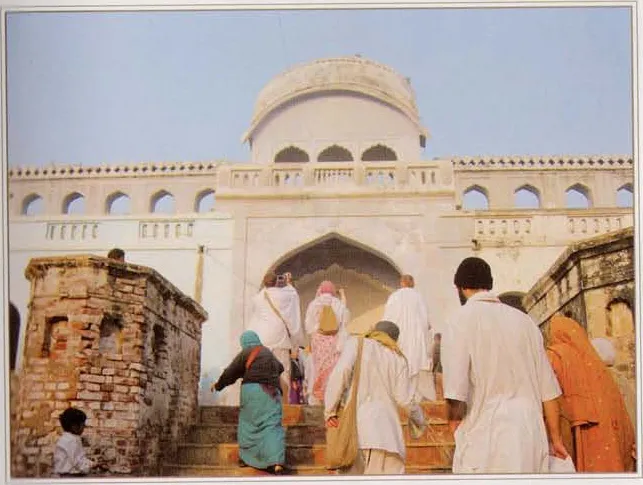
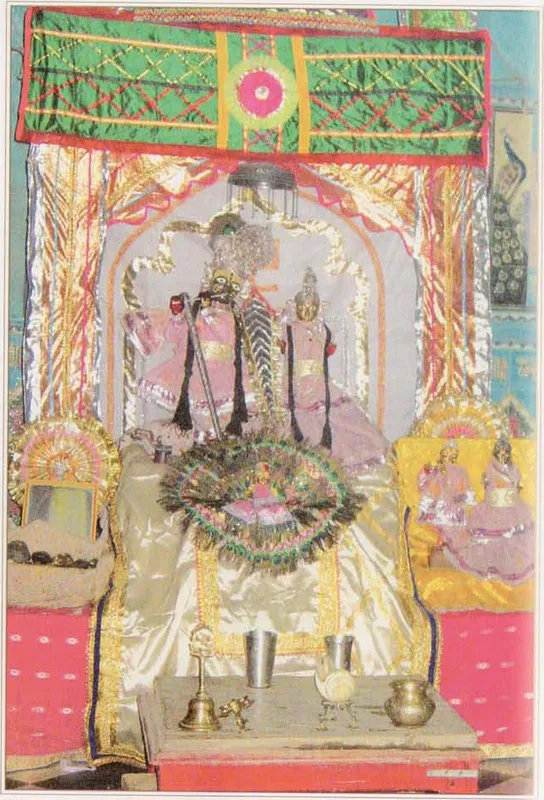
The temple of Saṅket-bihārījī, Saṅket-bihārījī Mandira, is the first of the sights that Śrī Vraja-maṇḍala Parikramā (2007) lists, with photographs of a large white temple and of its Deities.[1 +2] Growse (1883) says that a Rājā of Burdwan built the temple of Bihārī in a walled garden, Prabhudayāl Mītal (1966) says the same of the second temple of the village, in the walled garden, and Entwistle (1987) reports it of the Saṅket-bihārī temple by a tank on the west side of the village; none gives a date.[48 +2] Growse calls it a little temple, otherwise named Sija Mahal, which seemed to be held more sacred than the larger temple of Rādhā-Ramaṇa.[48] Whether the same name, which means a bed-chamber, belongs to the Śayyā Mandira, the "bed temple" that the 2007 guidebook lists without describing it, is not certain.[17 +2]
The rāsa-maṇḍala and the swing
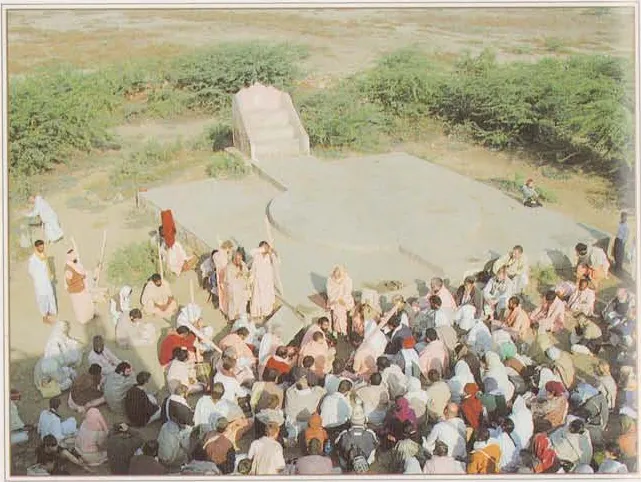
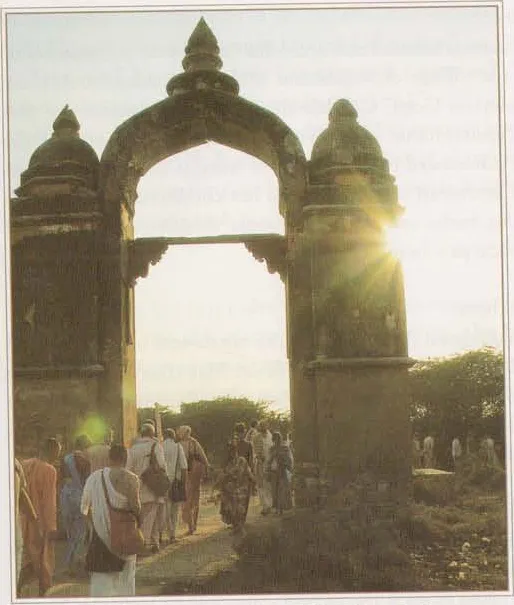
Śrīla Nārāyaṇa Bhaṭṭa Gosvāmī's Vraja-bhakti-vilāsa gives the marks of Saṅketa-vaṭa: a circle of the rāsa dance adorned with a swing, and beside it the pond called Kṛṣṇa-kuṇḍa, where bathing gives the sight of Kṛṣṇa.[12] The guidebook lists a rāsa-maṇḍala, a round raised stone platform in its photograph, and the place of a swing, a tall arched stone gateway; neither source says which rāsa the circle marks.[12 +1]
Mītal (1966) writes that the rāsa platform and the swing pavilion were built by Śrīla Nārāyaṇa Bhaṭṭa Gosvāmī; he gives no date or evidence, no other source names a builder, and so this is not certain.[49] Growse (1883) described a high swing in the walled garden, with holy spots marked by tablets that one of Sindhia's generals set up in saṁvat 1885 (A.D. 1828), and Entwistle (1987) described a large masonry swing frame with a rāsa-maṇḍala beside it.[48 +1] Growse (1883), Mītal (1966) and Entwistle (1987) each recorded a custom of their time: when the great pilgrimage of Vraja halted at Saṅket, the marriage of Rādhā and Kṛṣṇa was performed here as a scene of the rāsa-līlā, a devotional play. This is a remembrance in drama; none of them says that a wedding took place at Saṅket. Śrīmad-Bhāgavatam does not narrate a wedding of Rādhā and Kṛṣṇa.[48 +2]
The goddess of Saṅket
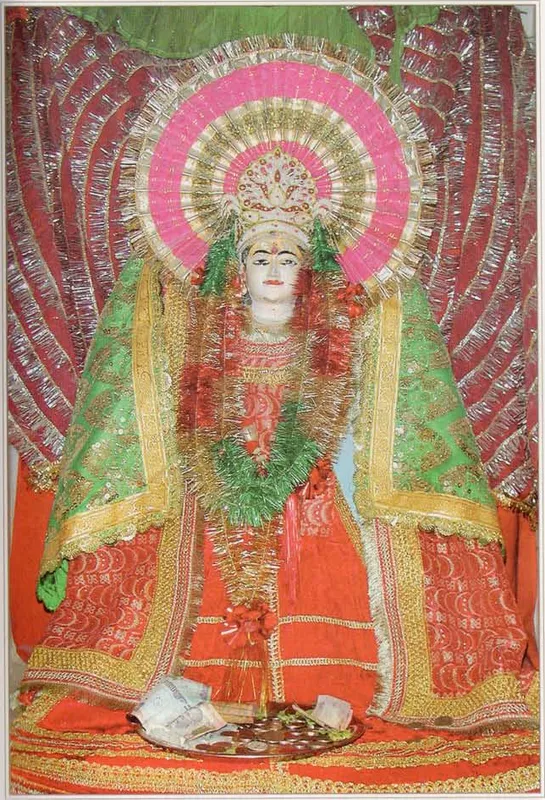
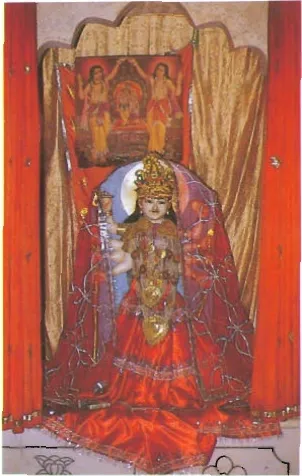
According to the 2007 guidebook, the temple of Saṅket-devī, Saṅket-devī Mandira, stands just near the rāsa-maṇḍala; its photograph shows a seated goddess wearing a jewelled crown.[17 +2] In 1987 Entwistle found a modern marble image there, in the care of the Gauḍīya Sampradāya, and Mītal (1966) names no builder for it.[50 +1] In the enclosure behind the temple, beside the swing frame, Entwistle also saw that local people revered two stones, one coated with vermilion, as the original goddess of Saṅket.[53]
Who the goddess is, the sources tell differently. The 2007 guidebook names her Vīrā-devī; Śrīla Rūpa Gosvāmī names Vīrā, bold in speech, among Kṛṣṇa's messengers but speaks of no temple, and the Vraja-bhakti-vilāsa honours a goddess Saṅketeśvarī, protectress of the place of Saṅketa, at nearby Vihvala-vana.[54 +3] The guidebook The Color Guide to Vṛndāvana (2000) records a local tradition, which is not certain, that the original Deity of Paurṇamāsī is at Saṅket.[3]
Accounts differ Who the goddess of the Saṅket-devī temple at Saṅket is.
- Śrī Vraja-maṇḍala Parikramā (2007)'Saṅket-devī (Śrī Vīrā-devī)': the goddess is Vīrā-devī, who with Vṛndā-devī is one of the principal messengers (dūtīs) arranging Rādhā and Kṛṣṇa's meetings at Saṅket.
- Vraja-bhakti-vilāsa ch. 2 v.54 and ch. 10 v.44 (Śrīla Nārāyaṇa Bhaṭṭa)At Vihvala-vana: the goddess (ambikā) Saṅketeśvarī, protectress of the Saṅketa place, giver of boons (to Lalitā); she is not called Vīrā and no temple in Saṅket village is named.
- Śrīla Rūpa Gosvāmī, Ujjvala-nīlamaṇi 2.20; Rādhā-Kṛṣṇa-gaṇoddeśa-dīpikā 2.88Vīrā is one of Kṛṣṇa's messengers (dūtīs), bold in speech; neither text speaks of a goddess or a temple of Vīrā at Saṅketa.
- A. W. Entwistle (1987), a historianEntwistle says the temple's image is a modern marble one, and that local people revere two stones in a small shrine behind it as the original goddess of Saṅketa.
The wording of these accounts is our summary of the sources, not a published translation.
The 2007 guidebook also names Vihvalā-devī near the rāsa-maṇḍala, without saying what it is.[17] Growse, Mītal and Entwistle record a goddess shrine on the bank of Vihvala-kuṇḍa, a little way from the village; Entwistle dated its four-armed image to the eighteenth century at the earliest.[48 +2] The Vraja-bhakti-vilāsa names no goddess Vihvalā there: at Vihvala-vana it honours the "vihvala form", Hari standing by a kadamba creeper with His friends, with Viśākhā, Lalitā and Rādhā.[56 +2] Raṅga-mahala is only a name in the guidebook's list.[17]
Kṛṣṇa-kuṇḍa
The Bhakti-ratnākara names Kṛṣṇa-kuṇḍa among the places of Saṅket, and the Vraja-bhakti-vilāsa puts a Kṛṣṇa-kuṇḍa beside the rāsa-maṇḍala and also a Śyāma-kuṇḍa, which, it says, arose where Rādhā and Kṛṣṇa bathed; whether these are one pond is not stated and is not certain.[12 +2] Growse (1883) described Kṛṣṇa-kuṇḍa as a large sheet of water, fifty yards square, with masonry steps on one side.[48] The 2007 guidebook puts it west of the village, with a sitting-place of Śrī Vallabhācārya on its bank; Entwistle (1987) records sitting-places of Śrī Vallabhācārya and Śrī Viṭṭhalanātha beside the Saṅket-bihārī temple at the tank on the west side.[17 +2] Śrīla Prabhupāda identifies Śrī Vallabha Bhaṭṭa as the ācārya of the Vallabhācārya-sampradāya and names his younger son, Viṭhṭhaleśvara, born in A.D. 1515, without mentioning Saṅket.[62 +1]
Saṅket-vaṭ
Mītal (1966) and Entwistle (1987) report that a great banyan called Saṅketvaṭa once stood in the village, next to the Saṅket-devī temple and the sitting-place of Śrī Gopāla Bhaṭṭa Gosvāmī; by their time it no longer stood.[49 +1]
Where the sources differ
Why the place is called Saṅket: from the messengers' signals according to Śrī Vraja-maṇḍala Parikramā (2007), from the sakhīs' …
Why the place is called Saṅket: from the messengers' signals according to Śrī Vraja-maṇḍala Parikramā (2007), from the sakhīs' signal according to the Bhakti-ratnākara, from the messengers' signal under the banyan according to the Bengali Bhaktamāla, and from the constant meeting of Rādhā and Kṛṣṇa according to the Vraja-bhakti-vilāsa; in the Padma Purāṇa the word only means the rendezvous.[1 +5]
Accounts differ Why the place is called Saṅket (Saṅketa).
- Śrī Vraja-maṇḍala Parikramā (2007)Vṛndā-devī, Vīrā-devī and Subala Sakhā, as messengers, arranged the Couple's meetings 'through signals (saṅket)'.
- Bhakti-ratnākara, Fifth Wave v.923–924In this Saṅketa-kuñja the sakhīs, making a signal (saṅketa), bring Rāi and Kānu; here was Their brief first meeting in pūrva-rāga (no messengers are named).
- the Bengali Bhaktamāla of Kṛṣṇadāsa Bābājī (1905)At the first meeting the dūtīs made the signal under the vaṭa; at the end of dusk Kṛṣṇa came and the dūtīs brought Kiśorī.
- Vraja-bhakti-vilāsa, ch. 5 v.29, citing the 'Kaurma'The place is called Saṅketaka because the meeting of Rādhā and Kṛṣṇa always takes place there, from the joining of (Their) comings.
The wording of these accounts is our summary of the sources, not a published translation.
Where and when the rāsa took place from which Kṛṣṇa went away with Rādhā: on the Yamunā's bank in autumn in the Bhāgavatam, at Nandīśvara in spring in the Garga-saṁhitā, near Govardhana in spring in the Caitanya-caritāmṛta.[34 +5]
Accounts differ Where and when the rāsa took place from which Kṛṣṇa disappeared with Rādhā (one gopī), before He adorned Her.
- Śrīmad-Bhāgavatam 10.29.1, 10.29.45, 10.29.48, 10.30.28On autumn nights, on the cool sandy bank of the Yamunā; there Kṛṣṇa disappeared and took one gopī, not named, to a secluded place.
- Śrīla Prabhupāda, Kṛṣṇa book ch. 30The same pastime; the gopī is Rādhārāṇī; no other place is named.
- Śrīla Prabhupāda, Kṛṣṇa book ch. 29Kṛṣṇa and the gopīs reached the cool, sandy bank of the Yamunā; seeing the gopīs' pride, Kṛṣṇa disappeared.
- Garga-saṁhitā 2.20.40–41, 2.21.9–10 and 2.21.18In its Vaiśākha (spring) rāsa series, a rāsa on the 'great slope/peak' of Nandīśvara; there Kṛṣṇa disappeared with Rādhā and entered Saṅketa-vaṭa with Her.
Where Kṛṣṇa adorned Rādhā with flowers: at Saṅketa-vaṭa according to the Garga-saṁhitā; at Śṛṅgāravaṭa or Kadamba-khaṇḍī according to other works.[5 +5]
Accounts differ Where Kṛṣṇa gathered flowers and adorned His beloved (Rādhā), and with which flowers.
- Śrīmad-Bhāgavatam 10.30.32–33On the path from the rāsa, at spots the gopīs point to ('here'); the gopī and the flowers are not named.
- Śrīla Prabhupāda, Kṛṣṇa book ch. 30Kṛṣṇa picked flowers to satisfy Rādhārāṇī and set them in Her hair; no place is named.
- Śrīla Viśvanātha Cakravartī, Sārārtha-darśinī on ŚB 10.30.32The flowers came from an aśoka tree that blossomed at once at the touch of her foot.
- Vaṁśīdhara, Bhāvārtha-dīpikā-prakāśa on ŚB 10.30.33That place is now known as Śṛṅgāra-vaṭa.
The wording of these accounts is our summary of the sources, not a published translation.
Where the night meeting and the parting at dawn take place: the 2007 guidebook says that the Govinda-līlāmṛta and the Kṛṣṇa-bhāvanāmṛta describe them at Saṅket, while those works set them by the Yamunā and do not name Saṅket.[1 +6]
Accounts differ Where the night (naiśa) and pre-dawn (niśānta) pastimes of Rādhā and Kṛṣṇa are set in the works that Śrī Vraja-maṇḍala Parikramā (2007) cites for Saṅket.
- Śrī Vraja-maṇḍala Parikramā (2007)At Saṅket: the book says that Śrīla Kṛṣṇadāsa Kavirāja in the Govinda-līlāmṛta and Śrīla Viśvanātha Cakravartī Ṭhākura in the Kṛṣṇa-bhāvanāmṛta describe Rādhā and Kṛṣṇa's pastimes here at night (naiśa) and before dawn (niśānta); it then tells of the end of the night, when Vṛndā-devī has Them woken so that They return home.
- Govinda-līlāmṛta 1.10, 1.24, 20.5, 21.27 (Śrīla Kṛṣṇadāsa Kavirāja Gosvāmī)The niśānta awakening is in a secluded bower on the Yamunā's bank; the night meeting is in the saṅketa-kuñja named Śrī Govinda-sthala, on an island-like bank of the Yamunā reached across a knee-deep stream; 'saṅketa' is only a common noun (rendezvous).
- Kṛṣṇa-bhāvanāmṛta 20.1 with Kṛṣṇadeva Sārvabhauma's ṭīkā (Śrīla Viśvanātha Cakravartī Ṭhākura)The night pastimes are in the two forests of the Kṛṣṇā (the Yamunā's water and bank) and a bower; Saṅketa is not named.
- Padma Purāṇa, Pātāla-khaṇḍa 83.101–102At night Kṛṣṇa meets His beloved at 'the rendezvous' (saṅketaka), which is not located.
The wording of these accounts is our summary of the sources, not a published translation.
Which rāsa the rāsa-maṇḍala of Saṅket marks: according to the guidebook and the Vraja-bhakti-vilāsa there is a rāsa-maṇḍala here, but neither says which; the accounts are set out on the page of Prema-sarovara.[12 +8]
Which temple is the temple of Saṅket-bihārījī, and who built it.[1 +3]
Accounts differ Which temple at Saṅket is the temple of Saṅket-bihārījī, how large it is, and who built it.
- Śrī Vraja-maṇḍala Parikramā (2007), Saṅket entry and photographs'the temple of Saṅket-bihārījī' is the first of the places worth visiting; the photograph so captioned shows a large white temple seen from the foot of a flight of steps, with long walls and a crenellated parapet
- F. S. Growse, Mathurá (1883), a historianGrowse says the larger temple, of Rādhā-ramaṇa, was built by Rūp Rām of Barsana in the style of the Nandagrāma temple and is visible from afar, and that the small Bihārī temple (Sija Mahal) in a walled garden, built by a Rājā of Burdwan, is held to be more sacred.
- Mītal (1966), p. 122Saṅket has temples of Saṅketavihārī, Saṅketī Devī and Rādhāvihārī; Rūparāma Kaṭārā of Barsana built the Rādhāvihārī temple (in the Nandagaon style, smaller, visible from far); the second temple, in the walled garden, was built by the Rājā of Vardhamāna
- A. W. Entwistle (1987), a historianEntwistle, after Growse, names Rādhā-ramaṇa's as the largest temple of the village, rebuilt by Rūp Rām; on the west side a tank has a temple of Saṅketa-bihārī said to have been built by a Rājā of Burdwan, with baiṭhakas of Śrī Vallabhācārya and Śrī Viṭṭhalanātha beside it.
Who built the goddess's shrine at Vihvala-kuṇḍa is not certain: the sources differ.[48 +2]
Accounts differ Who built the goddess's shrine (and the masonry) at Vihvala-kuṇḍa near Saṅket.
- Mītal (1966), p. 122Rājā Vīrasiṁh Deva of Orchhā lined the kuṇḍa with masonry and built the goddess's temple in saṁvat 1675 (1618 CE); no source is given for the date.
- F. S. Growse, Mathurá (1883), a historianGrowse says the Vihvala-kuṇḍa has on its bank a temple of Devī built by a Mahārāja of Gwalior.
- A. W. Entwistle (1987), a historianEntwistle reports both statements, suggests that Growse's builder may refer to the temple only in its present form, and judges the four-armed image no older than the eighteenth, perhaps the early nineteenth, century.
What the Vihvalā-devī near Saṅket is: a goddess, or, according to the Vraja-bhakti-vilāsa, the vihvala form of Kṛṣṇa with Rādhā.[17 +3]
Accounts differ What 'Vihvalā-devī' near Saṅket is: a goddess, or the 'vihvala form' of Kṛṣṇa with Rādhā.
- Śrī Vraja-maṇḍala Parikramā (2007)Names 'Vihvalā-devī' among the sites near Saṅket's rāsa-maṇḍala, with Vihvala-kuṇḍa, without saying who or what it is.
- Vraja-bhakti-vilāsa ch. 2 v.54 and ch. 10 v.43At Vihvala-vana, after Vihvala-kuṇḍa: darśana of the vihvala form at the kadamba place, whose prayer honours Hari standing at the kadamba creeper with His friends, and Viśākhā, Lalitā and Rādhā; the goddess it names there is Saṅketeśvarī (ch. 10 v.44), not Vihvalā.
- Growse (1883), p. 76A 'temple of Devi' on the margin of Vihvala-kund (no name).
- Prabhudayāl Mītal (1966) and A. W. Entwistle (1987), historiansMītal records a shrine (devālaya) of Vihvalā Devī, also called Vimalā Devī (the name is misprinted in his book). Entwistle describes a little-tended shrine of a four-armed goddess he names Vihvala, holding weapons.
The wording of these accounts is our summary of the sources, not a published translation.
More on this place
Saṅket, the meeting place of Rādhā and Kṛṣṇa · How Śrīla Lokanātha Gosvāmī came to Vraja and stayed there
References
87 references
- Śrī Vraja-maṇḍala Parikramā (2007), PDF p. 183
- Vṛndāvana-Dhāma Ki Jaya! (c. 1986), by Dhruva Mahārāja dāsa, PDF p. 50
- The Color Guide to Vṛndāvana (2000), Written and Photographed by Rājaśekhara dāsa Brahmacārī, PDF p. 75
- Śrīla Narahari Cakravartī, Bhakti-ratnākara, Fifth Wave, 1912 ed. p. 220; Grantha Mandira text v.923–926, 2nd ed., 1912
- Śrī Śrī Bhaktamāla grantha, printed p. 324, right column
- Śrīla Prabhupāda, Śrī Caitanya-caritāmṛta, Madhya-līlā 23.63, purport · vedabase.io
- Śrīla Viśvanātha Cakravartī Ṭhākura, Vraja-rīti-cintāmaṇi, sarga 1 v.82
- Śrīla Nārāyaṇa Bhaṭṭa, Vraja-bhakti-vilāsa, the twelve adhivanas, v.32, printed p. 3, 1st ed., publ. Bābā Kṛṣṇadāsa, Kusuma-sarovara, Saṁvat 2008
- Śrīla Nārāyaṇa Bhaṭṭa, Vraja-bhakti-vilāsa, list of the presiding deities of the twelve adhivanas, item 12, printed p. 6, 1st ed., publ. Bābā Kṛṣṇadāsa, Kusuma-sarovara, Saṁvat 2008
- Śrīla Nārāyaṇa Bhaṭṭa, Vraja-bhakti-vilāsa, ch. 2 v.20, printed p. 36, 1st ed., publ. Bābā Kṛṣṇadāsa, Kusuma-sarovara, Saṁvat 2008
- Śrīla Nārāyaṇa Bhaṭṭa, Vraja-bhakti-vilāsa, ch. 2 v.21, printed p. 36, 1st ed., publ. Bābā Kṛṣṇadāsa, Kusuma-sarovara, Saṁvat 2008
- Śrīla Nārāyaṇa Bhaṭṭa, Vraja-bhakti-vilāsa, ch. 2 v.56 (opening), printed p. 53, 1st ed., publ. Bābā Kṛṣṇadāsa, Kusuma-sarovara, Saṁvat 2008
- Śrīla Nārāyaṇa Bhaṭṭa, Vraja-bhakti-vilāsa, ch. 5 v.29 (Grantha Mandira (5) v.29), printed p. 121, 1st ed., publ. Bābā Kṛṣṇadāsa, Kusuma-sarovara, Saṁvat 2008
- Śrīmad-Bhāgavatam 10.30.32, GRETIL
- Śrīmad-Bhāgavatam 10.30.33, GRETIL
- Śrīla Prabhupāda, Kṛṣṇa, the Supreme Personality of Godhead (Kṛṣṇa book), Chapter 30, 'Kṛṣṇa’s Hiding from the Gopīs' · vedabase.io
- Śrī Vraja-maṇḍala Parikramā (2007), PDF p. 185
- Padma Purāṇa, Pātāla-khaṇḍa (5) 69.21, Sanskrit Wikisource
- Padma Purāṇa, Pātāla-khaṇḍa (5) 69.27, Sanskrit Wikisource
- Nārada Purāṇa, Uttara-bhāga 80.74
Show all 87 references
- Śrīla Nārāyaṇa Bhaṭṭa, Vraja-bhakti-vilāsa, ch. 13 v.22 (opening; Grantha Mandira (13) v.22), printed p. 263, 1st ed., publ. Bābā Kṛṣṇadāsa, Kusuma-sarovara, Saṁvat 2008
- Śrīla Rādhākṛṣṇa Gosvāmī, Sādhana-dīpikā, (4) part 4 v.8
- Śrīla Rādhākṛṣṇa Gosvāmī, Sādhana-dīpikā, (4) part 5 v.6
- Śrīla Rādhākṛṣṇa Gosvāmī, Sādhana-dīpikā, (4) part 6 v.15
- Śrīla Rādhākṛṣṇa Gosvāmī, Sādhana-dīpikā, (4) part 6 v.26
- Śrīla Rādhākṛṣṇa Gosvāmī, Sādhana-dīpikā, (4) part 10 v.4
- Śrīla Narahari Cakravartī, Bhakti-ratnākara, Fifth Wave, 1912 ed. pp. 220–221; Grantha Mandira text v.927–929, 2nd ed., 1912
- Śrīla Narahari Cakravartī, Bhakti-ratnākara, Fifth Wave, 1912 ed. p. 220; Grantha Mandira text v.923–926, 2nd ed., 1912
- Padma Purāṇa, Pātāla-khaṇḍa (5) 83.45–47, Sanskrit Wikisource
- Padma Purāṇa, Pātāla-khaṇḍa (5) 83.101b–102, Sanskrit Wikisource
- Vṛndāvana-Dhāma Ki Jaya! (c. 1986), by Dhruva Mahārāja dāsa, PDF p. 51
- Śrīla Kṛṣṇadāsa Kavirāja Gosvāmī, Govinda-līlāmṛta, sarga 20 v.5, after the editions of Haridas Das and Haridas Shastri
- Śrī Vraja-maṇḍala Parikramā (2007), PDF p. 201
- Garga-saṁhitā, Vṛndāvana-khaṇḍa (2) 21.10, first half, Sanskrit Wikisource
- Garga-saṁhitā, Vṛndāvana-khaṇḍa (2) 21.10, second half, Sanskrit Wikisource
- Garga-saṁhitā, Vṛndāvana-khaṇḍa (2) 21.18 (English edition: Canto 2, Chapter 21, Verse 2.21.18), online edition
- Garga-saṁhitā, Vṛndāvana-khaṇḍa (2) 21.19 (English edition: Canto 2, Chapter 21, Verse 2.21.19), online edition
- Prema-vilāsa, Seventh Vilāsa (সপ্তম বিলাস), printed p. 45, left column, Kolkata, 1913
- Prema-vilāsa, Seventh Vilāsa, printed p. 47, left column, Kolkata, 1913
- Prema-vilāsa, Sixteenth Vilāsa, printed p. 126, right column, Kolkata, 1913
- Pulinbihārī Datta, printed p. 102
- The Color Guide to Vṛndāvana (2000), Written and Photographed by Rājaśekhara dāsa Brahmacārī, PDF p. 116
- The Color Guide to Vṛndāvana (2000), Written and Photographed by Rājaśekhara dāsa Brahmacārī, PDF p. 115
- Śrīla Prabhupāda, Śrī Caitanya-caritāmṛta, Madhya-līlā 18.57, translation · vedabase.io
- Vṛndāvana-Dhāma Ki Jaya! (c. 1986), by Dhruva Mahārāja dāsa, PDF p. 47
- A. W. Entwistle, printed p. 167, Egbert Forsten, Groningen, 1987
- Śrī Vraja-maṇḍala Parikramā (2007), PDF p. 184
- Mathurá (1883), F. S. Growse, B.C.S., M.A. Oxon., C.I.E. (as the title page gives him, p. 76
- Prabhudayāl Mītal, printed p. 122
- A. W. Entwistle, printed p. 376, Egbert Forsten, Groningen, 1987
- A. W. Entwistle, printed pp. 376-377, Egbert Forsten, Groningen, 1987
- Prabhudayāl Mītal, 'Braj-yātrā', stage 11 Saṅket, printed p. 122
- A. W. Entwistle, §39 'Sanket', item 2, printed p. 377, Egbert Forsten, Groningen, 1987
- Śrīla Rūpa Gosvāmī, Ujjvala-nīlamaṇi, 2.20, GRETIL
- Śrīla Rūpa Gosvāmī, Rādhā-Kṛṣṇa-gaṇoddeśa-dīpikā, part 2 v.88
- Śrīla Nārāyaṇa Bhaṭṭa, Vraja-bhakti-vilāsa, ch. 2 v.54 (the list of forests: Vihvala-vana), printed p. 51, 1st ed., publ. Bābā Kṛṣṇadāsa, Kusuma-sarovara, Saṁvat 2008
- Śrīla Nārāyaṇa Bhaṭṭa, Vraja-bhakti-vilāsa, ch. 10 v.44 (Vihvala-vana: prayer on seeing the goddess Saṅketeśvarī), printed pp. 220–221, 1st ed., publ. Bābā Kṛṣṇadāsa, Kusuma-sarovara, Saṁvat 2008
- A. W. Entwistle, §39 'Sanket', item 1 'Vihval Kund', printed p. 376, Egbert Forsten, Groningen, 1987
- Śrīla Nārāyaṇa Bhaṭṭa, Vraja-bhakti-vilāsa, ch. 10 v.43 (the Bhādra forest pilgrimage: Vihvala-vana), printed p. 220, 1st ed., publ. Bābā Kṛṣṇadāsa, Kusuma-sarovara, Saṁvat 2008
- Śrīla Narahari Cakravartī, Bhakti-ratnākara, Fifth Wave (pañcama taraṅga), printed pp. 220-221 (1912 ed.), 2nd ed., 1912
- Śrīla Nārāyaṇa Bhaṭṭa, Vraja-bhakti-vilāsa, Fifth chapter, v.30: origin and glory of the Saṅketa grove, the Śyāma-kuṇḍa; printed p. 122, 1st ed., publ. Bābā Kṛṣṇadāsa, Kusuma-sarovara, Saṁvat 2008
- Śrīla Prabhupāda, Śrī Caitanya-caritāmṛta, Madhya-līlā 19.61, purport · vedabase.io
- Śrīla Prabhupāda, Śrī Caitanya-caritāmṛta, Madhya-līlā 18.47, purport · vedabase.io
- Śrīla Prabhupāda, Śrī Caitanya-caritāmṛta, Ādi-līlā 10.105, purport · vedabase.io
- Śrīla Prabhupāda, Śrī Caitanya-caritāmṛta, Antya-līlā 17.24, translation · vedabase.io
- Jaya Jaya Madana Gopāla Baṁśī Dhārī (Narottama dāsa Ṭhākura (as the song book credits it)) · song book
- Garga-saṁhitā, Vṛndāvana-khaṇḍa (2) 20.40–41, Sanskrit Wikisource
- Śrīmad-Bhāgavatam 10.29.1, GRETIL
- Śrīmad-Bhāgavatam 10.29.45, GRETIL
- Śrīmad-Bhāgavatam 10.29.48, GRETIL
- Śrīmad-Bhāgavatam 10.30.28, GRETIL
- Vaṁśīdhara: commentary on ŚB 10.30.33
- Śrīla Narahari Cakravartī, Bhakti-ratnākara, Fifth Wave, 1912 ed. p. 256; Grantha Mandira text v.1412, 2nd ed., 1912
- Śrīmad-Bhāgavatam 10.30 with Śrīla Viśvanātha Cakravartī's Sārārtha-darśinī: commentary on ŚB 10.30.32 (vedabase numbering; Grantha Mandira 10.30.33)
- Śrīla Kṛṣṇadāsa Kavirāja Gosvāmī, Govinda-līlāmṛta, sarga 1 v.10, after the editions of Haridas Das and Haridas Shastri
- Śrīla Kṛṣṇadāsa Kavirāja Gosvāmī, Govinda-līlāmṛta, sarga 1 v.24, after the editions of Haridas Das and Haridas Shastri
- Śrīla Kṛṣṇadāsa Kavirāja Gosvāmī, Govinda-līlāmṛta, sarga 21 v.27, after the editions of Haridas Das and Haridas Shastri
- Padma Purāṇa, Pātāla-khaṇḍa (5) 83.19–20, Sanskrit Wikisource
- Śrīmad-Bhāgavatam 10.32.11–12, GRETIL
- Śrīmad-Bhāgavatam 10.33.2, GRETIL
- Śrīmad-Bhāgavatam 10.33.3, GRETIL
- Śrīmad-Bhāgavatam 10.33.5, GRETIL
- Śrīla Prabhupāda, Kṛṣṇa, the Supreme Personality of Godhead (Kṛṣṇa book), Chapter 33, 'Description of the Rāsa Dance' · vedabase.io
- Garga-saṁhitā, Vṛndāvana-khaṇḍa (2) 21.10 in the Wikisource text (= 2.21.9-10 in the Danavir Goswami edition), Sanskrit Wikisource
- Garga-saṁhitā, Vṛndāvana-khaṇḍa (2) 21.17 in the Wikisource text (= 2.21.18 in the Danavir Goswami edition), Sanskrit Wikisource
- Śrī Vraja-maṇḍala Parikramā (2007), p. 340-341
- Vṛndāvana-Dhāma Ki Jaya! (c. 1986), by Dhruva Mahārāja dāsa, p. 32