Viṣṇu-parvata
विष्णु-पर्वत Hindi name proposed
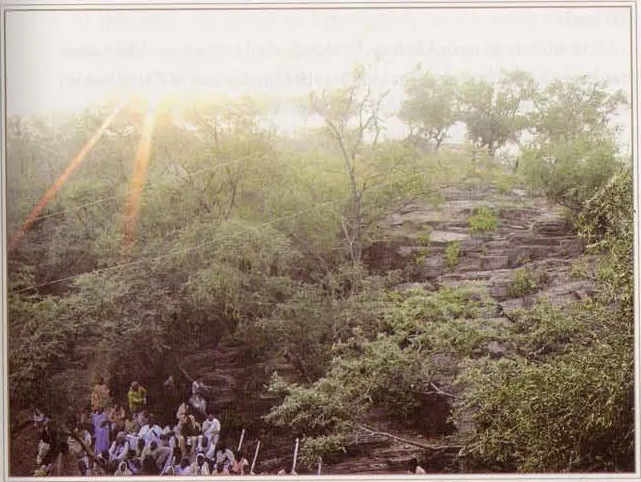
- What it is
- Viṣṇu-parvata is the hill that faces Brahma-parvata at Varṣāṇā, with the narrow pass Sāṅkarī-khor between them and Vilāsa-garh on top, as the guidebook Śrī Vraja-maṇḍala Parikramā (2007) describes it.
- Visiting
- Śrī Vraja-maṇḍala Parikramā lists Viṣṇu-parvata among the hills of Vraja.
- Places here
- Vilāsa-garh, Vilāsa Mandira, Kṛṣṇa Mandira (Viṣṇu-parvata), Līlā-nṛtya-mandira (Viṣṇu-parvata)
In short
Viṣṇu-parvata is the hill that faces Brahma-parvata at Varṣāṇā, with the narrow pass Sāṅkarī-khor between them and Vilāsa-garh on top, as the guidebook Śrī Vraja-maṇḍala Parikramā (2007) describes it.[1 +4] Śrīla Nārāyaṇa Bhaṭṭa Gosvāmī's Vraja-bhakti-vilāsa, citing the Padma Purāṇa, names the two hills Viṣṇu and Brahma and places on Viṣṇu-parvata a temple of Śrī Kṛṣṇa, a hall for the dance of pastimes and the Vilāsa-mandira.[6] The guidebook adds that Lord Viṣṇu has taken the form of this hill; the Vraja-bhakti-vilāsa only calls it the hill named Viṣṇu.[6 +3]
Key facts
| Kind | hill |
|---|---|
| Region · area | Varṣāṇā |
| Ācāryas | Śrīla Nārāyaṇa Bhaṭṭa Gosvāmī |
Traditional accounts
Two hills facing each other
The Vraja-bhakti-vilāsa (ch. 2, verse 47) lists the marks of Vṛṣabhānupura, the town of Śrī Rādhā's father, in a passage it gives from the Padma Purāṇa. Two hills named Viṣṇu and Brahma face each other, Brahma on the right and Viṣṇu on the left, and Sāṅkarī-khor lies between them (summarised here, not translated).[6] The Padma passage itself has not been found, and the book does not say from which side right and left are seen.[1 +5]
पाद्मे—विष्णुब्रह्माख्यनामानौ पर्व्वतौ द्वौ परस्परौ । … वामपार्श्वे विष्णुनामपर्व्वतः । … विष्णुब्रह्मनाम्नोरुभयोः पर्व्वतयोः साकरिखोरिस्थलम् । … विष्णुपर्व्वतोपरि श्रीकृष्णमन्दिरम् । अग्रे लीलानृत्यमन्दिरम् । तत्पार्श्वे विलासमन्दिरम् । तत्पार्श्वे गह्वरबनं ।
pādme—viṣṇubrahmākhyanāmānau parvvatau dvau parasparau
… vāmapārśve viṣṇunāmaparvvataḥ
… viṣṇubrahmanāmnorubhayoḥ parvvatayoḥ sākarikhoristhalam
… viṣṇuparvvatopari śrīkṛṣṇamandiram
agre līlānṛtyamandiram
tatpārśve vilāsamandiram
tatpārśve gahvarabanaṁ |
The Bhakti-ratnākara speaks of the two hills and of the three forts on them, Dāna, Māna and Vilāsa, but does not use the name Viṣṇu-parvata.[11 +1] The undated parikramā notes Varṣāṇā call the hill across Sāṅkarī-khor from Brahma-parvata "Vilasa Parvat" and set the dāna-keli, Kṛṣṇa's toll pastime, in the narrow gorge between the two hills.[13] Read more: Kṛṣṇa's toll pastime (dāna-līlā) at Govardhana and Varṣāṇā →
The hill as Viṣṇu
Śrī Vraja-maṇḍala Parikramā says that Lord Viṣṇu has assumed the form of Viṣṇu-parvata, as Lord Brahmā dwells in the form of the hills of Varṣāṇā. The undated parikramā notes Varṣāṇā record a local tradition that of the two hills the dark one is Lord Viṣṇu and the white one Lord Brahmā.[7 +2] No scripture or Gosvāmī text has been found that says Viṣṇu became a hill at Varṣāṇā; the Vraja-bhakti-vilāsa only calls it the hill "named Viṣṇu".[6 +3]
The temple of Kṛṣṇa and the hall of the dance
According to the Vraja-bhakti-vilāsa, on top of Viṣṇu-parvata stands a temple of Śrī Kṛṣṇa, with a līlā-nṛtya-mandira, a hall for the dance of pastimes, in front of it. It is the only text found that names either of them.[1 +2] This Kṛṣṇa temple appears in Śrī Vraja-maṇḍala Parikramā only in its untranslated Sanskrit note; its English names no temple on Viṣṇu-parvata, and no source says whether the hall is the rāsa-maṇḍala that the guidebook places at Vilāsa-garh.[1 +2] The two books render the list differently; the comparison is set out on the Brahma-parvata page.[1 +2]
The Vilāsa Mandira
The Vraja-bhakti-vilāsa lists the Vilāsa-mandira beside the hall of the dance on Viṣṇu-parvata, with Gahvaravana beside it. It gives a prayer for it, to be recited thirteen times with obeisances, to Kṛṣṇa whose form is vilāsa, loving play, who gains the happiness of the sakhīs and shows them spotless play (summarised here, not translated).[6 +1]
ततो विलासमन्दिरप्रार्थनमन्त्रः— विलासरूपिणे तुभ्यं नमः कृष्णाय ते नमः । सखीवर्गसुखाप्ताय क्रीड़ाविमलदर्शिने ॥ इति त्रयोदशावृत्या पठन्मन्त्रं नमश्चरेत् । कलत्रादिधनैर्धान्यैश्चिरञ्जीवी सुखी सदा ॥ ६१ ॥
tato vilāsamandiraprārthanamantraḥ— vilāsarūpiṇe tubhyaṁ namaḥ kṛṣṇāya te namaḥ
sakhīvargasukhāptāya krīḍāvimaladarśine
iti trayodaśāvṛtyā paṭhanmantraṁ namaścaret
kalatrādidhanairdhānyaiścirañjīvī sukhī sadā || 61 ||
The Vraja-bhakti-vilāsa names no source for this prayer; Śrī Vraja-maṇḍala Parikramā (2007) prints it as from the Ādi-varāha Purāṇa.[15] The two differ on its source:
Accounts differ The source of the Vilāsa-mandira prayer ('vilāsa-rūpiṇe tubhyaṁ …').
- Vraja-bhakti-vilāsa ch. 4 v.61No source label stands between the heading and the verse.
- Śrī Vraja-maṇḍala Parikramā (2007)'The Ādi-varāha Purāṇa states:' (with an English rendering).
The Bhakti-ratnākara names Vilāsa among the three forts and says that Rādhikā played and sported with Her sakhīs by the path between the hills, but it names no Vilāsa Mandira.[12] According to the local tradition recorded in Śrī Vraja-maṇḍala Parikramā (2007), the Vilāsa Mandira near Vilāsa-garh marks a pastime of Rādhā and Kṛṣṇa that is told on the Vilāsa-garh page; no older source for it has been found, so it is not certain.[2 +1]
Visiting today
Śrī Vraja-maṇḍala Parikramā lists Viṣṇu-parvata among the hills of Vraja. Its map draws Vilāsa-garh on top of the hill, east of Sāṅkarī-khor.[1 +4] Entwistle (1987) put Vilāsa-garh on the hill south of the pass, and the historian Mītal (1966) wrote that the principal temple of Śrī Rādhā stood on Vilāsa-garh, with Sāṅkarī-khor between the hills of Vilāsa-garh and Dāna-garh; the guidebook puts the Śrījī temple on Brahma-parvata, so his description is not certain.[17 +1] Where the shrine lies and what stands on the hill, the sources describe differently:
Accounts differ What stands on Viṣṇu-parvata and where the Vilāsa-mandira / Vilāsa-garh is.
- Vraja-bhakti-vilāsa ch. 2 v.47 (citing the Padma Purāṇa)on top of Viṣṇu-parvata a temple of Śrī Kṛṣṇa with a dance pavilion (līlā-nṛtya-mandira) before it; beside it the Vilāsa-mandira; beside that Gahvaravana, with a rāsa-maṇḍala below
- Śrī Vraja-maṇḍala Parikramā (2007)'s English quotation of the same passage'Further on between the two hills is Sāṅkarī-khor. Near Sāṅkarī-khor is Vilāsa Mandira, and next to Vilāsa Mandira is Gahvaravana'; no Kṛṣṇa temple on Viṣṇu-parvata
- Śrī Vraja-maṇḍala Parikramā (2007), own textVilāsa-garh is on Viṣṇu-parvata, east of Sāṅkarī-khor, with a rāsa-maṇḍala; Gahvaravana is south-west of Sāṅkarī-khor and west of Ciksaulī, with Mayūra-kuṭī to the right on entering it
- A. W. Entwistle (1987), a historianEntwistle places Vilāsa-garh on the hill south of Sāṅkarī-khor, which some call Viṣṇu-parvata.
Location
Places at Viṣṇu-parvata
4 places
Nearby places
Sāṅkarī-khor · Brahma-parvata
History
In 1987 the historian A. W. Entwistle described a small building called Vilas Garh on the hill south of Sāṅkarī-khor; no source says whether it is the Vilāsa Mandira of the guidebook.[17]
More on this place
Kṛṣṇa's toll pastime (dāna-līlā) at Govardhana and Varṣāṇā
References
18 references
- Śrī Vraja-maṇḍala Parikramā (2007), PDF p. 170
- Śrī Vraja-maṇḍala Parikramā (2007), PDF p. 171
- Śrī Vraja-maṇḍala Parikramā (2007), PDF p. 172
- Śrī Vraja-maṇḍala Parikramā (2007), PDF p. 176
- Śrī Vraja-maṇḍala Parikramā (2007), PDF p. 26
- Śrīla Nārāyaṇa Bhaṭṭa, Vraja-bhakti-vilāsa, ch. 2 v.47 ('ततो वृपभानुपुरलिंगानि', 'pādme'), printed p. 46, 1st ed., publ. Bābā Kṛṣṇadāsa, Kusuma-sarovara, Saṁvat 2008
- Śrī Vraja-maṇḍala Parikramā (2007), PDF p. 1
- Śrī Vraja-maṇḍala Parikramā (2007), PDF p. 19
- the undated parikramā notes Varṣāṇā, ¶3
- Śrīla Nārāyaṇa Bhaṭṭa, Vraja-bhakti-vilāsa, ch. 2 v.47 ('ततो वृपभानुपुरलिंगानि', 'pādme'), printed p. 46, 1st ed., publ. Bābā Kṛṣṇadāsa, Kusuma-sarovara, Saṁvat 2008
- Śrīla Narahari Cakravartī, Bhakti-ratnākara, Fifth Wave, 1912 ed. p. 218; Grantha Mandira text v.891–896, 2nd ed., 1912
- Śrīla Narahari Cakravartī, Bhakti-ratnākara, Fifth Wave, 1912 ed. p. 218; Grantha Mandira text v.894–896, 2nd ed., 1912
- the undated parikramā notes Varṣāṇā, ¶15
- Śrī Vraja-maṇḍala Parikramā (2007), PDF p. 188
- Śrīla Nārāyaṇa Bhaṭṭa, Vraja-bhakti-vilāsa, ch. 4 v.61 (prayer for the Vilāsa-mandira), printed p. 101, 1st ed., publ. Bābā Kṛṣṇadāsa, Kusuma-sarovara, Saṁvat 2008
- Śrīla Nārāyaṇa Bhaṭṭa, Vraja-bhakti-vilāsa, ch. 4 v.61 (prayer for the Vilāsa-mandira), printed p. 101, 1st ed., publ. Bābā Kṛṣṇadāsa, Kusuma-sarovara, Saṁvat 2008
- A. W. Entwistle, §37 item 4 'Vilas Garh', printed p. 372, Egbert Forsten, Groningen, 1987
- Prabhudayāl Mītal, section 'Braj-yātrā', entries 'विलासगढ' and 'साँकरी खोर', printed p. 120