Vilāsa-garh
विलास-गढ़ Hindi name proposed
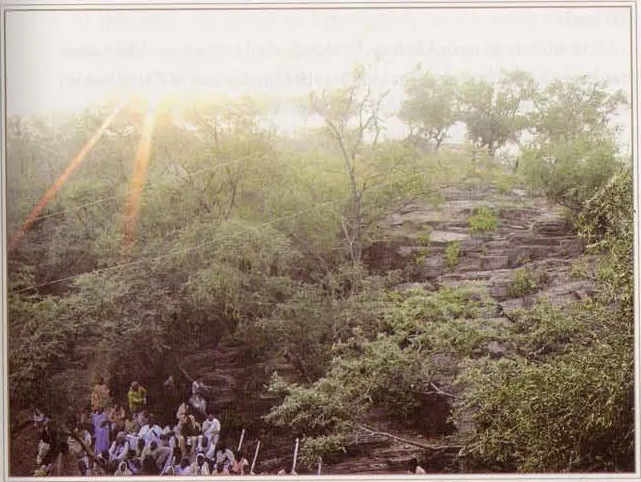
- What it is
- Vilāsa-garh is a small shrine on Viṣṇu-parvata at Varṣāṇā, beside the narrow pass Sāṅkarī-khor, according to the guidebook Śrī Vraja-maṇḍala Parikramā (2007).
- Visiting
- Śrī Vraja-maṇḍala Parikramā puts Vilāsa-garh on top of Viṣṇu-parvata, east of Sāṅkarī-khor, on its text and its map.
- Places here
- Rāsa-maṇḍala (Vilāsa-garh), Place where Rādhikā played in the sand (Vilāsa-garh)
In short
Vilāsa-garh is a small shrine on Viṣṇu-parvata at Varṣāṇā, beside the narrow pass Sāṅkarī-khor, according to the guidebook Śrī Vraja-maṇḍala Parikramā (2007).[1 +4] The Bhakti-ratnākara names Vilāsa as one of the three forts on the hills of Varṣāṇā, right after it says that Kṛṣṇa was absorbed here in many kinds of vilāsa, loving play.[6] The same book says that Śrī Rādhikā played here with Her friends as a child.[6] The guidebook places a rāsa-maṇḍala at Vilāsa-garh and tells of a dust-storm pastime of Rādhā and Kṛṣṇa here.[2 +1]
Key facts
| Kind | pastime site |
|---|---|
| Region · area | Varṣāṇā · Viṣṇu-parvata |
| Ācāryas | Śrīla Narahari Cakravartī Ṭhākura, Śrīla Rāghava Paṇḍita Gosvāmī of Govardhana, Śrīla Śrīnivāsa Ācārya, Śrīla Nārāyaṇa Bhaṭṭa Gosvāmī |
Traditional accounts
The three forts
In the Fifth Wave of the Bhakti-ratnākara, Śrīla Rāghava Paṇḍita Gosvāmī of Govardhana shows Śrīla Śrīnivāsa Ācārya the hill of Varṣāṇā. Here, he says (summarised here, not translated), Kṛṣṇa performed the dāna-līlā (the toll pastime), broke Rādhikā's māna (Her loving anger) and was absorbed in many kinds of play. No one can describe the fun on the narrow path between the two hills, now called Sāṅkarī-khor. Dāna, Māna and Vilāsa are the three forts on the hills.[6]
অপূর্ব্ব পর্ব্বত এথা ব্রজেন্দ্রকুমার। করিলেন দানলীলা অন্য অগোচর ॥ এই খানে রাধিকার মানভঙ্গ কৈল। এথা কৃষ্ণ বিবিধ বিলাসে মত্ত হৈল ॥ পর্ব্বতদ্বয়ের মধ্যে এ সঙ্কীর্ণ পথে। যে কৌতুক তাহা কেহ না পারে কহিতে ॥ এবে এ সাঁকরিখোর নাম সবে কয়। দান মান বিলাস পর্ব্বত গড় ত্রয় ॥ অহে শ্রীনিবাস শ্রীরাধিকা সখী সনে। বাল্যাবেশে নানা খেলা খেলিলা এখানে ॥ রাধিকার অপূর্ব্ব বয়স-সন্ধিকালে এথা মহা উল্লাসে বিলসে সখী মিলে ॥
apūrbba parbbata ethā brajendrakumāra| karilena dānalīlā anya agocara
ei khāne rādhikāra mānabhaṅga kaila| ethā kṛṣṇa bibidha bilāse matta haila
parbbatadbaẏera madhye e saṅkīrṇa pathe| ye kautuka tāhā keha nā pāre kahite
ebe e sām̐karikhora nāma sabe kaẏa| dāna māna bilāsa parbbata gaṛa traẏa
ahe śrīnibāsa śrīrādhikā sakhī sane| bālyābeśe nānā khelā khelilā ekhāne
rādhikāra apūrbba baẏasa-sandhikāle ethā mahā ullāse bilase sakhī mile ||
The book names the three pastimes just before the three forts, Dāna-garh, Māna-garh and Vilāsa, but it does not say in words that the forts are named after them.[6] It goes on: Śrī Rādhikā played many games here with Her friends in Her childhood, and at Her vayaḥ-sandhi, the age between childhood and youth, She sported here with great joy. By "here" it means the hill, the narrow path and its forts.[6]
The Vilāsa-mandira
Śrīla Nārāyaṇa Bhaṭṭa Gosvāmī's Vraja-bhakti-vilāsa, citing the Padma Purāṇa, places on Viṣṇu-parvata a temple of Śrī Kṛṣṇa with a dance pavilion before it, and beside it the Vilāsa-mandira.[8 +1] It gives a prayer for the Vilāsa-mandira to Kṛṣṇa whose form is play, who brings happiness to the sakhīs (Rādhā's companions); the prayer is described on the Viṣṇu-parvata page.[9] According to the introduction to the Hindi edition of the same book, Vilāsa-garh is one of the holy places of Varṣāṇā that were manifested through Śrīla Nārāyaṇa Bhaṭṭa Gosvāmī; this is a modern editor's report, and his own book does not say so.[10]
The dust-storm
According to the local tradition recorded in Śrī Vraja-maṇḍala Parikramā (2007), Rādhā and Kṛṣṇa performed many playful pastimes here. The book connects the Vilāsa Mandira with one of them: Rādhikā was playing in the dust with Her sakhīs when Kṛṣṇa came and a dust-storm covered the sky.[4] No scripture or Gosvāmī text has been found that tells this pastime; the oldest text found speaks only of Rādhikā's play and sport here.[4 +1]
Durvāsā's boon
The Bengali Bhaktamāla of Kṛṣṇadāsa Bābājī (1905) gives this place another story. It calls the forest named Vilāsa, at Vṛṣabhānupura, the place of Rādhā's play in the dust. As She sat playing with Her sakhīs, the sage Durvāsā passed by. Of all the girls only Rādhikā rose and bowed down flat, and the pleased sage gave Her a boon: whatever She cooked would be like nectar and would give long life, lustre, strength and health to whoever ate it (summarised here, not translated).[11]
The boon itself is told in older texts: in Śrīla Kṛṣṇadāsa Kavirāja Gosvāmī's Govinda-līlāmṛta, in Śrīla Raghunātha dāsa Gosvāmī's Viśākhānanda-stotra and in the Caitanya-caritāmṛta. The Govinda-līlāmṛta and the stotra add that Yaśodā therefore has Her brought to Nanda's house to cook. None of them names the place where She received the boon.[12 +2]
General teaching (does not name the place)“Śrīmatī Rādhārāṇī received from Durvāsā Muni the benediction that whatever She cooked would be sweeter than nectar. That is the special feature of Her cooking.”
Śrīla Prabhupāda, Śrī Caitanya-caritāmṛta, Antya-līlā 6.116, translation · vedabase.io
The place where Rādhikā played in the sand
According to Śrī Vraja-maṇḍala Parikramā (2007), near the Vilāsa Mandira is the place where Rādhikā, as a child, played with the sand, building palaces, and near Vilāsa-garh She played in the dust with Her sakhīs, Her girl companions. The guidebook does not give the place a name.[2 +1] The Bhakti-ratnākara speaks of Her childhood games on the hill and its forts but names no sand-play site, and the Bengali Bhaktamāla calls the forest named Vilāsa the place of Her dust-play, where She received Durvāsā's boon (both above).[6 +1]
Accounts differ Where Rādhikā played (in the dust) as a child and sported at Her vayaḥ-sandhi, and which pastime the place of Her dust-play recalls.
- the Bengali Bhaktamāla of Kṛṣṇadāsa Bābājī (1905)the forest named Vilāsa (at Vṛṣabhānupura) is the place of Her dust-play, where, as She played in the dust with Her sakhīs, Durvāsā passed by and gave Her the boon about Her cooking; no dust-storm, no Kṛṣṇa
- Govinda-līlāmṛta 3.14, Viśākhānanda-stotra 24, Caitanya-caritāmṛta Antya 6.116Rādhā received Durvāsā's boon about Her cooking; no place is named
- Bhakti-ratnākara, Fifth Wave, printed p. 218'here', at the narrow path between Varṣāṇā's two hills (now Sām̐karikhora), by the three hill-forts Dāna, Māna and Vilāsa: many childhood games with Her friends; at vayaḥ-sandhi She sported here with great joy with Her friends
- Śrī Vraja-maṇḍala Parikramā (2007)near the Vilāsa Mandira Rādhikā, as a child, played with the sand, building palaces
The rāsa-maṇḍala
Śrī Vraja-maṇḍala Parikramā says that Vilāsa-garh is the location of a rāsa-maṇḍala, a circle of the rāsa dance; no other source names one here.[2] The Vraja-bhakti-vilāsa names none at Vilāsa-garh: the rāsa-maṇḍala it lists near the Vilāsa-mandira lies below Gahvaravana, and its prayer there honours Kṛṣṇa, whose play is the vilāsa-rāsa.[8 +2]
The Bhāgavatam (10.29–33) tells the rāsa dance on autumn nights on the sandy bank of the Yamunā, and names no rāsa-maṇḍala at Varṣāṇā.[16 +9] The rāsa-maṇḍalas of Varṣāṇā keep the memory of the rāsa as a pilgrimage tradition, not as a statement of the Bhāgavatam.[2 +4] Read more: Where the autumn rāsa took place →
valayānāṃ nūpurāṇāṃ kiṅkiṇīnāṃ ca yoṣitām / sa-priyāṇām abhūc chabdas tumulo rāsa-maṇḍale
A tumultuous sound arose from the armlets, ankle bells and waist bells of the gopīs as they sported with their beloved Kṛṣṇa in the circle of the rāsa dance.
Translation: Śrīla Prabhupāda's disciples (BBT)Visiting today
Śrī Vraja-maṇḍala Parikramā puts Vilāsa-garh on top of Viṣṇu-parvata, east of Sāṅkarī-khor, on its text and its map.[1 +4] In 1987 Entwistle described it as a small building on the hill south of Sāṅkarī-khor, and he recorded a festival there on the tenth day of the bright fortnight of Bhādra, with Kṛṣṇa and Rādhā in a swing.[29 +1] The historian Mītal (1966) counts Vilāsgaṛh among the four peaks of the hill of Varṣāṇā itself.[31] The sources differ on where the shrine lies:
Accounts differ Where Vilāsa-garh, with its Vilāsa Mandira and rāsa-maṇḍala, lies: on Viṣṇu-parvata east of Sāṅkarī-khor, or among the peaks of the hill of Varṣāṇā (Brahma-parvata).
- Vraja-bhakti-vilāsa ch. 2 v.47On Viṣṇu-parvata: the Kṛṣṇa temple with the līlā-nṛtya-mandira in front, beside it the Vilāsa-mandira, beside it Gahvara-vana.
- Śrī Vraja-maṇḍala Parikramā (2007), and its sketch mapVilāsa-garh is on Viṣṇu-parvata, east of Sāṅkarī-khor ('This place is situated on Viṣṇu-parvata'); the map draws it (key 6) on top of Viṣṇu-parvata; the rāsa-maṇḍala is at Vilāsa-garh.
- A. W. Entwistle (1987), a historianEntwistle describes Vilāsa-gaḍh as a small building on the hill south of Sāṅkarī-khor, which some call Viṣṇu-parvata.
- Prabhudayāl Mītal (1966), a historianMītal counts Vilāsa-gaḍh among the four peaks of the Varṣāṇā hill, which he calls Brahmā's form (with Dāna-gaḍh, Māna-gaḍh and Mora-kuṭī); Sāṅkarī-khor runs between Vilāsa-gaḍh and Dāna-gaḍh, and he places the principal temple of Śrī Rādhā there.
The wording of these accounts is our summary of the sources, not a published translation.
Location
| Where it is | on Viṣṇu-parvata, east of Sāṅkarī-khor; map: on top of Viṣṇu-parvata[32] |
|---|
Places at Vilāsa-garh
2 places
Nearby places
Sāṅkarī-khor
History
According to the historian A. W. Entwistle (1987), a verse attributed to Nehī Nāgarīdās, a Rādhāvallabhī poet who settled at Varṣāṇā in the late sixteenth century, names Vilāsa-garh, with Sāṅkarī-khor and Gahvaravana. The verse itself could not be checked.[28]
More on this place
Where the autumn rāsa took place
References
32 references
- Śrī Vraja-maṇḍala Parikramā (2007), PDF p. 170
- Śrī Vraja-maṇḍala Parikramā (2007), PDF p. 171
- Śrī Vraja-maṇḍala Parikramā (2007), PDF p. 172
- Śrī Vraja-maṇḍala Parikramā (2007), PDF p. 176
- Śrī Vraja-maṇḍala Parikramā (2007), PDF p. 26
- Śrīla Narahari Cakravartī, Bhakti-ratnākara, Fifth Wave, 1912 ed. p. 218; Grantha Mandira text v.891–896, 2nd ed., 1912
- Śrīla Narahari Cakravartī, Bhakti-ratnākara, Fifth Wave, 1912 ed. p. 218; Grantha Mandira text v.891–896, 2nd ed., 1912
- Śrīla Nārāyaṇa Bhaṭṭa, Vraja-bhakti-vilāsa, ch. 2 v.47 ('ततो वृपभानुपुरलिंगानि', 'pādme'), printed p. 46, 1st ed., publ. Bābā Kṛṣṇadāsa, Kusuma-sarovara, Saṁvat 2008
- Śrīla Nārāyaṇa Bhaṭṭa, Vraja-bhakti-vilāsa, ch. 4 v.61 (prayer for the Vilāsa-mandira), printed p. 101, 1st ed., publ. Bābā Kṛṣṇadāsa, Kusuma-sarovara, Saṁvat 2008
- Vraja-bhakti-vilāsa, introduction, 1st ed., publ. Bābā Kṛṣṇadāsa, Kusuma-sarovara, Saṁvat 2008
- Śrī Śrī Bhaktamāla grantha, ṣaḍviṁśa-mālā, printed p. 337, left column
- Śrīla Kṛṣṇadāsa Kavirāja Gosvāmī, Govinda-līlāmṛta, sarga 3 v.14, after the editions of Haridas Das and Haridas Shastri
- Raghunātha dāsa Gosvāmī, Stavāvalī (23) Viśākhānanda-stotra v.24
- Śrīla Prabhupāda, Śrī Caitanya-caritāmṛta, Antya-līlā 6.116, translation · vedabase.io
- Śrīla Nārāyaṇa Bhaṭṭa, Vraja-bhakti-vilāsa, ch. 4 v.63 (prayer at the rāsa-maṇḍala), printed pp. 101–102, 1st ed., publ. Bābā Kṛṣṇadāsa, Kusuma-sarovara, Saṁvat 2008
- Śrīmad-Bhāgavatam 10.32.11–12, GRETIL
- Śrīmad-Bhāgavatam 10.33.2, GRETIL
- Śrīmad-Bhāgavatam 10.33.3, GRETIL
- Śrīmad-Bhāgavatam 10.33.5, GRETIL
- Śrīla Prabhupāda, Kṛṣṇa, the Supreme Personality of Godhead (Kṛṣṇa book), Chapter 33, 'Description of the Rāsa Dance' · vedabase.io
Show all 32 references
- Śrīmad-Bhāgavatam 10.29.1
- Śrīmad-Bhāgavatam 10.32.11–12
- Śrīmad-Bhāgavatam 10.33.2
- Śrīmad-Bhāgavatam 10.33.3
- Śrīla Prabhupāda, Kṛṣṇa, the Supreme Personality of Godhead (Kṛṣṇa book), Chapter 32, Kṛṣṇa Returns to the Gopīs (the scene before the rāsa dance of ch. 33) · vedabase.io
- Śrīla Nārāyaṇa Bhaṭṭa, Vraja-bhakti-vilāsa, ch. 4 v.59 (prayer for the rāsa-maṇḍala at the Mayūra-kuṭī site), printed p. 101, 1st ed., publ. Bābā Kṛṣṇadāsa, Kusuma-sarovara, Saṁvat 2008
- Śrī Vraja-maṇḍala Parikramā (2007), PDF p. 177
- A. W. Entwistle, §37 'Barsana', printed p. 370, Egbert Forsten, Groningen, 1987
- A. W. Entwistle, §37 item 4 'Vilas Garh', printed p. 372, Egbert Forsten, Groningen, 1987
- A. W. Entwistle, Calendar of festivals, Bhadon II (bright half of Bhādra), days 10 and 12, printed p. 487, Egbert Forsten, Groningen, 1987
- Prabhudayāl Mītal, 'Braj-yātrā', Barsana, printed pp. 119–120
- Śrī Vraja-maṇḍala Parikramā (2007), p. 326-327