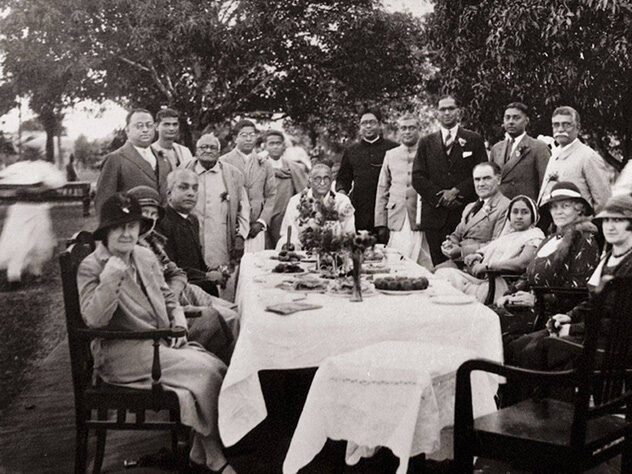
By the mid-1930s, Srila Bhaktisiddhanta Sarasvati Thakura had turned a single rented room in Calcutta, opened in 1918, into a movement with a presence across India and beyond. His health, meanwhile, was failing. He continued directing the Gaudiya Math's affairs and corresponding with disciples almost to the end, and died in Calcutta in the early hours of 1 January 1937, at the age of sixty-two.
| Died | 1 January 1937, Calcutta, Bengal Presidency, age 62 |
| Gaudiya Math centers founded | 64 in India, 3 abroad (London, Berlin, Rangoon) |
| Periodicals published | 7, in Bengali, English, Hindi, Assamese, and Odia |
| Sannyasa disciples initiated | 25 |
| Final instruction on governance | A twelve-man governing body to jointly manage the mission |
| Direct spiritual line | To A.C. Bhaktivedanta Swami Prabhupada, founder of ISKCON (1966) |
What He Left Behind #
Bhaktisiddhanta founded his first center in 1918 and died nineteen years later. In those years he established sixty-four Gaudiya Math centers across India. They were in Nabadwip, Mayapur, Calcutta, Mymensingh, Chittagong, Puri, Madras, Delhi, Varanasi, and Vrindavan, and in dozens of other towns. He also established three centers abroad, in London, Berlin, and Rangoon. His presses had produced periodicals in seven languages and a large body of Bengali Vaishnava literature. Much of it was his own translation and commentary on works such as the Chaitanya Charitamrita. He had personally initiated twenty-five disciples into sannyasa. This was the renounced order he had revived for Gaudiya Vaishnavism after it had been unused for centuries. He had also drawn a wider circle of educated, often wealthy followers into his mission. Scholars have since described this mission as the most powerful reform movement within Bengali Vaishnavism in its time.
Final Days #
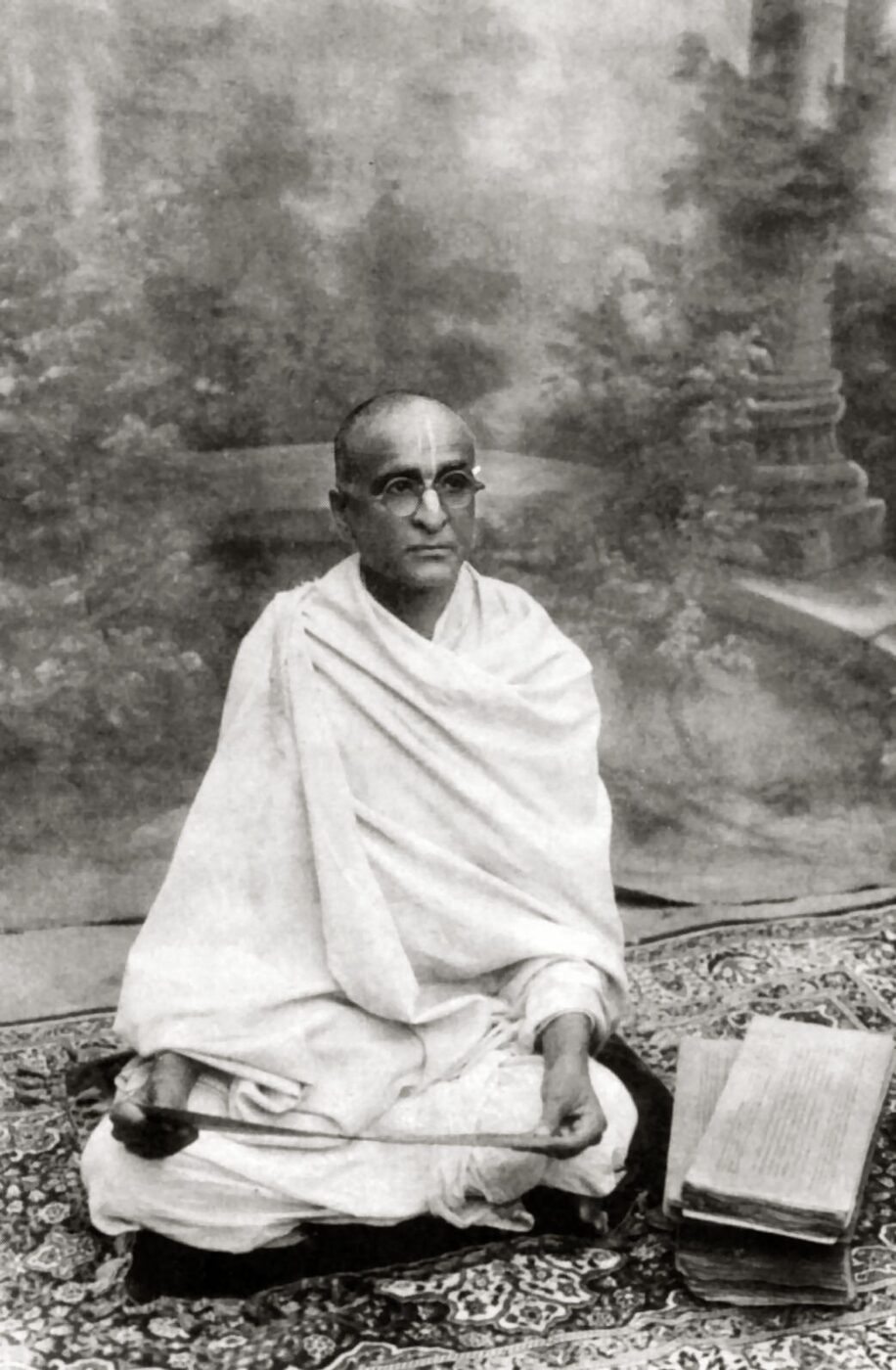
In October 1936 Bhaktisiddhanta went to Jagannatha Puri, where his final illness first became clear. There, at the Chatak-parvata, he observed the Appearance Day of Madhvacharya. This place is considered non-different from Giri-Govardhana. In his own final days there, he was heard again and again softly reciting verses of Rupa Gosvami and Raghunatha Dasa Gosvami addressed to Govardhana Hill: "Oh Govardhana, please fulfill my desire," and "Oh Govardhana, please give me a dwelling place on the banks of the pond nearby You." To his disciples he said plainly, "You all take to sincere Hari-bhajana. There are not many more days." He left Puri for Calcutta on 6 December 1936.
On the morning of 31 December, Bhaktisiddhanta asked one disciple to sing Sri Rupa Manjari by Narottama Dasa Thakura and another to sing the Shikshashtaka. He also asked that the Vaishnava Manjusha be finished and published. This was the encyclopedia of Vaishnava vocabulary that he had spent decades compiling. Among his last statements to his assembled disciples were, "Love and rapture, both should have the same end in view. Thakura Narottama lived on the principles of Rupa-Raghunatha. It is good to follow that path," and, to all present, "Please accept my blessings to you all, present and absent. Please bear in mind, our sole duty and religion is to spread and propagate service to the Lord and His devotees." Vaishnava accounts describe Bhaktisiddhanta spending his last days reading the Chaitanya Charitamrita and chanting on his beads. They say he refused medical treatment and made this request: "Simply chant Hare Krishna, that's all." He did not name a single successor to head the Gaudiya Math. Instead, he specifically instructed that its affairs be managed by a twelve-man governing body chosen from among the senior disciples. This arrangement was similar in spirit to the Governing Body Commission his own disciple Prabhupada would later establish for ISKCON. He passed from this world chanting the name of Krishna at about 5:30 in the morning on Thursday, 1 January 1937.
After his disappearance, his body was worshipped with scented oil, flowers, and sandalwood paste. Then it was carried in a great sankirtana procession to Sealdah railway station in Calcutta, and from there onward to Sridham Mayapur. Thousands gathered along the way for a final darshan. He was brought in turn to the Yogapitha, to Sri Shrivasa-angana, and finally to Vrajapattana, the place of his years of solitary bhajana. There he was laid to rest before the samadhi of his own guru, Gaura Kishora Dasa Babaji, on the banks of Radha-kunda, while devotees kept up an all-night kirtana.
The Crisis That Followed #
Bhaktisiddhanta was confident that qualified leaders would come forward naturally, because of their personal merit and not by appointment. But this confidence did not hold up against the practical work of running a large institution and its property. Within weeks of his death, a dispute broke out among his senior disciples over control of the mission and its assets. It hardened into rival groups and legal cases. The united Gaudiya Math first split into two rival institutions. Over the following decades it broke up further into a number of smaller independent groups, and each of them traces its authority back to Bhaktisiddhanta. This history is a recorded part of the Gaudiya Math's story. It is not a matter for this page to settle. So it is reported only briefly, without taking a side in disputes that were already decades old.
Legacy #
The breaking up of the institution did not undo what Bhaktisiddhanta had built into it. Scholars studying the period have compared the Gaudiya Math's reach and ambition to Swami Vivekananda's Ramakrishna Mission. In that era the impersonalist reading of Sanatana Dharma philosophy was dominant, and the Gaudiya Math challenged it. This challenge left a lasting mark on how Gaudiya Vaishnavism was understood in India. Through the Math's small early efforts in London and Berlin, it also left a mark on how Gaudiya Vaishnavism was understood in the West. Today the wider Gaudiya Math tradition that Bhaktisiddhanta founded has various independent branches. Together they are estimated to include more than forty institutions and hundreds of centers worldwide. In November 2023, UNESCO listed the 150th anniversary of his birth among the anniversaries it is associated with in 2024-2025. India put forward this proposal, with the backing of several other member states. This shows how far his reputation has traveled since 1937, not only as a religious teacher but also as a philosopher and social reformer.
But the clearest line from Bhaktisiddhanta's own work runs through one of his last disciples, who was also one of the least prominent at the time. This was A.C. Bhaktivedanta Swami. In 1966 he founded the International Society for Krishna Consciousness in New York. He carried the same teaching that Bhaktisiddhanta had asked him to spread in English on a Calcutta rooftop in 1922, and he carried it to a scale that neither man could have imagined in 1937. Asked once, years later, what he could say about his own guru, Srila Prabhupada answered simply, "What can I say? He was a Vaikuntha man!" The full guru-parampara connecting Bhaktisiddhanta, his disciple, and the tradition both served is set out on the sampradaya page.
