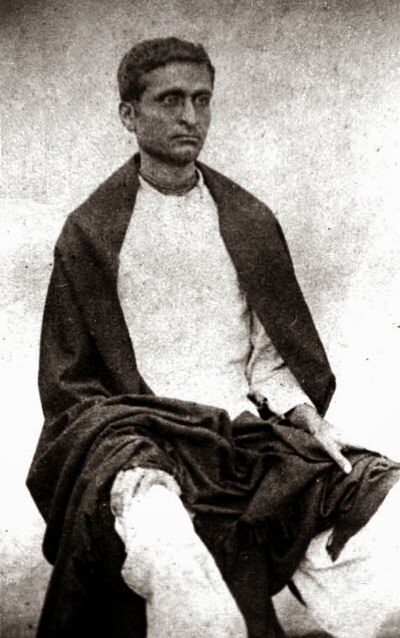
In 1887, at around thirteen, Bimala Prasad joined the Calcutta Metropolitan Institution, a college closely associated with the city's Western-educated Bengali elite, the bhadralok. There he pursued extracurricular studies in Sanskrit, mathematics, and jyotisha alongside the regular curriculum. Still a schoolboy, he so impressed his tutors with his command of astronomical calculation that they gave him an honorary title: Siddhanta Sarasvati, "the pinnacle of wisdom" in the exact sciences. He adopted it as his pen name from that point on, and later merged it with "Bhaktisiddhanta" into the name by which the world would eventually know him.
At around sixteen, while still at school, Bimala Prasad formed the Cirakumara Sabha, the "Assembly of Perpetual Bachelors," with a circle of friends. They met regularly at Calcutta's Beadon Square to discuss religious topics. Each member took a vow of celibacy, so that he would be free for devotional life instead of family duties. Of the whole assembly, only Bimala Prasad kept that vow without fail. This was an early sign of the disciplined renunciation that would mark the rest of his life.
| School (from 1887) | Calcutta Metropolitan Institution |
| Honorary title received | Siddhanta Sarasvati, "pinnacle of wisdom," for proficiency in Sanskrit grammar and jyotisha |
| Further study | Sanskrit College, Calcutta: Indian philosophy, ancient history, Vedic studies |
| Left Sanskrit College | 1895, after a dispute with the principal, Mahesh Chandra Nyayaratna |
| Post at Tripura court | Secretary and court historian (1895), then tutor to the royal princes (to 1908) |
| Independent teaching begun | Sanskrit school (catuspathi) and an astronomy school in Calcutta, 1897 |
Sanskrit College and a Parting of Ways #
In 1892, at eighteen, Bimala Prasad took the entrance examination and joined Sanskrit College. It was one of colonial Calcutta's leading colleges of classical learning. There he studied Indian philosophy and ancient history, and he read the Vedas under the guidance of the pandit Prithvidhara Sarma. He used the college library a great deal and read far beyond the set syllabus. Even as a student he wrote articles for religious journals. One of these was the Calcutta weekly Nivedana, where he published several pieces in 1899. During his college holidays he discussed the Vedas at length with Prithvidhara Sarma. By this stage he had already mastered five of the six traditional branches of Vedic learning: shiksha (pronunciation), kalpa (the sequence of Vedic rites), nirukta (etymology), chandah (Vedic metre), and jyotisha (astronomy and calendrical calculation). Prithvidhara Sarma urged him to take up the sixth branch, vyakarana or grammar, and to study the Siddhanta Kaumudi throughout his life. Bimala Prasad answered, "My life is for the single-minded cultivation of the teachings of Sri Chaitanya, not for the cultivation of grammar. I have only studied the Vedas, the branches of the Vedas and their related parts in a secondary manner."
In 1895 his formal studies there came to an end after a dispute over the astronomical calculations of the principal, Mahesh Chandra Nyayaratna. The episode shows that even as a student, Bimala Prasad was ready to challenge an established scholar's technical work instead of simply accepting his authority. By his own later account, there was more to the decision than the dispute itself. "If I remain studying with careful attention at the College," he wrote in his autobiography, "then extreme pressure will be brought upon me to enter family life, but if I am considered to be foolish and inefficient, then no one will put such an inducement upon me for becoming so engaged. By this consideration, I left the Sanskrit College, and, in order to maintain my life for the service of Hari, I was desirous of getting an honest occupation which I could perform with the intention of earning a humble income." He never returned to complete a formal college degree.
The Title Made Permanent #
The title Siddhanta Sarasvati was first given to him as a schoolboy for his skill in jyotisha. Over the following decade his knowledge of the subject grew from youthful promise into real scholarship, and the title became firmly established in Calcutta's learned circles. By around the age of twenty-five, according to his biographers, he had become thoroughly versed in Sanskrit, mathematics, and astronomy. He published many articles and prepared an edition of the ancient astronomical work Surya-siddhanta with his own commentary. This independent scholarly work, as much as the early recognition at school, fixed "Siddhanta Sarasvati" as his settled name among the bhadralok of Calcutta. He was a young man who had mastered the traditional Sanskrit sciences. He had also mastered the historical and philosophical learning valued by the Western-educated elite of his generation. And he had done this without passing through a university.
Secretary, Historian, Tutor #
In 1895, the same year his Sanskrit College studies ended, the Maharaja of Tripura, Bir Chandra Manikya, offered the young scholar a position at the royal court. The Maharaja was an associate of his father. The post was secretary and historian, and it included editing a chronicle of the Tripura royal line, the Rajaratnakara. The post gave him financial independence. More importantly, it gave him access to the palace library, where he read deeply in Indian and Western works of history, philosophy, and religion. After the Maharaja's death in 1896, his successor, Radha Kishore Manikya, asked Siddhanta Sarasvati to tutor the royal princes in Bengali and Sanskrit. He held this role until 1908. The king also asked him to stop dishonest court officials from misusing royal wealth. Siddhanta Sarasvati did so quickly, and the Maharaja was very pleased. Later he was also given the duty of inspecting the administration of the royal palace. But he became unhappy when he found envy and corruption in its affairs, and in time he gave notice that he wished to leave state service altogether. The Maharaja granted him a full pension in recognition of his service. Siddhanta Sarasvati accepted it for three years and then, by his own choice, gave that up too.
Early Teaching and Independent Scholarship #
Even while serving the Tripura court, Siddhanta Sarasvati was building an independent life of teaching and publishing in Calcutta. In 1897 he founded his own catuspathi, a traditional Sanskrit school, which he named Saraswati Chatuspati. From this school he brought out journals on astronomy and astrology, including Jyotirvid and Brihaspati. He also brought out editions of older astrological works such as the Surya-siddhanta, and an almanac he called the Bhakti Panjika. He was so well respected in this field that Sir Asutosh Mukherjee offered him a post as professor of astronomy at the University of Calcutta. Siddhanta Sarasvati declined the offer, because he felt it would be an obstacle to his spiritual life. At the request of Srila Jagannatha Dasa Babaji, he later composed the Sri Navadvipa Panjika. In this almanac the months, lunar days, and constellations were renamed after Vishnu. In 1898 he studied the Siddhanta Kaumudi, a standard Sanskrit grammar, under Prithvidhara Sarma at Bhakti Bhavana, his father's devotional center. He also opened an astronomy school in Calcutta.
During this same period he took up an austerity that was an early sign of the far more severe vows of his later bhajana years. From 1897 he strictly observed Chaturmasya, the four-month rainy-season vow. He cooked a single preparation for himself each day and lay on the bare earth without bedding or pillow. In 1898 he went with Bhaktivinoda Thakura on a tour of Benares, Prayaga, and Gaya, where he discussed philosophy with followers in the line of Ramanujacharya. By then, word of his debating skill had spread widely. On one occasion during his college years, a public debate on astrological calculation was held at the home of Sri Rajendra Chandra Sastri. There he defeated the scholar Panchanana Sahityacharya, a disciple of the noted professor Vasudeva Sastri. He defeated him so thoroughly that afterward few scholars in Calcutta were willing to debate him, for fear of a similar defeat.
So by his mid-twenties, Siddhanta Sarasvati was already a recognized teacher and scholar. He was equally at ease with Sanskrit grammar, with jyotisha, and with the historical and philosophical reading he had taken in at the Tripura court library. Across Calcutta's learned circles he was known by the title that, taken literally, named him "the pinnacle of wisdom."
Yet by his own later account, this very success began to leave him unsatisfied. It was success in the world that the bhadralok valued most. His dissatisfaction with a life measured in titles, positions, and scholarly recognition would, within a few years, lead him to seek out a very different kind of teacher. That story is told on the next page: Initiation from Gaura Kishora Dasa Babaji.
