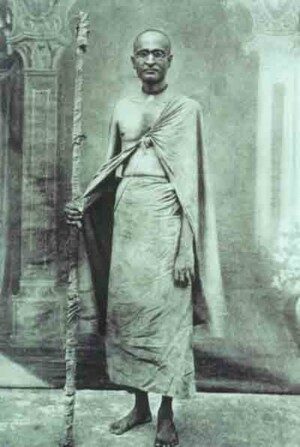
By his mid-twenties, Bimala Prasad was known across Calcutta's learned circles as Siddhanta Sarasvati. He held a secure position as tutor to Tripura's royal princes. He had real authority as a scholar in Sanskrit, jyotisha, and philosophy, and he moved comfortably among the bhadralok, Calcutta's Western-educated elite. By his own account, none of it satisfied him. He had come to feel that his religious life, for all its learning, was "confined to books and to a strict ethical life," and that such a life was incomplete. It needed contact with someone who lived devotion, and did not only study it. At his father's direction, he set out to find such a person. He found him not in Calcutta's colleges or courts, but living beneath a tree on the bank of the Ganga: the ascetic Gaura Kishora Dasa Babaji.
| Guru sought | Gaura Kishora Dasa Babaji, Vaishnava ascetic |
| Approached on the advice of | Bhaktivinoda Thakura |
| Initiation | Around 1900, at Godruma near Mayapur (by his own later testimony, January 1901) |
| Name received | Sri Varshabhanavi-devi-dayita Dasa ("servant of Krishna, the beloved of Radha") |
| Prior standing | Titled scholar, tutor to Tripura's royal princes |
An Illiterate Teacher for a Titled Scholar #
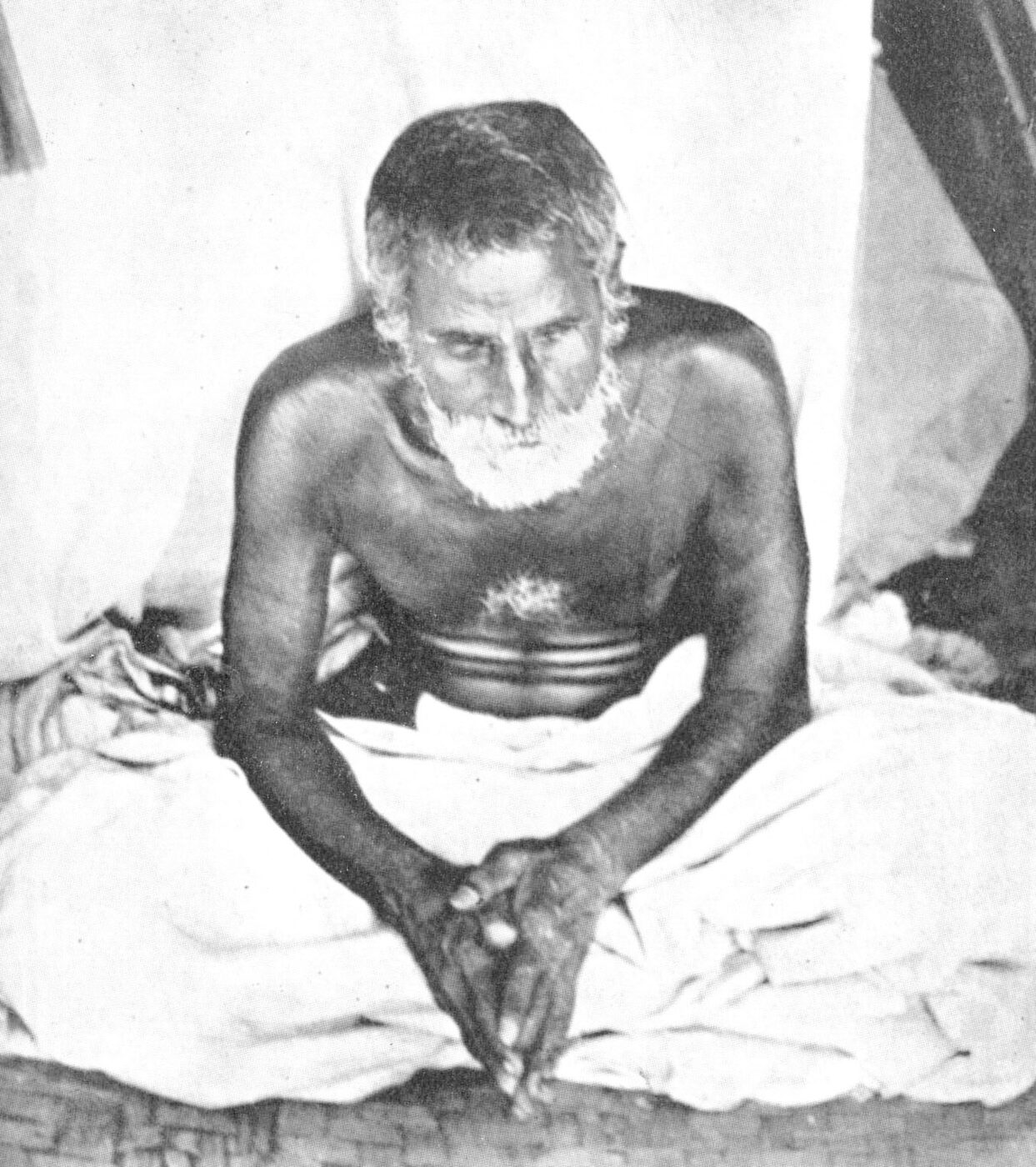
Every account agrees that Gaura Kishora Dasa Babaji was an unlikely guru for a man with Siddhanta Sarasvati's formal learning and titles. He could not read. He lived in extreme austerity. His waistcloth was reportedly made from cloth discarded from the dead. He ate plain rice soaked in Ganges water and seasoned with little more than salt and chili. Sometimes he cooked in thrown-away earthen pots that he had cleaned himself. He held no post, published nothing, and sought no following. But Bhaktivinoda Thakura, and the son he sent to find him, judged that he had something Siddhanta Sarasvati's own education had not given him. It was a life of devotion practiced so completely that it needed no books to pass it on. Bhaktisiddhanta Sarasvati later reflected on what it meant to finally meet such a person after years of purely intellectual religion:
It was by providential dispensation that I was able fully to understand the language and practical side of devotion after I had met the practicing master [Gaura Kishora Dasa Babaji]... Up to that time, my idea of religion was confined to books and to a strict ethical life, but that sort of life was found imperfect unless I came in touch with the practical side of things.
A Guru Who Made Him Wait #
Vaishnava biographers relate that Gaura Kishora Dasa Babaji did not accept Siddhanta Sarasvati readily. Known for being highly selective about whom he initiated, he is said to have turned the young scholar away three times. When Siddhanta Sarasvati first approached him at Bhaktivinoda Thakura's urging, in the month of Magha, 1900, Gaura Kishora Dasa Babaji replied only, "Mahaprabhu will be asked. If He gives permission, your desire will be fulfilled." On a second visit Siddhanta Sarasvati asked what Mahaprabhu's order had been, and received the answer, "I forgot to ask." A third time he was told, "I asked. I did not receive the command of Mahaprabhu." At this, Siddhanta Sarasvati stood up, his heart breaking. Weeping as he spoke, he pleaded that if he received no mercy he could no longer sustain his life. Seeing this, Gaura Kishora Dasa Babaji's heart melted, and he told the young scholar to bathe in the Sarasvati river and then return to him.
Vaishnava biographers also compare this episode to the slowness with which Lokanatha Gosvami once accepted Narottama Dasa Thakura as his only disciple. Lokanatha Gosvami, too, was a humble and renounced paramahamsa, slow to accept anyone into his shelter. Siddhanta Sarasvati never gave up. He is also said to have compared his own persistence to that of the medieval philosopher Ramanuja. By tradition, Ramanuja was turned away eighteen times before his own guru agreed to accept him. Siddhanta Sarasvati is said to have declared that he too would wait as long as necessary. We do not know exactly what passed between them. The details come down to us only through devotional memoir, not through independent record. But the outcome is not in doubt. Gaura Kishora Dasa Babaji accepted him and gave him initiation in a grove at Godruma near Mayapur. In the words his disciples remembered, he told him to preach the Absolute Truth and set aside all other work.
A New Name and a Disputed Date #
Bhaktisiddhanta Sarasvati himself later dated his acceptance of Gaura Kishora as guru to January 1901, though other accounts place the meeting in the closing months of 1900. With the initiation came a new name, Sri Varshabhanavi-devi-dayita Dasa, "servant of Krishna, the beloved of Radha," and, by his own later writings, instruction in the chanting of the Hare Krishna mantra. The full story of that acceptance, told from the guru's own side, appears on Gaura Kishora Dasa Babaji's page on initiating Bhaktisiddhanta Sarasvati.
How Calcutta's Educated Vaishnavas Received It #
Nothing in the record suggests that the bhadralok circles he had moved in until then stayed silent about his choice of guru. In the Calcutta of his young adulthood, people more and more judged spiritual authority by exactly the qualifications he already had. These were Western and Sanskrit education, published scholarship, a respected position in an institution, and a good command of the new reformist religious ideas then rising among the educated middle class. An ascetic who could not read, who lived under a tree, and who could show nothing except a life of visible renunciation went directly against those ideas. Bhaktisiddhanta Sarasvati would spend much of the following decade arguing, in essays and public debates, that devotion, not birth, learning, or social position, was the true measure of a person's spiritual standing. This stand brought him into conflict with parts of Calcutta's brahminical and bhadralok establishment. His choice of guru in 1900 was, in effect, the first and most personal expression of that same belief. He had gone looking for someone who lived what the books described. He found him in a man whom his own social world would not have looked at twice.
Years of Bhajana #
Around the time of his initiation, Siddhanta Sarasvati was not living in seclusion. He accompanied Bhaktivinoda Thakura to Puri in March 1900 to help establish a place of bhajana near the samadhi of Haridasa Thakura. There he began compiling a Vaishnava encyclopedia of terms, biography, and doctrine that he called Vaishnava-Manjusha-Samahriti. It was later published in four volumes. One Vaishnava scholar who read it remarked that the work "is only possible for a supra-mortal, a great personality," beyond what even twenty-five or thirty ordinary scholars working together could do. Between 1904 and 1905 he toured South India, preaching and debating pandits in Tirupati, Srirangam, Kumbhakonam, Madurai, and elsewhere. On this tour he met a tridandi swami of the Ramanuja line at Perambadur. From him he first gathered detailed knowledge of the rites of Vedic tridanda Vaishnava sannyasa. He would use this knowledge years later, when he himself accepted the sannyasa order.
In 1905, at thirty-one, he began the great vow that would define his next decade. He chanted three lakh, or three hundred thousand, names of the Lord daily, some 192 rounds, in the manner of Haridasa Thakura. He worked out that at this rate he would complete a billion names in about nine years. At first he lived in a grass hut at the Yogapitha, the birthsite of Chaitanya Mahaprabhu. From February 1909 he lived in a cottage he built nearby at Vrajapattana, on the site of the house of Chandrashekhara Acharya, Chaitanya Mahaprabhu's uncle. He cooked sun-dried rice in ghee and ate it from the floor, and he slept without a pillow. He never interrupted his chanting. Even when the roof of his hut broke, he simply held an umbrella against the rain. Watching this austerity, Gaura Kishora Dasa Babaji remarked, "I observe that the renunciation of Sri Rupa-Raghunatha is manifest in my Prabhu," speaking of his own disciple as "my Prabhu." This reversed the usual custom, in which a disciple, not a guru, uses this title of respect. Srila Prabhupada later described this period of his own guru's life: "From childhood he was a strict brahmachari, Bhaktisiddhanta Sarasvati Gosvami Maharaja. And he underwent very severe penances for starting this movement, world-wide movement. That was his mission." Even in the midst of this solitary bhajana, Siddhanta Sarasvati initiated his own first disciple in 1906. It was a quiet first sign that the seeker who had once wept for his guru's mercy would soon be sought out by others in the same way.
For Siddhanta Sarasvati, his decision to take this guru did not mean rejecting his education. It meant giving it a new direction. He did not abandon his scholarship. Over the following years he brought it into the service of the tradition his new guru lived by. The full results of this change, in the institution he went on to build, are told on the next page: Founding the Gaudiya Math.
