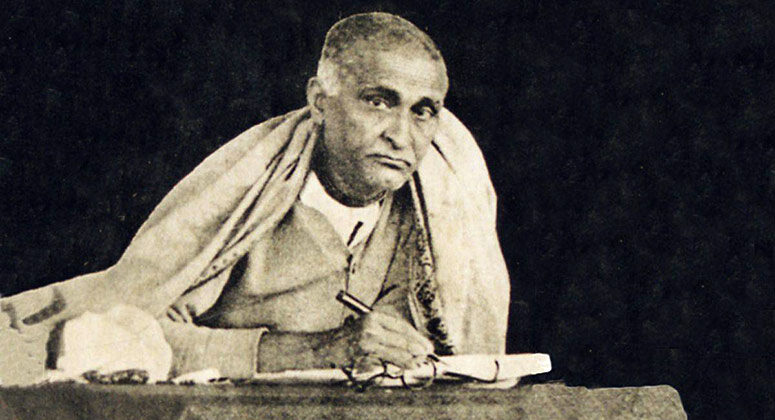
In a kirtana, the mridanga is the two-headed clay drum that carries the rhythm of the chanting. By long custom, its sound is considered inseparable from the holy name itself. Srila Bhaktisiddhanta Sarasvati Thakura surprised his own tradition by arguing that a printing press, run properly, was a bigger and more effective mridanga than the instrument in anyone's hands. His disciples remembered him calling it a brihad mridanga, a "great mridanga," and they remembered his reason. The sound of a drum reaches only as far as a courtyard or a temple hall. But a printed page carries the same message to readers who could never be reached in person. It also reaches more people than any group of kirtana singers could ever speak to directly.
A Father's Instruction Made Into a Mission #
This belief did not begin with Bhaktisiddhanta. In 1910, his father Bhaktivinoda Thakura wrote to him from Mayapur with an instruction. Looking back, it reads like a mission statement handed from one generation to the next: "The real service to Sri Mayapur can be done by acquiring printing presses, distributing devotional books, and sankirtana-preaching... I had a special desire to preach the significance of such books as Srimad Bhagavatam, Sat Sandarbha, and Vedanta Darshan. You have to accept that responsibility." Bhaktivinoda had spent decades of his own life doing exactly this on a smaller scale. He ran the Vaishnava Depository press and the Sajjana-toshani magazine from his home. Bhaktisiddhanta took up the instruction and carried it out on a far larger scale.
Bhagavat Yantra: God's Machine #
On 6 February 1913, Bhaktisiddhanta rented a house at #4 Sanagar Lane in the Kalighat section of Calcutta, for thirty-six rupees a month. This was still years before he accepted sannyasa or founded the Gaudiya Math as an institution. He set up a printing press there and gave it a name that stated his theology openly: bhagavat-yantra, "God's machine." Its first major project was a new edition of Krishnadasa Kaviraja Goswami's Chaitanya Charitamrita, the central biography of Chaitanya Mahaprabhu. It was printed with Bhaktivinoda Thakura's Amrita-pravaha-bhashya, together with Bhaktisiddhanta's own long Anubhashya commentary on the medieval Bengali text. The press also brought out the Bhagavad-gita with Vishvanatha Chakravarti Thakura's Sararthavarshini commentary and Bhaktivinoda Thakura's own Rasikaranjana commentary. After his father's death in 1914 he moved the press to Mayapur and then to nearby Krishnanagar. He continued both the Chaitanya Charitamrita project and his father's Sajjana-toshani without a break.
Why Print Rather Than Preach Only Aloud #
Oral kirtana and lecture remained central to Bhaktisiddhanta's own daily practice and to the Gaudiya Math's public life. For him it was never a choice of one or the other. But he saw particular advantages in the printed page that oral preaching alone could not give. A book did not get tired, forget a verse, or need to sleep. It could be read again at whatever speed and depth the reader chose. A skeptical college graduate could study it as carefully as a devotional history by Rupa Gosvami. It could travel to London, Berlin, or Rangoon in a trunk. It could reach a reader Bhaktisiddhanta himself would never meet, long after he was no longer alive to give the lecture in person. After he had accepted sannyasa and seriously begun founding Gaudiya Math centers across India, he built a press, editorial staff, and distribution network into nearly every one of them. He used the same principle to justify using other plain modern technology as instruments of bhakti, not as distractions from it. These included motorcars, loudspeakers, and even airplanes for a preaching tour that was planned but never took place.
A Publishing Operation, Not a Sideline #
By the end of his life, Bhaktisiddhanta's presses had produced periodicals in seven languages: the Bengali fortnightly Sajjana-toshani inherited from his father, the English fortnightly The Harmonist, the Bengali weekly Gaudiya (from which the Gaudiya Math itself took its name), a Hindi fortnightly called Bhagavata, a Bengali daily, an Assamese monthly, and an Oriya periodical. They also produced a steady stream of book editions of the standard Gaudiya Vaishnava texts. Publishing was not a small side activity of an institution built mainly around temples and preachers. It was one of the institution's main activities. Bhaktisiddhanta gave it staff and money, and he defended it as seriously as any temple's daily worship.
Technology in the Service of Devotion #
The press was one example of a wider principle that Bhaktisiddhanta applied on purpose throughout his mission: yukta-vairagya, a term coined by Chaitanya Mahaprabhu's associate Rupa Gosvami meaning "renunciation through engagement." Bhaktisiddhanta did not treat modern technology as worldly and therefore to be avoided. He held that any object, such as a printing press, a motorcar, or a loudspeaker, became spiritual the moment it was used purely in service to Krishna and not for personal enjoyment. This let him use the latest advances in printing, transportation, and communication without weakening what he considered the unchanged core teachings of the Chaitanya tradition. He did not choose the printing press mainly because of any casual fondness for machinery. He chose it because of this same reasoning. For a mission that meant to reach readers a kirtana party never could, the press was the obvious choice of instrument.
The Conviction Passed Down #
The clearest sign of how deeply this belief took root is what his disciple Srila Prabhupada did with it. Decades later, Prabhupada founded the Bhaktivedanta Book Trust to mass-produce his own translations and commentaries for a Western audience. He would describe his press in nearly the same words: "ISKCON Press remains our big mridanga and the backbone of our movement." He told disciples plainly that this had been his own guru's firm opinion, not just a figure of speech used for effect: "My Guru Maharaja used to say that this press is brihad-mridanga... the sound of press goes long, long distance, to long distant places." It began as one press, named for God, in a rented Calcutta building. Through a direct line of instruction from Bhaktivinoda to Bhaktisiddhanta to Prabhupada, it became one of the largest publishing operations in the history of any religious movement. See the full catalog of Prabhupada's books. The story of how this belief in publishing reached its fullest expression is told in Launching Back to Godhead.
