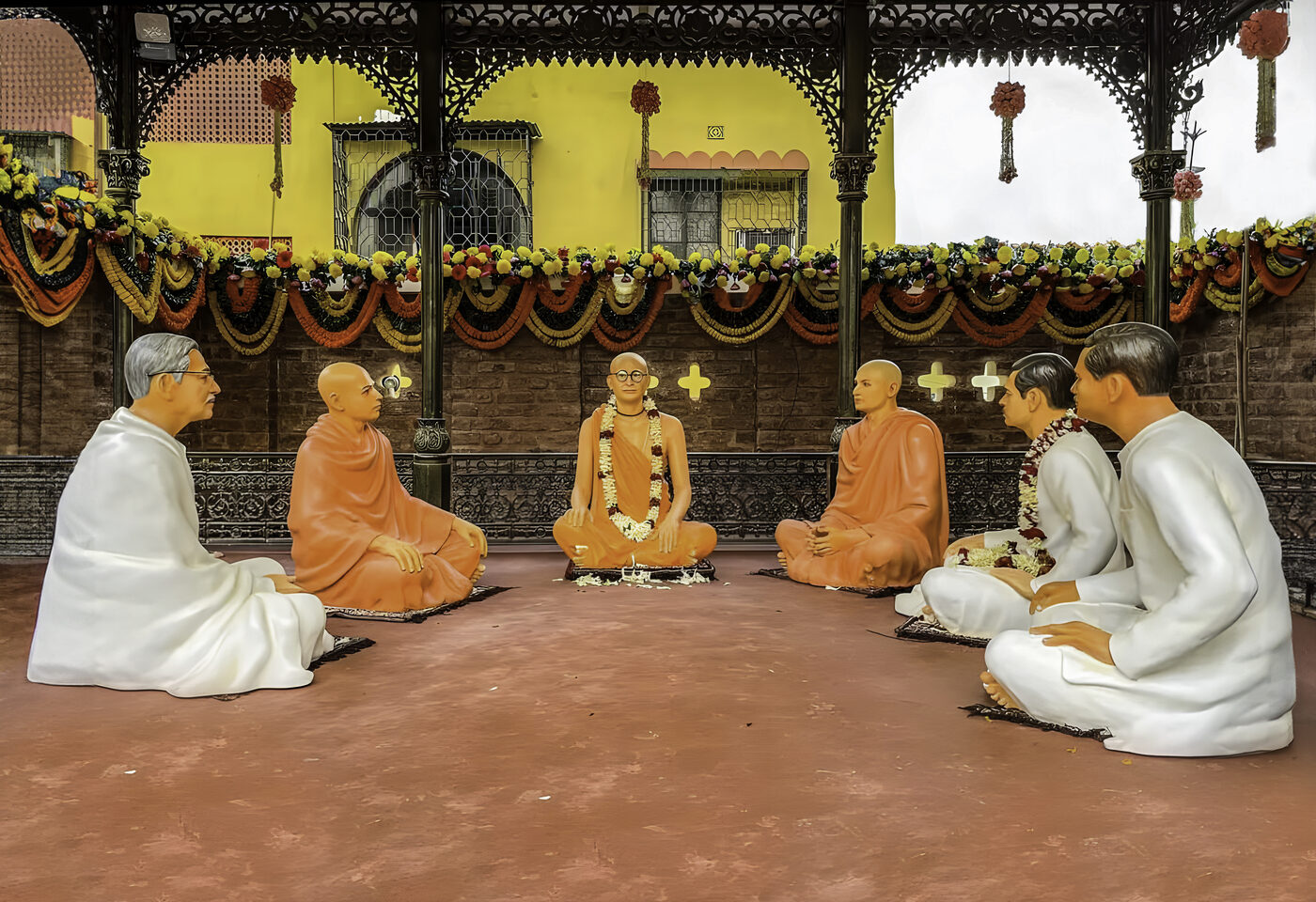
In 1922, a young Calcutta businessman named Abhay Charan De was brought, unwillingly, to a rooftop meeting with a sadhu he had no particular interest in seeing. Abhay and the friend who dragged him there had not yet finished offering their obeisances when Srila Bhaktisiddhanta Sarasvati Thakura spoke first: "You are an educated young man. Why don't you take the message of Chaitanya Mahaprabhu and spread it in English?" That story is told in full, from Abhay's side, on Srila Prabhupada's own pages: Meeting His Spiritual Master and The Order to Preach in English. This page tells the same story from the other side. It explains what in Bhaktisiddhanta's own mission led him to make this appeal to a stranger. It also shows how the relationship he began that evening grew over the fifteen years of life that remained to him.
A Question Bhaktisiddhanta Had Been Asking for Years #
By 1922, Bhaktisiddhanta had spent more than a decade preparing for exactly the kind of moment this meeting was. From his father, Bhaktivinoda Thakura, he had inherited a conviction that Chaitanya Mahaprabhu's teaching belonged to the whole world, not to Bengal alone. He had also received a specific instruction to make printing and preaching, not solitary practice, the main work of his mission. He had also inherited his father's confidence about the educated, English-speaking Bengali middle class, the bhadralok, into which Bhaktisiddhanta himself had been born. This class was not to be avoided by a serious Vaishnava mission. It was to be actively recruited, because its members alone had the language and the education to carry Krishna consciousness past India's borders. In Bhaktisiddhanta's eyes, Abhay Charan De was exactly the kind of person this effort had to reach. He was a college-educated young man who knew English and moved in nationalist and business circles. That evening he was dressed in the white khadi of a Gandhi follower. Bhaktisiddhanta's opening words were not casual talk before the real conversation. They were the same message he had been preparing and repeating, in one form or another, since he took over his father's press.
An Answer That Revealed the Whole Man #
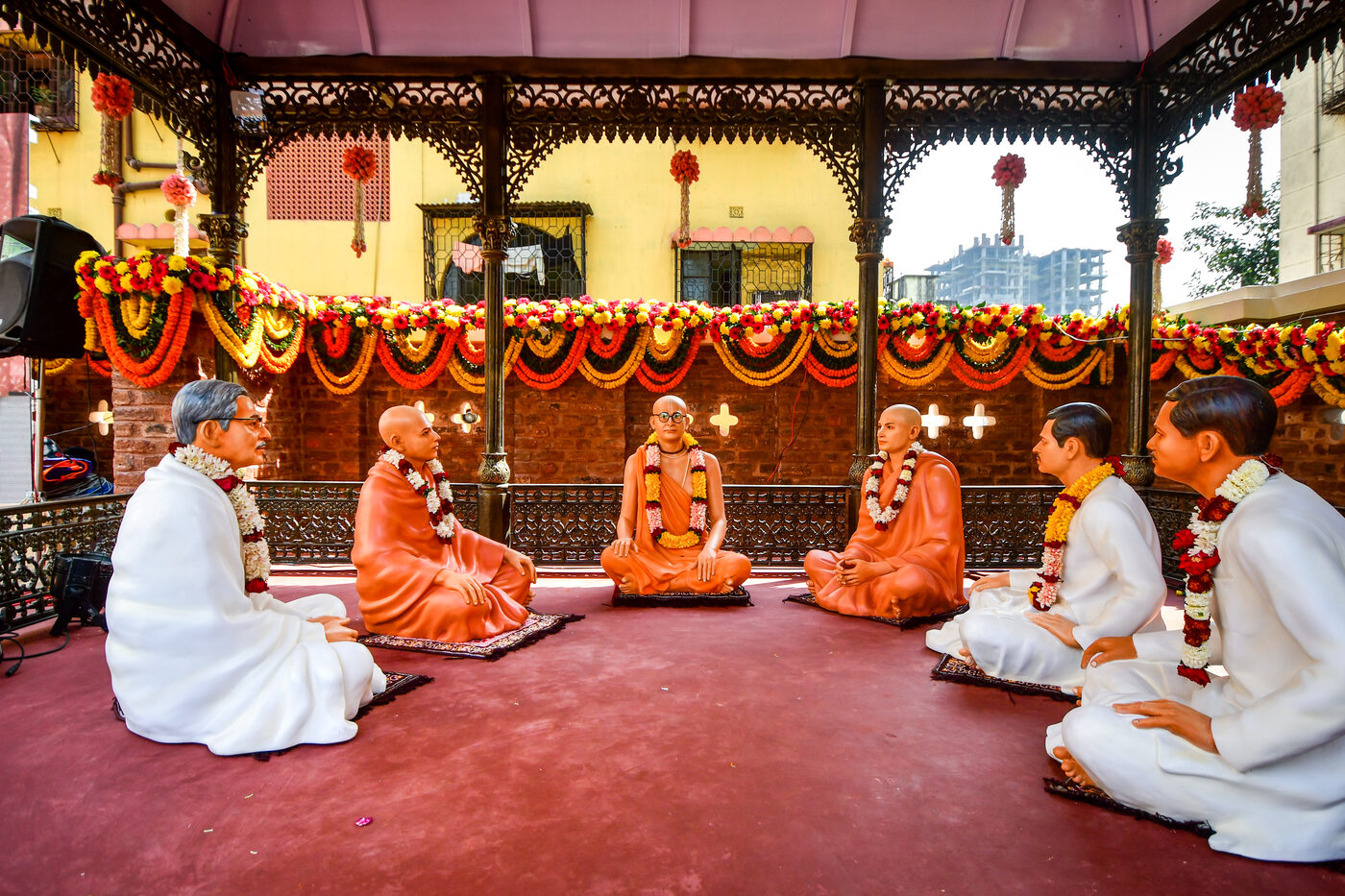
Abhay did not accept this instruction quietly. He raised the usual nationalist objection of the day. A nation ruled by others, he argued, had no right to export its culture until it had won its own political freedom. Bhaktisiddhanta replied partly in English and partly in Bengali. He did not dispute the facts of the argument. He set the argument aside. He said that Krishna consciousness addressed the eternal position of the soul, and that this truth did not wait for the outcome of any nation's politics. He added that to make one's own country, instead of one's relationship with God, the object of highest devotion was itself a subtle illusion. Vaishnava biographers record that Abhay left that rooftop meeting more than two hours after it began. He told his friend that the message of Chaitanya Mahaprabhu was "in the hands of a very expert person," and he later said that he had accepted Bhaktisiddhanta as his guru in his heart that same evening. But eleven years would pass before any formal ceremony confirmed it.
A Long Gap, Then a Steady Return #
After this came years of near silence, not immediate discipleship. Abhay built a pharmaceutical business in Allahabad, and Bhaktisiddhanta spread the Gaudiya Math across India and, more and more, abroad. Contact began again only in January 1928. A Gaudiya Math sannyasi arrived unannounced in Allahabad, looking for support for a new center there. Abhay recognized him from his earlier short contact with the Math in Calcutta, and he became one of the center's steadiest local supporters. In October 1932, Bhaktisiddhanta led several hundred disciples on a month-long parikrama around Vrindavan. Abhay traveled from Allahabad to join the pilgrimage for one of its days, at Kosi. He sat listening with full attention as Bhaktisiddhanta spoke for hours. In this way, after a decade of only indirect contact, he was again in direct contact with his future guru. On this occasion Bhaktisiddhanta noticed him in the crowd and remarked simply, "He likes to hear. He does not go away."
Formal Initiation, 1933 #
The following November, the Allahabad Gaudiya Math held a ceremony to lay the cornerstone of a permanent temple. Bhaktisiddhanta presided, and the governor of the United Provinces was the guest of honor. Abhay learned that Bhaktisiddhanta would also be giving initiations that day, and he asked to be included. He received first initiation into chanting. Unusually, on the same occasion he also received the sacred thread of second initiation. This was a sign of trust that Bhaktisiddhanta did not give as a matter of course. He gave Abhay the name Abhay Charanaravinda, "Abhay whose shelter is the lotus feet of Krishna."
Print Books #
At the end of 1936, Bhaktisiddhanta and his disciple were walking together at Radha-kunda near Vrindavan. Bhaktisiddhanta told him how troubled he was by quarrels among senior Gaudiya Math leaders in Calcutta. They were fighting over control of a newly built temple, and he feared the dispute would go on after he was gone. "It would be better," he said, "to take the marble from the walls and secure money. If I could do this and print books, that would be better." Then, turning to Abhay directly, he gave the instruction that would shape the rest of Abhay's life: "If you ever get money, print books." More than two decades would pass before Abhay, by then Srila Prabhupada, had the means to carry it out on a large scale. But he said afterward that in that moment the words entered his life permanently.
A Final Letter #
By December 1936, Bhaktisiddhanta's health had failed seriously. Abhay was busy with business in Bombay. He knew that most of his godbrothers were serving their guru directly as renunciants, while he was still a householder. So he wrote to ask whether there was some particular service he could do. Bhaktisiddhanta's reply is dated 3 December 1936, and it is among the last letters he wrote to any disciple. In it he returned to the same instruction he had given on that Calcutta rooftop fourteen years earlier: "I am fully confident that you can explain in English our thoughts and arguments to the people who are not conversant with the languages of the other members... I have every hope that you can turn yourself into a very good English preacher." Bhaktisiddhanta Sarasvati passed away less than a month later, on 1 January 1937. He had begun with this instruction as a stranger on a rooftop, and he ended with it as a dying guru writing to a trusted disciple. The instruction itself never changed. What remained to be seen was how completely Srila Prabhupada would fulfill it, decades later.
