Long before he compiled a single line of the Hari-bhakti-vilasa, Gopala Bhatta Goswami had already become known in Vrindavana for his intense personal worship. On a pilgrimage north to the Gandaki River in Nepal, he had collected twelve shalagram-shilas. These are small, dark, spiral-marked ammonite stones that Vaishnavas worship as a direct, self-manifested form of Vishnu. They need no ritual installation, because they are already understood to be the Lord himself. He carried these twelve shilas with him afterward and worshipped them every single day with full ceremony.
| Detail | Description |
|---|---|
| Number of shalagram-shilas | Twelve, collected from the Gandaki River in Nepal |
| Deity's traditional appearance date | Full moon of Vaishakha, 1542 |
| Deity's name | Sri Radha Raman ("the one who gives Radha delight") |
| Unique feature | No separate form of Radharani; a crown placed at His left side represents Her presence |
| Standing | One of the seven original principal Deities of Vrindavana |
| Status today | Worshipped continuously at the same site; never moved to Jaipur during the Mughal period |
A Longing Kept Quietly #
According to the story Vrindavana still tells, a wealthy visitor once arrived with fine cloth and ornaments to offer Gopala Bhatta's shalagram-shilas in charity. But these gifts were made for a form with arms, legs and a neck to wear them on. They could not actually be used to decorate stones that have none of these features. Gopala Bhatta kept the offerings carefully instead of turning them away. But the moment seems to have made stronger a wish he had already been carrying quietly in his heart. In prayer he expressed a wish to serve the Lord in a form he could dress and decorate directly, with a smiling face and moving limbs. He wanted a form with which he could have the kind of close, personal exchange that his stones, by their nature, could not offer. He is remembered as thinking of how Krishna, as Lord Nrisimha, had once come out bodily from a stone pillar to protect Prahlada Maharaja. For Gopala Bhatta this was proof enough that the Supreme Lord was never bound by the form in which his devotees happened to be worshipping him.
An Ordinary Evening #
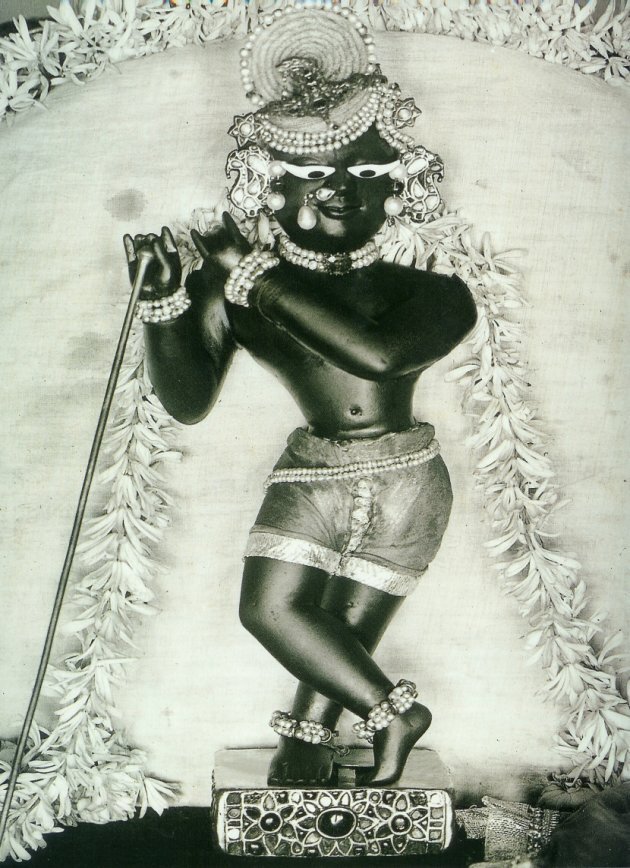
By every account, the night itself began exactly like every other night of Gopala Bhatta's worship. He offered his usual bhoga and arati to the twelve shilas, then set them to rest under a simple wicker basket, as he always did, and went out before dawn to bathe in the Yamuna. There was no sign in the preparation that anything unusual was about to happen. He returned and lifted the basket to begin the morning's worship. Then he found eleven shalagram-shilas exactly where he had left them. Standing among them was an ornamented form of Krishna, bending in three places and playing a flute. The form was smiling and complete down to the fingernails and teeth, and part of the original stone's dark, ammonite surface could still be seen along its back. One of the twelve, remembered afterward as the Damodara-shila, had become a living Deity.
Naming Radha Raman #
Gopala Bhatta and the Vrindavana Vaishnava community around him named the new Deity Sri Radha Raman. To this day the Deity stands without a separate murti of Radharani beside him. Instead, a small crown is placed at his left side to represent her eternal presence there. Rupa Gosvami and Sanatana Gosvami are remembered as personally guiding the young Deity's installation and the building of a temple. They approved a form of worship that Gopala Bhatta was specially qualified to design correctly. For this he drew on the same scriptural research that went into the Hari-bhakti-vilasa.
One Temple That Never Left #
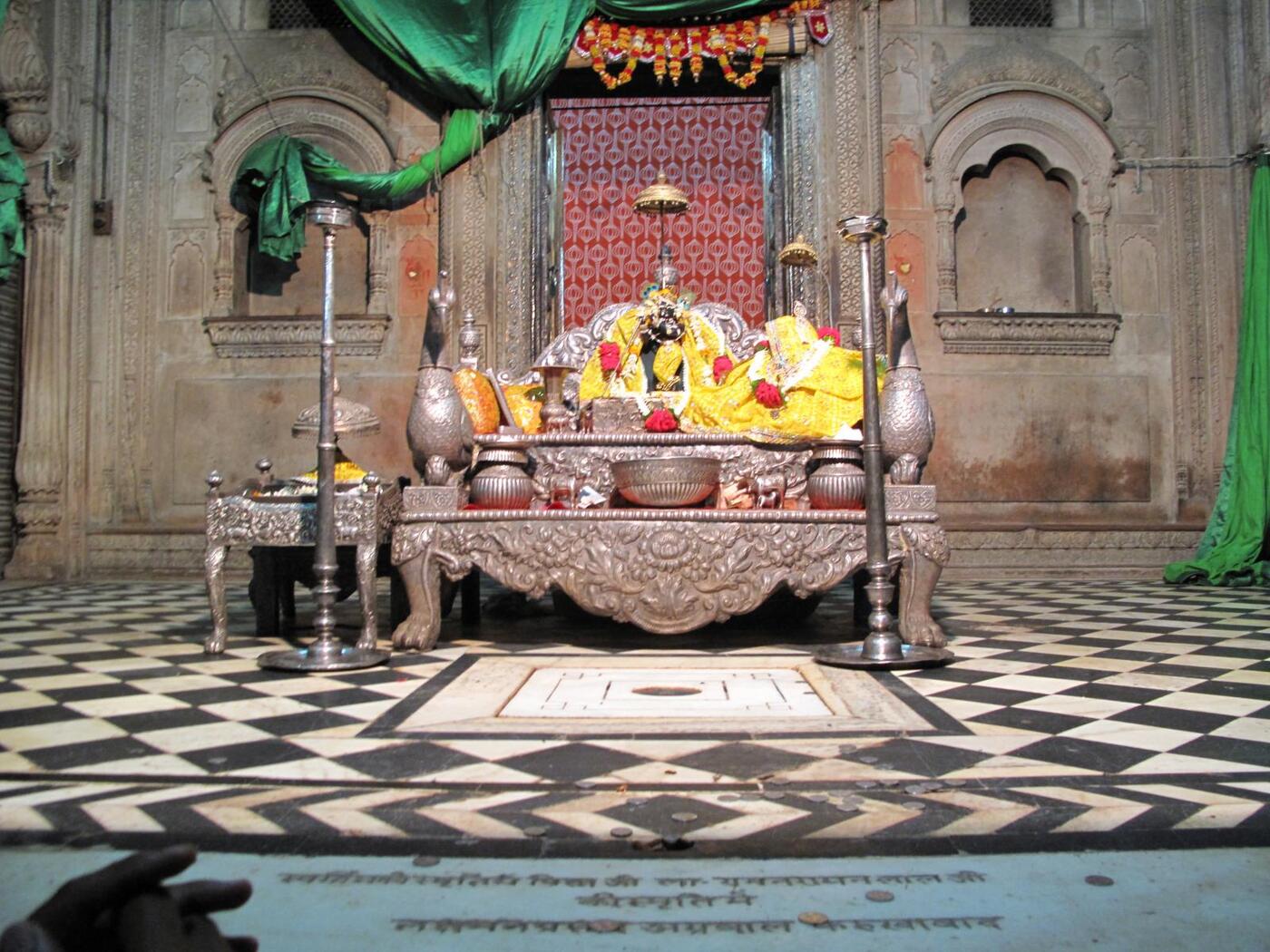
Radha Raman is counted today among the seven original principal Deities installed by the Goswamis of Vrindavana in the sixteenth century, alongside Radha Damodar, Radha Govind Dev, Radha Gopinath, Radha Madan Mohan, Radha Shyamsundar and Radha Gokulananda. In the later Mughal period, Aurangzeb's campaigns against Vrindavana's temples forced several of these original Deities to be carried away to Jaipur for safekeeping. Govindaji and Madan Mohan were among them. Radha Raman alone is remembered as never having left. Sources describing this period do not agree on every detail of how each Deity left, and how some of them, in some cases, later returned. But none of them records Radha Raman ever leaving Vrindavana at all.
A Living Shalagram-Deity #
Gaudiya Vaishnava tradition treats Radha Raman as special even among Deities. He emerged directly from a shalagram-shila. He was not carved and then ritually invoked. For this reason he is regarded as needing no pran-pratishtha, the separate ceremony that calls the Lord's presence into the form, in the way an ordinarily sculpted Deity does. By every account, the Deity that Gopala Bhatta found waiting inside his basket one ordinary morning has stood in the same place, in continuous worship, ever since. This connects directly to Disappearance and Legacy, the last chapter of Gopala Bhatta Goswami's own life.
