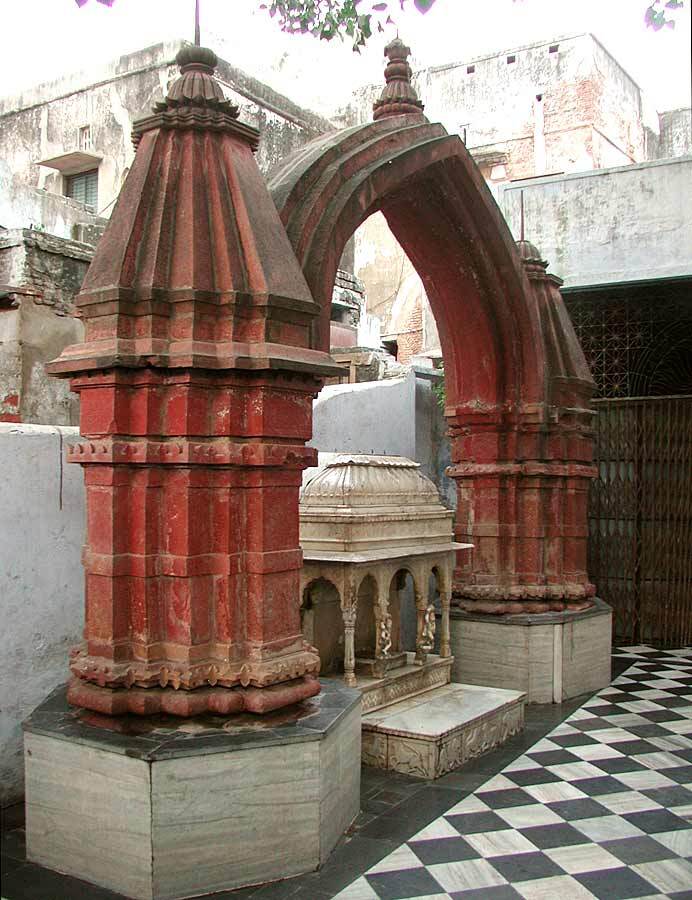
Gopala Bhatta Goswami is traditionally said to have left this world in 1578, on the sixth day of the dark half of the month of Shravana, at about seventy-five years of age. His life had carried him from a Sri Vaishnava temple town on the Kaveri River to the very heart of Gaudiya Vaishnava Vrindavana. His samadhi stands today within the Radha Raman temple complex, close to the spot where the Deity itself first appeared. Pilgrims visiting the temple still pay their respects there as part of the same visit.
| Detail | Description |
|---|---|
| Disappearance | Traditionally the 6th day of the dark half of Sravana, 1578, at about 75 years of age |
| Samadhi | Within the Radha Raman temple complex, Vrindavana |
| Chief disciples | Srinivasa Acharya and Gopinatha Pujari |
| Spiritual identity, per tradition | Ananga-manjari (some accounts: Guna-manjari), per the Gaura-ganoddesha-dipika |
| Legacy institution | The Radha Raman temple, one of the seven original Goswami temples of Vrindavana |
Two Disciples Who Carried the Work Forward #
Among Gopala Bhatta's own disciples, two in particular shaped how his legacy reached later generations. Srinivasa Acharya went on to carry the Six Goswamis' completed manuscripts back to Bengal. He later composed the Sri Sri Sad-gosvamy-ashtaka, the eight-verse prayer glorifying Rupa, Sanatana, Raghunatha Bhatta, Raghunatha Dasa Goswami, Jiva and Gopala Bhatta together. Gaudiya Vaishnavas still recite this prayer as part of daily worship. The other disciple, Gopinatha Pujari, was a lifelong celibate brahmachari. He took up the priestly service of Radha Raman directly. This began a line of temple priests, descended from that same circle of disciples, who continue the Deity's worship at Vrindavana to the present day.
How Gopinatha Pujari Came to Him #
The Bhakti-ratnakara remembers a gentler story behind that second disciple's arrival. While travelling toward Muktinatha in the Himalayas, Gopala Bhatta was caught in a storm and took shelter in the home of a devout brahmana at a village called Devavandya Gram, near Haridwar. The brahmana had no son, and Gopala Bhatta blessed him with one, a great devotee of Krishna. In gratitude, the brahmana promised that this future son would be given to Gopala Bhatta's own service. Years later, after Radha Raman had already appeared, a boy arrived at Gopala Bhatta's kutir in Vrindavana. He introduced himself as that same brahmana's son and was accepted at once. He became Gopinatha Pujari. Because Gopinatha had taken a lifelong vow of celibacy, Gopala Bhatta asked his younger brother, Damodara Dasa, to marry and raise a family. In this way the same priestly line could go on serving Radha Raman without interruption.
Bhajana Beyond the Temple #
Gopala Bhatta did not do his worship only at the Radha Raman temple. For a time he kept a bhajana-kutir at Sanket, the small village between Varsana and Nandagram associated with Radha and Krishna's night meetings, beside the temple of Sanket Devi, a form of Yogamaya. In his later years he also spent long periods at Radha-kunda, in the company of Raghunatha Dasa Goswami, Krishnadasa Kaviraja Goswami and Raghunatha Bhatta Goswami. Vraja tradition remembers the disappearance of this same circle of devotees alongside his.
A Reluctant Presence in Chaitanya-charitamrita #
Gopala Bhatta's natural wish to keep his name out of written accounts stayed with him to the very end of his life. Krishnadasa Kaviraja Goswami came seeking the blessing of Vrindavana's senior Vaishnavas before beginning Sri Chaitanya-charitamrita. Gopala Bhatta gave his blessing readily, but only on the condition that his own name be left out of the finished book. Krishnadasa Kaviraja Goswami honored the request as far as he reasonably could. He mentions Gopala Bhatta only briefly and carefully across the whole work. That is partly why a man so central to Vrindavana's early Gaudiya Vaishnava community appears in the book almost as a minor figure in his own story.
Spiritual Identity in the Eternal Pastimes #
Drawing on the Gaura-ganoddesha-dipika, later Gaudiya Vaishnava tradition identifies Gopala Bhatta's eternal spiritual identity as the gopi Ananga-manjari in Krishna's Vraja pastimes. But some authorities name Guna-manjari instead. This is a small disagreement, and it is openly acknowledged. It is not a settled fact, and the tradition has never tried to force it into false certainty.
A Deity Still Worshipped Without a Break #
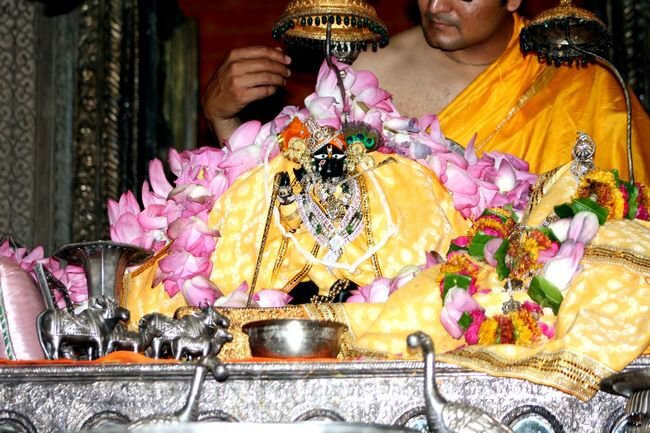
The Deity that Gopala Bhatta Goswami found in his basket one morning, nearly five hundred years ago, has outlasted every other part of his story. By most accounts, Sri Radha Raman is the only one of Vrindavana's seven original principal Deities that was never carried away from the town during the troubles of the Mughal period. Worship there has continued, daily and without interruption, from the sixteenth century to the present. Srila Prabhupada's own movement grew directly out of this same Gaudiya Vaishnava lineage. When he established how deity worship should be conducted in ISKCON temples founded on the other side of the world, he cited the Hari-bhakti-vilasa again and again as scriptural authority. In this way there is a direct, living line from Gopala Bhatta's own quiet scholarship in sixteenth-century Vrindavana to Krishna temples on every continent today.
What Later Generations Remember #
More than any single dramatic episode, later generations have found this same unbroken thread most worth remembering about Gopala Bhatta Goswami. He was a devotee who chose, again and again, to take no credit for either of his two great gifts to Gaudiya Vaishnavism. One was a book he insisted on publishing in humility. The other was a Deity he did not carve but simply found waiting for him one morning, already complete.
