Sri Chaitanya-charitamrita does not give an exact year for what happened next in Gopala Bhatta's life. No source says exactly how long after Mahaprabhu's visit to Srirangam it took place. But tradition agrees on the main events. Both of Gopala Bhatta's parents remained devoted to Sri Chaitanya Mahaprabhu for the rest of their lives. Srila Prabhupada's purport says plainly that they "gave up their lives thinking of Sri Chaitanya Mahaprabhu". Only after they had passed away did their son finally set out for Vrindavana, just as Mahaprabhu had once told him he one day would. The Bhakti-ratnakara remembers him as about thirty years old by the time he reached Vrindavana.
| Detail | Description |
|---|---|
| Trigger for departure | Death of both parents in Srirangam |
| Received in Vrindavana by | Rupa Gosvami and Sanatana Gosvami |
| Mahaprabhu's instruction | Accept Gopala Bhatta as a younger brother |
| Closest working bond | Sanatana Gosvami, in the compiling of Vaishnava conduct literature |
| Disciples accepted in Vrindavana | Srinivasa Acharya and Gopinatha Pujari |
Meeting Rupa and Sanatana Gosvami #
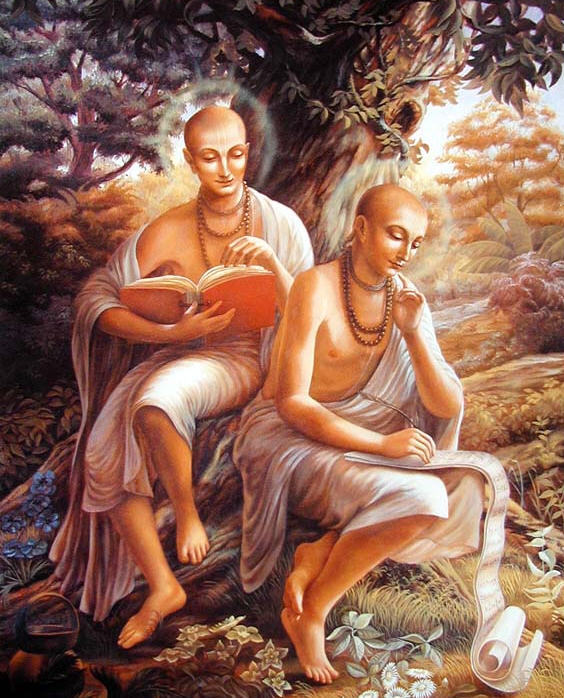
When Gopala Bhatta reached Vrindavana, he found Rupa Gosvami and Sanatana Gosvami already settled there. They were busy with the work Mahaprabhu had personally given them. They were recovering Krishna's lost pastime-places across Vraja. They were also building, almost from nothing, a systematic scriptural foundation for Gaudiya Vaishnava theology. News of the young South Indian scholar's arrival reached Sri Chaitanya Mahaprabhu himself, and he was overjoyed. According to Srila Prabhupada's account, Mahaprabhu told the two brothers to accept Gopala Bhatta as their own younger brother, not just as a capable new associate, and to take care of him in that way.
A Scholar Among Scholars #
Gopala Bhatta brought with him something that neither Rupa nor Sanatana Gosvami had in quite the same way. From childhood, in one of South India's great temple towns, he had received a complete Sri Vaishnava education in Sanskrit grammar, logic, poetry and the Vedanta-sutra. Sanatana Gosvami had already taken on the huge task of arranging centuries of scattered Puranic and dharma-shastra material into a practical guide to Vaishnava conduct. In Gopala Bhatta he found exactly the kind of trained helper that this project needed. Tradition remembers the bond between the two men as unusually close, closer than the ordinary relationship between a senior scholar and a junior helper. It was more like an elder brother who had taken in a promising younger one as his own.
Brought Into a Shared Life #
Rupa Gosvami and Sanatana Gosvami had themselves arrived in Vrindavana only a handful of years before Gopala Bhatta. Sri Chaitanya Mahaprabhu had sent them there directly, after they had left their careers in the Bengal Sultanate's government in a long and dramatic way. By the time Gopala Bhatta joined them, the way of life that the three would share for decades was already taking shape. Each studied and wrote on his own, and they also spent long hours in discussion together. They worshipped together at the pastime-places they were still rediscovering. And they shared a calm, unhurried devotion to filling in the theology Mahaprabhu had left for others to complete. Gopala Bhatta's own scriptural training helped him fit into this life almost at once. Before long, Sanatana Gosvami began to bring him directly into what would become Sanatana's own greatest project. This was a single, usable guide to Gaudiya Vaishnava ritual and devotional conduct, later known as the Hari-bhakti-vilasa.
A Household of Renunciates, Not a Monastery #
None of this happened inside a formal institution. Rupa Gosvami, Sanatana Gosvami and, soon after, Gopala Bhatta lived simply and separately around Vrindavana's forests and pastime-sites. They met to study, worship and discuss, but they did not live as members of an organized order. Their poverty was real and mostly by choice. It followed the vairagya, or renunciation, that Sri Chaitanya Mahaprabhu had asked of them. Gopala Bhatta had grown up in a comfortable South Indian priestly household. So for him, adjusting to this life was a real act of surrender, not simply a continuation of what he had always known.
Later Disciples #
In time Gopala Bhatta accepted disciples in Vrindavana. The best known were Srinivasa Acharya and Gopinatha Pujari. Srinivasa Acharya would later carry Gaudiya Vaishnava literature back to Bengal. He also composed the prayer glorifying all Six Goswamis that Gaudiya Vaishnavas still recite today. Gopinatha Pujari was a lifelong celibate brahmachari. He would go on to serve as priest of a Deity that Gopala Bhatta would not receive until years later. That story, the compiling of the Hari-bhakti-vilasa itself, and then the still more remarkable appearance of Sri Radha Raman are told in Compiling the Hari-bhakti-vilasa and The Self-Manifested Deity of Radha Raman.
