Sri Gopala Bhatta Goswami
Compiler of the Hari-bhakti-vilasa and Discoverer of Sri Radha Raman
The complete life, on one page: The main biography and every pastime page, in order, in one place
Introduction
anaṅga-mañjarī yāsīt sādya gopāla-bhaṭṭakaḥ
bhaṭṭa-gosvāminaṁ kecid āhuḥ śrī-guṇa-mañjarī
"Ananga-manjari appeared as Srila Gopala Bhatta Gosvami. Some say that Gopala Bhatta Gosvami was actually the incarnation of Sri Guna-manjari." (Gaura-ganoddesha-dipika 184)
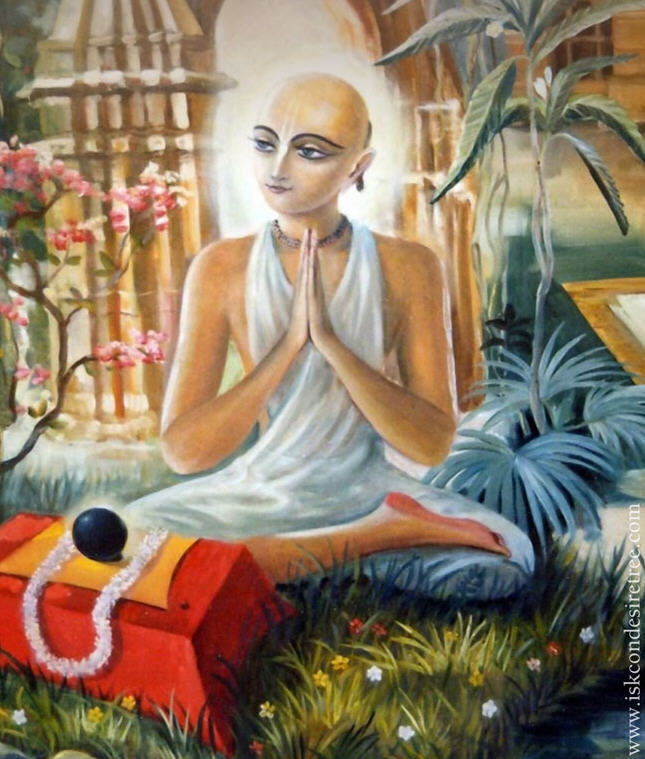
Sri Gopala Bhatta Goswami is remembered among the Six Goswamis of Vrindavana as a bridge between two great Vaishnava worlds. He was born into a family of Sri Vaishnava priests at the temple town of Srirangam in South India, and he grew up worshipping Lakshmi-Narayana in the Ramanuja tradition. As a young man, he joined the Gaudiya sampradaya founded by Sri Chaitanya Mahaprabhu. In Vrindavana he became one of the closest companions of Rupa Gosvami and Sanatana Gosvami. He is remembered above all for two things. First, he compiled the Hari-bhakti-vilasa, which is still the standard Gaudiya Vaishnava guide to devotional conduct and deity worship. Second, he installed the self-manifested Deity of Sri Radha Raman, who has been worshipped in Vrindavana without a single break since the sixteenth century.
| Detail | Description |
|---|---|
| Full name | Gopala Bhatta Goswami |
| Born | c. 1503, Srirangam, South India |
| Family | Son of Venkata Bhatta, a Sri Vaishnava priest connected to the Sri Ranganathaswamy temple; nephew of Prabodhananda Sarasvati |
| Identity | In Krishna-lila: Ananga-manjari; some say Guna-manjari (Gaura-ganoddesha-dipika 184; Chaitanya-charitamrita Adi 10.105 purport) |
| Guru | Formally initiated by his uncle Prabodhananda Sarasvati; accepted in Vrindavana as a younger brother by Rupa Gosvami and Sanatana Gosvami |
| Chief works | Editor/compiler of the Hari-bhakti-vilasa; author of Sat-kriya-sara-dipika and a commentary on Krishna-karnamrita |
| Best known for | Installing the self-manifested Deity of Sri Radha Raman in Vrindavana |
| Disappeared | Traditionally 1578, Vrindavana, at about 75 years of age |
Scriptural evidence for the introduction (2)
Quoted in the text above:
- Verse 184 Gaura-ganoddesha-dipika
Further verses:
শ্রীগোপাল ভট্ট এক শাখা সর্বোত্তম ।
রূপ–সনাতন–সঙ্গে যাঁর প্রেম–আলাপন ॥
śrī-gopāla bhaṭṭa eka śākhā sarvottama
rūpa-sanātana-saṅge yāṅra prema-ālāpana
Word for word
śrī-gopāla bhaṭṭa - Sri Gopala Bhatta; eka śākhā - one branch; sarva-uttama - very exalted; rūpa - Rupa; sanātana - Sanatana; saṅge - in the company of; prema-ālāpana - discussion of love of Godhead
Sri Gopala Bhatta Gosvami, the forty-seventh branch, was one of the great and exalted branches of the tree. He always engaged in discourses about love of Godhead in the company of Rupa Gosvami and Sanatana Gosvami.
From the purport: Purport excerpt: "Both the father and the mother of Gopala Bhatta Gosvami were extremely fortunate, for they dedicated their entire lives to the service of Lord Caitanya Mahaprabhu."
The verse from Chaitanya-charitamrita naming Gopala Bhatta among the branches of the Lord's devotee-tree; used as the pull-quote for his biography page.
Chapter 1
Birth in a Family of Temple Priests
Growing up inside the Sri Vaishnava tradition of Ramanuja, in the temple town where the Kaveri divides
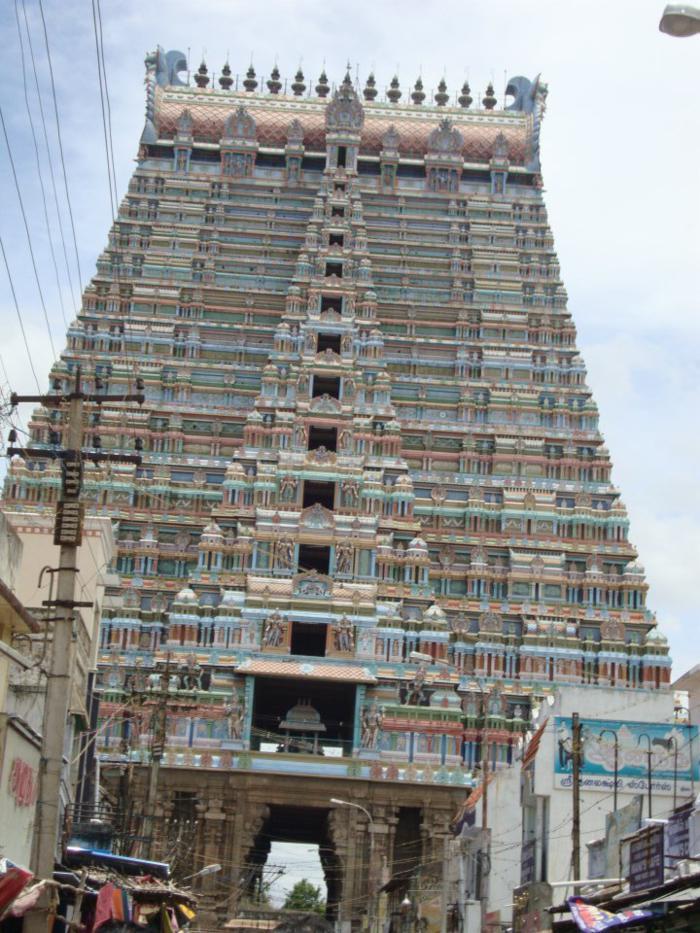
Sri Gopala Bhatta Goswami was born around 1503 in Srirangam, an island town in the Kaveri River in what is now Tamil Nadu. Tradition specifies the day as the thirteenth day of the dark half of the month of Pausha. By the sixteenth century, Srirangam was already one of the most important pilgrimage sites in South India. It was built around the huge Sri Ranganathaswamy temple, dedicated to Vishnu lying on the serpent Ananta Shesha. Gopala Bhatta's family had served that Sri Vaishnava temple tradition for generations. They were brahmanas of the lineage founded by the eleventh-century philosopher and theologian Ramanujacharya.
| Detail | Description |
|---|---|
| Birthplace | Srirangam, on the Kaveri River, South India |
| Family | Sri Vaishnava (Ramanuja-sampradaya) brahmanas connected to the Sri Ranganathaswamy temple |
| Father | Venkata Bhatta |
| Father's brothers | Tirumalla Bhatta and Prabodhananda Sarasvati |
| Family Deity worshipped | Lakshmi-Narayana |
| Birth year | c. 1503 (13th day of the dark half of Pausha, per tradition) |
A Family Devoted to Lakshmi-Narayana #
His father, Venkata Bhatta, was by all accounts a sincere and accomplished devotee in the Sri Vaishnava tradition. He worshipped the Deities of Lakshmi and Narayana with such deep feeling that Sri Chaitanya-charitamrita itself later singles it out for praise. Venkata Bhatta had two brothers. One, Tirumalla Bhatta, was the eldest brother and the head of the family. He is remembered mainly as part of the family's shared devotional life. The other, Prabodhananda Sarasvati, took sannyasa and became one of the most famous devotional poets and teachers of his generation. His own spiritual path would later run in the same direction as his young nephew's, toward Vrindavana and the worship of Radha and Krishna. But the records that survive do not make clear exactly when, or in what order, each of them made that turn.
Learning at His Uncle's Feet #
Gopala Bhatta grew up in a household deeply devoted to scripture, and he had every advantage that a serious education could offer. Sanskrit grammar, poetry, rhetoric and logic were all part of a Sri Vaishnava brahmana's normal training. By most accounts he mastered these early, and then went on to serious study of the Vedanta-sutra and the wider body of Vaishnava philosophy. More than anyone else, Prabodhananda Sarasvati shaped his education in bhakti-shastra in particular. Later, this same uncle performed Gopala Bhatta's formal diksha initiation. Srila Prabhupada records this detail directly in his purport to Sri Chaitanya-charitamrita, Adi-lila 10.105.
A Tradition Already Oriented Toward Surrender #
It is easy to think that Gopala Bhatta's later devotion to Krishna was a rejection of his Sri Vaishnava upbringing. But that view misses what his upbringing actually gave him. Ramanuja's tradition gave complete importance to prapatti, surrender to the Lord's mercy, and to temple worship done with very careful attention to detail. This was exactly the attitude, and exactly the training in ritual, that would make him so valuable a generation later. At that time Sanatana Gosvami needed a scholar able to search through centuries of Puranic and smriti literature to make a single, usable book of Vaishnava conduct. Nothing in Gopala Bhatta's childhood pointed toward Vrindavana in particular. But the seriousness of the temple, the family's discipline of daily worship, and an uncle already inclined toward renunciation all pointed toward exactly the kind of devotee he in fact became.
A Household Already Known for Its Devotion #
In this period Srirangam was not a quiet, out-of-the-way place. It was one of the great centers of Vaishnava learning and worship in the whole subcontinent. Any family trusted with a role in its temple life was closely watched by the wider Sri Vaishnava community. Venkata Bhatta's household was known locally for the depth of its bhakti, not only for performing rituals correctly. This mattered greatly for what followed. When a wandering sannyasi from Bengal arrived asking for shelter, the family did not simply accept him out of formal hospitality. They welcomed him because they were already the kind of people who could recognize real devotion when they saw it.
A Visit That Changed Everything #
Until then, none of this had been tested by anything outside the Sri Vaishnava world that Gopala Bhatta was born into. That test came to his own front door in the rainy season of 1511. Sri Chaitanya Mahaprabhu came to Srirangam on his tour of South India's holy places and asked to stay at Venkata Bhatta's house. Within four months, this visit would reshape the family's religious life. It is told in full in Mahaprabhu's Visit and a Father's Hospitality.
Chapter 2
Mahaprabhu's Visit and a Father's Hospitality
Four months under one roof, a friendly argument about Lakshmi and the gopis, and a boy who never forgot it
Srila Prabhupada records the year as 1433 Shakabda, which is A.D. 1511. In that year, during his long pilgrimage through South India, Sri Chaitanya Mahaprabhu reached Srirangam. He stayed in the home of Venkata Bhatta for the entire four months of Chaturmasya. It was the longest single stop of the whole tour. The family was already known locally for its sincere devotion. But in the Sri Vaishnava way, that devotion was directed to Lakshmi and Narayana, not to Krishna.
| Detail | Description |
|---|---|
| Visit | Chaturmasya (four-month rainy-season stay), 1433 Sakabda / A.D. 1511 |
| Host | Venkata Bhatta, at his home in Srirangam |
| Gopala Bhatta's age | About seven or eight years old |
| Subject of the conversation | Whether the Lord's cowherd form is superior to Lakshmi-Narayana |
| Outcome | The whole household turned to worship of Radha-Krishna |
| Textual source | Sri Chaitanya-charitamrita, Madhya-lila 9.108-165 |
An Unlikely Friendship #
Sri Chaitanya-charitamrita describes what followed with real warmth. Mahaprabhu and Venkata Bhatta talked about Krishna all the time and became very close friends. Krishnadasa Kaviraja Goswami's own account even records that they sometimes simply laughed and joked together like old companions. In this easy, loving mood, and not in a formal debate, Mahaprabhu raised the question that would shape the whole visit. Why does Lakshmi, the most chaste of all goddesses, leave the comfort of Vaikuntha and perform centuries of austerity, just for the chance to be with a cowherd boy tending cows in Vraja?
A Gentle Correction, Not a Debate #
Venkata Bhatta's first answer was the standard Sri Vaishnava position: Krishna and Narayana are one and the same Lord, so there could be no real difference to explain. Mahaprabhu did not reject this answer. Instead, he widened it. Drawing on Srimad-Bhagavatam, he described how the residents of Vraja love Krishna without even knowing him as the Supreme Personality of Godhead. They love him as a son to be scolded, a friend to wrestle with, a lover to long for. The great sages, and even the Vedic hymns themselves, are said to have taken birth as gopis to get exactly this open-hearted love, free from any thought of the Lord's majesty. In his own words, Mahaprabhu had playfully humbled the pride of his host. But just as quickly he comforted him again. He said that in the end there is no real difference between the Lord's forms at all. There are only different devotees, who meet him according to the different moods of their own love. By every account, Venkata Bhatta did not take the conversation as a defeat. For him it was a revelation. After this conversation his household turned, gladly and completely, to the worship of Radha and Krishna.
A Seven-Year-Old at the Center of It #
Through all four months of this, Venkata Bhatta's young son Gopala, about seven years old at the time, served Sri Chaitanya Mahaprabhu continuously. Tradition remembers that the affection ran both ways. Mahaprabhu is said to have held the boy, fed him his own remnants of food, and blessed him in a way that stayed with Gopala Bhatta for the rest of his life. One often-told part of the story is recorded on later Gaudiya history sites, not in the text of Sri Chaitanya-charitamrita itself. It says that when the time came for Mahaprabhu to leave, Gopala's grief was so plain that it moved the Lord to stay even longer. It also says that during this extra time the boy had a vision of Mahaprabhu's own Krishna nature. With it came a quiet promise that he would one day meet two exceptional devotees named Rupa and Sanatana in a place called Vrindavana. However we understand that vision, the direction it pointed to turned out to be exactly right.
A Temple Legacy Nearby #
One further, smaller episode belongs to this same stay. Even while traveling, Mahaprabhu felt separation from his beloved Lord Jagannatha at Puri. He is remembered to have carved his own small set of Jagannatha Deities during this period. These Deities are still worshipped today, not far from where the Bhatta family's own home once stood. They are a quiet, physical trace of those four months, which otherwise live on mainly in memory and scripture.
Formal Initiation Came Later #
One point here needs to be stated clearly, because tradition sometimes blurs it. Young Gopala Bhatta received a blessing directly from Mahaprabhu at Srirangam. But Srila Prabhupada's own purport records that his formal diksha initiation came later, and from a different person entirely. It came from his uncle, the sannyasi Prabodhananda Sarasvati. In the way Gopala Bhatta's life came to be told, the two kinds of grace are remembered together without any conflict. One is Mahaprabhu's personal touch in childhood. The other is a family guru's formal initiation afterward. After both of them came the death of his parents, and then the long road to Vrindavana. That is the subject of Arrival in Vrindavana.
Scriptural evidence for this chapter (2)
ei-mata bhaṭṭa-gṛhe rahe gauracandra
nirantara bhaṭṭa-saṅge kṛṣṇa-kathānanda
śrī-vaiṣṇava' bhaṭṭa seve lakṣmī-nārāyaṇa
tāṅra bhakti dekhi' prabhura tuṣṭa haila mana
Word for word
bhaṭṭa-gṛhe - in the house of Venkata Bhatta; rahe - remained; nirantara - constantly; kṛṣṇa-kathā-ānanda - the bliss of talking about Krishna; śrī-vaiṣṇava - a devotee of the Ramanuja-sampradaya; seve - used to worship; lakṣmī-nārāyaṇa - the Deities of Narayana and Lakshmi; tuṣṭa haila mana - the mind became satisfied
Sri Chaitanya Mahaprabhu remained at the house of Venkata Bhatta and constantly talked with him about Lord Krishna, and was very happy. Being a Vaishnava of the Ramanuja-sampradaya, Venkata Bhatta worshiped the Deities of Lakshmi and Narayana; seeing his pure devotion, Sri Chaitanya Mahaprabhu was very satisfied.
The opening description of Mahaprabhu's four-month stay at the home of Gopala Bhatta's father during the South India tour.
prabhu kahe, — bhaṭṭa, tomāra lakṣmī-ṭhākurāṇī
kānta-vakṣaḥ-sthitā, pativratā-śiromaṇi
āmāra ṭhākura kṛṣṇa — gopa, go-cāraka
sādhvī hañā kene cāhe tāṅhāra saṅgama
ei lāgi' sukha-bhoga chāḍi' cira-kāla
vrata-niyama kari' tapa karila apāra
Word for word
tomāra lakṣmī-ṭhākurāṇī - your worshipable goddess of fortune; kānta-vakṣaḥ-sthitā - situated on her husband's chest; pativratā-śiromaṇi - the topmost chaste woman; āmāra ṭhākura kṛṣṇa - My worshipable Lord Krishna; gopa, go-cāraka - a cowherd boy tending cows; sukha-bhoga chāḍi' - giving up the enjoyment of Vaikuntha; tapa karila apāra - performed unlimited austerity
Sri Chaitanya Mahaprabhu told the Bhattacharya, "Your worshipable goddess of fortune, Lakshmi, always remains on the chest of Narayana, the most chaste woman in creation. But My Lord is Krishna, a cowherd boy tending cows - why does she, being so chaste, want His association? Just to associate with Krishna, Lakshmi gave up the happiness of Vaikuntha and performed unlimited austerity for a long time."
Mahaprabhu's gentle, teasing opening move in the theological conversation with Venkata Bhatta over the relative position of Lakshmi-Narayana and Radha-Krishna.
Chapter 3
Arrival in Vrindavana
After his parents' passing, a promise made in childhood finally leads him to Rupa and Sanatana Gosvami
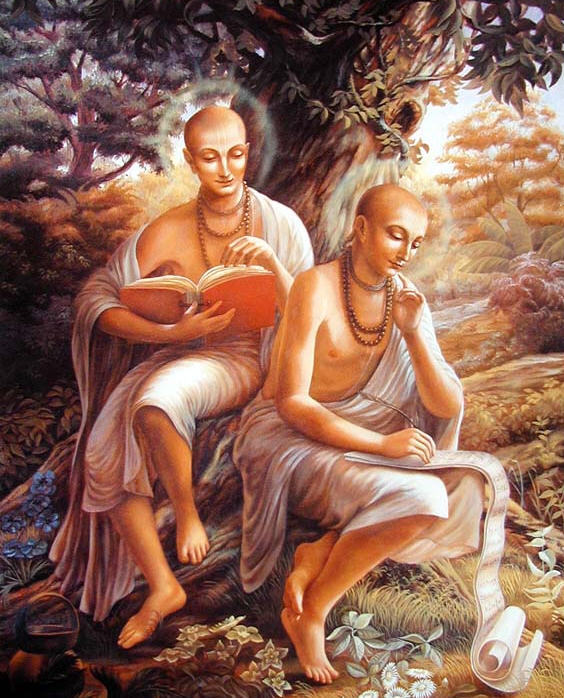
Sri Chaitanya-charitamrita does not give an exact year for what happened next in Gopala Bhatta's life. No source says exactly how long after Mahaprabhu's visit to Srirangam it took place. But tradition agrees on the main events. Both of Gopala Bhatta's parents remained devoted to Sri Chaitanya Mahaprabhu for the rest of their lives. Srila Prabhupada's purport says plainly that they "gave up their lives thinking of Sri Chaitanya Mahaprabhu". Only after they had passed away did their son finally set out for Vrindavana, just as Mahaprabhu had once told him he one day would. The Bhakti-ratnakara remembers him as about thirty years old by the time he reached Vrindavana.
| Detail | Description |
|---|---|
| Trigger for departure | Death of both parents in Srirangam |
| Received in Vrindavana by | Rupa Gosvami and Sanatana Gosvami |
| Mahaprabhu's instruction | Accept Gopala Bhatta as a younger brother |
| Closest working bond | Sanatana Gosvami, in the compiling of Vaishnava conduct literature |
| Disciples accepted in Vrindavana | Srinivasa Acharya and Gopinatha Pujari |
Meeting Rupa and Sanatana Gosvami #
When Gopala Bhatta reached Vrindavana, he found Rupa Gosvami and Sanatana Gosvami already settled there. They were busy with the work Mahaprabhu had personally given them. They were recovering Krishna's lost pastime-places across Vraja. They were also building, almost from nothing, a systematic scriptural foundation for Gaudiya Vaishnava theology. News of the young South Indian scholar's arrival reached Sri Chaitanya Mahaprabhu himself, and he was overjoyed. According to Srila Prabhupada's account, Mahaprabhu told the two brothers to accept Gopala Bhatta as their own younger brother, not just as a capable new associate, and to take care of him in that way.
A Scholar Among Scholars #
Gopala Bhatta brought with him something that neither Rupa nor Sanatana Gosvami had in quite the same way. From childhood, in one of South India's great temple towns, he had received a complete Sri Vaishnava education in Sanskrit grammar, logic, poetry and the Vedanta-sutra. Sanatana Gosvami had already taken on the huge task of arranging centuries of scattered Puranic and dharma-shastra material into a practical guide to Vaishnava conduct. In Gopala Bhatta he found exactly the kind of trained helper that this project needed. Tradition remembers the bond between the two men as unusually close, closer than the ordinary relationship between a senior scholar and a junior helper. It was more like an elder brother who had taken in a promising younger one as his own.
Brought Into a Shared Life #
Rupa Gosvami and Sanatana Gosvami had themselves arrived in Vrindavana only a handful of years before Gopala Bhatta. Sri Chaitanya Mahaprabhu had sent them there directly, after they had left their careers in the Bengal Sultanate's government in a long and dramatic way. By the time Gopala Bhatta joined them, the way of life that the three would share for decades was already taking shape. Each studied and wrote on his own, and they also spent long hours in discussion together. They worshipped together at the pastime-places they were still rediscovering. And they shared a calm, unhurried devotion to filling in the theology Mahaprabhu had left for others to complete. Gopala Bhatta's own scriptural training helped him fit into this life almost at once. Before long, Sanatana Gosvami began to bring him directly into what would become Sanatana's own greatest project. This was a single, usable guide to Gaudiya Vaishnava ritual and devotional conduct, later known as the Hari-bhakti-vilasa.
A Household of Renunciates, Not a Monastery #
None of this happened inside a formal institution. Rupa Gosvami, Sanatana Gosvami and, soon after, Gopala Bhatta lived simply and separately around Vrindavana's forests and pastime-sites. They met to study, worship and discuss, but they did not live as members of an organized order. Their poverty was real and mostly by choice. It followed the vairagya, or renunciation, that Sri Chaitanya Mahaprabhu had asked of them. Gopala Bhatta had grown up in a comfortable South Indian priestly household. So for him, adjusting to this life was a real act of surrender, not simply a continuation of what he had always known.
Later Disciples #
In time Gopala Bhatta accepted disciples in Vrindavana. The best known were Srinivasa Acharya and Gopinatha Pujari. Srinivasa Acharya would later carry Gaudiya Vaishnava literature back to Bengal. He also composed the prayer glorifying all Six Goswamis that Gaudiya Vaishnavas still recite today. Gopinatha Pujari was a lifelong celibate brahmachari. He would go on to serve as priest of a Deity that Gopala Bhatta would not receive until years later. That story, the compiling of the Hari-bhakti-vilasa itself, and then the still more remarkable appearance of Sri Radha Raman are told in Compiling the Hari-bhakti-vilasa and The Self-Manifested Deity of Radha Raman.
Chapter 4
Compiling the Hari-bhakti-vilasa
A scriptural rulebook for Gaudiya Vaishnava life, written by one Goswami and published, out of love, under another's name
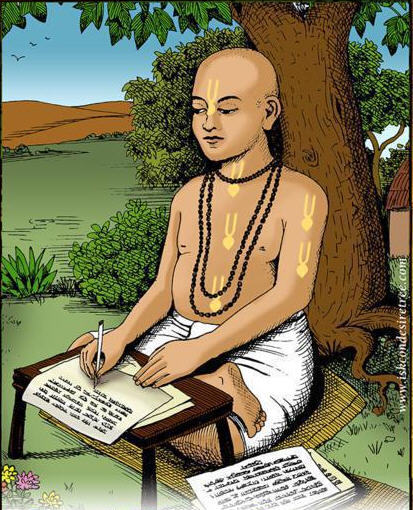
Of all the works connected with Gopala Bhatta Goswami's name, the Hari-bhakti-vilasa has shaped ordinary Gaudiya Vaishnava life most directly. It is a vast collection of rules and guidance drawn from the Puranas, the Agamas and the wider body of Vaishnava smriti literature. It covers everything from daily sadhana and the sacraments of Vaishnava life to the exact rules of conduct in deity worship. After five centuries, it is still the scriptural authority Gaudiya Vaishnavas turn to most often when a question of correct devotional practice comes up. Srila Prabhupada himself referred to it again and again when explaining how ISKCON's own temples should conduct deity worship.
| Detail | Description |
|---|---|
| Full name of the work | Hari-bhakti-vilasa ("The Pastimes of Devotion to the Lord") |
| Traditional compiler credited | Gopala Bhatta Goswami |
| Principal architect, per Srila Prabhupada | Sanatana Gosvami, who compiled it "out of his great affection" and published it under Gopala Bhatta's name |
| Subject | Vaishnava smriti: rules and rituals of devotional life, deity worship, sacraments |
| Other works involving Gopala Bhatta | Sat-kriya-sara-dipika, a foreword to the Sat-sandarbha, and a commentary on Krishna-karnamrita |
Whose Book Is It, Really #
The real answer to that question is not as simple as the traditional credit on the book suggests. Srila Prabhupada states the matter directly in his purport to Sri Chaitanya-charitamrita, Adi-lila 10.105: Sanatana Gosvami, "out of his great affection for Gopala Bhatta Gosvami, compiled the Vaishnava smriti named Hari-bhakti-vilasa and published it under his name." But in the very same purport, Prabhupada also says that Gopala Bhatta himself "edited the Hari-bhakti-vilasa". These words make clear that this was never a simple case of one man's work being wrongly credited to another. It was a real partnership, even if an unequal one, between an accomplished elder scholar and a gifted younger one who was still finding his place.
What the Book Itself Says #
The Hari-bhakti-vilasa's own opening pages support exactly this picture. They do not settle it one way or the other. Its second verse names Gopala Bhatta directly as the one who "first collected" the pastimes and rules gathered in the book. The verb used there, cinute, means to gather or assemble. It does not mean to create something new from nothing. Sanatana Gosvami himself wrote a note on that same verse. The note simply identifies "the pastimes of devotional service" being gathered as the book that follows. Read together, the verse and the note do not describe a mystery. They describe a way of working. Gopala Bhatta did the wide, patient research across scripture that his Sri Vaishnava training had prepared him for. Sanatana Gosvami shaped and checked the result, and in the end he stood behind it.
A Habit of Declining Credit #
This was not the only time Gopala Bhatta chose not to take credit. Krishnadasa Kaviraja Goswami sought the blessing of Vrindavana's senior Vaishnavas before beginning Sri Chaitanya-charitamrita. Gopala Bhatta gave it gladly, but he asked specifically not to be named in the finished work. That is why he appears only briefly and cautiously across its many chapters, even though he was so close to Rupa and Sanatana Gosvami. In his own introduction to the Tattva-sandarbha, Jiva Gosvami describes "a devotee from southern India... born of a brahmana family and a very intimate friend of Rupa Gosvami and Sanatana Gosvami," but does not name him outright. This devotee had gathered notes, but they were "not compiled chronologically". Jiva Gosvami then organized these notes into what became the systematic Six Sandarbhas. Srila Prabhupada's own purport identifies this unnamed devotee as Gopala Bhatta. The purport also credits him with two works:
- Sat-kriya-sara-dipika: which he wrote himself
- A commentary on Bilvamangala Thakura's Krishna-karnamrita
Why the Attribution Still Matters #
None of this makes Gopala Bhatta's name on the book any less important today. It would be a mistake to read the story as one of credit wrongly given. Sanskrit tradition has never treated the naming of a text's compiler in the way modern authorship works. In the world it was written for, a book like the Hari-bhakti-vilasa belonged to the community of Vaishnavas it served, not to the reputation of any single writer. If anything, publishing it in Gopala Bhatta's name was Sanatana Gosvami's own quiet act of vairagya, the renunciation of personal credit. It reflects the very humility that the book itself teaches its readers to cultivate.
A Legacy Neither Man Claimed Alone #
The Hari-bhakti-vilasa is not a lesser book because it grew out of two men's shared devotion, instead of one man's work alone. If anything, that origin fits exactly what the book itself teaches. Vaishnava life is built through humility, cooperation and the deliberate setting aside of personal credit, not through claiming it. Not long afterward, in this same spirit of shared, quiet labor, Gopala Bhatta received the most startling gift of his life. That is the subject of The Self-Manifested Deity of Radha Raman.
Scriptural evidence for this chapter (3)
bhakter vilāsāṁś cinute prabodha-
nandasya śiṣyo bhagavat-priyasya
gopāla-bhaṭṭo raghunātha-dāsaṁ
santoṣayan rūpa-sanātanau ca
Word for word
bhakteḥ vilāsān - the pastimes of devotional service; cinute - gathers; prabodhanandasya śiṣyaḥ - the disciple of Prabodhananda Sarasvati; bhagavat-priyasya - dear to the Lord; gopāla-bhaṭṭaḥ - Gopala Bhatta Gosvami; santoṣayan - pleasing; rūpa-sanātanau - Rupa and Sanatana Gosvami; ca - and
Srila Gopala Bhatta Gosvami, who pleased Srila Rupa Gosvami, Srila Sanatana Gosvami and Srila Raghunatha dasa Gosvami, and who was a disciple of Lord Chaitanya's dear devotee Srila Prabodhananda Sarasvati, first collected these pastimes of devotional service.
From the purport: Purport excerpt (Sanatana Gosvami's own commentary on this verse): "The pastimes of devotional service are this book, Sri Hari-bhakti-vilasa."
The Hari-bhakti-vilasa's own second verse, naming Gopala Bhatta as the one who gathered its contents, with Sanatana Gosvami's attached commentary identifying the book itself.
From the purport: Purport excerpt: "Sri Sanatana Gosvami, out of his great affection for Gopala Bhatta Gosvami, compiled the Vaishnava smriti named Hari-bhakti-vilasa and published it under his name."
Srila Prabhupada's own account of how the Hari-bhakti-vilasa came to carry Gopala Bhatta's name; the same purport also credits Gopala Bhatta with editing the finished work.
"A devotee from southern India who was born of a brahmana family and was a very intimate friend of Rupa Gosvami and Sanatana Gosvami has written a book that he has not compiled chronologically. Therefore I, a tiny living entity known as jiva, am trying to assort the events of the book chronologically."
Jiva Gosvami's own description, quoted by Srila Prabhupada, of the unnamed southern Indian devotee - understood to be Gopala Bhatta Gosvami - whose research fed into the Six Sandarbhas.
Chapter 5
The Self-Manifested Deity of Radha Raman
Twelve sacred stones, a private longing to serve a Lord with hands and feet, and a Deity that appeared overnight
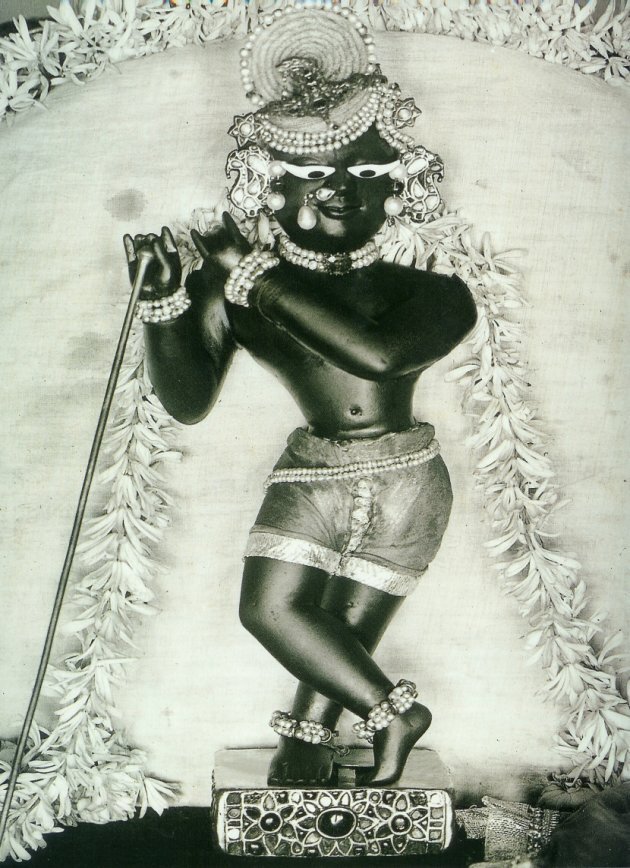
Long before he compiled a single line of the Hari-bhakti-vilasa, Gopala Bhatta Goswami had already become known in Vrindavana for his intense personal worship. On a pilgrimage north to the Gandaki River in Nepal, he had collected twelve shalagram-shilas. These are small, dark, spiral-marked ammonite stones that Vaishnavas worship as a direct, self-manifested form of Vishnu. They need no ritual installation, because they are already understood to be the Lord himself. He carried these twelve shilas with him afterward and worshipped them every single day with full ceremony.
| Detail | Description |
|---|---|
| Number of shalagram-shilas | Twelve, collected from the Gandaki River in Nepal |
| Deity's traditional appearance date | Full moon of Vaishakha, 1542 |
| Deity's name | Sri Radha Raman ("the one who gives Radha delight") |
| Unique feature | No separate form of Radharani; a crown placed at His left side represents Her presence |
| Standing | One of the seven original principal Deities of Vrindavana |
| Status today | Worshipped continuously at the same site; never moved to Jaipur during the Mughal period |
A Longing Kept Quietly #
According to the story Vrindavana still tells, a wealthy visitor once arrived with fine cloth and ornaments to offer Gopala Bhatta's shalagram-shilas in charity. But these gifts were made for a form with arms, legs and a neck to wear them on. They could not actually be used to decorate stones that have none of these features. Gopala Bhatta kept the offerings carefully instead of turning them away. But the moment seems to have made stronger a wish he had already been carrying quietly in his heart. In prayer he expressed a wish to serve the Lord in a form he could dress and decorate directly, with a smiling face and moving limbs. He wanted a form with which he could have the kind of close, personal exchange that his stones, by their nature, could not offer. He is remembered as thinking of how Krishna, as Lord Nrisimha, had once come out bodily from a stone pillar to protect Prahlada Maharaja. For Gopala Bhatta this was proof enough that the Supreme Lord was never bound by the form in which his devotees happened to be worshipping him.
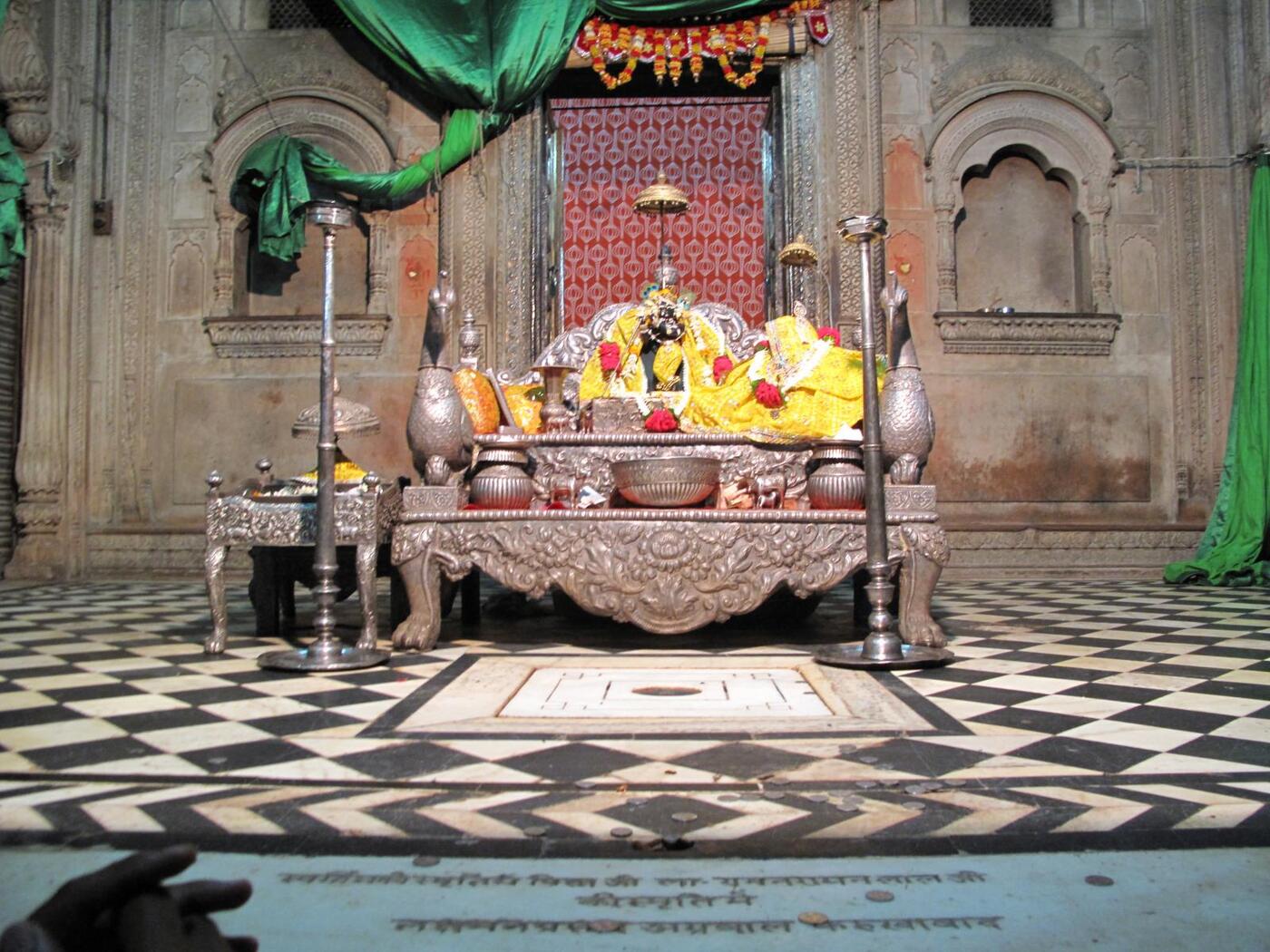
An Ordinary Evening #
By every account, the night itself began exactly like every other night of Gopala Bhatta's worship. He offered his usual bhoga and arati to the twelve shilas, then set them to rest under a simple wicker basket, as he always did, and went out before dawn to bathe in the Yamuna. There was no sign in the preparation that anything unusual was about to happen. He returned and lifted the basket to begin the morning's worship. Then he found eleven shalagram-shilas exactly where he had left them. Standing among them was an ornamented form of Krishna, bending in three places and playing a flute. The form was smiling and complete down to the fingernails and teeth, and part of the original stone's dark, ammonite surface could still be seen along its back. One of the twelve, remembered afterward as the Damodara-shila, had become a living Deity.
Naming Radha Raman #
Gopala Bhatta and the Vrindavana Vaishnava community around him named the new Deity Sri Radha Raman. To this day the Deity stands without a separate murti of Radharani beside him. Instead, a small crown is placed at his left side to represent her eternal presence there. Rupa Gosvami and Sanatana Gosvami are remembered as personally guiding the young Deity's installation and the building of a temple. They approved a form of worship that Gopala Bhatta was specially qualified to design correctly. For this he drew on the same scriptural research that went into the Hari-bhakti-vilasa.
One Temple That Never Left #
Radha Raman is counted today among the seven original principal Deities installed by the Goswamis of Vrindavana in the sixteenth century, alongside Radha Damodar, Radha Govind Dev, Radha Gopinath, Radha Madan Mohan, Radha Shyamsundar and Radha Gokulananda. In the later Mughal period, Aurangzeb's campaigns against Vrindavana's temples forced several of these original Deities to be carried away to Jaipur for safekeeping. Govindaji and Madan Mohan were among them. Radha Raman alone is remembered as never having left. Sources describing this period do not agree on every detail of how each Deity left, and how some of them, in some cases, later returned. But none of them records Radha Raman ever leaving Vrindavana at all.
A Living Shalagram-Deity #
Gaudiya Vaishnava tradition treats Radha Raman as special even among Deities. He emerged directly from a shalagram-shila. He was not carved and then ritually invoked. For this reason he is regarded as needing no pran-pratishtha, the separate ceremony that calls the Lord's presence into the form, in the way an ordinarily sculpted Deity does. By every account, the Deity that Gopala Bhatta found waiting inside his basket one ordinary morning has stood in the same place, in continuous worship, ever since. This connects directly to Disappearance and Legacy, the last chapter of Gopala Bhatta Goswami's own life.
Chapter 6
Disappearance and Legacy
The one original Vrindavana Deity that never left, and a devotee tradition that continues at His side
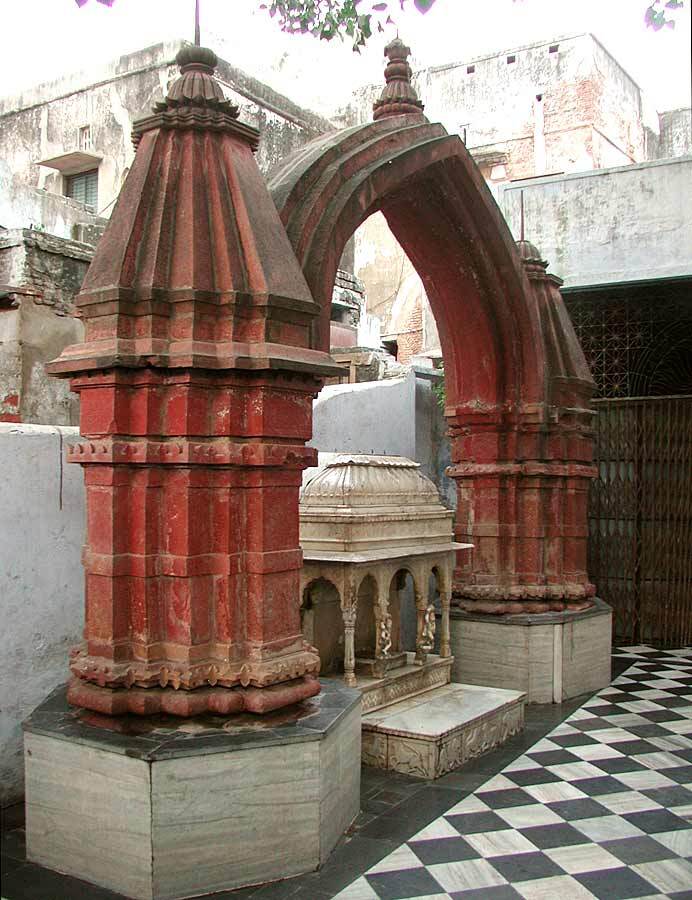
Gopala Bhatta Goswami is traditionally said to have left this world in 1578, on the sixth day of the dark half of the month of Shravana, at about seventy-five years of age. His life had carried him from a Sri Vaishnava temple town on the Kaveri River to the very heart of Gaudiya Vaishnava Vrindavana. His samadhi stands today within the Radha Raman temple complex, close to the spot where the Deity itself first appeared. Pilgrims visiting the temple still pay their respects there as part of the same visit.
| Detail | Description |
|---|---|
| Disappearance | Traditionally the 6th day of the dark half of Sravana, 1578, at about 75 years of age |
| Samadhi | Within the Radha Raman temple complex, Vrindavana |
| Chief disciples | Srinivasa Acharya and Gopinatha Pujari |
| Spiritual identity, per tradition | Ananga-manjari (some accounts: Guna-manjari), per the Gaura-ganoddesha-dipika |
| Legacy institution | The Radha Raman temple, one of the seven original Goswami temples of Vrindavana |
Two Disciples Who Carried the Work Forward #
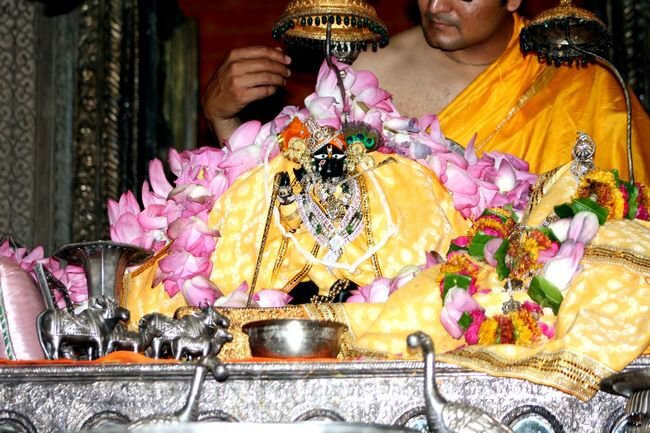
Among Gopala Bhatta's own disciples, two in particular shaped how his legacy reached later generations. Srinivasa Acharya went on to carry the Six Goswamis' completed manuscripts back to Bengal. He later composed the Sri Sri Sad-gosvamy-ashtaka, the eight-verse prayer glorifying Rupa, Sanatana, Raghunatha Bhatta, Raghunatha Dasa Goswami, Jiva and Gopala Bhatta together. Gaudiya Vaishnavas still recite this prayer as part of daily worship. The other disciple, Gopinatha Pujari, was a lifelong celibate brahmachari. He took up the priestly service of Radha Raman directly. This began a line of temple priests, descended from that same circle of disciples, who continue the Deity's worship at Vrindavana to the present day.
How Gopinatha Pujari Came to Him #
The Bhakti-ratnakara remembers a gentler story behind that second disciple's arrival. While travelling toward Muktinatha in the Himalayas, Gopala Bhatta was caught in a storm and took shelter in the home of a devout brahmana at a village called Devavandya Gram, near Haridwar. The brahmana had no son, and Gopala Bhatta blessed him with one, a great devotee of Krishna. In gratitude, the brahmana promised that this future son would be given to Gopala Bhatta's own service. Years later, after Radha Raman had already appeared, a boy arrived at Gopala Bhatta's kutir in Vrindavana. He introduced himself as that same brahmana's son and was accepted at once. He became Gopinatha Pujari. Because Gopinatha had taken a lifelong vow of celibacy, Gopala Bhatta asked his younger brother, Damodara Dasa, to marry and raise a family. In this way the same priestly line could go on serving Radha Raman without interruption.
Bhajana Beyond the Temple #
Gopala Bhatta did not do his worship only at the Radha Raman temple. For a time he kept a bhajana-kutir at Sanket, the small village between Varsana and Nandagram associated with Radha and Krishna's night meetings, beside the temple of Sanket Devi, a form of Yogamaya. In his later years he also spent long periods at Radha-kunda, in the company of Raghunatha Dasa Goswami, Krishnadasa Kaviraja Goswami and Raghunatha Bhatta Goswami. Vraja tradition remembers the disappearance of this same circle of devotees alongside his.
A Reluctant Presence in Chaitanya-charitamrita #
Gopala Bhatta's natural wish to keep his name out of written accounts stayed with him to the very end of his life. Krishnadasa Kaviraja Goswami came seeking the blessing of Vrindavana's senior Vaishnavas before beginning Sri Chaitanya-charitamrita. Gopala Bhatta gave his blessing readily, but only on the condition that his own name be left out of the finished book. Krishnadasa Kaviraja Goswami honored the request as far as he reasonably could. He mentions Gopala Bhatta only briefly and carefully across the whole work. That is partly why a man so central to Vrindavana's early Gaudiya Vaishnava community appears in the book almost as a minor figure in his own story.
Spiritual Identity in the Eternal Pastimes #
Drawing on the Gaura-ganoddesha-dipika, later Gaudiya Vaishnava tradition identifies Gopala Bhatta's eternal spiritual identity as the gopi Ananga-manjari in Krishna's Vraja pastimes. But some authorities name Guna-manjari instead. This is a small disagreement, and it is openly acknowledged. It is not a settled fact, and the tradition has never tried to force it into false certainty.
A Deity Still Worshipped Without a Break #
The Deity that Gopala Bhatta Goswami found in his basket one morning, nearly five hundred years ago, has outlasted every other part of his story. By most accounts, Sri Radha Raman is the only one of Vrindavana's seven original principal Deities that was never carried away from the town during the troubles of the Mughal period. Worship there has continued, daily and without interruption, from the sixteenth century to the present. Srila Prabhupada's own movement grew directly out of this same Gaudiya Vaishnava lineage. When he established how deity worship should be conducted in ISKCON temples founded on the other side of the world, he cited the Hari-bhakti-vilasa again and again as scriptural authority. In this way there is a direct, living line from Gopala Bhatta's own quiet scholarship in sixteenth-century Vrindavana to Krishna temples on every continent today.
What Later Generations Remember #
More than any single dramatic episode, later generations have found this same unbroken thread most worth remembering about Gopala Bhatta Goswami. He was a devotee who chose, again and again, to take no credit for either of his two great gifts to Gaudiya Vaishnavism. One was a book he insisted on publishing in humility. The other was a Deity he did not carve but simply found waiting for him one morning, already complete.
Scriptural evidence for this chapter (1)
kṛṣṇotkīrtana-gāna-nartana-parau premāmṛtāmbho-nidhī
dhīrādhīra-jana-priyau priya-karau nirmatsarau pūjitau
śrī-caitanya-kṛpā-bharau bhuvi bhuvo bhārāvahantārakau
vande rūpa-sanātanau raghu-yugau śrī-jīva-gopālakau
Word for word
kṛṣṇa-utkīrtana-gāna-nartana-parau - devoted to loudly chanting, singing and dancing in the name of Krishna; premāmṛtāmbho-nidhī - oceans of the nectar of love of God; nirmatsarau - free from envy; śrī-caitanya-kṛpā-bharau - full of the mercy of Sri Chaitanya; vande - I offer respects; rūpa-sanātanau raghu-yugau śrī-jīva-gopālakau - to Rupa and Sanatana, the two Raghunathas, Jiva, and Gopala [Bhatta]
I offer my respectful obeisances unto the Six Gosvamis, namely Sri Rupa Gosvami, Sri Sanatana Gosvami, Sri Raghunatha Bhatta Gosvami, Sri Raghunatha dasa Gosvami, Sri Jiva Gosvami and Sri Gopala Bhatta Gosvami, who are always engaged in chanting the holy name and dancing, who are just like oceans of the nectar of love of God, and who are fully blessed by Lord Chaitanya.
The opening verse of the prayer to the Six Goswamis composed by Gopala Bhatta's own disciple Srinivasa Acharya, still recited daily by Gaudiya Vaishnavas.
- Sri Chaitanya-charitamrita, Adi-lila 10.105 and purport (Bhaktivedanta VedaBase)
- Sri Chaitanya-charitamrita, Madhya-lila 9.100-165 (Bhaktivedanta VedaBase)
- Gopala Bhatta Goswami - Biography, Gaudiya History
- Sri Gopala Bhatta Goswami, Gaudiya History
- Gopala Bhatta Goswami - Pastimes, Gaudiya History
- Venkatta Bhatta, Gaudiya History (tag page)
- Sri Hari-bhakti-vilasa (full text), Internet Archive
- The Seven Goswami Temples of Vrindavan, The Hare Krishna Movement
- Srila Prabhupada lecture, Six Gosvamis Lecture (Sri Sri Sad-gosvamy-astaka), Los Angeles, November 18 1968
