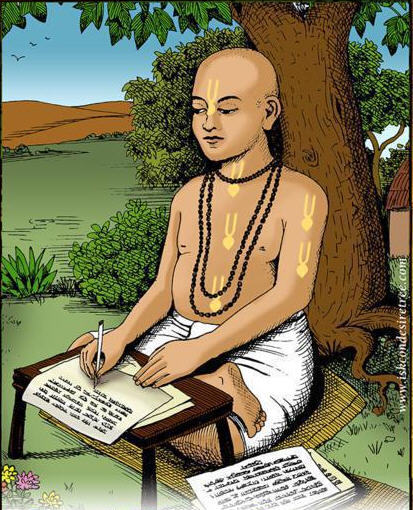
Of all the works connected with Gopala Bhatta Goswami's name, the Hari-bhakti-vilasa has shaped ordinary Gaudiya Vaishnava life most directly. It is a vast collection of rules and guidance drawn from the Puranas, the Agamas and the wider body of Vaishnava smriti literature. It covers everything from daily sadhana and the sacraments of Vaishnava life to the exact rules of conduct in deity worship. After five centuries, it is still the scriptural authority Gaudiya Vaishnavas turn to most often when a question of correct devotional practice comes up. Srila Prabhupada himself referred to it again and again when explaining how ISKCON's own temples should conduct deity worship.
| Detail | Description |
|---|---|
| Full name of the work | Hari-bhakti-vilasa ("The Pastimes of Devotion to the Lord") |
| Traditional compiler credited | Gopala Bhatta Goswami |
| Principal architect, per Srila Prabhupada | Sanatana Gosvami, who compiled it "out of his great affection" and published it under Gopala Bhatta's name |
| Subject | Vaishnava smriti: rules and rituals of devotional life, deity worship, sacraments |
| Other works involving Gopala Bhatta | Sat-kriya-sara-dipika, a foreword to the Sat-sandarbha, and a commentary on Krishna-karnamrita |
Whose Book Is It, Really #
The real answer to that question is not as simple as the traditional credit on the book suggests. Srila Prabhupada states the matter directly in his purport to Sri Chaitanya-charitamrita, Adi-lila 10.105: Sanatana Gosvami, "out of his great affection for Gopala Bhatta Gosvami, compiled the Vaishnava smriti named Hari-bhakti-vilasa and published it under his name." But in the very same purport, Prabhupada also says that Gopala Bhatta himself "edited the Hari-bhakti-vilasa". These words make clear that this was never a simple case of one man's work being wrongly credited to another. It was a real partnership, even if an unequal one, between an accomplished elder scholar and a gifted younger one who was still finding his place.
What the Book Itself Says #
The Hari-bhakti-vilasa's own opening pages support exactly this picture. They do not settle it one way or the other. Its second verse names Gopala Bhatta directly as the one who "first collected" the pastimes and rules gathered in the book. The verb used there, cinute, means to gather or assemble. It does not mean to create something new from nothing. Sanatana Gosvami himself wrote a note on that same verse. The note simply identifies "the pastimes of devotional service" being gathered as the book that follows. Read together, the verse and the note do not describe a mystery. They describe a way of working. Gopala Bhatta did the wide, patient research across scripture that his Sri Vaishnava training had prepared him for. Sanatana Gosvami shaped and checked the result, and in the end he stood behind it.
A Habit of Declining Credit #
This was not the only time Gopala Bhatta chose not to take credit. Krishnadasa Kaviraja Goswami sought the blessing of Vrindavana's senior Vaishnavas before beginning Sri Chaitanya-charitamrita. Gopala Bhatta gave it gladly, but he asked specifically not to be named in the finished work. That is why he appears only briefly and cautiously across its many chapters, even though he was so close to Rupa and Sanatana Gosvami. In his own introduction to the Tattva-sandarbha, Jiva Gosvami describes "a devotee from southern India... born of a brahmana family and a very intimate friend of Rupa Gosvami and Sanatana Gosvami," but does not name him outright. This devotee had gathered notes, but they were "not compiled chronologically". Jiva Gosvami then organized these notes into what became the systematic Six Sandarbhas. Srila Prabhupada's own purport identifies this unnamed devotee as Gopala Bhatta. The purport also credits him with two works:
- Sat-kriya-sara-dipika: which he wrote himself
- A commentary on Bilvamangala Thakura's Krishna-karnamrita
Why the Attribution Still Matters #
None of this makes Gopala Bhatta's name on the book any less important today. It would be a mistake to read the story as one of credit wrongly given. Sanskrit tradition has never treated the naming of a text's compiler in the way modern authorship works. In the world it was written for, a book like the Hari-bhakti-vilasa belonged to the community of Vaishnavas it served, not to the reputation of any single writer. If anything, publishing it in Gopala Bhatta's name was Sanatana Gosvami's own quiet act of vairagya, the renunciation of personal credit. It reflects the very humility that the book itself teaches its readers to cultivate.
A Legacy Neither Man Claimed Alone #
The Hari-bhakti-vilasa is not a lesser book because it grew out of two men's shared devotion, instead of one man's work alone. If anything, that origin fits exactly what the book itself teaches. Vaishnava life is built through humility, cooperation and the deliberate setting aside of personal credit, not through claiming it. Not long afterward, in this same spirit of shared, quiet labor, Gopala Bhatta received the most startling gift of his life. That is the subject of The Self-Manifested Deity of Radha Raman.
