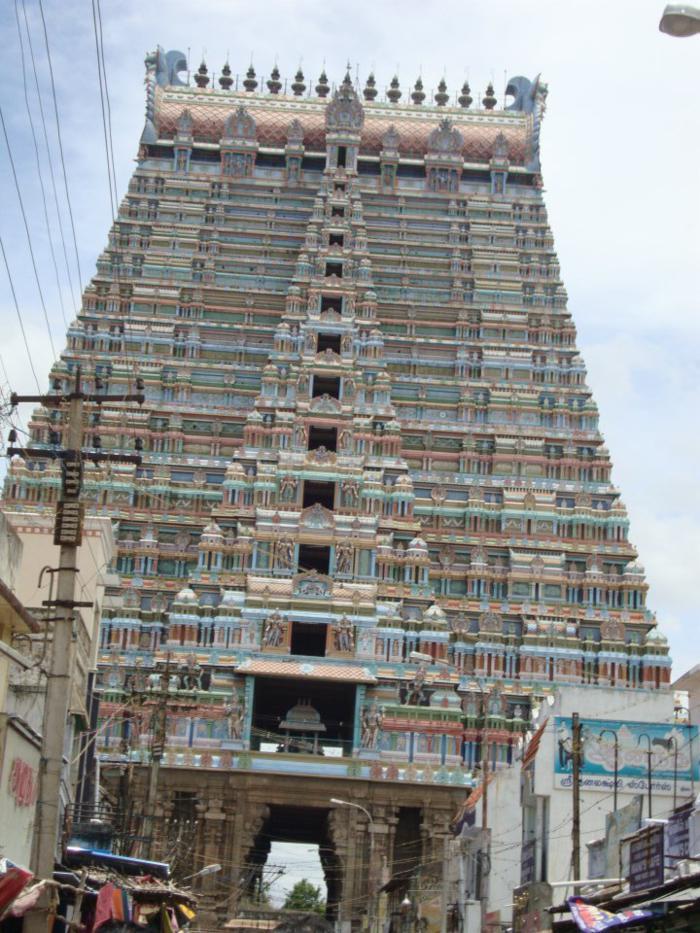
Sri Gopala Bhatta Goswami was born around 1503 in Srirangam, an island town in the Kaveri River in what is now Tamil Nadu. Tradition specifies the day as the thirteenth day of the dark half of the month of Pausha. By the sixteenth century, Srirangam was already one of the most important pilgrimage sites in South India. It was built around the huge Sri Ranganathaswamy temple, dedicated to Vishnu lying on the serpent Ananta Shesha. Gopala Bhatta's family had served that Sri Vaishnava temple tradition for generations. They were brahmanas of the lineage founded by the eleventh-century philosopher and theologian Ramanujacharya.
| Detail | Description |
|---|---|
| Birthplace | Srirangam, on the Kaveri River, South India |
| Family | Sri Vaishnava (Ramanuja-sampradaya) brahmanas connected to the Sri Ranganathaswamy temple |
| Father | Venkata Bhatta |
| Father's brothers | Tirumalla Bhatta and Prabodhananda Sarasvati |
| Family Deity worshipped | Lakshmi-Narayana |
| Birth year | c. 1503 (13th day of the dark half of Pausha, per tradition) |
A Family Devoted to Lakshmi-Narayana #
His father, Venkata Bhatta, was by all accounts a sincere and accomplished devotee in the Sri Vaishnava tradition. He worshipped the Deities of Lakshmi and Narayana with such deep feeling that Sri Chaitanya-charitamrita itself later singles it out for praise. Venkata Bhatta had two brothers. One, Tirumalla Bhatta, was the eldest brother and the head of the family. He is remembered mainly as part of the family's shared devotional life. The other, Prabodhananda Sarasvati, took sannyasa and became one of the most famous devotional poets and teachers of his generation. His own spiritual path would later run in the same direction as his young nephew's, toward Vrindavana and the worship of Radha and Krishna. But the records that survive do not make clear exactly when, or in what order, each of them made that turn.
Learning at His Uncle's Feet #
Gopala Bhatta grew up in a household deeply devoted to scripture, and he had every advantage that a serious education could offer. Sanskrit grammar, poetry, rhetoric and logic were all part of a Sri Vaishnava brahmana's normal training. By most accounts he mastered these early, and then went on to serious study of the Vedanta-sutra and the wider body of Vaishnava philosophy. More than anyone else, Prabodhananda Sarasvati shaped his education in bhakti-shastra in particular. Later, this same uncle performed Gopala Bhatta's formal diksha initiation. Srila Prabhupada records this detail directly in his purport to Sri Chaitanya-charitamrita, Adi-lila 10.105.
A Tradition Already Oriented Toward Surrender #
It is easy to think that Gopala Bhatta's later devotion to Krishna was a rejection of his Sri Vaishnava upbringing. But that view misses what his upbringing actually gave him. Ramanuja's tradition gave complete importance to prapatti, surrender to the Lord's mercy, and to temple worship done with very careful attention to detail. This was exactly the attitude, and exactly the training in ritual, that would make him so valuable a generation later. At that time Sanatana Gosvami needed a scholar able to search through centuries of Puranic and smriti literature to make a single, usable book of Vaishnava conduct. Nothing in Gopala Bhatta's childhood pointed toward Vrindavana in particular. But the seriousness of the temple, the family's discipline of daily worship, and an uncle already inclined toward renunciation all pointed toward exactly the kind of devotee he in fact became.
A Household Already Known for Its Devotion #
In this period Srirangam was not a quiet, out-of-the-way place. It was one of the great centers of Vaishnava learning and worship in the whole subcontinent. Any family trusted with a role in its temple life was closely watched by the wider Sri Vaishnava community. Venkata Bhatta's household was known locally for the depth of its bhakti, not only for performing rituals correctly. This mattered greatly for what followed. When a wandering sannyasi from Bengal arrived asking for shelter, the family did not simply accept him out of formal hospitality. They welcomed him because they were already the kind of people who could recognize real devotion when they saw it.
A Visit That Changed Everything #
Until then, none of this had been tested by anything outside the Sri Vaishnava world that Gopala Bhatta was born into. That test came to his own front door in the rainy season of 1511. Sri Chaitanya Mahaprabhu came to Srirangam on his tour of South India's holy places and asked to stay at Venkata Bhatta's house. Within four months, this visit would reshape the family's religious life. It is told in full in Mahaprabhu's Visit and a Father's Hospitality.
