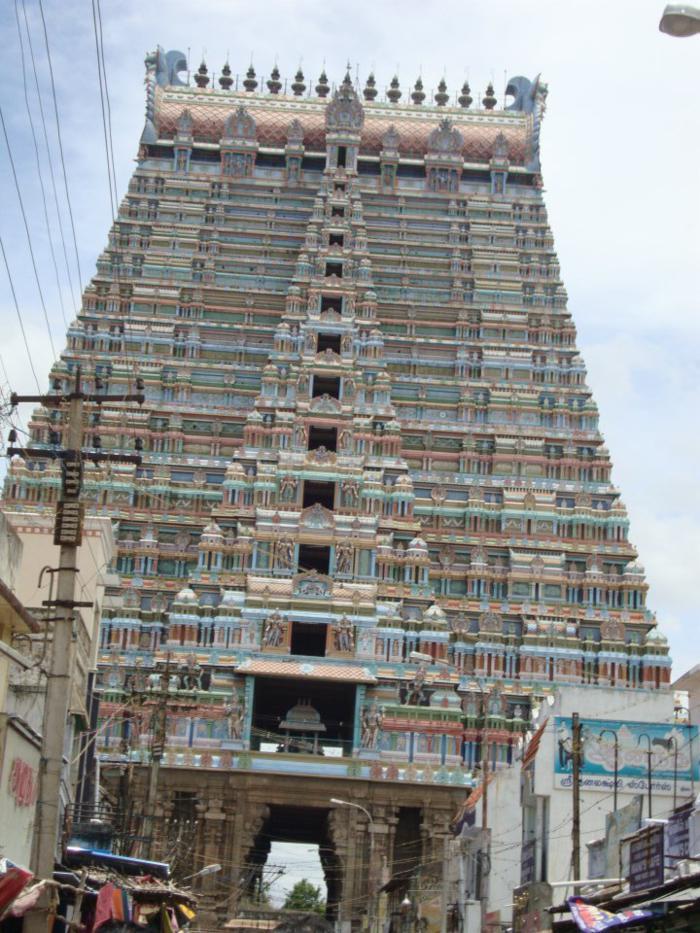
Srila Prabhupada records the year as 1433 Shakabda, which is A.D. 1511. In that year, during his long pilgrimage through South India, Sri Chaitanya Mahaprabhu reached Srirangam. He stayed in the home of Venkata Bhatta for the entire four months of Chaturmasya. It was the longest single stop of the whole tour. The family was already known locally for its sincere devotion. But in the Sri Vaishnava way, that devotion was directed to Lakshmi and Narayana, not to Krishna.
| Detail | Description |
|---|---|
| Visit | Chaturmasya (four-month rainy-season stay), 1433 Sakabda / A.D. 1511 |
| Host | Venkata Bhatta, at his home in Srirangam |
| Gopala Bhatta's age | About seven or eight years old |
| Subject of the conversation | Whether the Lord's cowherd form is superior to Lakshmi-Narayana |
| Outcome | The whole household turned to worship of Radha-Krishna |
| Textual source | Sri Chaitanya-charitamrita, Madhya-lila 9.108-165 |
An Unlikely Friendship #
Sri Chaitanya-charitamrita describes what followed with real warmth. Mahaprabhu and Venkata Bhatta talked about Krishna all the time and became very close friends. Krishnadasa Kaviraja Goswami's own account even records that they sometimes simply laughed and joked together like old companions. In this easy, loving mood, and not in a formal debate, Mahaprabhu raised the question that would shape the whole visit. Why does Lakshmi, the most chaste of all goddesses, leave the comfort of Vaikuntha and perform centuries of austerity, just for the chance to be with a cowherd boy tending cows in Vraja?
A Gentle Correction, Not a Debate #
Venkata Bhatta's first answer was the standard Sri Vaishnava position: Krishna and Narayana are one and the same Lord, so there could be no real difference to explain. Mahaprabhu did not reject this answer. Instead, he widened it. Drawing on Srimad-Bhagavatam, he described how the residents of Vraja love Krishna without even knowing him as the Supreme Personality of Godhead. They love him as a son to be scolded, a friend to wrestle with, a lover to long for. The great sages, and even the Vedic hymns themselves, are said to have taken birth as gopis to get exactly this open-hearted love, free from any thought of the Lord's majesty. In his own words, Mahaprabhu had playfully humbled the pride of his host. But just as quickly he comforted him again. He said that in the end there is no real difference between the Lord's forms at all. There are only different devotees, who meet him according to the different moods of their own love. By every account, Venkata Bhatta did not take the conversation as a defeat. For him it was a revelation. After this conversation his household turned, gladly and completely, to the worship of Radha and Krishna.
A Seven-Year-Old at the Center of It #
Through all four months of this, Venkata Bhatta's young son Gopala, about seven years old at the time, served Sri Chaitanya Mahaprabhu continuously. Tradition remembers that the affection ran both ways. Mahaprabhu is said to have held the boy, fed him his own remnants of food, and blessed him in a way that stayed with Gopala Bhatta for the rest of his life. One often-told part of the story is recorded on later Gaudiya history sites, not in the text of Sri Chaitanya-charitamrita itself. It says that when the time came for Mahaprabhu to leave, Gopala's grief was so plain that it moved the Lord to stay even longer. It also says that during this extra time the boy had a vision of Mahaprabhu's own Krishna nature. With it came a quiet promise that he would one day meet two exceptional devotees named Rupa and Sanatana in a place called Vrindavana. However we understand that vision, the direction it pointed to turned out to be exactly right.
A Temple Legacy Nearby #
One further, smaller episode belongs to this same stay. Even while traveling, Mahaprabhu felt separation from his beloved Lord Jagannatha at Puri. He is remembered to have carved his own small set of Jagannatha Deities during this period. These Deities are still worshipped today, not far from where the Bhatta family's own home once stood. They are a quiet, physical trace of those four months, which otherwise live on mainly in memory and scripture.
Formal Initiation Came Later #
One point here needs to be stated clearly, because tradition sometimes blurs it. Young Gopala Bhatta received a blessing directly from Mahaprabhu at Srirangam. But Srila Prabhupada's own purport records that his formal diksha initiation came later, and from a different person entirely. It came from his uncle, the sannyasi Prabodhananda Sarasvati. In the way Gopala Bhatta's life came to be told, the two kinds of grace are remembered together without any conflict. One is Mahaprabhu's personal touch in childhood. The other is a family guru's formal initiation afterward. After both of them came the death of his parents, and then the long road to Vrindavana. That is the subject of Arrival in Vrindavana.
