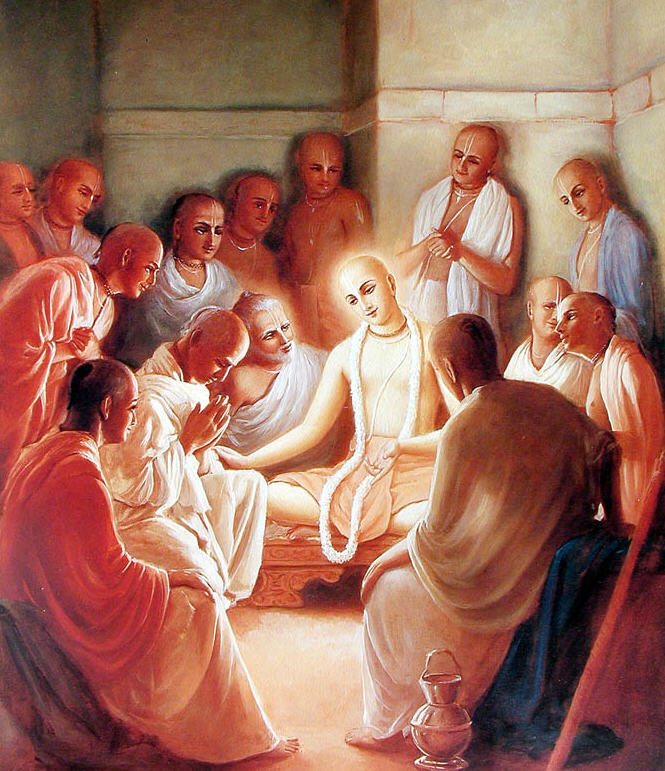
Mukunda Datta was a gifted singer, but he had a habit that in the end brought him trouble. He tried to keep a place in more than one world. Among devotees he glorified bhakti. But among philosophers of a very different kind, he discussed something else entirely. Mahaprabhu missed nothing, and He made Mukunda answer for it. The way He did this became one of the most quoted episodes in Mukunda's life.
A Foot in Both Worlds #
As the tradition describes it, Mukunda's fault was not disbelief. It was a habit of mixing with every kind of thinker, without choosing carefully. He would speak of bhakti to the devotees at Srivasa Pandita's courtyard. Then he would go and debate worldly subjects with karmis. Most seriously, he would sit with Mayavadi impersonalists to hear their discourses on the Yoga-vasistha-Ramayana. This text is full of the philosophy that Mahaprabhu spent His life opposing. It was the same restlessness already seen in the khadajathiya beta rebukes told on the singer's page, only now it had grown serious enough to matter. In effect, the tradition says, he was treating bhakti as just one more school of thought among several equally valid ones. He did not treat it as the one thing devotional service actually is. He glorified it to bhaktas, argued worldly points with karmis, and discussed impersonalism with Mayavadis, as though the same man could sincerely belong to all three audiences. That is remembered as an offense against Bhakti-devi herself.
Left Standing at the Door #
The correction came during Mahaprabhu's maha-prakasha-lila at Srivasa Angana. On that extraordinary occasion, the Lord sat as though on Vishnu's own throne. He called the devotees to Him one by one and blessed each of them according to what was in their hearts. Mukunda Datta was left standing outside. The other devotees pleaded with Mahaprabhu on his behalf, and He explained exactly why, in words Srila Prabhupada later preserved: "I shall not soon be pleased with Mukunda Datta, for though he explains devotional service among devotees, he then goes to Mayavadis to hear from them the Yoga-vasistha-Ramayana, which is full of Mayavada philosophy. For this I am greatly displeased with him." Mukunda was standing outside and heard this. Strangely, he was glad. He was glad that the Lord's words at least left open the hope that He would be pleased with him in time, even if not yet.
Ten Million Births #
The fuller account in Sri Chaitanya-bhagavata takes the episode further and makes it much more intense. Mukunda was pained beyond bearing by Mahaprabhu's rebuke, and he decided to give up his own body as atonement. He had Srivasa Pandita ask the Lord for him whether there was any hope at all of receiving His mercy in some future life. Mahaprabhu's answer was that Mukunda would receive it after ten million births. Mukunda did not despair. Instead he danced where he stood, repeating that the Lord's word could never be false. He was glad, because even ten million births meant that the mercy would still come one day.
A Debt Cancelled at Once #
At that moment Mahaprabhu's mercy overcame the punishment He Himself had just given. Mukunda had faith in a promise that gave him almost nothing to hope for, and this moved the Lord. He freed Mukunda from the offense at once and revealed His opulent form to him on the spot. Completely reversing His earlier rebuke, He declared that He would forever reside on Mukunda's tongue. He also declared that wherever He appeared, Mukunda would have a place singing for Him. The tradition tells this story again and again. It is told as proof that no punishment the Lord gives, however severe, can outlast genuine faith in Him for even a moment.
Two sources describe in slightly different ways how Mukunda was forgiven after being left outside. In Srila Prabhupada's purport, the Lord simply softens once He sees that Mukunda is giving up the Mayavadis for good. The fuller Chaitanya-bhagavata story builds up to the dramatic exchange over the punishment of ten million births. But neither account leaves any doubt about the outcome. After this, the same devotee who could not tell a Mayavadi text from a devotional one is remembered mainly for a promise that his voice would always belong to Mahaprabhu. That promise was fulfilled for the rest of his life. One clear example is the story told on introducing Gadadhara Pandit to Pundarika Vidyanidhi.
